
 Worksheets
Chapter 8 Biology
Total questions: 30
Worksheet time: 15mins
Complete Oxidative breakdown of glucose results in _____ ATP molecules.
36-38
40-42
1-5
2
Aerobic cellular respiration yields about ___ of the energy of glucose in ATP molecules.
2%
15%
28%
39%
The first phase of cellular respiration is:
Glycolysis
Krebs cycle
Electron transport chain
Oxidative phosphorylation
Which process produces both NADH and FADH2?
The citric acid cycle
Glycolysis
The krebs cycle
Photosynthesis
The correct sequence for aerobic metabolic breakdown of glucose is:
Glycolysis-preparatory reaction-citric acid cycle-electron transport system
Electron transport system-preperatory reaction-citric acid cycle- glycolysis
Glycolysis-citric acid cycle-electron transport system-preperatory reaction
None of these
Which of the following coenzymes will accept two electrons and two hydrogen ions during the oxidation of glucose?
FAD
FAD+
NADP
NADPH
Which of these processes occurs in the Cytosol?
The citric acid cycle
Glycolysis
The electron transport chain
The preperatory reaction
During glycolysis ____carbons will enter the pathway and ____ carbons will leave in the form of pyruvates
6;6
6;0
4;6
5;5
What is the correct summary for the energy investment vs. energy harvesting steps of glycolysis?
2 ATP are invested and 4 ATP are harvested to produce a net gain of 2 ATP.
4 ATP are invested and 6 ATP are harvested to produce a net gain of 2 ATP.
No ATP are invested and 2 ATP are harvested to produce a net gain of 2 ATP.
2 ATP are invested and no ATP are harvested to produce a net loss of 2 ATP.
Which process produces alcohol or lactate?
The citric acid cycle
Glycolysis
The electron transport system
Fermentation
The first reaction in the citric acid cycle binds which of the following molecules together?
Acetyl CoA to a C4 molecule.
Carbon dioxide to a four-carbon (C4) molecule.
Carbon dioxide to a five-carbon (C5) molecule.
Acetyl CoA to a C5 molecule.
The preparatory reaction converts:
Pyruvates into acetyl CoA and carbon dioxide.
Glucose into pyruvates.
Pyruvates into glucose.
Pyruvates into acetyl CoA and water.
Which process reduces molecular oxygen to water?
The electron transport system.
Aerobic respiration.
Photsynthesis.
Meiosis.
The electron transport chain and chemiosmosis produce ___ ATP from each NADH and ___ ATP from each FADH2 entering the system.
3;2
2;3
4;6
1;3
One turn of the citric acid cycle produces:
3 NADH, 1 FADH2, and 1 ATP
1 NADH, 1 FADH2, and 1 ATP
5-carbon atoms
5 ATP
Acetyl CoA is produced from:
Pyruvate and CoA
ATP and FADH
Pyruvate and carbon dioxide
Carbon dioxide and CoA
The majority of the carbon dioxide we exhale is produced in:
The citric acid cycle
Cellular respiration
The Krebs cycle
Fermentation
The most important contribution of the citric acid cycle to cellular respiration is:
Oxidation of metabolite molecules and the corresponding reduction of coenzymes.
Production of large quantities of ATP.
Creation of proton gradients.
Reduction of glucose and corresponding oxidation of carbon dioxide.
Some desert beetles can live without ever drinking liquid water. They survive on “metabolic water,” which:
Is water formed during the electron transport chain.
Is water that was stored in the beetle's tissue during its larval stage.
Is water formed during glycolysis.
Is water absorbed directly from the atmosphere.
During the preparatory reaction of aerobic respiration what happens to the carbon molecules?
The carbon molecules are broken down from a 3-carbon to a 2-carbon acetyl group and a 1-carbon CO2 is released.
The carbon molecules are broken down from a 4-carbon to a 3-carbon acetyl group and a 2-carbon CO2 is released.
The carbon molecules are converted from a 2-carbon to a 3-carbon acetyl group and a 1-carbon CO2 is consumed.
The carbon molecules are broken down from a 3-carbon to a 1-carbon acetyl group and two 1-carbon CO2 are released.
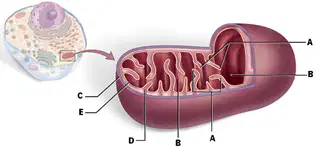
Identify "A"
Cristae
Matrix
Outer membrane
Cytoplasm
Ribosome
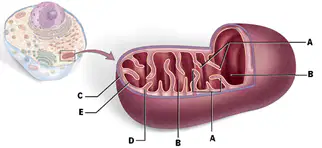
Identify "B"
Cristae
Matrix
Outer membrane
Inner membrane
Intermembrane space
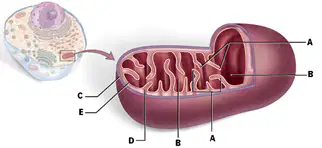
Identify "C"
Cristae
Matrix
Outer membrane
Intermembrane space
Inner membrane
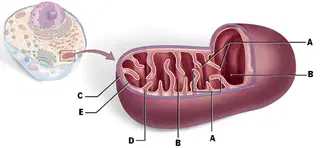
Identify "D"
Cristae
Intermembrane space
Inner membrane
Outer membrane
Matrix
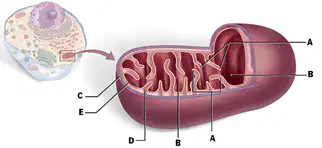
Identify "E"
Cristae
Matrix
Outer membrane
Inner Membrane
Intermembrane space
Compared with other components found in a plant cell such as the cell membrane, the chloroplasts or the nucleus, the mitochondria would be the only one that would:
Form an electrochemical gradient across a membrane
Use significant amounts of oxygen to produce ATP
Use a chemiosmotic complex to produce ATP
Produce ATP via glycolysis
Release protons (H+)
The amino acids we cannot synthesize are called ____ because we _____.
Unnecessary; therefore do not need them
Limiting; must include them in our diet
Anabolic; must use alternative amino acids
Essential; must include them in our diet
Superfluous; must survive without them
Degradative reactions:
Cause death
Can cause anabolic reactions
Tend to be endergonic
Include a buildup of products such as complex proteins and nucleic acids
Adult humans cannot synthesize ___ out of the _____ common amino acids.
Eleven; twenty
Nine; eleven
Nine; twenty
Any; Twenty
Half; All
For fatty acids to enter the citric acid cycle of aerobic respiration, the fatty acids must be:
Deaminated
Combined with glycerol
Combined with ATP
Converted to acetyl groups
Converted into five-carbon sugars

