wayground logo

Free Printable Worksheets

Font size

S
M
L
XL
Worksheets

History EOC

Total questions: 112

Worksheet time: 37mins

Name
Class
Date
1.

What does TVA stand for?

a)

Trans-State Valley Association

b)

Tennessee Valley Authority

c)

Texas Volunteers Association

d)

Texas Virginia Airlines

2.
What was the primary reason for U.S. involvement in East Asia during the early 1950s? 
a)
North Korean attempts to unify the peninsula challenged the U.S. policy of containment. 
b)
Communities in Korea needed humanitarian aid due to a famine.
c)
International groups needed help investigating North Korean officials charged with corruption. 
d)
Democratic reformers sought help from the U.S. military to overthrow dictatorial regimes in Korea. 
3.
Why did the United States formulate the Open Door policy toward China?
a)
 to develop democratic institutions and practices in China 
b)
to prevent a European and Japanese monopoly of Chinese trade and markets 
c)
to establish a military presence on the Chinese mainland
d)
to support Japanese efforts to industrialize China
4.

Commanded 1st US Army during D-Day Invasion, lead liberation of Paris, won the Battle of the

Bulge

a)

Cesar Chavez

b)

Omar Bradley

c)

Dwight Eisenhower

d)

Glenn Curtiss

5.

34th President. Prior to Presidency, served in WWII as commander of Allied Forces in North Africa,

Sicily, and Italy. Promoted to General after D Day. Created the Interstate Highway System as

President.

a)

John F. Kennedy

b)

Harry truman

c)

George Marshall

d)

Dwight Eisenhower

6.

Leader of the Civil Rights Movement; preached nonviolent approach and demanded equal rights for African Americans

a)

Rosa Parks

b)

Lester Maddox

c)

Martin Luther King Jr.

d)

Thurgood Marshall

7.

Chief of Staff that coordinated the war effort from Washington, D.C. in WWII

a)

Douglas Mac Arthur

b)

George Patton

c)

Omar Bradley

d)

George Marshall

8.

African American civil rights activist; in Montgomery, Alabama (1955), refused to give up her seat on the city bus for a white man; led to the Montgomery Bus Boycott

a)

Claudette Colven

b)

Vernon Baker

c)

Ida B. Wells

d)

Rosa Parks

9.

Determined young men who enlisted to become America's first black military aviators at a time when the U.S. military still practiced racial segregation. They participated in over 15,000 sorties and earned over 100 Flying Crosses.

a)

Tuskegee Airmen

b)

Flying Tigers

c)

Charles Lindbergh

d)

Black Panthers

10.
The Federal Housing Administration is a New Deal agency that continues to assist many Americans primarily by-
a)
providing them with money to pay for moving expenses
b)
helping them obtain mortgage loans from banks
c)
helping the choose a reputable home builder
d)
offering incentives for them to invest in rental properties
11.
Senator Joseph McCarthy is best known for his involvement in-
a)
the war effort of the 1940s
b)
the Red Scare of the 1950s 
c)
the Civil Rights movement of the 1960s
d)
the political scandals of the 1970s
12.

During World War II, posters of Rosie the Riveter were used to

a)

promote women's suffrage

b)

recruit women into wartime industries

c)

support higher education for women

d)

encourage women to serve in the armed forces

13.

In 1944, Congress enacted the GI Bill of Rights in order to

a)

ban racial segregation in the armed forces

b)

create government jobs for returning soldiers

c)

provide economic aid to veterans

d)

reduce military expenditures

14.

During World War II, the federal government used rationing to

a)

increase imports of scarce products

b)

provide more resources for the military

c)

increase educational benefits for veterans

d)

hold down prices of military weapons

15.

Trevor has a relative who was a WAC during World War II. Trevor's relative is most likely who?

a)

his European uncle

b)

his great grandfather

c)

his grandfather

d)

his great grandmother

16.

Television shows, advertising, and a number of "scientific" books suggested that women should fulfill what roles during the 1950s?

a)

wife and mother

b)

wife, mother, and worker

c)

wife and career woman

d)

single career woman

17.

Political Machines promised to protect immigrants' jobs in return for

a)

military service

b)

physical security

c)

votes

d)

cash payments

18.

Which trend has reflected the increasing diversity in United States society in recent years?

a)

new efforts by public schools to teach religious education

b)

an increase in immigration from Latin America

c)

failure of Congress to approve appointments of women and minority groups to federal courts

d)

growing demands for unskilled labor

19.

Which of the following individuals would have been most likely to become a Nativist?

a)

a Protestant worker

b)

an Italian immigrant

c)

a Catholic priest

d)

an English speaking Irish immigrant

20.

Which statement about immigration to the United States is most accurate?

a)

the number of immigrants has remained constant in each decade during most of American history

b)

the ethnic mix of immigrants to the United States has remained mostly unchanged

c)

nearly all immigrants have easily assimilated into American culture

d)

the desire for economic advancement has been a major reason for immigration to the US

21.

Which of the following individuals would have been most likely to visit Ellis Island during the first few years of the 20th century?

a)

an Italian immigrant

b)

a farmer moving to New York

c)

a Chinese immigrant

d)

an emancipated slave

22.

Which of the following was a product of a "Red Scare" that swept the United States after World War II?

a)

the Palmer Raids

b)

the Sacco and Vanzetti trial

c)

McCarthyism

d)

Students for a Democratic Society

23.

As part of the Nixon administration’s policy of Vietnamization, the U.S. military

a)

trained South Vietnamese forces to take over combat responsibilities from U.S. troops

b)

shared military technology with North Vietnam

c)

installed a puppet government in South Vietnam

d)

imposed martial law in North Vietnam

24.
Scandal that led to the resignation of President Nixon, following his attempt to cover up involvement in spying on the Democratic National HQ.
a)
Watergate
b)
Iran-Hostage Crisis
c)
Berlin Wall
d)
Island Hopping
25.
After the Shah of Iran was expelled from his country and sought refuge in the US, Iranian protesters overran the US Embassy.
a)
Iran-Contra
b)
Iran-Hostage
c)
Gulf War
d)
War on Terror
26.
Allied effort to supply West Berlin with supplies after it was cut off from the West by the USSR
a)
Berlin Wall
b)
Berlin Airlift
c)
Battle for Britian
d)
NAFTA
27.
Free Trade Organization between North Americans countries (Mexico, USA, and Canada)
a)
OPEC
b)
NAFTA
c)
NATO
d)
League of Nations
28.
1st successful peace treaty between Israel and Middle Eastern Country, negotiated under the watchful eye of Pres. Jimmy Carter.
a)
Camp David Accords
b)
Atlantic Charter
c)
Treaty of Versailes
d)
Treaty of Paris
29.
Buying with the intent to sell (Cause of the Great Depression)
a)
Speculation
b)
Buying of the Margin
c)
High Tarriffs
d)
Over reliance on credit
30.
Super duper secret project to develop the Atomic Bomb, lead by Einstein and Oppenheimer. 
a)
Project X
b)
Project Runway
c)
Manhattan Project
d)
The Projects
31.
After the US entered World War II, the following people were placed in internment camps because of "military necessity."
a)
Mexican-Americans
b)
Japanese-Americans
c)
African-Americans
d)
German-Americans
32.
Witch-hunt that was part of the second red scare was named after Senator
a)
Joseph McCarthy
b)
Douglas MacAurthur
c)
Harry S Truman
d)
Henry Cabot Lodge
33.
Organization of countries that produce the majority of the oil that is used today.  Boycotted the USA after their support of Israel in the 1970s.
a)
OPEC
b)
NAFTA
c)
NATO
d)
USSR
34.
Civil Rights movement led by Cesar Chavez, and Dolores Huerta, in order to glorify Mexican-American culture and economic impact.
a)
Progressive Movement
b)
Chicano Movement
c)
Spanish-American War
d)
Cuban Revolution
35.
What were the major goals of the New Deal?
a)
no gold standard and free coinage of silver
b)
abolition and suffrage
c)
relief, recovery, and reform
d)
expanding the size and economic influence of the United States
36.
The successful Allied invasion of France was known as
a)
Battle of Midway
b)
Battle of the Bulge
c)
D-Day
d)
Battle of El Alamein 
37.
Why is the Cold War considered a “cold” war, compared to WWII, a “hot” war?
a)
Most of the fighting took place in the cooler Northern Hemisphere
b)
The Soviet Union is located in a fairly cold area
c)
The Soviets and Americans never actually fought against one another with weapons
d)
The United States believed a nuclear war would end the seasons and it would be cold on Earth
38.
In the 1950s, the United States became involved in the Vietnam War. Why did the United States become involved in this war?
a)
to prevent the collapse of the government of North Vietnam
b)
to stop Vietnam from taking over Hong Kong
c)
to stop the spread of communism to South Vietnam
d)
to prevent attacks against United States shipping
39.
How did the Cuban Missile Crisis end?
a)
The Soviets and the U.S. entered into a nuclear war
b)
It never really ended, there are still tensions today
c)
Soviets backed down and pulled their missiles out of Cuba
d)
the Cubans forced the Soviets to leave because they didn't want war with the U.S.
40.
How did the Cuban Missile Crisis end?
a)
The Soviets and the U.S. entered into a nuclear war
b)
It never really ended, there are still tensions today
c)
Soviets backed down and pulled their missiles out of Cuba
d)
the Cubans forced the Soviets to leave because they didn't want war with the U.S.
41.
What did the Iron Curtain divide?
a)
North and South Korea
b)
Soviet Union and China
c)
Eastern and Western Europe
d)
America and Europe
42.
How did Martin Luther King, Jr.'s "I Have a Dream" speech impact the civil rights movement?
a)
It called for violent resistance, resulting in riots across the country.
b)
It inspired many people, giving strength and momentum to the movement.
c)
It was largely ignored by the movement, though regarded as a superbly written speech.
d)
It was considered controversial and fragmented the movement into small groups.
43.
The policy objectives of Reaganomics were based on the theory that —
a)
borrowing from foreign countries would help cover the costs of domestic programs
b)
significant increases in government spending would help reduce unemployment
c)
broad tax cuts and financial deregulation would promote economic expansion
d)
reducing trade barriers would result in a budget surplus
44.
Broad tax cuts, and financial deregulation, which would promote economic expansion, are examples of what policy's objective:
a)
Reaganomics
b)
Trade Imbalance
c)
Iran-Contra Affair
d)
Heritage Foundation
45.
How did the Watergate Scandal affect American politics?
a)
It had a negative impact because it caused distrust in the government.
b)
It had a positive impact because it brought the people together.
c)
It didn't impact anything.
46.
What did Iranian student activists do when the Shah of Iran was treated in an American hospital?
a)
they terrorized American travelers in Europe
b)
they forced an attack on Iraq
c)
they seized the American embassy and took hostages
d)
they staged an overthrow of the government
47.
Which Supreme Court case reversed "separate but equal" and led to the desegregation of public schools?  
a)
Brown v Board of Education 
b)
Texas v Johnson 
c)
New Jersey v TLO 
d)
Madison v Marbury 
48.
Which Supreme Court case stated that all individuals must be read their rights at the time of arrest?  
a)
U.S. v Leon 
b)
Nixon v. U.S. 
c)
Korematsu v U.S. 
d)
Mirranda v Arizonia
49.
Jackie Robinson first rose to national prominence in the late 1940s when he-
a)
organized sit-ins to desegregate lunch counters
b)
enrolled in the racially segregated University of Mississippi
c)
helped bring an end to racial segregation in Major League Baseball
d)
participated in the Freedom Rides to desegregate interstate bus terminals
50.
Why did the government order rationing during WWII?
a)
to increase foreign trade
b)
to limit the growth of industry
c)
to conserve raw materials for the war effort
d)
to encourage women to enter the workforce
51.
Who was:
•President from 1945-1953•Used atomic weapons against Japan to bring WWII to an end •Assisted in the founding of the United Nations •Executed policy to contain communism
a)
President Wilson
b)
President Truman
c)
President Roosevelt
d)
President Obama
52.
Who was:
•Arrested for refusing to give up her seat on a bus to a white person
•Her actions led to Montgomery Bus Boycott (1955-56) which  led to integrated buses and thrust her into the national spotlight
a)
Rosa Parks
b)
Betty Friedan
c)
Phyllis Schlafly
d)
Jane Addams
53.
Who was:
•President from 1981-1989 •Policy to reduce taxes & regulations to encourage business activity •Believed you achieved peace by being prepared for war, known as  “Peace Through Strength” •His presidency saw the beginnings of the end of the Cold War
a)
President Truman
b)
President Carter
c)
President Reagan
d)
President Nixon
54.
Who was: 
•Leader of Chicano Movement to eliminate racism against Mexican Americans
•Organized farm workers in California •Demanded increased wages and better working conditions •Emphasized non-violent methods such as boycotts, strikes, hunger fasts
a)
Cesar Chavez
b)
Hector Garcia
c)
Lionel Sosa
d)
Pancho Villa
55.

These American Indians were recruited by the military to encode, transmit, and decode messages; the Navajo language was used to develop a code that was not broken by the enemy in WWII

a)

Cherokee

b)

Navajo

c)

Apache

d)

Sioux

56.
Who was:
•President from 1961-1963 •Supported Space Race – John Glenn orbited earth •Embarrassed by Bay of Pigs Invasion (unsuccessful attempt to overthrow Castro) •Created Alliance for Progress & Peace Corp – programs to promote progress in under-developed countries to discourage the spread of communism •Avoided nuclear showdown – Cuban Missile Crisis
a)
John F. Kennedy
b)
Franklin D. Roosevelt
c)
John J. Pershing
d)
Dwight D. Eisenhower
57.
Who was:
•President from 1969-1974 •Reopened relations with Red China  (1972) •Introduced détente with Soviet Union (relaxing of tension and de-escalating arms race) •Resigned office to avoid impeachment after Watergate scandal
a)
Jimmy Carter
b)
Richard Nixon
c)
Ronald Reagan
d)
George Bush
58.
The policy of providing economic and military aid to any country threatened by communism and initially helped Greece and Turkey. 
a)
 Truman Doctrine
b)
Marshall Plan 
c)
Eisenhower Big 5 
d)
Domino Theory
59.
The policy of containment meant that--
a)
The U.S.S.R. would not let democracy spread.
b)
The U.S. would not let Islam spread.
c)
The U.S. would not let Communism spread.
60.
The Marshall Plan was developed to help rebuild ______________ after World War 2.
a)
Eastern European countries
b)
Asian countries
c)
Latin American countries
d)
Western European countries
61.
How did the growing use of the automobile in the 1920s and the Interstate Highway Act of 1956 affect the United States? 
a)
Resurgence in travel by railroads
b)
Immigration was increasing
c)
Inner Cities were expanding
d)
Suburbs were growing
62.
What event is most closely associated with the end of the Cold War?
a)
President Nixon's visit to China
b)
Withdrawal of United States troops form Vietnam
c)
Tearing down of the Berlin Wall
d)
Sending US troops to Afghanistan 
63.
Cars lining up for miles at gas stations in the 1970s is an effect of what?
a)
The end of oil production in the Gulf of Mexico
b)
Decrease in the amount of oil reserves in the United States
c)
Oil embargo imposed by nations in the Middle East
d)
Terrorist attacks on United States petroleum reserves
64.
Which of the following foreign policy guidelines did the United States follow during the Cold War period?
a)
Great Society
b)
Detente
c)
Containment
d)
McCarthyism
65.
Which event marked the beginning of the space race with the Soviet Union?
a)
Creation of the space shuttle program
b)
Launch of Sputnik
c)
U-2 spy plan incident
d)
Berlin Airlift
66.
The Truman Doctrine and Eisenhower Doctrine were similar in that they were both designed to do which of the following?
a)
Increase Israel's security against Arab states
b)
Support West Germany and West Berlin
c)
Assist nations abroad to resist communism
d)
Pledge to negotiate rather than use military action to solve disputes
67.
What was the primary reason the North Atlantic Treaty Organization (NATO) as formed in 1949? 
a)
Promote social and cultural exchanges between members
b)
Provide for the mutual defense of the member nations
c)
Promote free trade between the United States and Soviet Union
d)
Rebuild Western Europe's war-ravaged economy
68.
How did President Kennedy respond when the Soviet Union attempted to install nuclear weapons in Cuba? 
a)
He ordered a naval blockade of the island of Cuba
b)
He ordered an invasion of Cuba at the Bay of Pigs
c)
He installed more nuclear weapons in Turkey
d)
He ordered "surgical" air strikes against the missile sites
69.
The United States got involved in conflicts like Korea and Vietnam because they were afraid of the domino theory. What is the domino theory?
a)
If one country fell to democracy, others would follow
b)
If one country fell to communism, others would follow
70.
President Truman adopted a new foreign policy during the Cold War know as the Truman Doctrine. What was the main goal of the Truman Doctrine?
a)
To expand trade with Europe
b)
To limit the build up of nuclear weapons
c)
To stop the spread of communism
71.
What organization was created by Congress to hunt for communist spies?
a)
Federal Civil Defense Administration (FCDA)
b)
Central Intelligence Agency (CIA)
c)
North Atlantic Treaty Organization (NATO)
d)
House Un-American Activites Commitee (HUAC)
72.
Which country was the aggressor that started the Korean War?
a)
North Korea
b)
South Korea
c)
Neither - they were forced into war by Germany
d)
Japan
73.
What important entertainment industry influenced Americans the most in the 1950's and 1960's?
a)
Internet
b)
Newspapers
c)
Movies
d)
Television
74.
Which amendment guarantees equal protection under the law?
a)
13th
b)
14th
c)
15th
d)
16th
75.
Which Supreme Court case integrated public schools?
a)
Plessy v Ferguson
b)
Brown v Board of Education
c)
Schenk v US
d)
Korematsu v US
76.
This president sent federal troops to Arkansas to integrate the schools in Little Rock
a)
Truman
b)
Eisenhower
c)
Roosevelt
d)
Kennedy
77.
Political leaders such as George Wallace, Orval Faubus, and Lester Maddox were committed to the idea of —
a)
women’s rights
b)
racial segregation
c)
school integration
d)
rights for farm workers
78.
What event is being described in the picture which used non-violent activist actions? 
a)
Freedom Riders
b)
Montgomery Bus Boycott 
c)
Greensboro Sit-ins
d)
March on Washington 
79.
What court case stated, "We conclude that in the field of public education, the doctrine of 'separate but equal' has no place. Separate educational facilities are inherintly unequal."
a)
Plessy v. Ferguson 
b)
Brown v. Board of Education 
c)
Tinker v. Des Moines 
d)
Delgado v. Bastrop ISD
80.
One result of the civil rights movement has been the —
a)
creation of new forms of legal segregation
b)
elimination of segregation in American society
c)
resurgence of groups advocating violent social change
d)
increased participation of women and minorities in politics
81.
The Civil Rights Era in U.S. History is most characterized by social changes brought about by
a)
groups involved in violent riots and protests in American cities
b)
the efforts of leaders advocating non-violent civil disobedience
c)
the cooperation among the labor unions to pass new legislation
d)
a series of presidential initiatives aimed at ending racial segregation
82.
One accomplishment of the _____ was to bring about a federal ban on segregation in all interstate travel facilities. 
a)
Little Rock Nine
b)
Freedom Riders
c)
Black Panthers
d)
Montgomery bus boycott
83.
Appealing to many African Americans' anger and frustration over a lack of social and economic power, ______ predicted a militant approach to civil rights. 
a)
Martin Luther King, Jr. 
b)
Malcolm X
c)
Medgar Evans
d)
Fannie Lou Hamer
84.
By boycotting the bus system in Montgomery, African Americans hoped to
a)
Abolish the bus system
b)
Exert economic pressure and protest segregation
c)
Get more jobs in the Montgomery bus system
d)
Free Rosa Parks from prison
85.
These black teenagers were the first to integrate into Little Rock Central High
a)
Elite Eight
b)
Little Rock Nine
c)
Arkansas Seven
d)
Final Four
86.
Which US president signed the Voting Rights Act of 1965?
a)
Lyndon B. Johnson
b)
John F. Kennedy
87.
After the Civil Rights Act of 1964 was passed, it was no longer legal to
a)
let African Americans ride the bus.
b)
deny someone of a job because of their race.
c)
fire someone for not doing their job.
d)
kick someone out of the military.
88.
Name the only President that resigned.
a)
Nixon
b)
JFK
c)
LBJ
d)
Carter
89.
What Middle East country had taken U.S. hostages making President Carter look weak?
a)
Iraq
b)
Iran
c)
Syria
90.
People waited in lines in their automobiles for what?
a)
Tires
b)
Windshield Wipers
c)
Gas
91.
Name the proposed Amendment that would have gender equality for the U.S.
a)
E.R.A.
b)
Don’t Ask Don’t Tell
c)
Watergate
92.
Name the first female U.S. Supreme court justice
a)
Anita Hill
b)
Sandra Day O'Connor
c)
Elena Kagen
d)
Sonya Sotomayor
93.
The charge that Bill Clinton lied to a grand jury concerning his relationship with Monica Lewinsky eventually led to _____. 
a)
 Clinton’s dismissal from office 
b)
 Republicans winning the 1994 presidential election
c)
 the president’s resignation
d)
 the president’s impeachment
94.
period of large population growth after WWII
a)
Baby Boom
b)
Watergate 
c)
NAFTA
d)
Iran-Contra Scandal 
95.
Which of the following promotes trade between Canada, the United States, and Mexico?
a)
North Atlantic Treaty Organization
b)
North American Free Trade Agreement
96.
What international organization worked with the United States in the Persian Gulf War?
a)
United Nations
b)
League of Nations which did not exist after WWII
c)
World Trade Organization
d)
NAFTA
97.
Which of these entrepreneurs created a computer software company?
a)
Oprah Winfrey
b)
Sam Walton
c)
Bill Gates
d)
Lionel Sosa
98.
What was an immediate effect of the terrorist attacks on New York City in 2001?
a)
The U.S. canceled its treaties with Iran
b)
The U.S. led airstrikes on the Balkans
c)
The U.S. captured Saddam Hussein in Iraq
d)
The U.S. invaded Afghanistan
99.
How did New Deal programs like the Civilian Conservation Corps and the Works Progress Administration provide relief to the needy?
a)
by giving loans to the needy
b)
by creating jobs for the needy
c)
by distributing food to the needy
d)
by providing pensions to the needy
100.
What happened to Roosevelt's court-packing plan?
a)
It was rejected by Congress.
b)
It was signed into law by the president.
c)
It was ratified as a constitutional amendment.
d)
It was declared unconstitutional by the Supreme Court.
101.
Which of the following was, to the federal government, the  most immediate problem during the Great Depression?
a)
low prices
b)
buying on margin (credit)
c)
high unemployment
d)
business consolidation
102.
At the Munich conference, Britain and France reached an agreement with Hitler allowing the takeover of Sudetenland.  Hitler violated the Munich pact when he invaded-- 
a)
Denmark
b)
Sweden
c)
France
d)
Poland
103.
When was Pearl Harbor attacked?
a)
December 7, 1941
b)
September 1, 1939
c)
October 31, 1941
d)
December 25, 1941
104.
World War 2 helped America come out of _________________ by providing jobs for people. 
a)
The Cold War
b)
The Dust Bowl
c)
The Great Depression
105.
The bombing of Hiroshima and Nagasaki
a)
ended war in the Pacific
b)
opened a second front to Asia
c)
caused the Japanese seizure of Manchuria
d)
was a result of the Potsdam conference
106.
The island hopping strategy was used in which theater of World War 2?
a)
Atlantic
b)
Pacific
c)
Europe
d)
North Africa 
107.
Which battle was the turning point of the war in the Pacific?
a)
Battle of Singapore
b)
Battle of the Coral Sea
c)
Battle of Guadalcanal
d)
Battle of Midway
108.
Who were the first African-American fighter pilots? 
a)
Tuskegee Boys
b)
Tuskegee Airmen
c)
Birmingham Airmen
d)
Tuskegee Tough Guys 
109.
How did Eleanor Roosevelt help her husband to continue his career after he became ill with polio?
a)
she was the First Lady
b)
she listened to what he had to say
c)
she stood beside him daily
d)
She traveled around the country giving speeches, making sure everyone knew of his ideas
110.
The greatest escalation of troops in Vietnam took place under which President?
a)
Dwight Eisenhower
b)
John F. Kennedy
c)
Lyndon Johnson
d)
Richard Nixon
111.
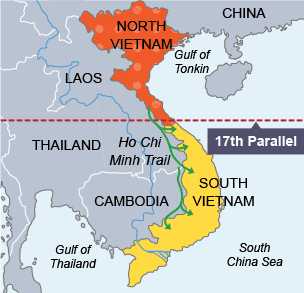
What allowed North Vietnam to bring soldiers and supplies into South Vietnam?
a)
Ho Chi Minh Trail
b)
The fall of Dien Bien Phu
c)
The Gulf of Tonkin
d)
Operation Rolling Thunder
112.
What gave President Johnson authority to send soldiers into Vietnam?
a)
Declaration of War
b)
Executive Order 1954
c)
Gulf of Tonkin Resolution
d)
the Constitution