
 Worksheets
Unit 4 Econ Review
Total questions: 136
Worksheet time: 2hrs 41mins
A trade agreement between 27 countries with the same currency and open trade between those nations.
NAFTA
EU
WTO
ABC
What is an exchange rate?
The rate at which goods are exchanged between two countries
The price of one nation's currency in terms of another's
How many US dollars you can exchange for RMB at Travelex
The price of goods in terms of a foreign currency

According to the table, what is the Euro equivalent of 1 USD?
1.32 Euros
0.53 Euros
.76 Euros
1.59 Euros

According to the table, what is the USD equivalent of 1 Australian?
0.97 USD
1.32 USD
1.28 USD
1.03 USD
If the US $ were to appreciate in relation to the Euro, what effect would this have?
European consumers would have more purchasing power in US
US consumers can buy more European goods and services for fewer $$
US consumers can buy more English goods and services for fewer $$
European tourists to the US will spend more $$
If the Mexican Peso depreciates in relation to the Chinese Yuan, how is Mexico affected?
Mexico has less purchasing power in Chinese currency
Mexico benefits from increased purchasing power
Mexico would have more Chinese investors
They would be invaded by China
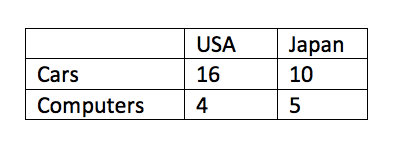

Who has the comparative advantage in cars?
Peru
neither
U.S.
not enough info

Which type of economy has central ownership, the government, and lack of individual choice?
Market
Mixed
Command
Traditional
Capitalism is in what type of economy?
Traditional
Command
Market
Authortarian
The amount of money a business makes after its expenses are paid
profit
supply
demand
scarcity

Focusing on a narrow range of products/services that can be produced most efficiently and cost-effectively.
subsistence
specialization
scarcity
bartering
Competition and profit motive are important characteristics of a:
command economy
traditional economy
market economy
socialist economy
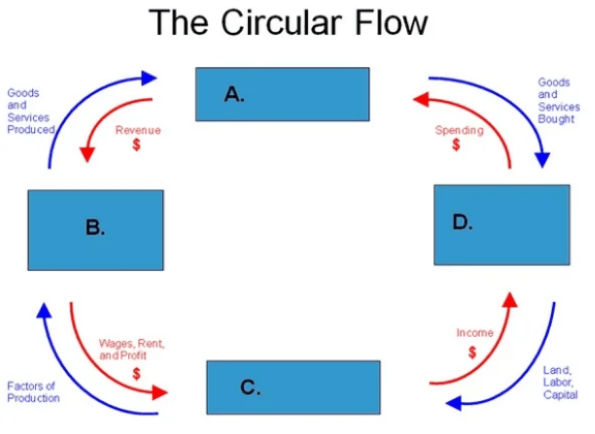
Point B represents
Product Market
Factor Market
Individuals
Businesses
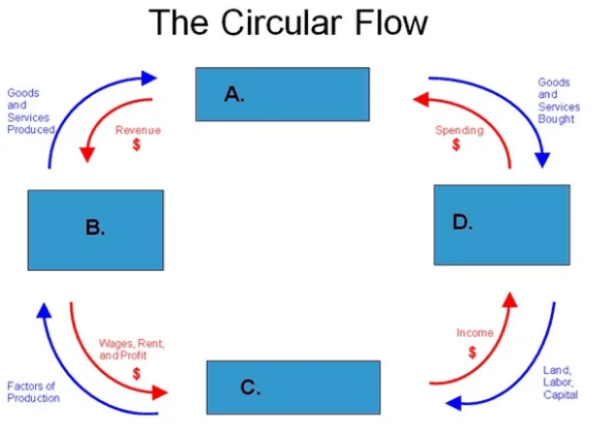
What does point A represent on the Circular flow diagram?
Households
Businesses
Factor Market
Product Market
Where are factors of production (land, labor, etc) exchanged in the circular flow model?
Factor Market
Product Market
Firms
Individuals
In the circular flow diagram firms pay wages for which factor of production?
Land
Labor
Entrepreneurship
Raw materials

The exchange of money for goods/services to consumers is represented in which part of the circular flow diagram?
1 and 2
3 and 4
5 and 6
7 and 8

The delivery of finished products for sale in exchange for revenue is represented in which arrows?
1 and 2
3 and 4
5 and 6
7 and 8
A person stocks shelves at a grocery store and receives a wage. They have completed an exchange in which part of the circular flow model?
Individuals
Businesss
Factor Market
Product Market
Someone buys a car in exchange for a large amount of money. They have completed an exchange in which part of the circuclar flow model?
Product Market
Factor Market
Firms
Individuals
Money exchanged between businesses and individuals for labor.
wages
revenue
spending
profit
Money exchanged between an individual and a store for a good or service.
Revenue
Wages
Rent
Donation
Money exchanged between an individual and a store for a good or service.
Revenue
Wages
Rent
Donation
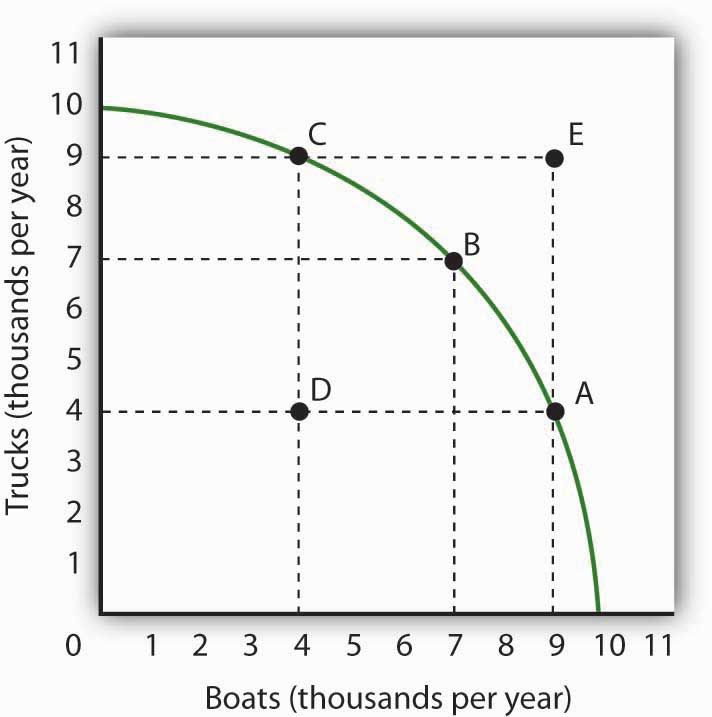

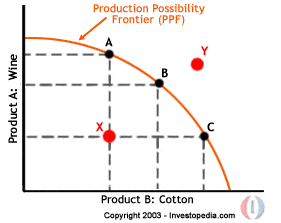
Land includes...
The "gifts of nature" or natural resources not created by human effort.
the tools, equipment, and factories used in production of goods and services
people with all their efforts and abilities
individuals who start a new business or bring a product to market.
Capital refers to...
The "gifts of nature" or natural resources not created by human effort.
people with all their efforts and abilities
the tools, equipment, and factories used in production of goods and services
individuals who start a new business or bring a product to market.
Labor refers to...
people with all their efforts and abilities
individuals who start a new business or bring a product to market.
the tools, equipment, and factories used in production of goods and services.
The "gifts of nature" or natural resources not created by human effort.
Entrepreneurs are...
people with all their efforts and abilities
individuals who start a new business or bring a product to market.
The "gifts of nature" or natural resources not created by human effort.
the tools, equipment, and factories used in production of goods and services
If operators are fired and replaced with computer technology, the operators would be considered
frictionally unemployed
structurally unemployed
cyclically unemployed
dissatisfiededly unemployed dissatisfiededly unemployed
Cyclical unemployment
Describes recent college graduates
Lasts longer than 6 months
Describes employees moving from one job to another
Increases inflation Increases inflation
Seasonal unemployment
Describes recent college graduates
Is predictable
Is a result of changes in technology
Slows the economy Slows the economy
Which of these people is officially unemployed
A secretary who took 6 months off for maternity leave
An aspiring actress who waits tables but would rather act
Maid who got fired and will start a new job in 2 weeks
A student who only works 4 hours a week in the library
Farm helpers are unemployed when the cropping season is over.
frictional
cyclical
structural
seasonal
Which of the following best defines unemployment?
The state of being able to work and actively seeking work, but unable to find employment
The state of being able to work, but choosing not to
The percentage of the labour force that is able and actively seeking work, but cannot find employment
The total number of people who do not work
When individuals lose jobs due to fall in aggregate demand, often during an economic recession.
Structural Unemployment
Cyclical Unemployment
Frictional Unemployment
Seasonal Unemployment
What type of unemployment is a person experiencing when they are laid off during a recession?
Frictional
Seasonal
Cyclical
Structural
Most countries try to maintain an inflation rate of ______ per year.
One percent or less
Two to three percent
Four to five percent
Six to seven percent
Which of the following terms is also known as total output?
Price index
Price level
Aggregate demand
Aggregate supply
The _______ considers the weighted averages of a group of consumer goods and services.
Consumer price index
Aggregate supply
Producer price index
Aggregate demand
__________ refers to a decrease in price level.
Hyperinflation
Disinflaation
Deflation
Stagflation
__________ occurs in the economy when unemployment and inflation are both high.
Hyperinflation
Disinflation
Deflation
Stagflation
Which of the following causes of inflation is often described as “too much money chasing too few goods”?
Demand-pull inflation
Cost-push inflation
Demand-push inflation
Cost-pull inflation
Thousands of people leave a small town due to a factory closing down. Sales at the local grocery store are reduced. What causes this change?
Prices or availability of substitutes
Prices or availability of complementary goods
Change in the weather or season
Change in the number of buyers
New technology advances the rate at which furniture can be assembled. Why does this change the supply?
There is a change in cost of production.
The number of producers changes.
The expectations of consumers changes.
The output rate declines.
Which of the following best refers to the market equilibrium price?
Surpluses depress the number of goods supplied.
Shortages and surpluses will have no effect on the market.
The government will not intervene in the market.
The quantity demanded is the same as the quantity supplied.
Mr Coyote goes to the ticket booth to buy tickets for a Spurs game. Mr. Coyote is told that the game is sold out and no tickets are available. Which best explains why there are no basketball tickets available?
The arena forgot to print enough tickets.
The supply of tickets was greater than the demand.
The arena charged too much money for each ticket.
The demand for tickets was greater than the supply.
Which statement expresses a central idea of how the laws of supply and demand work?
The government sets the prices for goods and services.
Prices are determined by the interaction of producers and consumers.
Consumers alone determine the prices for goods and services.
Technology dictates the prices charged for goods and services.
If the price of a substitute to good X increases, then
The demand for good X will increase.
The market price of good X will decrease.
The demand for good X will decrease.
The demand for good X will not change.
Suppose you like banana cream pie made with vanilla pudding. Assuming all other things are constant, you notice that the price of bananas is higher. How would your demand for vanilla pudding be affected by this?
It would decrease.
It would increase.
It would be unaffected.
There is insufficient information given to answer the question.
What will happen in the rice market if buyers are expecting higher prices in the near future?
The demand for rice will increase.
The demand for rice will decrease.
The demand for rice will be unaffected.
The supply of rice will increase.

Refer to Graph 4-1. The movement from point A to point B on the graph shows
a decrease in demand.
an increase in demand.
an increase in quantity demanded.
a decrease in quantity demanded.
Other things equal, when the price of a good rises, the quantity supplied of the good also rises. What best refers to this situation?
The law of increasing costs.
The law of diminishing returns.
The law of supply.
The law of demand

Refer to Graph 4-4. On the graph, what could most likely cause the movement from S to S1?
A decrease in the price of the good.
An increase in income.
An improvement in technology.
An increase in input prices.

Refer to Graph 4-5. According to the graph, what are the equilibrium price and quantity?
$7, 20.
$7, 60.
$5, 40.
$3, 60.

Refer to Graph 4-5. According to the graph, What occurs at a price of $7?
there would be a shortage of 40 units.
there would be a surplus of 40 units.
there would be a surplus of 20 units.
the market would be in equilibrium.
All of these are functions of money EXCEPT
Medium of exchange
Store of value
Commodity money
unit of measurement
Jack saves his money in a piggy bank. He is using money as a
medium of exchange
store of value
unit of measurement
bartering tool
When a bank makes a loan of $1,000, then
the money supply increases by $1,000
the money supply decreases by $1,000
nothing
the bank owes the FED $1,000
It is the study of the nations economy as a whole.
Microeconomics
National economy
National output
Macroeconomics
This happens when there is an increase in the production of goods and services.
Economic Development
Economic Progress
Economic Growth
Economic efficiency
It is the list all final goods and services sold within an economy for a period of time.
Gross Domestic Product
Gross National Product
Consumer Price Index
Market Basket of Goods

Point A on the graph is:
trough
period of contraction
peak
recovery

Point D on the graph is a period of:
contraction
expansion
recession
decline
The natural rate of unemployment is between:
3% and 6%
2% and 4%
4% and 7%
4% and 6%
GPD that is adjusted for inflation is called:
nominal GDP
real GDP
A period of macroeconomic expansion or growth, followed by a period of contraction, or decline.
Business Cycle
Circular Flow
Equilibrium
GDP
The actions the Federal Reserve System takes to influence the level of real GDP and the rate of inflation in the economy.
Fiscal Policy
Monetary Policy
Congressional Policy
Executive Policy
The buying and selling of government securities in order to alter the supply of money.
Open Market Operations
Expansion
Discount Rate
Trough
What is macroeconomic policy objective?
to increase employment
to increase the output of the car industry
to reduce the price level
to reduce economic growth
Which change is most likely to reduce total demand ?
an increase in investment
an increase in savings
a reduction in government tax revenue
a reduction in imports
How may fiscal policy increase total (aggregate) demand?
by cutting the rate of interest
by cutting the rate of taxation
by increasing the budget surplus
by increasing the money supply
Which policy measure is an example of monetary policy designed to reduce total (aggregate) demand?
a limit placed on bank lending
a reduction in interest rates
a rise in income tax
a switch in government spending from consumer to capital goods
What is meant by a regressive tax ?
one designed to create a more even distribution of income
one which is impossible to evade
one which is earning less tax revenue than previously
one which takes a larger percentage of tax from the poor than the rich
The expansionary fiscal policy involves
only an increase in taxes
a decrease in government spending and/or an increase in taxes
only a decrease in government spending
an increase in government spending and/or a decrease in taxes
Acting as a banker to the commercial bank and establishing an effective monetary policy are the basic functions of
central bank
commercial banks
merchant banks
clearing house
An increase in the price of raw materials causes a __________________ inflation
cost push
profit push
import push
demand pull
In this tax structure a single tax rate (percentage) is applied to all levels of income. Some states use this as structure for State Income tax, and our FICA taxes are collected in this way.
Progressive Tax
Regressive Tax
Proportional or Flat Tax
Excise Tax
An example of contractionary fiscal policy would be
raise taxes
raise government spending
raise production of consumer goods
increase unemployment payments
The difference between representative money and fiat money is that
representative money is worth more than fiat money.
fiat money is counted in coins; representative money is counted in paper dollars.
fiat money is more durable than representative money.
representative money is backed by silver or gold, ; fiat money is not.

