
 Worksheets
Transcription and Translation
Total questions: 44
Worksheet time: 32mins
Name
Class
Date
1.
What type of RNA carries the DNA message out of the nucleus to the ribosomes?
a)
mRNA
b)
tRNA
c)
RNA
d)
DNA
2.
What do we call the process of turning DNA into mRNA?
a)
Translation
b)
Transcription
c)
Replication
3.
Amino acids are the building blocks of...
a)
DNA
b)
RNA
c)
Atoms
d)
Proteins
4.
In translation, C pairs with
a)
U
b)
G
c)
A
d)
T
5.
One difference between DNA and RNA is that....
a)
Only RNA has the base Uracil
b)
only RNA contains the base Thymine
c)
only RNA contains the base Cytocine
d)
only RNA contained the base Guanine
6.
True or false: RNA is double-stranded.
a)
true
b)
false
c)
it depends on the type
7.
Which of these bases does not exist in RNA?
a)
C
b)
T
c)
U
d)
A
8.
_______ is made during transcription and ________ is made during translation.
a)
mRNA / a protein
b)
a protein / mRNA
c)
Ribosome / Nucleus
d)
mRNA / tRNA
9.
In comparison to a DNA strand, a
a)
mRNA strand is shorter and single stranded
b)
mRNA strand is longer and single stranded
c)
mRNA strand is shorter and double stranded
d)
mRNA strand is longer and double stranded
10.

Nucleotides are made up of a sugar, phosphate, and..?
a)
nitrogenous base
b)
nucleic acid
c)
cholesterol
d)
fatty acid
11.
Which of the following is the sugar found in RNA?
a)
Ribose
b)
Maltose
c)
Deoxyribose
d)
Amylose
12.
Codons contain ______ bases
a)
1
b)
3
c)
6
d)
9
13.
Which is the organelle that makes proteins?
a)
Nucleus
b)
Ribosomes
c)
Rough ER
d)
Golgi Apparatus
14.

DNA codes for...
a)
cholesterol
b)
proteins
c)
fatty acids
d)
a sandwich
15.
Brings the amino acids to the ribosome
a)
mRNA
b)
tRNA
c)
rRNA
d)
DNA
16.
Which RNA bases would pair with TAC in transcription?
a)
AUG
b)
ATG
c)
GCA
d)
GCA
17.

What amino acid is represented by the codon CAG?
a)
Aspartic Acid
b)
Histidine
c)
Glutamine
d)
Methionine
18.
How many amino acids are coded for by this sequence of nucleotides:
ATG GGA ACT
ATG GGA ACT
a)
4
b)
3
c)
6
d)
2
19.
Translation happens in the -
a)
Nucleus
b)
Ribosome
c)
Chloroplast
d)
Smooth Endoplasmic Reticulum
20.
Does the order of amino acids in a protein matter?
a)
YES!
b)
NO!
21.
How many types of RNA are there?
a)
1
b)
2
c)
3
d)
4
22.
What is the function of mRNA?
a)
storage of food
b)
prevents mutations
c)
provides energy
d)
carries genetic message
23.
What is the correct sequence?
a)
RNA --> DNA --> Protein
b)
Protein --> RNA --> DNA
c)
DNA --> RNA --> Protein
d)
DNA --> Protein --> RNA
24.
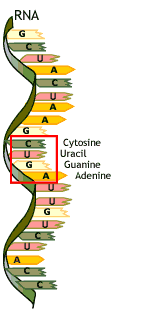
In RNA, Uracil pairs with ______.
a)
cytosine
b)
adenine
c)
guanine
d)
thymine
25.
The 3 letters found on tRNA are referred to as
a)
an amino acid
b)
the anticodon
c)
the codon
d)
the bases
26.
Where does TRANSCRIPTION occur?
a)
Nucleus
b)
Ribosome
c)
Cytoplasm
d)
Mitochondria
27.
Which of the following best describes how DNA and RNA are similar?
a)
they both contain A and T
b)
They both have a double helix
c)
They are both composed of 5 different nucleotides
d)
they both have C and G
28.
Choose the nucleotide sequence of the RNA strand that would be complementary to the following strand:
GTAGTCA
GTAGTCA
a)
UATUAGA
b)
ACGACTG
c)
CAUCAGU
d)
CATCAGT
29.
The central dogma of biology states that information flows in one direction from
a)
nuclei to RNA to cytoplasm
b)
ribosomes to proteins to DNA
c)
genes to nuclei to ribosomes
d)
DNA to RNA to proteins
30.
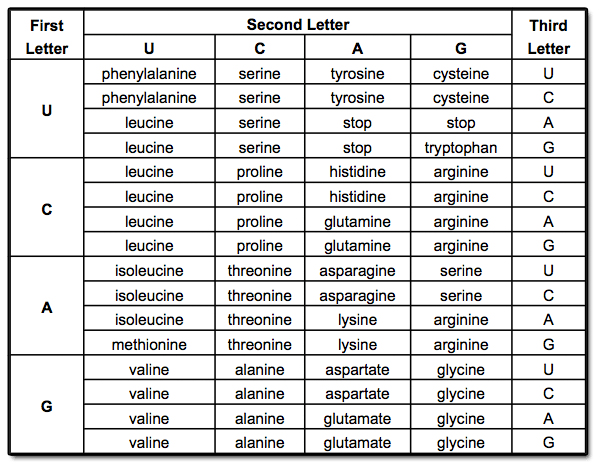
What amino acid is represented by the codon UUA?
a)
Phenylalanine
b)
Tyrosine
c)
Leucine
d)
Stop codon
31.
What are the backbones (sides) of the DNA structure made up of?
a)
repeating phosphates and sugars
b)
nitrogen bases
c)
nucleotides
d)
adenine and thymine
32.
The anti-codon
a)
contains a sequence the same as the codon
b)
contains a sequence complementary to the codon
c)
contains the base thymine
33.

Which amino acid is made from the RNA codon GUA?
a)
Phenylalanine
b)
Leucine
c)
Serine
d)
Valine
34.
What do genes do?
a)
make proteins
b)
store energy
c)
create covalent bonds
d)
create hydrogen bonds
35.
The size and shape of proteins determines:
a)
their function
b)
their bonds
c)
their nucleotides
d)
their chromosomes
36.
DNA is shaped in a:
a)
double helix
b)
tightly packed swirl
c)
twisted ladder
d)
nucleotide
37.
antiparallel stands of nucleotides run in:
a)
opposite directions
b)
the same direction
c)
base pairs
d)
chromosomes
38.

Why is DNA important?
a)
it is very small and very complicated
b)
it's in everything
c)
it serves as the blueprint for traits of all living things
d)
because we eat it every day for energy
39.

What determines the code, or information, of a DNA molecule?
a)
the shape (structure) of the nitrogen bases
b)
the order (sequence) of the nitrogen bases
c)
the color of the nitrogen bases
d)
the frequency (number) of nitrogen bases
40.

In a molecule of double-stranded DNA, the amount of Adenine present is always equal to the amount of
a)
cytosine
b)
guanine
c)
thymine
d)
uracil
41.
The enzyme that unzips the DNA to prepare for replication
a)
helicase
b)
replicase
c)
polymerase
d)
synthase
42.
A process in which DNA has the unique ability to make an exact copy of itself.
a)
Replication
b)
Translation
c)
Transcription
43.
Which of the following units are repeatedly joined together to form a strand of DNA? (This is the MONOMER of DNA.)
a)
amino acids
b)
nucleotides
c)
fatty acids
d)
polysaccharides
44.
What are the 4 nitrogen bases?
a)
adenine, thymine, cytoplasm, and guanine
b)
adenine, thymine cytosine, and guanine
c)
adenine, thymine, cytosine, and gylcerol
d)
adenine, thymine, cytosine, and glucose
100 %

