
 Worksheets
Chemical Bonding Review
Total questions: 75
Worksheet time: 2hrs 57mins
Which part of the atom is responsible for chemical bonding?
Core Electrons
Valence Electrons
Protons
Neutrons
A chemical bond that forms when atoms share electrons is always a(n)
polar bond
ionic bond
metallic bond
covalent bond
When two fluorine atoms share a pair of electrons, the bond that forms is a(n)
Polar covalent bond
Ionic bond
Nonpolar covalent bond
Double bond
The compound with the formula SiCl4 is
Silicon chloride
Silicon chlorine
Silicon(I) chloride
Silicon tetrachloride
Which type of solid is likely to be the best conductor of electric current?
Ionic compound
Covalent compound
metal element
nonmetal element

AlPO4
Aluminum Phosphorus Oxide
Aluminum Phosphate
Aluminum Phosphorus Tetraoxide
Phosphorus Aluminumate
Metallic bonds form bonds between
Cations and protons
Anions and protons
Anions and electrons
Cations and free electrons

Name the following binary molecule:
SCl2
Silicon dichlorine
Silicon dichloride
Sulfur dichloride
Sulfur chloride
Which type of bond results in a crystal lattice?
metallic bond
ionic bond
nonpolar covalent bond
polar covalent bond
What happens to the charge on atoms when they form a polar covalent bond?
the electrons are shared equally by each molecule
the protons and electrons are shared equally by each molecule
the attraction between the shared electrons causes the ends of the molecule to be positive
the attraction between the shared electrons causes one end of the molecule to be positive and the other negative

Name the following binary molecules:
LiCl2
Lithium Chlorine
Lithium Dichlorine
Lithium Chloride
Lithium Chlorine-ide
Double bonds involve how many electrons?
2
4
6
8
Single bonds involve how many electrons?
2
4
6
8
electrons are permanently transferred from a metal to a nonmetal
metallic bond
ionic bond
covalent bond
ionization bond
electrons are shared between atoms
metallic bond
ionic bond
covalent bond
ionization bond
Name the following binary compound:
Ca(OH)2
Calcium Hydrogen
Calcium Oxide
Calcium hydroxide
Calcium Oxygen Hydroxide
What do the dots represent on a dot diagram?
number of electrons
valence electrons
number of protons
number of shared electrons
In the Lewis Dot Structure, how many dots should Fluorine have?
3
5
7
8
K2SO4
Potassium Sulfur Oxygen
Kinser Sodium Tetraoxide
Potassium Sulfate
Dipotassium Sulfur Tetraoxide
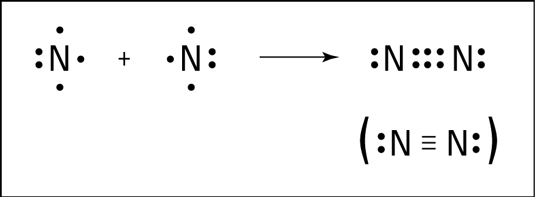

What is the correct chemical name for the ionic compound: Fe3N2
Iron nitride
Iron (III) nitride
Iron (II) nitride
TriIron dinitride

Titanium(IV) oxide has the formula
Ti4O
TiO4
Ti(IV)O
TiO2
Ti4O2
The substance ClO3– is best described as
a molecule
a polyatomic ion
a polyatomic molecule
a mixture

What is the number of valence electrons for Calcium?
1
2
3
4

What is the number of valence electrons for Neon and the other Noble Gases?
5
6
7
8
If I was trying to determine if two atoms will bond, what would be helpful to know:
Valence electrons, found by group number
Whether the elements are metals or nonmetals
The electronegativity of the atoms
All of the above, all of which can be found on the Periodic Table

Using electronegativities, what type of bond is formed by S and Br.
ionic
polar covalent
non-polar covalent

Using electronegativities, what type of bond is formed by Co and F.
ionic
polar covalent
non-polar covalent


Which compound would be a good conductor only when in solution?
aluminum
sulfur dioxide
ammonia
sodium nitrate

Which compound would have a very low melting point?
sodium chloride
copper (II) sulfate
sulfur dioxide
aluminum
In a chemical formula for ionic compounds, the total positive charge and negative charge must add up to equal _____.
0
1
2
3
When writing the chemical formula of a compound that contains more than one of a particular polyatomic ion, _____ must be used.
ionic charges
parenthesis
Greek prefixes
lower case letters.
The acronym VSEPR stand for
very strong electron pair repulsion.
varied symmetry electrostatic proton reaction.
venomous snakes enjoy pink ribbons.
valence shell electron pair repulsion.
VSEPR theory is used to predict
the number of unshared pairs of electrons in a Lewis structure.
the number of multiple bonds in a Lewis structure.
the three-dimensional geometry of a molecule.
the three-dimensional crystal lattice structure of ionic compounds.
Any molecule with only two atoms must be linear. Three-atom molecules such as BeCl2 can also be linear. For linear molecules, the bond angle is
360°
180°
120°
90°
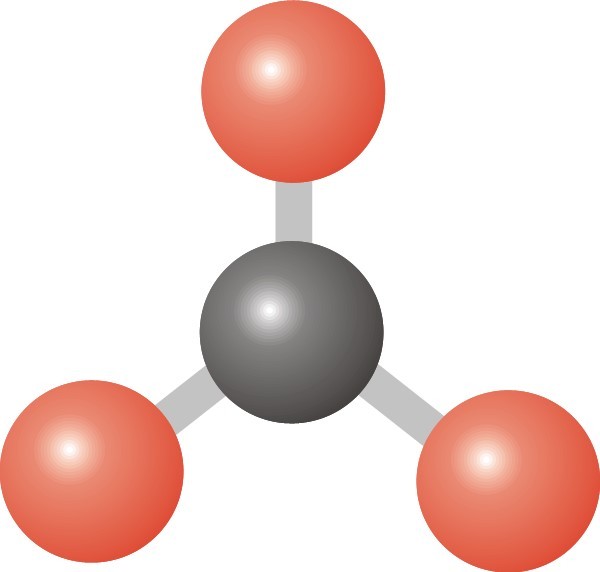
What molecular geometry would PH3 have?
Trigonal Pyramidal
Trigonal Bipyramidal
Bent
Linear

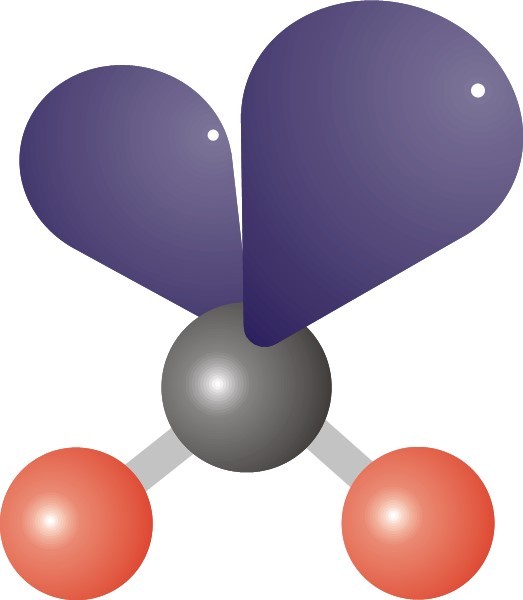
What shape would this have?
Trigonal planar
Pyramidal
Tetrahedral
Bent


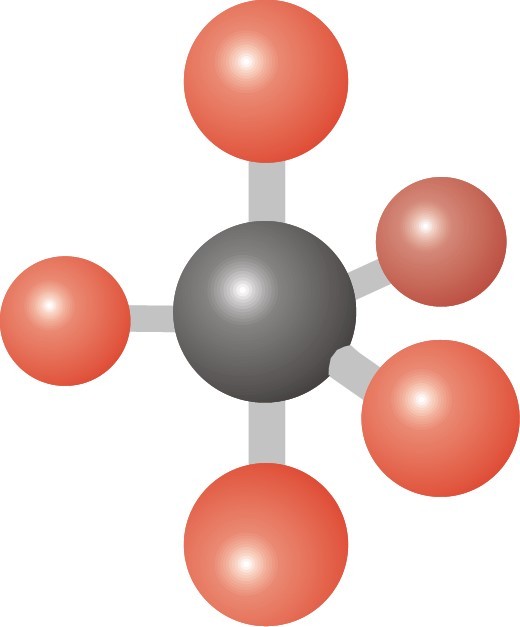
What shape is shown here?
Octahedral
Tetrahedral
Trigonal bipyramidal
Seesaw

Identify the molecule structure
Bent
Linear
Trigonal Planar
Pyramidal
3 atoms bonded and 0 lone pairs
linear
trigonal planar
bent
tetrahedral
trigonal pyramidal

USE THE PERIODIC TABLE
How many valence electrons does Phosphorus have?
31
5
15
4


Which image could be a representation of NH3?
A
B
C

Which is the correct molecular structure for carbon dioxide?


How many total valence electrons are participating in bonding in the molecule above?
8
4
2
3
In HCN (Carbon is usually the central atom) what kind of bond is between the C and N
Single
Double
Triple

