wayground logo

Free Printable Worksheets

Font size

S
M
L
XL
Worksheets

Physics Midterm 2021

Total questions: 58

Worksheet time: 49mins

Name
Class
Date
1.
According to Newton’s first law of motion, a moving object that is not acted on by an unbalanced force will
a)
remain in motion.
b)
eventually come to a stop.
c)
change its momentum.
d)
accelerate.
2.
A person steps out of the boat and onto the dock.  As the person moves forward onto the dock, the boat moves backward.  Which statement best describes the backward motion of the boat as the person steps forward?
a)
For every action there is an equal and opposite reaction.
b)
Every mass exerts a force on every other mass.
c)
An object at rest tends to stay at rest.
d)
Friction opposes the motion of an object.
3.
An object will not have any inertia if it is __________?
a)
Accelerating
b)
Moving in a circle
c)
In space
d)
… Nonsense! All objects have inertia
4.
What is Newtons 1st law of motion?
a)
Force= Mass multiplied by acceleration 
b)
An object at rest stays at rest unless acted on an unbalanced force. (inertia)
c)
For every action there is a equal and opposite  re-action.
d)
law of gravity 
5.
What law of motion does this picture represent?
a)
Newtons 3rd law
b)
Newtons 4th law
c)
Newtons 1st law
d)
Newtons 2nd law 
6.
What is Newtons 2nd law of motion?
a)
Pancakes 
b)
Force= Mass multiplied by acceleration
c)
For every action there is a equal and opposite  re-action.
d)
Law of gravity 
7.
What law of motion does this picture represent?
a)
Newtons 1st law
b)
law of gravity 
c)
Newtons 4th law 
d)
Newtons 2nd law
8.
What law of motion does this picture represent?
a)
Newtons 1st law
b)
Newtons 4th law 
c)
Newtons 3rd law 
d)
Newtons 2nd law
9.

1. Colas may be purchased in two or three ................ bottles.

a)

litter

b)

kilogam

c)

ampere

d)

volt

10.

1. The mass of a bowling ball is 7.25 ..........

a)

litter

b)

kilogram

c)

milligram

d)

micro gram

11.

1. The length of the common housefly is about 1 ..........

a)

m

b)

g

c)

kg

d)

cm

12.

1. The mass of a paperclip is about 1 ..........

a)

ton

b)

kg

c)

g

d)

mg

13.

1. The mass of my chair is about 8 ......

a)

ton

b)

kg

c)

g

d)

mg

14.

1. One teaspoon of cough syrup has a volume of 5 .........

a)

ml

b)

L

c)

kg

d)

g

15.

Stand with your arms raised out to your side. The distance from your nose to your outstretched fingers is about 1 ........

a)

km

b)

m

c)

cm

d)

mm

16.

The distance between exit 8 and exit 7 in north road is about 2 .....

a)

ton

b)

L

c)

km

d)

kg

17.

Convert the following metric measurements: 1000 g = .....mg

a)

103

b)

109

c)

102

d)

106

18.

What unit is used to measure volume?

a)

Meter

b)

Gram

c)

Pounds

d)

Liter

19.

Which of the following is an acceptable velocity measurement?

a)

25 m/s North

b)

25 m/s

c)

25 m

d)

25 m North

20.
Can be measured in meters per second (m/s)
a)
Distance
b)
Time
c)
Speed
d)
Acceleration
21.
What is velocity?
a)
the quickness of an object
b)
the location of an object
c)
acceleration
d)
speed in a specific direction
22.
Acceleration is defined as the CHANGE in 
a)
time it takes for one place to move to another place. 
b)
velocity of an object.
c)
distance divided by the time interval 
d)
velocity divided by the time interval 
23.
Acceleration only takes place when things speed up. 
a)
True
b)
False
24.
A ping-pong ball rolls forward 6 meters, and bounces backward 3 meters. It traveled a total distance of:
a)
9 meters
b)
6 meters
c)
3 meters
d)
0 meters
25.
Liza is swimming laps from one end of a 50 meter pool to the other. Going from one end to the other is considered one lap. If she swims four complete laps, which statement is TRUE?
a)
Her distance and displacement are both zero.
b)
Her distance is zero, but her displacement is 200 meters.
c)
Her distance is 200 meters, but her displacement is zero.
d)
Her distance and displacement are both 200 meters.
26.

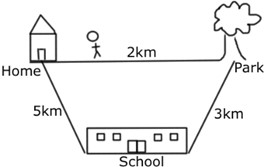
Jerry walked from home to school, then from the school to the park. What is his total displacement?

a)

2 km

b)

5 km

c)

8 km

d)

10 km

27.
What is force?
a)
A push exerted on an object
b)
A push or pull exerted on an object
c)
A pull exerted on an object
d)
Nothing
28.

Which diagram best shows person pushing a couch (accelerating) across the floor?

a)
b)
c)
d)
29.

The down-arrow in this diagram is most-likely:

a)

gravity

b)

normal

c)

a push or pull

d)

friction

30.
Gravity affects weight.
a)
True
b)
False
31.

As distance between two objects increase, the pull of gravity

a)

Increases

b)

Decreases

c)

Stays the same

32.
The amount of matter in an object is 
a)
pressure
b)
weight
c)
mass
d)
force
33.

Motion is the result of ____ force

a)

balanced

b)

no

c)

unbalanced

34.
Friction is a force that acts in an ___________ direction of movement.
a)
similar
b)
opposite
c)
parallel
d)
west
35.

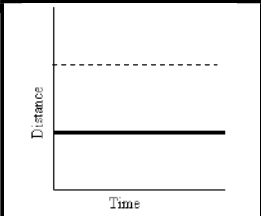
What does the solid line on this graph represent?

a)

Constant speed

b)

Acceleration

c)

At rest

d)

deceleration

36.

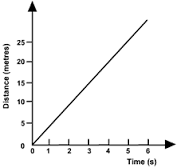
What is the line on this graph showing?

a)

moving away from starting point at a constant speed

b)

moving back towards the starting point at a constant speed

c)

acceleration (getting faster)

d)

deceleration (getting slower)

37.

An object at rest will remain at rest unless acted upon by an unbalanced force. Likewise an object in motion will remain in motion unless acted upon by an unbalanced force.

a)

Newton's 2nd law

b)

Newton's 3rd law

c)

Fig Newton's law

d)

Newton's 1st law

38.
The term for when an object speeds up, slows down, or changes direction
a)
Speed
b)
Velocity
c)
Acceleration
d)
Newtons
39.
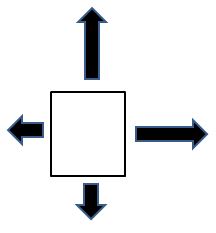
The net force of the following diagram is
a)
620N→
b)
To the right→
c)
20N←
d)
balanced↔
40.
What is the common formula for work?
a)
W=Fv
b)
W=Fd
c)
W=Fd2
d)
W=F2d
41.
A construction worker pushes a wheelbarrow 5 m with a horizontal force of 50 N.  How much work is done?
a)
10J
b)
55J
c)
250J
d)
1250J
42.
Which of the following formulas would be used to calculate kinetic energy?
a)
KE=1/2kx2
b)
KE=-1/2kx2
c)
KE=1/2mv2
d)
KE=-1/2mv2
43.
What is the kinetic energy of a 0.135 kg baseball thrown at 40.0m/s?
a)
54.0J
b)
87.0J
c)
108J
d)
216J
44.
What is the potential energy of a 1kg mass 1 m above the ground?
a)
1.0J
b)
9.8J
c)
10J
d)
98J
45.

A runner decreases his velocity from 20 m/s to 10 m/s in 2.0 s. What was his average acceleration?

Hint: use acceleration equals final velocity minus initial velocity divided by time (a = v final - v initial / time)

a)

-5.0 m/s2

b)

5.0 m/s2

c)

-7.5 m/s2

d)

-10.0 m/s2

46.

An automobile slows from 26 m/s to 20 m/s. Its acceleration is −2.0 m/s2. How much time does it take for the vehicle to slow down?

Hint: use time equals final velocity minus initial velocity divided by acceleration (t = v final - v initial / acceleration)

a)

3.0 s

b)

-3.0 s

c)

8.0 s

d)

9.0 s

47.

If the slope of a velocity-time graph is horizontal, then acceleration is

a)

0

b)

1 unit/time

c)

2 unit/time

d)

3 unit/time

48.

The steeper an upwards line is on a velocity-time graph, the faster the object’s motion is changing (the greater the acceleration).

a)

true

b)

false

49.

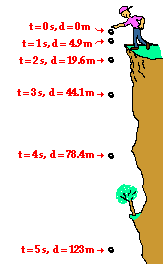
What happens to the velocity of a ball as it is dropped off a cliff?

a)

It decreases at a uniform rate

b)

It increases at a uniform rate

c)

It is constant

50.

What is the velocity during the time interval t = 0 s to t = 2 s

a)

6 m/s

b)

3 m/s

c)

2.5 m/s

51.

In the Velocity - time graph, which time interval(s) is the object moving at constant speed?

a)

0 to 3 seconds

b)

3 to 5 seconds

c)

5 to 11 seconds

d)

11 to 14 seconds

52.

The slope on a velocity - time graph represents the objects...

a)

speed

b)

position

c)

acceleration

d)

time

53.

the units (m/s2) are used for which quantity?

a)

position

b)

speed

c)

velocity

d)

acceleration

54.
A change in velocity over time is known as:
a)
acceleration
b)
constant speed
c)
average speed
d)
displacement
55.

What is the value of acceleration due to gravity?

a)

9.8 m/s2

b)

9.8 m

c)

9.8 m.s

d)

9.8 s

56.

A train travels from Stockholm to Copenhagen. The journey is 500 kilometers long and takes 5 hours. What is the train’s average speed (in km/hr) over the course of the trip?

a)

100

b)

2500

c)

200

d)

505

57.

What does it mean when an object has negative acceleration?

a)

Velocity is increasing

b)

Velocity is decreasing

58.
If there are two forces going in the same direction how would you find the net force?
a)
Subtract
b)
Add
c)
Neither
d)
Multiply