Wayground logo

Free Printable Worksheets

Font size

S
M
L
XL
Worksheets

Unit 4 and 5 Final Review

Total questions: 40

Worksheet time: 46mins

Name
Class
Date
1.
What atom matches this electron configuration?
1s22s22p63s23p64s23d10
a)
Zinc
b)
Copper
c)
Nickel
d)
Germanium
2.

How many electrons can the d sublevel (the d orbitals) hold?

a)

14

b)

10

c)

2

d)

6

3.

Each row on the periodic table represents:

a)

an energy level

b)

a sublevel

c)

an electron

d)

an orbital

4.

Which area on the periodic table represents the electrons in the "d" sublevel (d orbitals)?

a)

representative elements

b)

columns 3-8

c)

rare earth elements

d)

transition elements

5.
How many electrons can the first energy level hold?
a)
1
b)
2
c)
8
d)
0
6.

Each orbital can hold how many electrons?

a)

5

b)

4

c)

8

d)

2

7.
What's a valence electron?
a)
electrons in the second energy level
b)
electrons in the outermost energy level
c)
the atomic number
d)
electrons in the first level
8.
Which electron configuration belongs to Chlorine (Cl)?
a)
1s2 2s2 2p6 3s2 3p5
b)
1s2 2s2 2p6 3s2 3p6
c)
1s2 2s2 2p6 3s2 3p7
9.
What atom matches this electron configuration?
1s22s22p63s2
a)
Neon
b)
Magnesium
c)
Aluminum
d)
Potassium
10.

Which area on the periodic table represents the electrons in the "d" sublevel?

a)

representative elements

b)

columns 3-8

c)

rare earth elements

d)

transition elements

11.
There are 4 different types of subshells (orbitals) s,p,d,f.
a)
true
b)
false
12.
How many electron can be found in a p orbital?
a)
2
b)
3
c)
4
d)
6
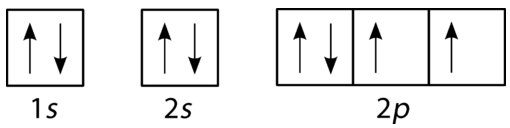
13.
This orbital diagram represents:  
a)
C
b)
B
c)
N
d)
O
14.

What element's orbital notation is pictured here?

a)

Ar

b)

Br

c)

Cu

d)

Cl

15.

Which shows the correct orbital diagram for Cobalt?

a)
b)
c)
d)
16.
What do you start electron configuration with?
a)
1s2
b)
1d10
c)
1f14
d)
1p6
17.
The atomic number tells you what?
a)
number of electrons
b)
number of protons
c)
number of neutrons
d)
both electrons and protons in an atom.
18.
Elements which are shiny, conduct electricity and heat are called
a)
metal
b)
nonmetal
c)
metalloid
d)
nonexistent
19.
Which is a halogen?
a)
Helium
b)
Chlorine
c)
Oxygen
d)
Neptune
20.
Which is an alkali metal?
a)
Magnesium
b)
Iron
c)
Sodium
d)
Europium
21.
If an atom had the same properties as fluorine (F), it would probably be located in
a)
period 1.
b)
period 2.
c)
group 2.
d)
group 17.
22.
Atoms with similar properties are most likely located...
a)
in the same period.
b)
in the same group.
c)
in different periods.
d)
to the right and left of each other.
23.
What is the element symbol for boron? 
a)
B
b)
Bo
c)
Bn
d)
W
24.
The atomic number of this pictured element is
a)
28
b)
58.6934
c)
Ni
d)
Nickel
25.

Group Name and Number for Neon

a)

Alkaline Earth Metals, 2

b)

Noble Gases, 18

c)

Halogens, 17

d)

Alkali Metals, 1

26.
Who first developed the Periodic Table?
a)
Mendeleev
b)
Mosely
c)
Mendella
d)
Murphy
27.

The vertical (up and down) columns in the Periodic Table are called

a)

groups

b)

towers

c)

periods

d)

atomic numbers

28.
The atoms along the staircase are called 
a)
metals
b)
nonmetals
c)
metalloids
d)
noble gases
29.
As you move down a group, atomic radius increases because - 
a)
you add more and more neutrons
b)
you add more and more protons
c)
you add more and more shells (energy levels)
d)
you add more atomic mass
30.
Francium (Fr) has the lowest ionization energy in Group 1 because - 
a)
it has the smallest number of valence electrons
b)
it has the greatest atomic mass
c)
it has the greatest number of protons, so it attracts its electrons the strongest
d)
its 1 valence electron is very far from the nucleus, so little energy is needed to remove it
31.
How many valence electrons are in an atom of K?
a)
3
b)
8
c)
4
d)
1
32.
How many valence electrons are in an atom of Ar?
a)
2
b)
8
c)
4
d)
1
33.
Elements in the same column of the periodic table always have the same # of _______ as one another.
a)
Protons
b)
Neutrons
c)
Electrons
d)
Valence Electrons
34.
The period for Bromine is ___________.
a)
3
b)
2
c)
4
35.

Name group 2 on the periodic table.

a)

alkali metals

b)

alkaline earth metals

c)

noble gases

d)

halogens

36.
The majority of elements on the periodic table are
a)
man made.
b)
nonmetals.
c)
metals.
d)
gases.
37.
Which of the following will have a larger radius than Zinc?
a)
Gallium
b)
Aluminum
c)
Magnesium
d)
Strontium
38.
Which of the following will have a lower ionization energy than Scandium (Sc)?
a)
Helium (He)
b)
Titanium (Ti)
c)
Calcium (Ca)
d)
Magnesium (Mg)
39.
As atoms of elements in group 16 are considered in order from top to bottom, the electronegativity of each successive element....
a)
decreases
b)
increases
c)
remains the same
d)
none of the above
40.
Ionization energy is...
a)
the energy required to add an electron to a specific atom
b)
how much energy it takes to remove an electron from an atom
c)
the energy required to shield the outer electrons from the nucleus
d)
a measure of the ability of an atom to attract electrons