wayground logo

Free Printable Worksheets

Font size

S
M
L
XL
Worksheets

PQ Fall Final Review (Geometry Honors)

Total questions: 144

Worksheet time: 3hrs 17mins
Name
Class
Date
1.
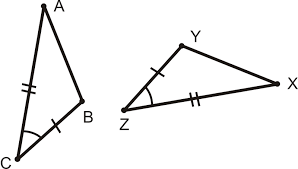
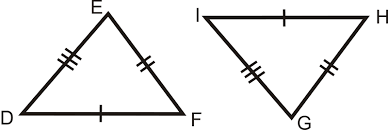
Which triangle congruence theorem can be used to prove the triangles are congruent?
a)
SAS
b)
SSS
c)
ASA
d)
HL
2.
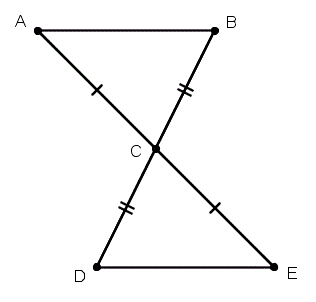
Which triangle congruence theorem can be used to prove the triangles are congruent?
a)
SSS
b)
ASA
c)
AAS
d)
SAS
3.
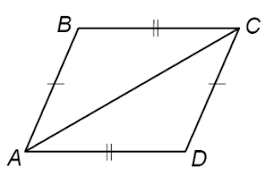
Which triangle congruence theorem can be used to prove the triangles are congruent?
a)
AAS
b)
SSS
c)
Not enough information given
d)
ASA
4.
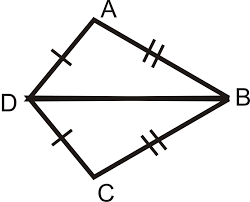
Which triangle congruence theorem can be used to prove the triangles are congruent?
a)
AAS
b)
SSS
c)
SAS
d)
SSA
5.
Which triangle congruence theorem can be used to prove the triangles are congruent?
a)
SAS
b)
Not enough information
c)
SSS
d)
AAS
6.

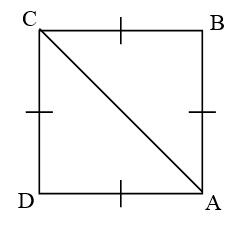
Which congruency statement can be written for the triangles pictured?

a)

ΔACBΔABD\Delta ACB\cong\Delta ABD

b)

ΔBACΔBAD\Delta BAC\cong\Delta BAD

c)

ΔCABΔDBA\Delta CAB\cong\Delta DBA

d)

ΔADBΔBCA\Delta ADB\cong\Delta BCA

7.

Which triangle congruence theorem can be used to prove the triangles are congruent?

a)

SSS

b)

SAS

c)

ASA

d)

HL

8.

Use the congruency statement to answer the following: 

 F=?\angle F=?  

a)

 H\angle H  

b)

 I\angle I 

c)

 G\angle G  

d)

not congruent to another angle

9.

Which congruency statement can be written for the triangles pictured?

a)

ΔABC ≅ ΔEDC

b)

ΔACB ≅ ΔEDC

c)

ΔECD ≅ ΔCAB

10.

Which triangle congruence theorem can be used to prove the triangles are congruent?

a)

SAS

b)

ASA

c)

AAS

d)

Not Possible

11.

Which triangle congruence theorem can be used to prove the triangles are congruent?

a)

SSS

b)

SAS

c)

ASA

d)

NONE

12.

Which triangle congruence theorem can be used to prove the triangles are congruent?

a)

SSS

b)

SAS

c)

ASA

d)

NONE

13.

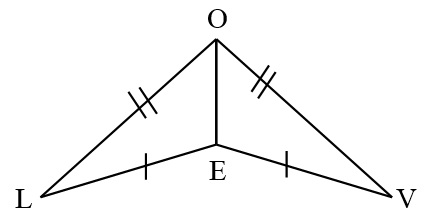
Which congruency statement can be written for the triangles pictured?

a)

ΔLEOΔOVE\Delta LEO\cong\Delta OVE

b)

ΔOEVΔOLE\Delta OEV\cong\Delta OLE

c)

ΔOVLΔOLV\Delta OVL\cong\Delta OLV

d)

ΔOLEΔOVE\Delta OLE\cong\Delta OVE

14.

Which triangle congruence theorem can be used to prove the triangles are congruent?

a)

SSS

b)

SAS

c)

ASA

d)

AAS

15.

What additional information is needed to prove the 2 triangles are congruent by the listed theorem?

a)

MK =GI\overline{MK}\ =\overline{GI}

b)

GIH = MKL\angle GIH\ =\ \angle MKL

c)

MLK=GHI\angle MLK=\angle GHI

16.

What additional information is needed to prove the 2 triangles are congruent by the listed theorem?

a)

RT =XZ\overline{RT}\ =\overline{XZ}

b)

RST = XYZ\angle RST\ =\ \angle XYZ

c)

SR =YX\overline{SR}\ =\overline{YX}

17.

Are these triangles congruent by SSS? Give a congruence statement

a)

Yes ΔACBΔXYZ\Delta ACB\cong\Delta XYZ

b)

No

c)

Yes ΔCBA ΔYXZ\Delta CBA\ \cong\Delta YXZ

d)

Yes ΔCBAΔYZX\Delta CBA\cong\Delta YZX

18.
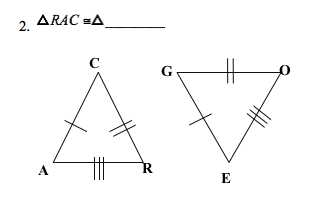
Complete the congruence statement.
a)
OEG
b)
OGE
c)
EGO
d)
GOE
19.

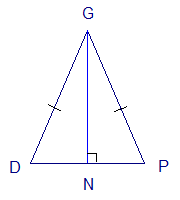
Which statement will make  ΔDNG  ΔPNG\Delta DNG\ \cong\ \Delta PNG  by SSS?

a)

N is the midpoint of  DP\overline{DP}  

b)

 DP\angle D\cong\angle P  

c)

 PG DG\overline{PG}\ \cong\overline{DG}  

d)

 GN  DP\overline{GN}\ \perp\ \overline{DP}  

20.

Reflect (4,-7) across the y-axis

a)

(-4.-7)

b)

(4,7)

c)

(-4,7)

d)

(-7,4)

e)

(4,-7)

21.

Reflect (4,-7) across the x-axis

a)

(-4.-7)

b)

(4,7)

c)

(-4,7)

d)

(-7,4)

e)

(4,-7)

22.

What axis is the triangle being reflected over?

a)

X-axis

b)

Y-axis

23.

What axis is the image reflected over?

a)

X-axis

b)

Y-axis

24.

What axis is the image reflected over?

a)

X-axis

b)

Y-axis

25.

What axis is the image reflected over?

a)

X-axis

b)

Y-axis

26.

What would be the coordinates of point K if it was reflected over the x-axis?

a)

(-5, -2)

b)

(-5, 2)

c)

(5, -2)

27.

What would be the coordinates of point K if it was reflected over the Y-axis?

a)

(-5, 2)

b)

(5, 2)

c)

(5, -2)

28.
Which answer shows a reflection across the x-axis?
a)
d
b)
c
c)
b
d)
a
29.

A(4,6) and A'(6,4). What is the line of reflection?

a)

y-axis

b)

x-axis

c)

y=x

d)

y=-x

e)

y=2x

30.

A(4,6) and A'(4,-6). What is the line of reflection?

a)

y-axis

b)

x-axis

c)

y=x

d)

y=-x

e)

y=2x

31.

A(4,6) and A'(-2,0). What is the line of reflection?

a)

y= -x+4

b)

y=-6

c)

y=-6x

d)

y=x-6

e)

y=x-2

32.
What is the rule for the following reflection? 
a)
Reflection across       y = −1
b)
Reflection across        y = 1
c)
Reflection across            x = −1
d)
Reflection across          x = 1
33.
What is this transformation?
(x, y) ----> (-x, y) 
a)
Reflect over the x axis
b)
Reflect over the y-axis
c)
Slide down 1
d)
slide left 1
34.
B(-2, -4)
Reflect over the line y = x
a)
(2, -4)
b)
(-4, 2)
c)
(-4, -2)
d)
(4, 2)
35.
The point ( -2,5) is reflected over the line x = 1.  Find its image.
a)
(  4,  5)
b)
( -2  , -5)
c)
( 2  ,  5)
d)
(2   , -5)
36.
What is the rule for the following reflection? 
a)
Reflection across       y = −2
b)
Reflection across        y = 2
c)
Reflection across            x = 2
d)
Reflection across          x =  −2
37.
What is the rule for the following reflection? 
a)
Reflection across      x-axis
b)
Reflection across        y-axis
c)
Reflection across            y = x
d)
Reflection across          y = −x
38.
Flipping a figures is a ...
a)
Rotation
b)
Reflection
c)
Dilation
d)
Translation
39.
After being transformed the new point is called a(n):
a)
Pre-Image
b)
Post Image
c)
Transformed
d)
Image
40.
How is trapezoid ABCD translated to trapezoid A'B'C'D'?
a)
Translated 5 units to the right and 5 units down
b)
Translated 8 units to the right and 5 units down
c)
Translated  5 units to the right and 8 units down
d)
Translated 4 units to the right and 5 units down 
41.
A transformation in which a graph or geometric figure is picked up and moved to another  location without any change in size or orientation.
a)
Translation
b)
Rotation
c)
Reflection
d)
Dilation
42.
The original figure prior to a transformation.
a)
Pre-image
b)
Image
43.
Determine where X' would be if you translated X 3 units to the left and 9 units down.
a)
(-4, 4)
b)
(-10, 2)
c)
(-4, -5)
d)
(-1, 5)
44.
How would you translate point P to P'?
a)
Translate 2 units to the right and  8 units down
b)
Translate 3 units down and 2 units to the right
c)
Translate 4 units down and 4 units to the left
d)
Translate 8 units to the right and 2 units down
45.

Translate the blue shape to the green shape...

a)

3 Left

3 Down

b)

3 Right

3 Up

c)

2 Right

3 Up

d)

2 Left

3 Down

46.

Determine where X' would be for T<3,5>T_{<3,-5>}  

a)

(-6, 7)

b)

(-4, 9)

c)

(2, -1)

d)

(-4, -1)

47.

The point A(7,1) is reflected over the point (4,0) and its image is point B. What are the coordinates of point B?

a)

(1,-1)

b)

(3,1)

c)

(10,2)

d)

(-1,-7)

48.

The point A(6,-6) is reflected over the origin and its image is point B. What are the coordinates of point B?

a)

(-6,6)

b)

(6,-6)

c)

(6,6)

d)

(-6,-6)

49.

The point A(-8,-2) is reflected over the point (4,-1) and its image is point B. What are the coordinates of point B?

a)

(16,0)

b)

(8,2)

c)

(-20,-3)

d)

(-4,-3)

50.

A(2,5) is reflected over line k to get the point A'(6,1). What is the equation for line k?

a)

y=x-1

b)

y=-x+7

c)

y=x+7

d)

y=-x-1

51.

A(7,-5) is reflected over line k to get the point A'(3,-1). What is the equation for line k?

a)

y=x-8

b)

y=-x+2

c)

y=-x-8

d)

y=x+2

52.

Solve for w

a)

55o alternate

b)

55o corresponding

c)

125o alternate

d)

125o corresponding

e)

Can not be determined.

53.

Find f

a)

f = 49o

b)

f = 131o

c)

f = 41o

d)

f = 120o

54.

find g

a)

g = 49o

b)

g = 131o

c)

g = 41o

d)

g = 120o

e)

Can not be determined.

55.

∠A and ∠D are in what relationship?

a)

Supplementary

b)

Vertical

c)

Alternate Interior

d)

Alternate exterior

56.

∠C and ∠F are in what type of relationship?

a)

Supplementary

b)

Vertical

c)

Alternate interior

d)

Alternate exterior

57.

Solve for x & list how you found it

a)

32... Same Side Interior = 180

b)

32... Alternate Interiors = 180

c)

32... Corresponding angles are congruent

d)

-20... Alternate Interiors are equal

e)

-20... Same Side Interiors are =

58.
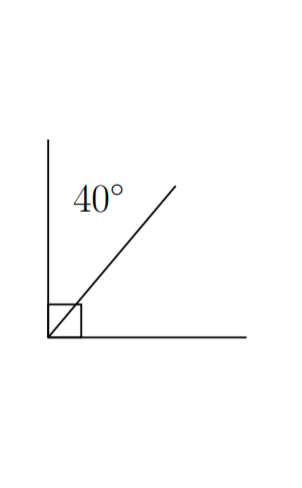
Find the missing angle.
a)
60°
b)
70°
c)
50°
d)
140
59.
Which lines are parallel?
a)
Line a and Line b
b)
Line b and Line c
c)
All Lines are Parallel
d)
No Lines are Parallel
60.

Which of the following lines in the figure is transversal?

a)

n

b)

l

c)

m

61.
Angle R and C are...
a)
Alternate Interior Angles
b)
Consecutive Interior Angles
c)
Corresponding Angles
d)
Alternate Exterior Angles
62.

Solve for the value of x.

a)

46

b)

42

c)

44

d)

48

e)

Can not be determined.

63.

Solve for the value of x.

a)

110

b)

120

c)

130

d)

140

64.

Solve for the value of y.

a)

20

b)

24

c)

28

d)

32

65.

Line A is parallel to Line B.

Line B is Perpendicular to Line C.

So Line A and Line C must be...

a)

Parallel

b)

Perpendicular

c)

Not Enough Information

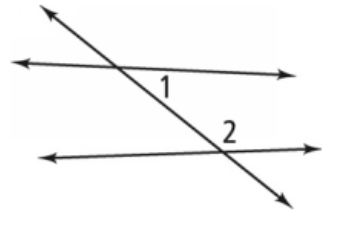
66.

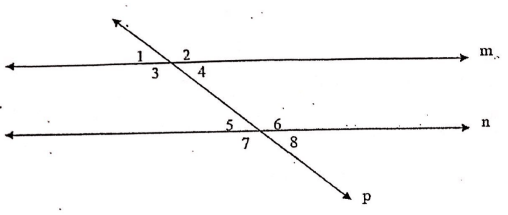
 1\angle1  and  2\angle2  are ___.  

a)

Alternate Interior Angles

b)

Alternate Exterior Angles

c)

Same-side Interior Angles

d)

Corresponding Angles

e)

None of these

67.

 1 \angle1\   and  2\angle2  are ___.

a)

Alternate Interior Angles

b)

Alternate Exterior Angles

c)

Same-side Interior Angles

d)

Corresponding Angles

e)

None of these

68.

 1 \angle1\   and  2\angle2  are ___.

a)

Alternate Interior Angles

b)

Alternate Exterior Angles

c)

Same-side Interior Angles

d)

Corresponding Angles

e)

None of these

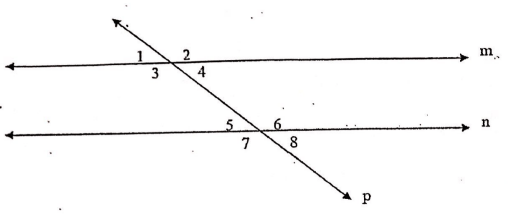
69.

 3\angle3  and   7\angle7  are ___.  

a)

Alternate Interior Angles

b)

Alternate Exterior Angles

c)

Same-side Interior Angles

d)

Corresponding Angles

e)

None of these

70.

 3 \angle3\   and   2\angle2   are ___.  

a)

Alternate Interior Angles

b)

Alternate Exterior Angles

c)

Same-side Interior Angles

d)

Corresponding Angles

e)

None of these

71.

Which Angles are congruent?

a)

 5 and 8\angle5\ and\ \angle8 

b)

 3 and 5\angle3\ and\ \angle5 

c)

 6 and 4\angle6\ and\ \angle4 

d)

 3 and 4\angle3\ and\ \angle4 

72.

Name an angle in the figure that is adjacent to angle 2.

a)

∠4

b)

∠5

c)

∠6

d)

∠1

73.
What are vertical angles?
a)
Angles that are adjacent to each other
b)
Angles that add up to 180°
c)
Angles that are opposite of each other when lines intersect
d)
Angles that add up to 90°
74.

Which angles are Corresponding Angles? \angle  

a)

 4\angle4   and  8\angle8  

b)

 5 and 4\angle5\ and\ \angle4  

c)

 1 and 4\angle1\ and\ \angle4  

d)

 6 and 4\angle6\ and\ \angle4  

75.

If lines m and n are parallel, then which of the following pairs must be congruent? Choose all that apply.

a)

1 and 6

b)

3 and 8

c)

4 and 5

d)

2 and 8

e)

1 and 8

76.
Angles 1 and 3 are called _______.
a)
Supplementary Angles
b)
Vertical Angles
c)
Linear Pair of Angles
d)
Adjacent Angles
77.
Which angles would be considered adjacent?
a)
1 and 2
b)
1 and 3
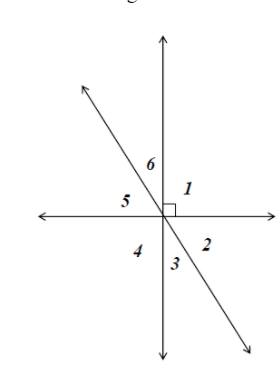
78.

What is the justification?

a)

Congruent Supplements Theorem

b)

Vertical Angles Theorem

c)

Definition of Supplementary Angles

d)

Definition of Complementary Angles

79.

What is the justification?

a)

Angle Addition Postulate

b)

Angle Bisector Definition

c)

Addition Property of Equality

d)

Supplement Theorem

80.

What is the reason for step #2?

a)

Definition of linear pair

b)

Definition of supplementary angles

c)

Angle Addition Postulate

d)

Addition property

81.

What is the reason for step #2?

a)

Definition of congruent segments

b)

Definition of congruent angles

c)

Definition of straight angle

d)

Definition of midpoint

82.

What is the reason for step #2? (May be more than one answer)

a)

Definition of congruent segments

b)

Definition of congruent angles

c)

Transitive property

d)

Definition of congruence

83.

What is the reason for step #2?

a)

Definition of angle bisector

b)

Definition of congruent angles

c)

Definition of right angle

d)

Definition of perpendicular lines

84.

What is the reason for step #2?

a)

Definition of supplementary angles

b)

Definition of straight angle

c)

Angle Addition Postulate

d)

Addition property

85.

What is the reason for step #1?

a)

Definition of straight angle

b)

Addition property

c)

Angle Addition Postulate

d)

Segment Addition Postulate

86.

What is the reason for step #2?

a)

Addition property

b)

Transitive property

c)

Segment Addition Postulate

d)

Multiplication property

87.

Select the response that justifies the given statement:

XP + PY = XY

a)

Addition property

b)

Subtraction property

c)

Segment Addition postulate

d)

Angle addition postulate

88.
Subtraction Property of Equality
a)
If a=b, then a∙c = b∙c.
b)
If a=b, then a-c = b-c.
c)
If a=b, then a+c = b+c.
d)
If a = b, then a/c=b/c when c≠0.
89.
Addition Property of Equality
a)
If a=b, then a∙c = b∙c.
b)
If a=b, then a-c = b-c.
c)
If a=b, then a+c = b+c.
d)
If a = b, then a/c=b/c when c≠0.
90.
Substitution Property
a)
If a=b, then (a) can be substituted for (b) in any equation or expression.
b)
If a=b and b=c, then a=c.
c)
a=a
d)
If a=b, then b=a.
91.
Segment Addition Postulate
a)
Vertical Angles are Congruent
b)
m∠ABC+m∠BCD=m∠ABD
c)
An angle that measures 90°.
d)
AB+BC=AC
92.
Definition of Right Angle
a)
Vertical Angles are Congruent
b)
m∠ABC+m∠BCD=m∠ABD
c)
An angle that measures 90°.
d)
AB+BC=AC
93.
Vertical Angles Theorem
a)
Vertical Angles are Congruent
b)
m∠ABC+m∠BCD=m∠ABD
c)
An angle that measures 90°.
d)
AB+BC=AC
94.
The first step of an indirect proof is to ____?
a)
write the given
b)
assume the negation of the given
c)
assume the negation of what you are trying to prove
d)
contradict the given
95.
What assumption would you make to start the indirect proof of AB≅BC?
a)
AB≠BC
b)
BA≅CB
c)
B is the midpoint of AC
d)
B is the perpendicular bisector oa AC
96.
What assumption would you make to start the indirect proof of:
 there can be only one 90 angle in a triangle
a)
there can be more than one 90 angle in a triangle
b)
<a+<b+<c=180
c)
<a+<b+<c≠180
d)
all the angles in a triangle add up to 180.
97.
What assumption would you make to start the indirect proof of if 3x+7>13, then x>2?
a)
x≤2
b)
x<2
c)
x>2
d)
x=2
98.
If ∠A ≅ ∠B, then we know m∠A = m∠B because...
a)
Given
b)
Definition of Congruent
c)
Congruent means equal
d)
Transitive Property
99.

Which TWO statements below contradict each other.

a)

Quadrilateral is a square.

b)

Quadrilateral has four equal sides.

c)

Quadrilateral has no right angles.

100.
Given, "If I have a Siberian Husky, then I have a dog." Identify the converse.
a)
If I do not have a Siberian Husky, then I do not have a dog.
b)
If I have a dog, then I have a Siberian Husky.
c)
If I do not have a dog, then I do not have a Siberian Husky.
d)
If I do not have a Siberian Husky, then I have a dog. 
101.
Given, "If I have a Siberian Husky, then I have a dog." Identify the hypothesis.
a)
If I have a Siberian Husky.
b)
I have a Siberian Husky.
c)
Then I have a dog.
d)
I have a dog.
102.
Conditional: If Maria gets married, then the reception will be at the country club.
What is this statement: If the reception is at the country club, then Maria will be getting married.
a)
Converse
b)
Inverse
c)
Contrapositive
d)
Negation
103.
What is the hypothesis of the given Conditional Statement?
a)
Jimmy will go to Orlando
b)
Jimmy goes on vacation
c)
Jimmy will go to Orlando
d)
Who is Jimmy?
104.
Which is a counterexample for the following conditional:
If an electronic device has a screen then it is a television.
a)
television
b)
cell phone
c)
computer mouse
d)
keyboard
105.
What is the biconditional statement of the following conditional statement?
“If Shelly lives in Texas, then she lives in the United States.”
a)
If Shelly lives in Texas, then she lives in the United States.
b)
If Shelly lives in the United States, then she lives in Texas.
c)
Shelly lives in Texas if and only if she lives in the United States.
d)
If Shelly does not live in Texas, then she does not live in the United States.
106.
Which of the following is a biconditional statement?
a)
If you do not vote, then you are not at least 18 years old.
b)
You can vote if and only if you are 18 years old.
c)
If you are 18 years old, then you can vote.
107.
If today is Monday, then tomorrow is Tuesday.
a)
True conditional statement
b)
False conditional statement
c)
True biconditional statement
d)
False biconditional statement
108.
When can a biconditional statement be true?
a)
When the inverse and the converse are both true
b)
When the original statement (conditional statement) & the contrapositive are both true.
c)
When the converse is true.
d)
When the original statement (conditional statement) and the converse are both true.
109.

Consider the statement:

If Julie eats tomatoes, then she likes salad.


What is the hypothesis?

a)

If Julie eats tomatoes

b)

Julie eats tomatoes

c)

then she likes salad

d)

she likes salad

e)

None of these

110.
What is the if-then-form of the following Conditional statement? "It is time for dinner if it is 6 pm."
a)
If it is 6pm, then it is time for dinner.
b)
If it is time for dinner, then it is 6pm.
c)
If you want to eat dinner, then you must eat at 6pm.
d)
None of these are right
111.
What phrase does a biconditional statement use?
a)
if, then
b)
if, when
c)
if and only if
d)
then, if
112.
Draw a conclusion from the statement.
If you live in Orlando, then you live in Florida.
You live in Orlando.
a)
You live in Disney Land
b)
You are an old person.
c)
You live in Florida
d)
You live in Orlando
113.
Use the Law of Detachment to draw a conclusion from the two given statements. If not possible, write not possible.
Statement 1: If I study for one hour each day, then I will score well on the exam
Statement 2: I will score well on the exam
a)
 I study for 1 hour each day.
b)
I do not study for 1 hour each day
c)
If I do well on the exam, I studied for 1 hour each day.
d)
not possible
114.
Draw a conclusion from the statement.
If you go fishing, then you will need to bring your fishing rod.
You go fishing.
a)
You will need to bring your fishing rod.
b)
Invalid
c)
You are a boring person.
d)
You are going to catch a fish.
115.
Use the law of syllogism to draw a conclusion from the two given statements:
Statement 1: If you exercise regularly, then you have a healthy body
Statement 2: If you have a healthy body, then you have more energy
a)
You have more energy
b)
If you exercise regularly, then you have more energy
c)
You have a healthy body
d)
If you do not have a healthy body, then you do not exercise regularly
116.

Which law of logic is this?

If I clean the bathroom, then I don't have to do the dishes.

I cleaned the bathroom.

Therefore, I don't have to do the dishes.

a)

Law of Detachment

b)

Law of Syllogism

c)

Law of Contrapositive

d)

None

117.

Use the law of syllogism to write a new conditional statement.

If you go to the swimming pool, then you will enjoy yourself. If you enjoy yourself, you will want to return.

a)

If you return to the pool you will enjoy yourself.

b)

If you enjoy yourself, then you went to the pool.

c)

If you go to the pool, you will want to return.

d)

No conclusion can be made.

118.
Which is a valid conclusion from these statements?
If a quadrilateral is a rhombus, then it is a parallelogram.
If a quadrilateral is a parallelogram, then its opposite angles are congruent.
a)
Opposite angles of a quadrilateral are congruent
b)
Opposite angles of a rhombus are congruent
c)
Every quadrilateral is a rhombus
d)
Every parallelogram is a rhombus
119.
Using the Law of Syllogism, which of the following completes the statement to form a valid conclusion?
If it is snowing heavily, then school will be canceled.
If school is canceled, the big test will not be given today.
It is snowing heavily, then...
a)
Look out for the snowplows while driving to school.
b)
The big test will not be given today.
c)
The roads will be hard to drive on.
d)
You should call the school to see if school is canceled.
120.
Find HG.
a)
8
b)
9
c)
10
d)
11
121.
RM=
a)
RM=6
b)
RM=3
c)
RM=12
d)
RM=9
122.
Solve
a)
50°
b)
58°
c)
115°
d)
226°
123.
Find the value of ∠A.
a)
39 degrees
b)
49 degrees
c)
51 degrees
d)
59 degrees
124.
a)

44

b)

3-3

c)

5-5

d)

99

125.
Which postulate or definition states that
m∠ADB + m∠BDC = m∠ADC?
a)
Segment Addition Postulate
b)
Angle Addition Postulate
c)
Definition of Angle Bisector
d)
Definition of Congruent Angles
126.

 ECD=122°\angle ECD=122\degree  and  BCE=36°\angle BCE=36\degree . Find the measure of  BCD\angle BCD  . 

a)

 BCD=158°\angle BCD=158\degree  

b)

 BCD=86°\angle BCD=86\degree  

c)

 BCD=58°\angle BCD=58\degree  

d)

 BCD=144°\angle BCD=144\degree  

127.

 Find  HIW\angle HIW  if  HIJ = 164°\angle HIJ\ =\ 164\degree  and  WIJ = 140°\angle WIJ\ =\ 140\degree  

a)

 HIW = 304°\angle HIW\ =\ 304\degree  

b)

 HIW=16°\angle HIW=16\degree  

c)

 HIW=40°\angle HIW=40\degree  

d)

 HIW=24°\angle HIW=24\degree  

128.

Find  PSR\angle PSR  if  TSP=54°\angle TSP=54\degree  and  TSR =138°\angle TSR\ =138\degree  

a)

 TSR=192°\angle TSR=192\degree  

b)

 TSR=84°\angle TSR=84\degree  

c)

 TSR=42°\angle TSR=42\degree  

d)

 TSR=126°\angle TSR=126\degree  

129.

Find x if    STB=x+49, BTU=x+108\angle STB=x+49,\ \angle BTU=x+108 , and  STU=141°\angle STU=141\degree  . 


a)

x =  8-8  

b)

x = 33

c)

x = 92

d)

x = 39

130.

 UTS=145°, MTS=114+x\angle UTS=145\degree,\ \angle MTS=114+x , and  UTM=x+33\angle UTM=x+33   Find the measure of  MTS\angle MTS  .


a)

 MTS=1°\angle MTS=-1\degree  

b)

 MTS=145°\angle MTS=145\degree  

c)

 MTS=113°\angle MTS=113\degree  

d)

 MTS=115°\angle MTS=115\degree  

131.

Find the midpoint of the line segment with the given endpoints (1,1) and (9,9)

a)

(5,5)

b)

(1,9)

c)

(17,17)

d)

(-4,-4)

132.

Find the other endpoint of the line segment with the given endpoint (4,0) and midpoint (-2,8)

a)

(3,-4)

b)

(-8,16)

c)

(2,3)

d)

(5,9)

133.

Find the other endpoint of the line segment with the given endpoint (-8,-6) and midpoint (0,8)

a)

(-7,4)

b)

(0,3)

c)

(-4,-7)

d)

(8,22)

134.
Find the distance between (-12, 1) and (12, -1).
a)
24.05
b)
24.06
c)
24.07
d)
24.08
135.
Find the distance between (-4, 5) and (7, 18).
a)
15.96
b)
16.08
c)
16.23
d)
17.03
136.
Find the distance between the points (4, 3) and (0, 6).
a)
3
b)
4
c)
5
d)
7
137.
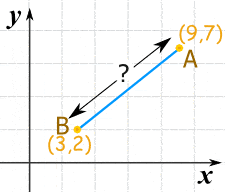
How far is point A from point B?
a)
7.1
b)
7.8
c)
8.7
d)
8.9
138.
Find the midpoint of an imaginary diagonal AC of ABCD.
a)
(1, 3)
b)
(5, 4)
c)
(6, 4)
d)
(0, 4)
139.

Find a point on AB\overline{AB} that is 2/5 the distance from A to B

a)

(7,2)

b)

(8,3)

c)

(4,-3)

d)

(11,8)

140.

Find a point on AB\overline{AB} that is 1/5 the distance from A to B

a)

(5,-1)

b)

(8,3)

c)

(4,-3)

d)

(11,8)

141.
What is the distance of JK, where J(4,3) and K(2, -3)?
a)
√ ̅3̅2̅
b)
40
c)
32
d)
√ ̅4̅0̅
142.

Find a point on AB\overline{AB} that is 4/5 the distance from B to A

a)

(5,-1)

b)

(8,3)

c)

(4,-3)

d)

(11,8)

143.

Find a point on AB\overline{AB} that is 1/5 the distance from B to A

a)

(5,-1)

b)

(8,3)

c)

(4,-3)

d)

(11,8)

144.

Find a point on AB\overline{AB} that is 3/5 the distance from B to A

a)

(5,-1)

b)

(7,2)

c)

(4,-3)

d)

(11,8)