
Font size
 Worksheets
Q2 Science Test Review
Total questions: 50
Worksheet time: 29mins
Which object works by changing chemical energy to mechanical energy?


Which of the following energy transformations take place in a hair dryer?
Electrical to thermal and sound
Chemical to thermal and sound
Electrical to chemical
Radiant to electrical
The Law of Conservation of Energy states that ____.
Energy is neither created nor destroyed
Energy cannot be transformed
Energy can be created
Energy can be destroyed
The energy contained in the nucleus of atoms. _______________energy.
Nuclear
Chemical
Radiant
Electrical
Thermal
Which energy transformation produces electricity without causing pollution?
Burning natural gas in a power plant to transform heat energy into electricity.
Using batteries in a flashlight to transform chemical energy into electricity.
Spinning windmills to transform mechanical energy into electricity.
Using coal in a grill to transform chemical energy into thermal.

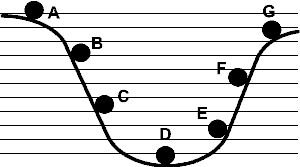
What number in the picture does a roller coaster have the most potential energy?
1
2
3
4
5

This appliance dries clothes primarily by converting —
electrical energy to heat and mechanical energy
mechanical energy to heat and electrical energy
electrical energy to heat and light
mechanical energy to heat and vaporization

A Steam Locomotive uses wood or coal, to create steam from water. This steam moves pistons, and thus, the train. Choose the best energy transformation below for a steam locomotive.
Thermal --> Mechanical --> Chemical (plus heat)
Chemical --> Thermal --> Mechanical (plus heat)
Mechanical --> Chemical --> Thermal (plus heat)
Electrical -> Chemical --> Thermal (plus heat)

What type of heat transfer is happening at "A"?
conduction
convection
radiation

What type of heat transfer is happening at "B"?
conduction
radiation
convection

What type of heat transfer is happening at "C"?
conduction
radaition
convection
Heat will always transfer from the ____ object to the _____ object.
The hottest object to the coolest object.
The coolest object to the hottest object.
The solid object to the liquid object.
The liquid object to the solid object.
Chris leaves chocolate pudding out on the counter which is at "room temperature". What will happen if the pudding is not put back into the refrigerator after several hours?
The pudding will increase temperature, but the counter temperature will remain the same.
The pudding and the counter will become lower temperatures.
The pudding and the counter will become higher temperatures.
The pudding and the counter will become the same temperature.


By pushing the crate up the ramp rather than lifting it to the platform, you are using ________ force, but moving the crate a ____________ distance.
the same amount; greater
more; greater
more; less
less;greater
A man is pushing a heavy crate up an inclined plane (ramp) into the back of semi trailer. What can the man do to make it easier to get the crate up the ramp?
Use gloves
Make the ramp longer
Make the ramp shorter
Pull it instead of push it.

Which of these accurately describes the motion of the toy train?
The toy train speeds up while going forward and then slows down
The toy train slows down while going forward and the moves backwards.
The toy train moves forward at a constant speed , slows down, and then stops.
The toy train moves forward at in increasing speed, stops, and then moves forward.
Four students ran two times around a running path at a local park. Which graph best represents a stop for 10 minutes the student's motion?


Describe the motion in the graph...
Constant speed
stopping
decreasing speed
deceleration
Which graph shows the fastest speed?


Which increase over time or acceleration?


It takes Mrs. Shields 13 hours to drive from Houston to her hometown of St. Louis, which is a distance of 780 miles. What is the average speed of this trip?
(a)
A bus travels 20 km in 30 minutes. What is the average speed of the bus?
20 km/h
30 km/h
40 km/h
50 km/h
Which of the following is a UNIT for speed?
m/s2
m/s
d/t
A golf ball is hit a distance of 400 yards in 20 seconds. What is the speed of the golf ball?
(a)
Define force?
Nonmoving objects on Earth’s surface.
A force that appears whenever two objects touch each other;
opposes motion between two surfaces in contact.
Push/pull on an object; anything that causes the shape or motion of an object to change; forces cause a change in speed and direction.
The force of attraction between objects that is due to mass.
A(n) _________________ force always causes a change in position, speed or direction of an object.
balanced
unbalanced
net
invisible

When an object continues to move in the same direction at the same speed, we consider to the object to have:
balanced forces
unbalanced forces




What type of power plant uses the potential energy of water trapped behind a dam?
nuclear power plant
hydroelectric power plant
solar station
tidal harness
What are fossil fuels?
coal, oil, uranium
oil, natural gas, uranium
coal, oil, natural gas
geothemals, coal, natural gas
What type of power plant uses scraps from farming and waste products to generate electricity?
Hydroelectric Power Plant
Geothermal Power Plant
Biomass Power Plant
Nuclear Power Plant
Uranium atoms are split to create a tremendous amount of energy in a _____ power plant.
biomass
geothermal
nuclear
hydroelectric
Resources that are not able to be reproduced as quickly as they are used are called _____.
renewable resources
replaceable resources
non renewable resources
non replaceable resources
Renewable resources ...
are not replaceable
are used more frequently than non renewables
are never going to run out
going to run out
Why do we tend to use non-renewable resources instead of renewable resources?
Less Expensive
More Energy
All of these
What is a disadvantage of using non-renewable resources?
They have a large carbon footprint.
They can all be used up over time.
They can lead to global warming.
All of these.
Which of the following can be a disadvantage of renewable resources?
They can be intermittent (only available at certain times or in certain places).
They release a lot of CO2 and have a large carbon footprint.
They are renewable and will always be available.
Renewable resources have no disadvantages.

