wayground logo

Free Printable Worksheets

Font size

S
M
L
XL
Worksheets

HA2T Semester 1 Exam Review Mrs. Powers

Total questions: 130

Worksheet time: 11hrs 50mins

Name
Class
Date
1.

Write an expression to represent: "the sum of twice a number and 7"

a)

2n + 7

b)

2 (n + 7)

c)

(2 + n) + 7

d)

2n(7)

e)

2 + n (7)

2.

Write an expression to represent: "-4 increased by the sum of 7 and a number"

a)

-4 + (7 + n)

b)

-4 - (7 + n)

c)

-4(7 + n)

d)

-4 + (7n)

3.

Write an expression to represent: "the product of 2 and a number, increased by 1"

a)

2(n + 1)

b)

2n + 1

c)

2 + n + 1

d)

2 + n(1)

4.

What is the value of 3x2-7

when x=-5

a)

-57

b)

43

5.

Evaluate Expression x=7, y=15, z=8

9y ÷ (2x+1)

a)

5

b)

10

c)

9

d)

19

6.

Evaluate m² + 12q if m = 5 and q = -3

a)

10

b)

-25

c)

-11

d)

13

7.
3y+6+4y-7=-8
a)
y=-1
b)
y=-8
c)
y=1
d)
y=7
8.

(3v+1)+7(6v+6)=37-\left(3v+1\right)+7\left(6v+6\right)=-37  

a)

44  

b)

00  

c)

22  

d)

2-2  

9.

118=5(4+7x)+7-118=-5\left(4+7x\right)+7  

a)

5-5  

b)

9-9  

c)

33  

d)

1-1  

10.
Four times a number increased by  7 is at least 19. 
a)
4x > 19
b)
4x + 7 ≥ 19
c)
4x < 19
d)
4x + 7 ≤ 19
11.
Translate into a correct inequality: Six increased by twice a number is no more than 20.
a)
6x + 2 ≥20
b)
6x + 2 > 20
c)
6 - 2x ≤20
d)
6 + 2x ≤20
12.
Translate:
 4 plus the product of 6 and n is less than 10
a)
4 + 6n 
< 10
b)
4 - 6 + n 
> 10
c)
6m + n 
≠ 5
d)
4 + 6 + n 
≥ 3
13.

x + 2 < -4 or -5x < -15

a)

-6 < x < 3

b)

x < -3 and x > 6

c)

x < -6 or x > 3

d)

No Solution

14.

2 < 3x - 12 < 5

a)

143 < x < 173\frac{14}{3}\ <\ x\ <\ \frac{17}{3}

b)

314 < x < 317\frac{3}{14}\ <\ x\ <\ \frac{3}{17}

c)

4 < x <34\ <\ x\ <3

d)

42 < x < 5142\ <\ x\ <\ 51

15.
Solve:
|x + 4| - 8 > 2
a)
x > 6 and x < 10
b)
x > 6 or x < -14
c)
all real numbers
d)
no solution
16.
Solve.
|2x - 1| = -7
a)
x = -3 or x = 4
b)
all real numbers
c)
x = 3 or x = -3
d)
no solution
17.
Solve.
-5|x - 4| > -20
a)
x < 8 and x > 0
b)
x > 8 or x < 0
c)
all real numbers
d)
no solution
18.
Solve for x
l 2x−1 l +4 = 8 
a)
x = 2.5 and x = -1.5
b)
x = 2 and x = -1
c)
x = -2 and x = 9
d)
No Solution
19.

What has to be done first in order to solve this inequality?

a)

subtract 3 from both sides

b)

distribute the 3

c)

divide both sides by 3

d)

nothing

20.

Which graph represents the solution to the absolute-value inequality:

I 2x - 11 I < 21

a)
b)
c)
d)
21.

Which graph represents the solution to the absolute-value inequality:

I 3x + 9 I > 27

a)
b)
c)
d)
22.

Describe the transformation of the equation below:


y = I x + 3 I

a)

Left 3

b)

Right 3

c)

Up 3

d)

Down 3

23.

What shifts have occurred?

a)

left 1, up 5

b)

left 1, down 5

c)

right 1, up 5

24.

Describe the transformation from the Absolute Value Parent Function.

a)

Stretches more narrow, shifts up 4 units

b)

Stretches more narrow, shifts down 4 units

c)

Compresses wider, shifts down 4 units

25.
What is the equation of the graph below?
a)
f(x ) = I x + 4 I + 2
b)
f(x ) = -I x - 4 I + 2
c)
f(x ) = I x - 4 I + 2
d)
f(x ) = -I x + 4 I + 2
26.
What is the equation of the graph below?
a)
f(x) = I x + 2 I 
b)
f(x) = I x + 2 I +2
c)
f(x) = I x - 2 I +2
d)
f(x) = I x - 2 I 
27.
What is the equation of the absolute value function?
a)
f(x)= 4|x+3|
b)
f(x)= 1/4 |x+3|
c)
f(x)= 1/4 |x - 3|
d)
f(x)= 4|x - 3|
28.
What is the inequality graphed here? 
a)
y ≤ | x + 3 | + 2
b)
y ≥ | x + 3 | + 2
c)
y >  | x - 3 | + 2
d)
y <  | x + 3 | - 2
29.
Which ordered pair is NOT a solution? 
a)
(1, -1)
b)
(-1, 1) 
c)
(2, 2)
d)
(2, -2) 
30.
What is the inequality represented here? 
a)
y < -2| x | + 3
b)
y > 2| x | - 3
c)
y ≤ 2| x | + 3
d)
y ≤ -2 | x | + 3
31.

Which of the following is the vertex form of an absolute value function?

a)

f(x)=kxh+af\left(x\right)=k\left|x-h\right|+a

b)

f(x)=ax+hkf\left(x\right)=a\left|x+h\right|-k

c)

f(x)=axh+kf\left(x\right)=a\left|x-h\right|+k

d)

f(x)=hxk+af\left(x\right)=h\left|x-k\right|+a

32.

What happens when the value of aa  is positive in the equation of an absolute value function?

a)

The graph opens up.

b)

The graph opens down.

c)

The graph gets wider.

d)

The graph gets narrower.

33.

What happens when 0<a<10<\left|a\right|<1  in the equation of an absolute value function?

a)

The graph opens up.

b)

The graph opens down.

c)

The graph gets wider.

d)

The graph gets narrower.

34.

What happens when the value of aa  is negative in the equation of an absolute value function?

a)

The graph opens up.

b)

The graph opens down.

c)

The graph gets wider.

d)

The graph gets narrower.

35.

Find the vertex of the absolute value function: f(x)=12x5+6f\left(x\right)=\frac{1}{2}\left|x-5\right|+6  

a)

(5,6)\left(5,6\right)  

b)

(5,6)\left(-5,6\right)  

c)

(5,6)\left(-5,-6\right)  

d)

(5,6)\left(5,-6\right)  

36.

The mapping below represents all of the points on the graph of the function f. What is the domain of f?

a)

{-4, -1, 0, 2, 7}

b)

{-5, 0, 1, 2, 4}

c)

All Real Numbers

d)

-4 ≤ x ≤ 7

37.

Find the domain of the graph below.

a)

{-4, -2, 0, 2, 3}

b)

{-3, 2, 0, 2, 4,}

c)

All Real Numbers

d)

-3 ≤ x ≤ 4

38.

Find the domain of the following relation R = {(4, 8), (1, 2), (2, 1), (1, 1), (3, 2), (4, 6)}.

a)

{1, 2, 3, 4}

b)

{4, 1, 2, 1, 3, 4}

c)

{1, 2, 6, 8}

d)

{1, 2, 3, 4, 6, 8}

39.

Find the range of the following relation R = {(4, 8), (1, 2), (2, 1), (1, 1), (3, 2), (4, 6)}.

a)

{1, 2, 3, 4}

b)

{4, 1, 2, 1, 3, 4}

c)

{1, 2, 6, 8}

d)

{1, 2, 3, 4, 6, 8}

40.
Find the slope of the line that passes through
(1, -19) and (-2, -7)
a)
-4
b)
4
c)
1/4
d)
-1/4
41.
What is the formula for Point-Slope Form?
a)
y - y1 = m(x - x1)
b)
y = mx + b
c)
y + y1 = m(x + x1)
d)
y = mx - b
42.
Write the equation of the line in Point-Slope form that goes through the point (10,5) and has a slope of -3
a)
y-5=-3(x-10)
b)
y=-3x+35
c)
y+5=-3(x+10)
d)
y=-3x-35
43.

Given y + 6 = 10( x - 9) , what is the point used to write this equation?

a)

(10, 9)

b)

(6, -9)

c)

(-6, 9)

d)

(9, -6)

44.
y - 2 = 3(x + 1)
Convert to Slope Intercept Form
a)
y = 3x
b)
y = 3x + 1
c)
y = 3x + 3
d)
y = 3x + 5
45.
point (5, 3)
Slope  2
Write in point slope form and then convert to slope intercept form
a)
y = 2x - 7
b)
y = 2x + 3
c)
y  = 2x + 13
d)
y - 3 = 2(x - 5)
46.

Are the two linear equations parallel, perpendicular, or neither?

a)

Parallel

b)

Perpendicular

c)

Neither

47.
Write an equation for a line parallel to the line
y = 1/3x - 4 through (-3, 2)
a)
y = 2/3x +3
b)
y = -1/3x + 3
c)
y = 1/3x + 3
d)
y = -5/3x + 3
48.
Slopes of parallel lines are...
a)
opposite reciprocals.
b)
opposites.
c)
identical.
d)
always 7.
49.
Slopes of perpendicular lines are...
a)
opposite reciprocals.
b)
opposites.
c)
identical.
d)
always 7.
50.
Given the line 2x-3y=9, write the equation of a line perpendicular to it that passes through the point (4, -1)
a)
y = -3/2x - 7
b)
y = 2/3x + 4
c)
y = 2/3x - 1
d)
y = -3/2x + 5
51.

Write the equation for a graph that is vertically compressed by a factor of 2/5 and shifted up 6.

a)

y=6|x|-2/5

b)

y=2/5|x|+6

c)

y=2/5|x+6|

d)

y=2/5|x-6|

52.

Write the absolute value equation given the following transformations:
Reflection over the x-axis
Horizontal shift right 2 units
Vertical shift down 7 units

a)

y=x+27y=-\left|x+2\right|-7  

b)

y=x27y=\left|x-2\right|-7  

c)

y=x27y=-\left|x-2\right|-7  

d)

y=x+27y=\left|x+2\right|-7  

53.
Describe the transformations of the absolute value equation.
a)
Reflects over x-axis, compresses wider, shifts right 1 unit
b)
Reflects over x-axis, compresses wider, shifts up 1 unit
c)
Reflects over x-axis, stretches more narrow, shifts right 1 unit
d)
Reflects over x-axis, stretches more narrow, shifts up 1 unit
54.

What is the equation of this graph?

a)

y=2|x-3|+1

b)

y=2|x-1|+3

c)

y=-2|x+1|+3

d)

y=-2|x-1|+3

55.
Parallel Lines never intersect because...
a)
they have the same slopes. 
b)
they have the same y-intercept.
c)
they have different slopes.
d)
they have different y-intercepts. 
56.
This system has _____ solutions
a)
0
b)
1
c)
2
d)
Infinitely many
57.
Solve by elimination:
4x+9y=28
-4x-y=-28
a)
(-7,0)
b)
(6,0)
c)
(-6,0)
d)
(7,0)
58.
Solve the system by multiplication.
3x + 2y = 16
7x + y = 19
a)
(-2,5)
b)
(-2,-5)
c)
(2,-5)
d)
(2,5)
59.
When you graph the exact same equation twice,
a)
you will have no solution. 
b)
you will have one solution.
c)
you will have infinite solutions. 
d)
you will graph a giraffe. 
60.
If a system of linear equations has one solution, what does this mean about the two lines? 
a)
Parallel lines
b)
the same line 
c)
Intersecting lines
61.
Solve the system of equations by substitution.
y = -4x + 5
y =  3x - 16
a)
(-3, -25)
b)
(3,-7)
c)
(11, 17)
d)
(21, 47)
62.
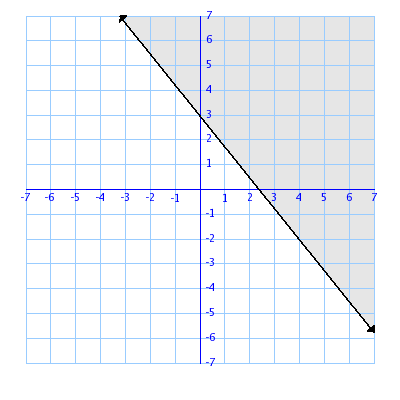
Which of the following equations match the given graph?
a)
x ≥ -1
b)
x ≤ -1
c)
x > -1
d)
x < -1
63.
Consider the function y < 2x+3. Which is true?
a)
The line would be solid with shading above.
b)
The line would be dashed with shading above.
c)
The line would be solid with shading below.
d)
The line would be dashed with shading below.
64.

Which of the following equations match the given graph?

a)


y54x+3y\le-\frac{5}{4}x+3

b)

y54x+3y\ge-\frac{5}{4}x+3

c)

y<45x+3y<-\frac{4}{5}x+3

d)

y>54x+3y>-\frac{5}{4}x+3

65.
Solid or dashed line?  
Y ≥
a)
Solid
b)
Dashed
66.
a)
≤ -2x - 1
b)
y ≥ -2x - 1
c)
y ≤ 2x - 1
d)
y ≥ 2x - 1
67.
Select the correct graph for each inequality.
a)
A
b)
B
c)
C
d)
D
68.
Which system of inequalities matches the graph?
a)
y > 2x - 4
y < 2
b)
y < 2x - 4
y < 2
c)
y > 2x - 4
<  2 
d)
y < 2x - 4
<   -2
69.
Match the system to the graph (solution set is on the left)
a)
y ≤ 3x   and  y ≤ -2x + 4
b)
y > 3x   and  y > -2x + 4
c)
y < 3x   and  y > -2x + 3
d)
y > 3x   and  y < -2x + 4
70.
Which system of inequalities matches the graph?
a)
y > 2x - 4
y < 2
b)
y < 2x - 4
y < 2
c)
y > 2x - 4
<  2 
d)
y < 2x - 4
<   -2
71.

Fill in the blanks with the correct inequality symbol.

a)

\le
\le

b)

<<
<<

c)

>>
<<

72.

Fill in the blanks with the correct inequality symbols.

a)

<<
>>

b)

\le
>>

c)

<<
\le

73.

Which system of inequalities would produce the following graph?

a)

y>x3+4       y>-\left|x-3\right|+4\ \ \ \ \ \ \ yx3y\ge\left|x-3\right|

b)

y<x3+4        y<-\left|x-3\right|+4\ \ \ \ \ \ \ \ yx3y\le\left|x-3\right|

c)

y>x3+4        y>\left|x-3\right|+4\ \ \ \ \ \ \ \ yx+3y\ge\left|x\right|+3

74.
Solve the system. 
a)
(5, -6, 3)
b)
(2, 3, -1)
c)
(-4, 2, 5)
d)
No Solution
75.
Solve the system of equations: 
a)
( -2, 3, -3)
b)
None of these
c)
( -2, -3, 3)
d)
( -3, 3, -2)
76.
If a system of equations has no solution, what does the graph look like? 
a)
intersecting lines
b)
parallel lines
c)
same lines
77.

A system of equations that has a least one solution is

a)

Consistent

b)

inconsistent

c)

dependent

d)

independent

78.

A consistent system that has infinitely many solutions is

a)

dependent

b)

consistent

c)

independent

d)

inconsistent

79.
a)
Consistent : Unique solution
b)
Consistent: Many Solutions 
c)
Inconsistent: No solution 
d)
None of the above 
80.

If a system of linear equations is consistent and independent, the lines are...

a)

Parallel lines

b)

The same line

c)

Intersecting lines

81.
Standard form of a quadratic equation
a)
y=x²
b)
y=ax²+bx+c
c)
y=mx+b
d)
y=x
82.
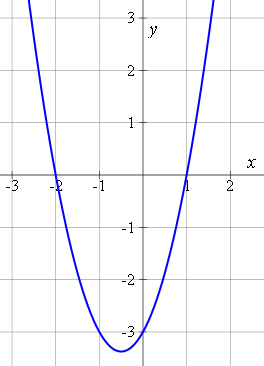
Does this parabola have a maximum or minimum?
a)
Maximum
b)
Minimum
83.
What are the x- intercepts?
a)
x= 0 and x= -4
b)
x= 0 and x= 4
c)
y= 0
d)
x= 2
84.
The formula x = -b/2a is used to find
a)
the roots
b)
the x-value of the vertex
c)
the y-intercept
d)
the axis of symmetry
85.
What is the vertex of the quadratic function:
y = x2 - 6x + 11?
a)
(3,2)
b)
(-3,-2)
c)
(-3,2)
d)
(3,-2)
86.
When a parabola opens downward the vertex is
a)
a minimum
b)
a maximum
c)
a vertex
d)
a parabola
87.

Does the equation Up or or down?

Y = -3x2 +7x - 2

a)

up

b)

down

88.

Which of the following represents the standard form of the quadratic function?

a)

ax2 + bx + c = 0

b)

y = a(x - h)2

c)

y = ax2 + bx + c

d)

y = a(x - h)2 + k

89.

What is the value of h when writing the quadratic function

y = x2 + 10x + 21 in vertex form?

a)

-5

b)

-10

c)

-20

d)

-25

90.

What are the binomial factors of this perfect square trinomial

y = x2 - 12x + 36?

a)

(x + 6)(x - 6)

b)

(x + 3)(x + 12)

c)

(x - 3)(x -12)

d)

(x - 6)(x - 6)

91.

Which of the following functions represents the vertex form of

y = x2 + 16x + 31?

a)

y = (x + 8)2 - 33

b)

y = (x + 8)2 + 95

c)

y = (x - 8)2 - 33

d)

y = (x - 8)2 - 95

92.
What piece of information does h identify in the following equation?
y=a(x-h)2+k
a)
y value of the vertex
b)
Axis of Symmetry
c)
Direction (facing up or down)
d)
x-intercept
93.
If given the equation y = 3(x + 5)2 - 4, what is the vertex of the parabola?
a)
(5, -4)
b)
(-5, -4)
c)
(-15, -4)
d)
(15, -4)
94.
What is the axis of symmetry for the following quadratic function: f(x)=1/2(x-4)2+3
a)
x=4
b)
x=-4
c)
x=1/2
d)
x=3
95.
Which of the following is the correct equation for the given graph?
a)
f(x) = (x - 2)2 - 1
b)
f(x) = (x + 2)2 - 1
c)
f(x) = -(x + 2)2 - 1
d)
f(x) = -(x - 2)2 - 1
96.

f(x)=(x4)2+1f\left(x\right)=-\left(x-4\right)^2+1  

Choose the correct graph of the equation.

a)
b)
c)
d)
97.
What are the zeros for the function
f(x) = (x + 7)(x + 5)
a)
(7 , 0) and (5 , 0)
b)
(0 , 7) and (0 , 5)
c)
(-7 , 0) and (-5 , 0)
d)
(7 , 0) and (5 , 0)
98.
What is the y-intercept of 
f(x)=2x2 + 4x + 6
a)
(6 , 0)
b)
(-6 , 0)
c)
(0, -6)
d)
(0 , 6)
99.
What form is the quadratic equation written in?
y = (x - 2)(x + 4)
a)
Factored
b)
Standard
c)
Vertex
d)
Descending Polynomial
100.
What can we find easily in standard form?
a)
vertex
b)
zeros/x-intercepts
c)
y-intercept
101.
What can we find easily in factored form?
a)
y-intercept
b)
vertex
c)
zeros/x-intercepts
102.
Which of the following equations shows the vertex form of a quadratic?
a)
x = -b/2a
b)
x = (-b ±√b2 - 4ac)/2a
c)
y = ax2 + bx + c
d)
y = a(x - h)2 + k
103.
What is the green dashed line called?
a)
roots or x-intercepts
b)
parabola
c)
axis  or line of symmetry
d)
line of dashes
104.
What is the equation for axis of symmetry?
a)
y=3
b)
x=3
c)
x=5
d)
x=1
105.
Determine the values of
a, b, and c for
the quadratic equation: 
4x2 – 8x = 3
a)
a = 4, b = -8, c = 3
b)
a = 4, b =-8, c =-3
c)
a = 4, b = 8, c = 3
d)
a = 4, b = 8, c = -3
106.
Identify the domain and range of the function.
a)
Domain: -6 ≤ x ≤ 2
Range: -3 ≤ y ≤ 5
b)
Domain: All real number
Range: -3 ≤ y ≤ 5
c)
Domain: All real numbers
Range: y ≥ -3
d)
Domain: All real number
Range: y ≤ -3
107.
What is the range for the function below? 
a)
y ≤ 4
b)
y ≥ 4
c)
All real numbers
d)
-3 ≤ y ≤ 1
108.
What is the domain of the graph?
a)
All real numbers
b)
To infinity and beyond
c)
y ≥ 0
d)
x ≥ 0
109.

y=5(x+2)210y=-5(x+2)^2-10  
Convert the equation from vertex form to standard form.

a)

y = -5x2 - 20x - 30

b)

y = -5x2 - 4x - 10

c)

y = 25x2 + 100x + 90

d)

y = 25x2 - 10x - 30

110.


y=4(x+2)28y=4(x+2)^2-8

Convert the equation from vertex form to standard form. 

a)

y=4x2+16x+8y=4x^2+16x+8  

b)

y=4x2+16x+16y=4x^2+16x+16  

c)

y=16x2+64x8y=16x^2+64x-8  

d)

y=16x2+256x+8y=16x^2+256x+8  

111.
Graph the quadratic.
a)
A
b)
B
c)
C
d)
D
112.
Graph the quadratic.
a)
A
b)
B
c)
C
d)
D
113.

Identify the maxiumum or minimum value of the graph.

a)

Minimum: y=1

b)

Maximum: y=1

c)

Minimum: x=-2

d)

Maximum: x=-2

114.

Identify the range of the graph.

a)

x2x\ge-2

b)

y1y\ge1

c)

x2x\le-2

d)

y1y\le1

115.

Identify the domain of

f(x)=x24x+2f\left(x\right)=-x^2-4x+2  

a)

All real numbers

b)

x0x\ge0  

c)

x6x\le6  

d)

x2x\ge-2  

116.

Identify the range of

f(x)=x24x+2f\left(x\right)=-x^2-4x+2  

a)

All real numbers

b)

y0y\le0  

c)

y6y\le6  

d)

y2y\le-2  

117.

What is the vertex and axis of symmetry of f(x) = - x2 + 6x - 2

a)

Vertex: (3,7) AOS: x = 3

b)

Vertex: (3,7) AOS: y = 3

c)

Vertex: (-2,6) AOS: x = -2

d)

Vertex: (2,6) AOS: x = 2

118.
Factor completely 
2c2 + 4c - 84
a)
(c-6)(2c+14)
b)
(c+7)(2x-12)
c)
(c-4)(2c+21)
d)
2(c+7)(c-6)
119.
Factor Completely: 
2k2-14k-60
a)
2(k-10)(k-3)
b)
Not Factorable
c)
(k-5)(k+9)
d)
2(k-10)(k+3)
120.

Factor Completely.
4x2+24x644x^2+24x-64  

a)

4(x+8)(x2)4\left(x+8\right)\left(x-2\right)  

b)

4(x2+6x16)4(x^2+6x-16)  

c)

4(x2+24x16)4\left(x^2+24x-16\right)  

d)

4(x8)(x+2)4\left(x-8\right)\left(x+2\right)  

121.

25x219625x^2-196  

a)

(5x+14)2\left(5x+14\right)^2  

b)

(5x14)2\left(5x-14\right)^2  

c)

(5x+14)(5x14)\left(5x+14\right)\left(5x-14\right)  

d)

(25x+196)(25x196)\left(25x+196\right)\left(25x-196\right)  

122.
Factor Completely: 
 x2+13x+40
a)
(x+5)(x+8)
b)
5x(x+3)
c)
3x(x+6)
d)
x(x-4)
123.

x2 - 25

a)

( x + 5 ) ( x - 5 )

b)

( x - 5 ) ( x - 5 )

c)

( x + 5 ) ( x + 5 )

d)

Unfactorable

124.
Is this a perfect square trinomial?
x2 + 16x + 64
a)
Yes
b)
No
125.
Is this a perfect square trinomial?
x2 + 18x + 9
a)
Yes
b)
No
126.
Factor: x2 + 24x + 144
a)
(x + 12)2
b)
(x + 9)2
c)
(x + 15)2
d)
(x + 13)2
127.

b2+8b33=0b^2+8b-33=0  

a)

{8,33}\left\{8,-33\right\}  

b)

{3,11}\left\{3,-11\right\}  

c)

{3,11}\left\{3,11\right\}  

d)

{11,3}\left\{-11,-3\right\}  

128.

n2+3n=0n^2+3n=0  

a)

{3,0}\left\{-3,0\right\}  

b)

{3,0}\left\{3,0\right\}  

c)

No Real Solution

d)

{3,1}\left\{-3,-1\right\}  

129.

x2100=0x^2-100=0  

a)

{25,4}\left\{25,4\right\}  

b)

{50,2}\left\{-50,2\right\}  

c)

{10,10}\left\{-10,10\right\}  

d)

{0,100}\left\{0,100\right\}  

130.

x224x+114=19x^2-24x+114=19  

a)

{10,14}\left\{10,14\right\}  

b)

{5,19}\left\{-5,-19\right\}  

c)

{24, 19}\left\{24,\ 19\right\}  

d)

{5,19}\left\{5,19\right\}