
 Worksheets
Topic 12 Assessment Review
Total questions: 128
Worksheet time: 6hrs 30mins
Select ALL the true statements about an image after a dilation.
The image is a different shape than the preimage.
The image is a different size than the preimage.
The image has the same angle measures as the preimage.
The image is similar to the preimage.
The image has the same side lengths as the preimage.

Triangle PQR is the image of triangle JKL after a dilation. Is the dilation an enlargement or a reduction? Explain.
Enlargement, because the image is larger than the original figure.
Enlargement, because the image is smaller than the original figure.
Reduction, because the image is smaller than the original figure.
Reduction, because the image is larger than the original figure.

Rajesh is making pennants in preparation for a school soccer game. He wants the pennants to be similar triangles. Which of these triangles could he use for the pennants?
QRS and TVW
QRS and XYZ
TVW and JKL
TVW and XYZ

Are ABC and DEF similar?
Yes
No

Are ABC and LMN similar?
Yes
No

Are LMN and DEF similar?
Yes
No

Figure D´E´F´G´ is a dilation with center (0, 0) of figure DEFG. What is the scale factor?
(a)

A sequence of transformations is required to map ΔPQR onto ΔP’Q’R’. Which is a possible step?
A dilation with scale factor 1
A dilation with scale factor 2
A dilation with scale factor 3
A dilation with scale factor 4

A sequence of transformations is required to map ΔPQR onto ΔP’Q’R’. Which is a possible step?
Reflection across the line x=1
Reflection across the y-axis
Reflection across the x-axis
Reflection across the line y=1

Find the image of ΔABC after a dilation with center (0, 0) and a scale factor of 3. What is the ordered pair for A'?
(1, 1)
(3, 3)
(5, 5)
(6, 6)

Triangle DEF is similar to triangle ABC. What is a sequence of transformations that maps triangle ABC to triangle DEF?
Reflection then rotation
Rotation then dilation with scale factor of 2
Rotation then dilation with scale factor of 0.5
Rotation then translation
Select ALL the true statements about an image after a dilation.
The image is a different shape than the preimage.
The image is a different size than the preimage.
The image has the same angle measures as the preimage.
The image is similar to the preimage.
The image has the same side lengths as the preimage.
Triangle PQR is the image of triangle JKL after a dilation. Is the dilation an enlargement or a reduction? Explain.
Enlargement, because the image is larger than the original figure.
Enlargement, because the image is smaller than the original figure.
Reduction, because the image is smaller than the original figure.
Reduction, because the image is larger than the original figure.
Rajesh is making pennants in preparation for a school soccer game. He wants the pennants to be similar triangles. Which of these triangles could he use for the pennants?
QRS and TVW
QRS and XYZ
TVW and JKL
TVW and XYZ
Are ABC and DEF similar?
Yes
No
Are ABC and LMN similar?
Yes
No
Are LMN and DEF similar?
Yes
No
Figure D´E´F´G´ is a dilation with center (0, 0) of figure DEFG. What is the scale factor?
(a)
A sequence of transformations is required to map ΔPQR onto ΔP’Q’R’. Which is a possible step?
A dilation with scale factor 1
A dilation with scale factor 2
A dilation with scale factor 3
A dilation with scale factor 4
A sequence of transformations is required to map ΔPQR onto ΔP’Q’R’. Which is a possible step?
Reflection across the line x=1
Reflection across the y-axis
Reflection across the x-axis
Reflection across the line y=1
Find the image of ΔABC after a dilation with center (0, 0) and a scale factor of 3. What is the ordered pair for A'?
(1, 1)
(3, 3)
(5, 5)
(6, 6)
Triangle DEF is similar to triangle ABC. What is a sequence of transformations that maps triangle ABC to triangle DEF?
Reflection then rotation
Rotation then dilation with scale factor of 2
Rotation then dilation with scale factor of 0.5
Rotation then translation
Under a dilation, which of the following scale factor will result in a congruent image? Select all that apply.
-1
A dilation produces a similar figure. If two shapes are similar then: (select all that apply)
corresponding angles are congruent
corresponding angles are proportional
corresponding sides are congruent
corresponding sides are proportional.


Are the following similar? Why or why not?
Yes
No, the corresponding angles are not equal.
No, the ratios of the corresponding sides are not proportional.
Which of the following are Dilations? Select all that apply.
(x, y) → (4x, 5y)


7
12
6
4
Under a dilation, which of the following scale factor will result in a congruent image? Select all that apply.
-1
A dilation produces a similar figure. If two shapes are similar then: (select all that apply)
corresponding angles are congruent
corresponding angles are proportional
corresponding sides are congruent
corresponding sides are proportional.
Are the following similar? Why or why not?
Yes
No, the corresponding angles are not equal.
No, the ratios of the corresponding sides are not proportional.
Which of the following are Dilations? Select all that apply.
(x, y) → (4x, 5y)

Solve the proportion. Type only the value of q. So if the answer is q=5 type 5


7
12
6
4
What is Dilation?
Dilation means to enlarge or reduce a shape
Dilation means to flip over a line
Dilation means two figures that look alike
Dilation means to make a shape smaller
A triangle has vertices with coordinates A(2,0), B(3, -1) and C(-2,-5). If the triangle is dilated by a scale factor of 3 with the origin as the center of dilation, what are the coordinates of C'?
(1,-2)
(-6,-15)
(-2/3,-5/3)
(-5,-8)

Are these two figures congruent, similar or neither?
Congruent
Neither
Similar
State the coordinate of the image of point B (-10,-6) after a dilation with a scale factor of 1/2.
(5,3)
(20,12)
(-20,-12)
(-5,-3)

Choose the correct scale factor:
2.5
1.5
3.5
4
If two figures are similar, the corresponding angles are...
Congruent
Supplementary
Proportional
Different

The two triangles are similar. Solve for X.

Tell whether the two figures are congruent or similar.
Congruent, because their sides are the same.
Congruent, because their sides are proportional.
Similar, because their sides are the same.
Similar, because their sides are proportional.
They are not congruent or similar.

Tell whether the two figures are congruent or similar.
Congruent, because their sides are the same.
Congruent, because their sides are proportional.
Similar, because their sides are the same.
Similar, because their sides are proportional.
They are neither congruent or similar.

A ~ B. What is the scale factor of the dilation of A to B?
34
43
3
4
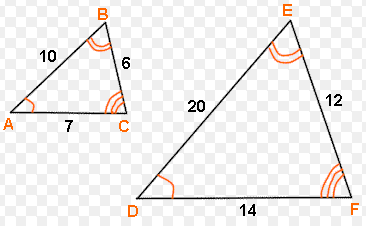

ABC ~ XYZ. What is the scale factor of the dilation of ABC to XYZ?
32
23
2
3


Find the slope of the line using slope triangles
A
B
C
D

Find the slope of the line using slope triangles
A
B
C
D

Find the slope of the line using slope triangles
A
B
C
D

Find the slope of the line using slope triangles
A
B
C
D

Find the slope of the line using slope triangles
A
B
C
D


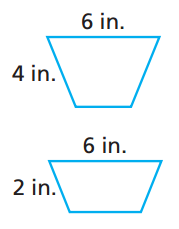
A dilation produces a similar figure
True
False
When the scale factor of a dilation is less than one, the dilation is a reduction (gets smaller).
True
False
An image is dilated at a scale factor of 1.5. This means the dilation is an enlargement and the dilated image will be bigger.
True
False


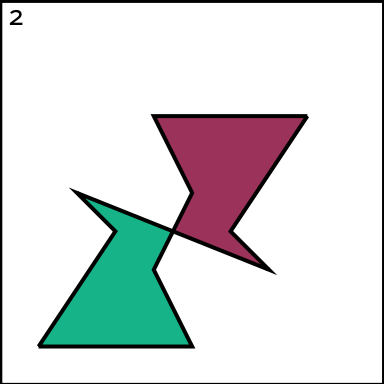
What transformation is this?
Translation
Reflection
Rotation
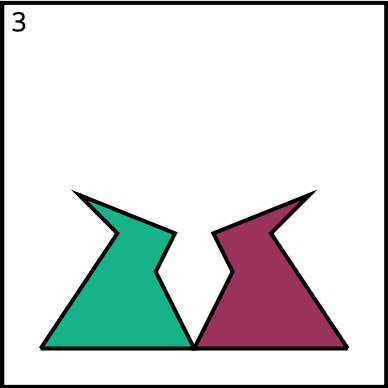
What transformation is this?
Reflection
Translation
Rotation

Identify the correct picture which represents a 90o clockwise rotation about the origin.


A dilation produces a similar figure
True
False
When the scale factor of a dilation is less than one, the dilation is a reduction (gets smaller).
True
False
An image is dilated at a scale factor of 1.5. This means the dilation is an enlargement and the dilated image will be bigger.
True
False
What transformation is this?
Translation
Reflection
Rotation
What transformation is this?
Reflection
Translation
Rotation
Identify the correct picture which represents a 90o clockwise rotation about the origin.

AC ∥ ____
LK
LJ
JK
The segment is not parallel to any other segment in the diagram.
AB ∥ ____
LK
LJ
JK
The segment is not parallel to any other segment in the diagram.
BC = ______
4
5
8
10
What is the perimeter of ΔABC ?
13
14
26
Cannot be determined from the information given.

If AB = 22, what is YZ?
22
11
44
Impossible to determine from the information given.
If XZ = 22, what is BC?
22
11
44
Impossible to determine from the information given.

What is the value of x?
17
34
68
Impossible to determine from the information given.

What is the value of x?
1
2
4
Impossible to determine from the information given.

What is the value of x?
25.5
43
78
Impossible to determine from the information given.

What is the value of x?
3
6
9
Impossible to determine from the information given.

What is the value of x?
-4
10
20
Impossible to determine from the information given.
m∠A = 52o , what is m∠BXY?
52
128
104
26
Which angle is congruent to ∠CYZ ?
∠B
∠A
∠ZYB
∠AXZ
m∠XZA =40°, what is m∠C ?
40
80
20
140
m∠A=32°, what is m∠AXY ?
32
16
64
148

