Wayground logo

Free Printable Worksheets

Font size

S
M
L
XL
Worksheets

SEMESTER 1 FINAL REVIEW

Total questions: 83

Worksheet time: 3hrs 43mins

Name
Class
Date
1.
A line that contains point M.
a)
Line q
b)
Line p
c)
Line r
d)
Line NH
2.

Give another name for line k.

a)

Line BC

b)

Line BCF

c)

Line ED

d)

Line k is the only name, there isn't another name.

3.
A plane containing point A.
a)
Plane DEA
b)
Plane k
c)
Plane CDF
d)
Plane F
4.
Name 3 coplaner points.
a)
ZRW
b)
VZX
c)
VWX
d)
WYZ
5.

Find the midpoint of the line segment with the given endpoints (-2,-6) and (8,8)

a)

(-4,8)

b)

(18,22)

c)

(3,1)

d)

(-5,-7)

6.

Find the midpoint of the line segment with the given endpoints (3,9) and (5,9)

a)

(-1,0)

b)

(4,9)

c)

(6,7)

d)

(7,9)

7.

Find the midpoint of the line segment with the given endpoints (1,1) and (9,9)

a)

(5,5)

b)

(1,9)

c)

(17,17)

d)

(-4,-4)

8.

Find the measure of the angle.

a)

10 degrees

b)

43 degrees

c)

80 degrees

d)

37 degrees

9.

Find the measure of the angle.

a)

100 degrees

b)

80 degrees

c)

90 degrees

d)

10 degrees

10.

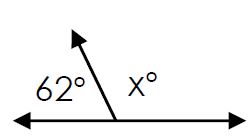
Find the measure of the angle.

a)

106 degrees

b)

100 degrees

c)

78 degrees

d)

160 degrees

11.

What is the measure of <QRT?

a)

160 degrees

b)

20 degrees

c)

85 degrees

d)

2 degrees

12.

What is the measure of <FGJ?

a)

140 degrees

b)

160 degrees

c)

106 degrees

d)

20 degrees

13.
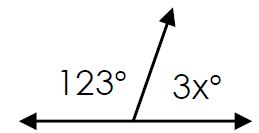
Find the value of x.
a)
15
b)
16
c)
18
d)
19
14.
What is an example of a pair of complementary angles?
a)
13° and 45°
b)
10° and 170°
c)
81° and 9°
d)
90° and 3°
15.
What kind of angles are shown?
a)
complementary
b)
supplementary
c)
adjacent
d)
corresponding
16.
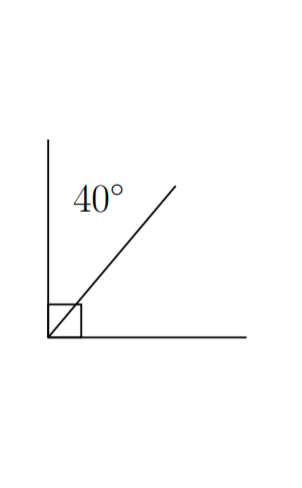
Find the missing angle.
a)
60°
b)
70°
c)
50°
d)
140
17.
What are supplementary angles?
a)
Angles that add up to 180°
b)
Angles that add up to 90°
c)
Angles that are equal to each other
d)
Angles that are opposite of each other when lines intersect
18.
What are complementary angles?
a)
Angles that add up to 180°
b)
Angles that add up to 90°
c)
Angles that are equal to each other
d)
Angles that are opposite of each other when lines intersect.
19.
a)
x = 118
b)
x = 108
c)
x = 28
d)
x = 58
20.
Using the statements:
If it is Friday, then I will get paid.
It is Friday.
What is the conclusion?
a)
It is not Friday
b)
It is Friday
c)
I will not get paid
d)
I will get paid
21.
Using deductive reasoning, which of the following completes the statement to form a valid conclusion?
If it is snowing heavily, then school will be canceled.
If school is canceled, the big test will not be given today.
It is snowing heavily, then...
a)
Look out for the snowplows while driving to school.
b)
The big test will not be given today.
c)
The roads will be hard to drive on.
d)
You should call the school to see if school is canceled.
22.
What conclusion can be drawn from the following statements?
If the sun is shining, then it is a beautiful day.  
If it is a beautiful day, then we will have a picnic.
a)
If the sun is shining, then it is a beautiful day.
b)
If it is a beautiful day, then the sun is shining.
c)
If the sun is shining, then we will go on a picnic.
d)
If we go on a picnic, then the sun is shining.
23.
Inductive Reasoning means...
a)
Guessing
b)
Testing and observing patterns to make conjectures
c)
Explaining why
d)
Ura nok seblu!
24.
What is the next term in the sequence:
1, 1, 2, 3, 5, 8, 13, ...
a)
17
b)
20
c)
21
d)
24
25.
What are the next 2 numbers of this pattern?
23, 27, 31, 35, ___, ___
a)
37, 39
b)
40, 45
c)
39, 43
d)
38, 41
26.
What is the rule for this pattern?
32,36,40,44
a)
add 4
b)
multiply 2
c)
subtract 4
d)
divide by 2
27.
Identify the hypothesis and conclusion of the conditional statement:
If you give me twenty dollars, then I will be your best friend.
a)
Hypothesis: I will be your best friend
Conclusion: you give me twenty dollars
b)
Hypothesis: you give me twenty dollars
Conclusion: I will be your best friend
c)
Hypothesis: if you have to pay for friends
Conclusion: then you probably should reevaluate your life
d)
Hypothesis: you will not have to pay twenty dollars
Conclusion: if you have lots of friends
28.
If something is an angle, then it is acute. What is an appropriate counterexample?
a)
70⁰
b)
45⁰
c)
120⁰
d)
True. There is no counterexample.
29.
Given, "If angles are congruent, then the measures of the angles are equal." Identify the contrapositive.
a)
If the measures of the angles are equal, then the angles are congruent.
b)
If angles are not congruent, then the measures of the angles are not equal.
c)
If the measures of the angles are not equal, then the angles are not congruent.
d)
If the angles are not congruent, then the measure of the angles are equal.
30.
Which of the following is the inverse to the statement: 
"If you diet and exercise, then you will lose weight."
a)
If you don't diet and exercise, then you will not lose weight.
b)
If you don't diet and exercise, then you will lose weight.
c)
If you lose weight, then you dieted and exercised.
d)
If you don't lose weight, then you diet and exercise. 
31.
What is this?
a)
Conditional Statement
b)
Inverse
c)
Converse
d)
THIS IS A GEOMETRY CLASS!!! GIVE ME NUMBERS!
32.
To write the converse you negate both the hypothesis and the conclusion.
a)
False
b)
True
33.
Draw a conclusion from the statement.
If you live in Orlando, then you live in Florida.
You live in Orlando.
a)
You live in Disney Land
b)
You are an old person.
c)
You live in Florida
d)
You live in Orlando
34.
Draw a conclusion from the statement.
If you are at least 25 year old, then you can rent a car.
You can rent a car
a)
You are at least 25 years old
b)
You can rent a car
c)
You can go on a road trip
d)
Invalid
35.
Use the Law of Detachment to draw a conclusion from the two given statements. If not possible, write not possible.
Statement 1: If I study for one hour each day, then I will score well on the exam
Statement 2: I will score well on the exam
a)
 I study for 1 hour each day.
b)
I do not study for 1 hour each day
c)
If I do well on the exam, I studied for 1 hour each day.
d)
not possible
36.
Use the law of syllogism to draw a conclusion from the two given statements:
Statement 1: If you exercise regularly, then you have a healthy body
Statement 2: If you have a healthy body, then you have more energy
a)
You have more energy
b)
If you exercise regularly, then you have more energy
c)
You have a healthy body
d)
If you do not have a healthy body, then you do not exercise regularly
37.

Which law of logic is this?

If I clean the bathroom, then I don't have to do the dishes.

I cleaned the bathroom.

Therefore, I don't have to do the dishes.

a)

Law of Detachment

b)

Law of Syllogism

c)

Law of Contrapositive

d)

None

38.
Identify the property you would use to solve this equation:
4x = 72
a)
Addition Property of Equality
b)
Subtraction Property of Equality
c)
Multiplication Property of Equality
d)
Division Property of Equality
39.
Name the first property you will use to solve this equation:
3(x – 7) = 42
a)
Multiplication Property of Equality
b)
Commutative property
c)
Associative Property
d)
Distributive Property
40.
If a = b, then a may be replaced by b in any expression.
a)
Transitive Property         
b)
Reflexive Property             
c)
Symmetric Property 
d)
Substitution Property
41.
For any numbers a, b, and c, if a = b and b = c, then a = c.
a)
Transitive Property         
b)
Symmetric Property
c)
Reflexive Property
d)
Substitution Property
42.
For any numbers a and b, if a = b, then b = a.
a)
Transitive Property         
b)
Reflexive Property 
c)
Symmetric Property   
d)
Substitution Property
43.
Name the property described:
∠B≅∠B
a)
Reflexive
b)
Symmetric
c)
Transitive
d)
Addition
44.
Name the property described:
If PQ = RS then RS = PQ
a)
Reflexive
b)
Symmetric
c)
Transitive
d)
Addition
45.
Name the property described:
If ∠A≅∠B and ∠B≅∠C, then ∠A≅∠C
a)
Reflexive
b)
Symmetric
c)
Transitive
d)
Addition
46.
Name the property.
<A≅<A
a)
Transitive Property of Congruence
b)
Symmetric Property of Equality
c)
Reflexive Property of Congruence
d)
Symmetric Property of Congruence
47.
If 2x - 5 = 10, then 2x = 15.
a)
Subtraction Property of Equality
b)
Addition Property of Equality
c)
Division Property of Equality
d)
Substitution
48.

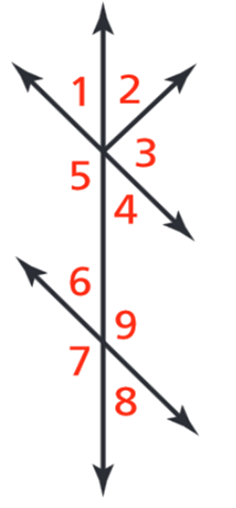
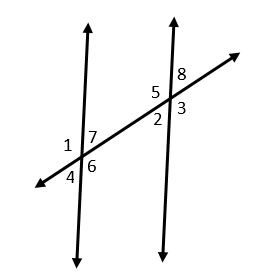
 ∠1\angle1  and  ∠2\angle2  are ___.  

a)

Alternate Interior Angles

b)

Alternate Exterior Angles

c)

Same-side Interior Angles

d)

Corresponding Angles

e)

None of these

49.
Vertical angles are always
a)
acute
b)
total 180 degrees
c)
congruent (equal measures)
d)
adjacent angles
50.

Which angle is a vertical angle to with ∠7\angle7  ?

a)

 ∠1\angle1  

b)

 ∠5\angle5  

c)

 ∠3\angle3  

d)

 ∠6\angle6  

e)

 ∠9\angle9  

51.

2) Given the following two parallel lines cut by a transversal.


Which pair of angles represents corresponding angles?

a)

 ∠1\angle1  and  ∠6\angle6  

b)

 ∠6\angle6  and ∠5\angle5  

c)

 ∠7\angle7  and ∠8\angle8  

d)

 ∠4\angle4  and ∠8\angle8  

52.

3) Given the following two parallel lines cut by a transversal.


Which pair of angles represents alternate interior angles?

a)

 ∠3\angle3  and ∠8\angle8  

b)

 ∠7\angle7  and ∠2\angle2  

c)

 ∠7\angle7  and ∠8\angle8  

d)

 ∠4\angle4  and ∠8\angle8  

53.

4) Given the following two parallel lines cut by a transversal.


Which pair of angles represents alternate exterior angles?

a)

 ∠4\angle4  and ∠8\angle8  

b)

 ∠7\angle7  and ∠5\angle5  

c)

 ∠1\angle1  and  ∠2\angle2  

d)

 ∠6\angle6  and  ∠5\angle5  

54.

5) True or False.

If the following parallel lines are cut by a transversal, would 
 ∠2\angle2  and  ∠6\angle6   be corresponding?

a)

True

b)

False

55.

7) Given the following two parallel lines that have been cut by a transversal.


True or False,  ∠6\angle6  and  ∠4\angle4  are vertical angles?

a)

True

b)

False

56.

11) Given the two parallel lines cut by a transversal,

What is the measure of ∠4\angle4  if  m∠8=76°m\angle8=76\degree  ?


(a)  

57.

Translate the blue shape to the pink shape...

a)

5 Right

2 Down

b)

5 Left

2 Up

c)

3 Right

1 Down

d)

3 Left

1 Up

58.

Translate the pink shape to the blue shape...

a)

5 Right

2 Down

b)

5 Left

2 Up

c)

3 Right

1 Down

d)

3 Left

1 Up

59.

Translate the green shape to the blue shape...

a)

3 Left

3 Down

b)

3 Right

3 Up

c)

2 Right

3 Up

d)

2 Left

3 Down

60.

Translate the blue shape to the green shape...

a)

4 Down

b)

4 Up

c)

3 Down

d)

3 Up

61.
State the line of reflection.
a)
Reflection across y-axis
b)
Reflection across x-axis
c)
Reflection across x = 1
d)
Reflection across y = 1
62.
Find K' if the figure is reflected across the x-axis
a)
(4, 1))
b)
(-1, -4)
c)
(1, -4)
d)
(1, 4)
63.
Reflect the point (2, -4) over the y-axis.
a)
(-4, 2)
b)
(-2, 4)
c)
(-2, -4)
d)
(2, 4)
64.
Another name for Reflection is...
a)
flip
b)
turn
c)
slide
d)
dilation
65.

What is the rule for a reflection across the y = x line?

a)

(x, y) becomes (x, -y)

b)

(x, y) becomes (-x, y)

c)

(x, y) becomes (-x, -y)

d)

(x, y) becomes (y, x)

66.

Graph the reflection with line of reflection y=x. Point C is currently located at (3,1). What are the new coordinates of C' ?

a)

(3, 1)

b)

(1, 3)

c)

(-3, -1)

d)

(-3, 1)

67.

What are the new coordinates of A' after a reflection across the line y=x?

a)

(1,1)

b)

(1, 2)

c)

(2,1)

d)

(-1, 2)

68.

What is the new location of image point C' when reflected over the line y=x ?

a)

(0, 2)

b)

(0, -2)

c)

(2, 0)

d)

(0, 0)

69.
What color is the x-axis?
a)
red
b)
black
c)
green
d)
white
70.
How many degrees was the figure rotated?
a)
90 degrees counterclockwise 
b)
180 degrees
c)
90 degrees clockwise
71.
If you were to rotate ABCD 180°  about the origin, what would the coordinate of A' be?
a)
(-5, 5)
b)
(-3, -5)
c)
(-5, 3)
d)
(-3, 3)
72.
What is this picture an example of? 
a)
An angle
b)
A cat vertex 
c)
Rotation 
d)
Dilation
73.
The image A'B'C' is a rotation of ABC.
a)
True
b)
False
74.
Triangle A is rotated 270° counterclockwise with the origin as the center of rotation to create a new figure. Which rule describes rotating 270° counterclockwise?
a)
(x,y)→(y, -x) 
b)
(x,y)→(x,y)
c)
(x,y)→(-y,x)
d)
(x,y)→(-x,-y)
75.
How many degrees was the figure rotated?
a)
90 degrees counterclockwise 
b)
180 degrees
c)
270 counterclockwise 
d)
90 degrees clockwise
76.

Find the coordinates of the centroid of the triangle whose vertices are l(0, -6), M(-10, -6) and N(1,0)

a)

(3, 4)

b)

(3, -4)

c)

(-3, 4)

d)

(-3, -4)

77.
The centroid cuts each median into two segments.  The shorter segment is ___________ the length of the entire segment.
a)
one third
b)
two thirds
c)
three fourths
d)
one half
78.

Find the coordinates of the centroid of the triangle whose vertices are V(-7, -6), T(-8, 0) and W(0,0)

a)

(-3, -7)

b)

(-5, -2)

c)

(-3, -9)

d)

(-5, -2.5)

79.

Find the coordinates of the centroid of the triangle whose vertices are S(0, 0), P(1, 3) and D(-2,0)

a)

(1/3, 1)

b)

(- 1/3, 1)

c)

(- 1/3, -1)

d)

(1/3, -1)

80.

Will the side lengths 5, 6, 12 make a triangle?

a)

Yes

b)

No

81.

Will the side lengths 6, 8, 11 make a triangle?

a)

Yes

b)

No

82.
Can the sides of a triangle have lengths 3, 4, and 9?
a)
Yes
b)
No
83.
Which side lengths would NOT form a triangle?
a)
{3,4,5}
b)
{2,5,9}
c)
{5,10,12}
d)
{7,9,11}