Wayground logo

Free Printable Worksheets

Font size

S
M
L
XL
Worksheets

SEMESTER REVIEW- Pre-Calculus

Total questions: 84

Worksheet time: 3hrs 29mins

Name
Class
Date
1.
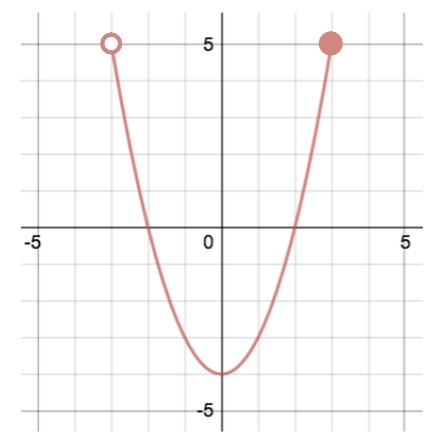
What is the range of the graph?
a)
-2 < y < 10
b)
-3 < x < 3
c)
-2 ≤ y ≤ 10
d)
-3≤ x ≤ 3
2.
a)

Inverse Functions

b)

Not Inverse Functions

3.

What is/are the increasing interval(s) for the function shown?

a)

(−3, 1)\left(-3,\ 1\right)

b)

(4, 8)\left(4,\ 8\right)

c)

(−∞,1) and (−3, 1)\left(-\infty,1\right)\ and\ \left(-3,\ 1\right)

4.

What is the decreasing interval(s) on the function shown?

a)

(−7, −6) and (−2, 4)\left(-7,\ -6\right)\ and\ \left(-2,\ 4\right)

b)

(−7, 0) and (−2, 4)\left(-7,\ 0\right)\ and\ \left(-2,\ 4\right)

c)

(−7, −6) and (−2, 0)\left(-7,\ -6\right)\ and\ \left(-2,\ 0\right)

d)

(−7, 0) and (4, 5)\left(-7,\ 0\right)\ and\ \left(4,\ 5\right)

5.
What does it mean to find the inverse of a function?
a)
the x's and y's are switched
b)
the x's and y's are divided by 2
c)
the x's and y's are made negative
d)
the x's and y's are the same
6.
The inverse has been reflected over which line?
a)
y = x
b)
y =1
c)
y = 0
d)
y = x + 1
7.

Find the inverse of  f(x)=x−53f(x)=\frac{x-5}{3} 

a)

 f−1(x)=35+xf^{-1}(x)=\frac{3}{5}+x

b)

 f−1(x)=3x+5f^{-1}(x)=3x+5

c)

 f−1(x)=5x+3f^{-1}(x)=5x+3

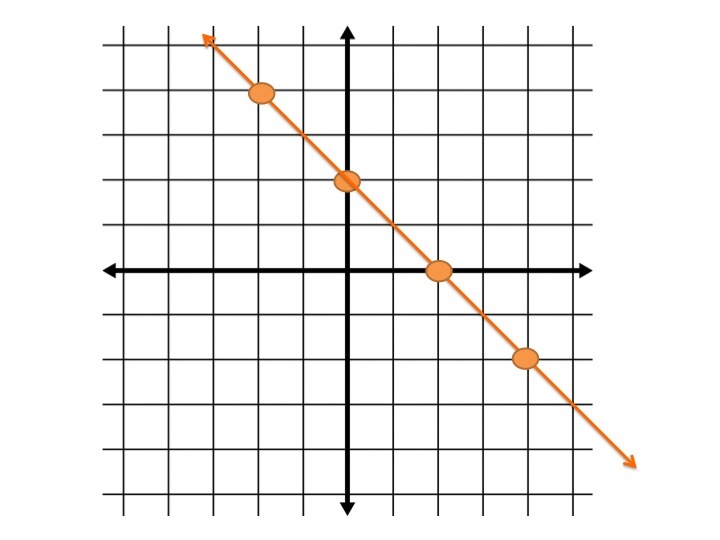
8.

Find the value of "c" that completes the square.

x2+8x+cx_{ }^2+8x+c  

a)

-4

b)

4

c)

8

d)

16

9.

Solve  x2−4x+18=0x^2-4x+18=0 .

a)

 x=−2±i14x=-2\pm i\sqrt{14} 

b)

 x=−2±14x=-2\pm\sqrt{14} 

c)

 x=2±i14x=2\pm i\sqrt{14} 

d)

 x=2±14x=2\pm\sqrt{14} 

10.
Anything raised to a power of zero is always: 
a)
0
b)
1
c)
itself
d)
negative
11.
According to exponent rules, when we raise the power to a power we _______ the exponents.
Example: (d2)5
a)
add
b)
subtract
c)
multiply
d)
divide
12.
According to exponent rules, when we multiply two power with the same base we _______ the exponents.
Example: c6 ⋅ c4
a)
add
b)
subtract
c)
multiply
d)
divide
13.
According to exponent rules, when we divide two powers with the same base we _______ the exponents.
Example: h8 / h3
a)
add
b)
subtract
c)
multiply
d)
divide
14.

Simplify using your exponent rule(s) (-2)³⋅(-2)⁶

a)

(-2)⁹

b)

(-2)¹⁸

c)

(-2)⁻³

d)

(-2)

15.

Simplify using your exponent rule(s) x⁻⁶

a)

1 ⁄ x⁶

b)

x⁶

c)

-x⁶

d)

-1 ⁄ x⁶

16.

Simplify using your exponent rule(s) x⁵⁄x³

a)

x²

b)

x

c)

1

d)

x⁸

17.
Simplify:  (5p9q3)(2pq7)
a)
7p10q10
b)
10p9q21
c)
10p10q10
d)
10p8q-4
18.

Simplify: 7p0

a)

7

b)

1

c)

simplified

d)

7p

19.

Factor using GCF or monomial factoring:

2n2-8n3

a)

2n2(n-4n2)

b)

2n2(1-4n)

c)

2n3(10-8n2)

d)

3n(1-4n)

20.
Factor
x2 + 9x - 36
a)
(x + 12)(x - 3)
b)
(x + 9)(x - 4)
c)
(x - 12)(x + 3)
d)
(x - 9)(x - 4)
21.
Factor
n2 + 16n + 63
a)
(n-7)(n+4)
b)
(n+7)(n-9)
c)
(n-3)(n-10)
d)
(n+7)(n+9)
22.
Factor
x2 - 5x - 36
a)
(x - 4)(x + 9)
b)
(x - 6)(x + 6)
c)
(x + 4)(x - 9)
d)
(x -12)(x + 3)
23.
Factor
3a2 + 4a + 1
a)
(7a-10)(a-8)
b)
Not factorable
c)
(3a+1)(a+1)
d)
(3a-1)(a-1)
24.
factor:x2 - 25
a)
( x + 5 ) ( x - 5 ) 
b)
( x - 5 ) ( x - 5 ) 
c)
( x + 5 ) ( x + 5 ) 
d)
Prime
25.
Solve
4m2 - 100 = 0
a)
m=25 or m=-25
b)
m=96
c)
m=5 or m =  -5
d)
m=-96
26.
Factor:
p2 - 14p
a)
p(1 - 14)
b)
2p(p - 7)
c)
p2(1-14)
d)
p(p - 14)
27.
Factor completely: 
3x2 + 18x +15
Hint: Factor GCF first.
a)
3(x2 + 6x + 5)
b)
(x + 5)(x + 1)
c)
3(x + 5)(x + 1)
d)
Prime
28.
Solve
x2 + 2x - 24 = 0
a)
x = -6, x = 4
b)
x = 6, x = -4
c)
x = 12, x = -2
d)
x = 8, x = -3
29.

Solve for the values of x:

(2x - 1)(x + 4) = 0

a)

x=1/2, x= -4

b)

x=1/2, x= 4

c)

x= 1, x=-4

d)

x=-2.5, x=4

30.

Rewrite the following

∛x5

a)

x3/5

b)

x5/3

c)

x2

d)

x3⋅x5

31.
Write in exponential form
∜(3x)³
a)
3x³⁄ ⁴
b)
(3x)³∕ ⁴
c)
(3x)⁴⁄ ³
d)
3x⁴⁄ ³
32.
∜m3 is the same as which answer?
a)
m3/4
b)
m12
c)
m4/3
d)
m7
33.
Simplify:
a)
2
b)
8
c)
16
d)
32
34.
Simplify the following expression:
a)
16
b)
32
c)
40
d)
64
35.
Simplify the following radical: √150
a)
5√15
b)
5√2
c)
5√6
d)
15√5
36.
a)
8√6
b)
8√12
c)
12√6
d)
12√12
37.
a)
y2z10√xy
b)
20yz√xy
c)
xy2z10√y
d)
yz6√xy2z2
38.
Simplify the exponential expression:
a)
10x-2
b)
2x2
c)
2x12
d)
10x12
39.

 2564\sqrt{\frac{25}{64}}  

a)

1

b)

40

c)

 85\frac{8}{5}  

d)

 58\frac{5}{8}  

40.

 64+81\sqrt{64}+\sqrt{81}  

a)

 17\sqrt{17}  

b)

 1717  

c)

 145\sqrt{145}  

d)

8.5

41.

 49−100\sqrt{49}-\sqrt{100}  

a)

 −51-\sqrt{51}  

b)

 −3-3  

c)

 −1.5-1.5  

d)

 −3-\sqrt{3}  

42.

Solve.

a)

-1/2

b)

2

c)

7

d)

no solution

43.
What is the domain?
a)
{-4, -1, 0, 2, 7}
b)
{-5, -4, -1, 0, 1, 2, 4, 7}
c)
{-5, 0, 1, 2, 4}
d)
{5}
44.
What is the Range?
a)
y ≥ 6
b)
y ≤ 6
c)
-10 ≤ y ≤ 6
d)
-10 ≤ x ≤ 6
45.

Identify all of the functions

a)
b)
c)
d)
e)
46.

What is the domain of the function graphed on the grid?

a)

-4 ≤ x < 5

b)

-4 ≤ x ≤ 5

c)

-3 ≤ x < 3

d)

-3 < x ≤ 3

47.

What is the range of the function graphed?

a)

x = 2

b)

All real numbers

c)

y = 2

d)

-6 < x < 6

48.

What is the decreasing interval on the function shown?

a)

(−∞, 1)\left(-\infty,\ 1\right)

b)

(−∞, 2)\left(-\infty,\ 2\right)

c)

(2, ∞)\left(2,\ \infty\right)

d)

(1, ∞)\left(1,\ \infty\right)

49.

What is the increasing interval on the function shown?

a)

(−∞, 1)\left(-\infty,\ 1\right)

b)

(−∞, 2)\left(-\infty,\ 2\right)

c)

(2, ∞)\left(2,\ \infty\right)

d)

(1, ∞)\left(1,\ \infty\right)

50.

Where is the function decreasing?

a)

(−∞,−1)\left(-\infty,-1\right)

b)

(−1,∞)\left(-1,\infty\right)

c)

(−∞,3)\left(-\infty,3\right)

d)

(3,∞)\left(3,\infty\right)

51.
Over what interval is this function constant?
a)
-5 < x < ∞
b)
-3 < x < 4
c)
4 < x < ∞
d)
-5
52.

What is/are the decreasing interval(s) for the function shown?

a)

 (2, 4) and (8, ∞)\left(2,\ 4\right)\ and\ \left(8,\ \infty\right) 

b)

 (−∞, 1) and (8, ∞)\left(-\infty,\ 1\right)\ and\ \left(8,\ \infty\right) 

c)

 (−∞,1), (−3, 1) and (8, ∞)\left(-\infty,1\right),\ \left(-3,\ 1\right)\ and\ \left(8,\ \infty\right) 

d)

 (−∞, 1), (2, 4) and (8, ∞)\left(-\infty,\ 1\right),\ \left(2,\ 4\right)\ and\ \left(8,\ \infty\right) 

53.
What is g(7) if:
a)
-17
b)
-13 
c)
13       
d)
17
54.

What is the domain interval for the green piece of this function?

a)

-2 < x ≤ 1

b)

-1 < x ≤ 0.5

c)

x > -2

d)

x ≤ 1

55.
Write the following in interval notation
 x < 8
a)
(8, ∞)
b)
(8, -∞)
c)
(-∞, 8)
d)
[-∞, 8]
56.
Look at the Graph. Write the inequality in interval notation.
a)
[-4, -1)
b)
(-4, -1)
c)
(-4, -1]
d)
[-4, -1]
57.

What interval notation does the number line graph represent?

a)

[∞, -5)

b)

(∞, -5)

c)

[-5, ∞)

d)

(-5, ∞)

58.
Would you use a closed or open circle to graph x < 3?
a)
Closed
b)
Open
59.

When writing a solution in interval notation, what brackets do i use for:

> or <

a)

[ ]

b)

( )

60.
√-20
a)
4i
b)
2i√5
c)
5√2
d)
10i
61.
Question 4
a)
x = 2
b)
x = 4
c)
x = 7
d)
x = 9
62.

Solve the equation.

a)

n = 27

b)

n = 18

c)

n = -18

d)

n = 36

63.
Solve.
a)
8
b)
-8
c)
0
d)
no solution
64.

f(g(x))

a)

3x - 16

b)

3x - 2

c)

3x - 26

d)

4x - 2

65.


 f(x)=x+2   and    g(x)=2x2−2xf\left(x\right)=x+2\ \ \ and\ \ \ \ g\left(x\right)=2x^2-2x  

 Find (f−g)(x)Find\ \left(f-g\right)\left(x\right)  

a)

 3x3+23x^3+2  

b)

 2x2+3x+22x^2+3x+2  

c)

 2x3+x2+2x2x^3+x^2+2x  

d)

 −2x2+3x+2-2x^2+3x+2  

66.

 g(x)=3x+3g\left(x\right)=3x+3   h(x)=4x+5h\left(x\right)=4x+5  

 Find g(3)−h(3)Find\ g\left(3\right)-h\left(3\right)  

a)

9

b)

-5

c)

-9

d)

5

67.


 g(n)=n2+4+2ng\left(n\right)=n^2+4+2n  and  h(n)=−3n+2h\left(n\right)=-3n+2  

 Find (g⋅h)(1)Find\ \left(g\cdot h\right)\left(1\right)  

a)

-7

b)

-5

c)

0

d)

35

68.

 If f(x)=x2−1 and g(x)=x3If\ f\left(x\right)=x^2-1\ and\ g\left(x\right)=x^3   Find (f ∘ g)(2)Find\ \left(f\ \circ\ g\right)\left(2\right)  


a)

72

b)

80

c)

63

d)

97

69.

If  f(x)=1xf\left(x\right)=\frac{1}{x}   and  g(x)=3x+2g\left(x\right)=3x+2   find  (f∘g)(2)\left(f\circ g\right)\left(2\right)  

a)

 14\frac{1}{4}  

b)

 18\frac{1}{8}  

c)

 72\frac{7}{2}  

d)

8

70.

If  f(x)=1xf\left(x\right)=\frac{1}{x}   and  g(x)=3x+2g\left(x\right)=3x+2   find  (g∘f)(x)\left(g\circ f\right)\left(x\right)  

a)

 13x+2\frac{1}{3x}+2 

b)

 3x+23x+2  

c)

 3x+2\frac{3}{x}+2  

d)

 13x+2\frac{1}{3x+2}  

71.

 Find g(f(4)).Find\ g\left(f\left(4\right)\right).  

a)

 44  

b)

 66  

c)

 88  

d)

 1010  

72.

f(g(3)) =

a)

2

b)

1

c)

0

d)

-2

73.

f(h(-4)) =

(a)  

74.

What is the equation of the following line?

a)

x=2

b)

y=2

75.
What is the equation of this line?
a)
y = 2x +2
b)
y = 2x -2
c)
y = -x + 2
d)
Cannot be Determined
76.
Write the equation of the line.
a)
y = -1/3x - 2
b)
y = 1/3x - 2
c)
y = 3x - 2
d)
y = -3x - 2
77.
Name the slope
a)
7/1
b)
3/4
c)
-3/4
d)
-7/1
78.
In the equation y=mx+b,
what does m represent?
a)
Nothing in particular
b)
The y-intercept
c)
The x-intercept
d)
Slope
79.
Name the slope.
a)
Zero slope
b)
1
c)
Undefined
d)
-1
80.
Which parent function matches the graph?
a)
f(x) = x
b)
f(x)= x2
c)
f(x) = |x|
d)
f(x) = abx
81.
Which parent function matches the graph?
a)
f(x) = √(x)
b)
f(x) = ∛(x)
c)
f(x) = |x|
d)
f(x) = a⋅bx
82.
Name the parent function. 
a)
constant
b)
quadratic
c)
linear
d)
exponential
83.
Name the parent function. 
a)
constant
b)
square root
c)
linear
d)
absolute value
84.
Name the parent function.
a)
quadratic
b)
cubic
c)
square root
d)
logarithmic