wayground logo

Free Printable Worksheets

Font size

S
M
L
XL
Worksheets

Q2 Summative A Review

Total questions: 35

Worksheet time: 18mins
Name
Class
Date
1.

The movement of particles from an area of high to low concentration is known as--

a)

Passive Transport

b)

Active Transport

2.

What is it called when large molecules move across the cell membrane from an area of high concentration to an area of low concentration through a protein channel?

a)

Diffusion

b)

Osmosis

c)

Active Transport

d)

Facilitated Diffusion

3.

Cell membrane transport that occurs without energy is called--

a)

active transport

b)

endocytosis

c)

passive transport

d)

exocytosis

4.
ALL living cells have this in common
a)
Nucleus
b)
Cell Membrane
c)
Cell Wall
d)
Mitochondria
5.
Osmosis is the movement of _____ across a membrane.
a)
food
b)
energy
c)
oxygen
d)
water
6.
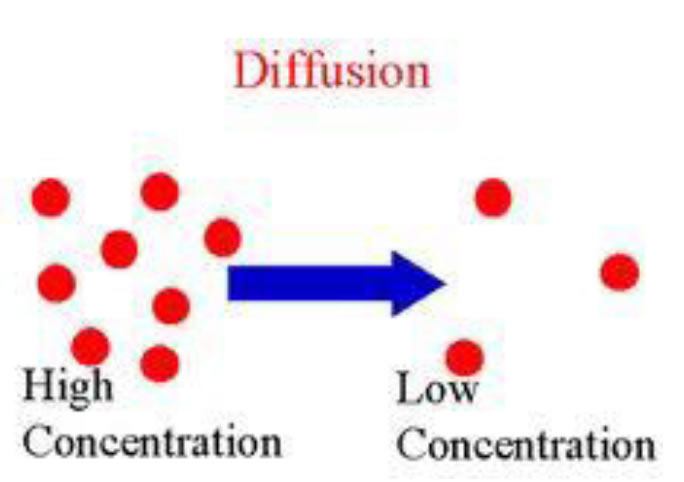
What type of transport is illustrated?
a)
facilitated diffusion
b)
active transport
c)
diffusion
d)
osmosis
7.
The picture is an example of...
a)
active tranport
b)
passive transport
c)
diffusion
d)
osmosis
8.
Proteins are made of monomers called ___________
a)
Nucleotides
b)
Monosaccharides
c)
Amino Acids
d)
Glycerol and fatty acids
9.
Nucleotides are monomers of
a)
Carbohydrates
b)
Lipids
c)
Proteins
d)
Nucleic Acids
10.
Monosaccharides are monomers of
a)
Carbohydrates
b)
Lipids
c)
Proteins
d)
Nucleic Acids
11.
Waxes, oils and fats are examples of
a)
Carbohydrates
b)
Lipids
c)
Proteins
d)
Nucleic Acids
12.
What is the function of nucleic acids?
a)
store genetic information
b)
store energy (long-term)
c)
store energy (short-term)
d)
build skin, hair, nails, muscles
13.
Which of the following organic compounds is the main source of energy for living things?
a)
carbohydrates
b)
lipids
c)
nucleic acids
d)
proteins
14.
Which group of biomolecules provide quick energy to organisms?
a)
proteins
b)
carbohydrates
c)
lipids
d)
nucleic acids
15.
All polymers are made up of...
a)
monosaccharides
b)
monomers
c)
proteins
d)
None of these
16.
All organic compounds contain the element
a)
carbon
b)
nitrogen
c)
phosphorus
d)
sulfur
17.
Is found in the cell membrane as a bilayer. 
a)
lipids
b)
protein
c)
nucleic acid
d)
carbohydrate
18.

How many significant figures are there in 1008 grams?

a)

1

b)

2

c)

3

d)

4

19.

How many significant figures are there in 0.0054 grams?

a)

1

b)

2

c)

3

d)

4

20.

What is the product of 2.67 meters and 1.3 meters?

a)

3.4 meters

b)

3.5 meters

c)

3.47 meters

d)

3.471 meters

21.

What is the difference of 12.58 meters and 5.7 meters?

a)

7 meters

b)

6.9 meters

c)

6.8 meters

d)

6.88 meters

22.
Enzymes are considered to be 
a)
Lipids
b)
Carbohydrate
c)
Protein
d)
Nucleic Acid
23.
What is the purpose  of an enzyme?
a)
give permission for the reaction
b)
raise activation energy
c)
speed up reactions
d)
control how many reactions occur
24.
Where do substrates bind on an enzyme?
a)
voltage-gated channels
b)
surface receptor
c)
calcium channels
d)
active site
25.
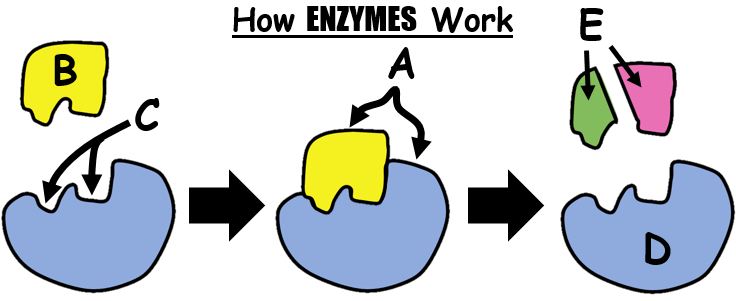
What is structure A?
a)
Substrate
b)
Active site
c)
Enzyme
d)
Products
26.
What 3 letters do enzymes typically end in?
a)
-ose
b)
-ase
c)
-ese
d)
-tic
27.
What is the name for the mechanism of enzyme activity?
a)
Lock and key
b)
jigsaw puzzle
c)
hammer and nail
d)
two hands pattern
28.
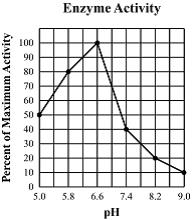
Which of the following conclusions can be drawn from this graph?
a)
The optimum pH of the enzyme is 6.6.
b)
The optimum pH of the enzyme is 5.8
c)
The enzyme’s activity increases as pH increases 5.0 to 9.0
d)
The enzyme’s activity is greater around pH of 8.0 .
29.
What makes an enzyme substrate specific?
a)
Size
b)
Shape
c)
Name
d)
Location it is found in
30.
What is a substance called if it speeds up a chemical reaction?
a)
reusable
b)
catalyst
c)
specific
d)
fragile
31.
In the diagram, what is letter A? 
a)
product
b)
substrate
c)
enzyme-substrate complex
d)
active site
32.
An enzyme speeds up a chemical reaction in the cell but can only be used once.  True or False? 
a)
true
b)
false
33.
What happens when enzymes are heated to a high temperature?
a)
The enzymes die.
b)
The shapes of the enzyme are altered denature
c)
The enzymes' amino acid sequence changes.
d)
The enzymes remain the same
34.
What is another name for enzymes?
a)
chemical catalysts
b)
microorganisms
c)
biological catalysts
d)
inorganic catalysts
35.

Which 2 factors can affect the rate of enzyme activity?

a)

Light intensity

b)

Temperature

c)

pH

d)

Oxygen concentration