wayground logo

Free Printable Worksheets

NEW

Font size

S
M
L
XL
Worksheets

SOH 2025-2026 Semester 2 Pre-Assessment

Total questions: 30

Worksheet time: 30mins

Name
Class
Date
1.

When a cell goes through mitosis, the daughter cells

a)

are genetically unique from the mother cell

b)

are genetically identical to the mother cell

c)

are used in sexual reproduction

d)

have half the number of chromosomes as the mother cell

2.
Why would it be important to replicate DNA before a cell divides in mitosis or meiosis?
a)
In order for genetic information to be transferred into daughter cells.
b)
In order for the cell to be able to increase in size.
c)
In order for the DNA to be contained in the nucleus.
d)
In order for the cell to re-order the DNA sequencing in the new cells.
3.

If a somatic (body) cell in a butterfly contains 24 chromosomes, a butterfly egg would contain

a)

3

b)

6

c)

12

d)

24

4.

Meiotic cell division makes sperm and egg cells. In humans, sperms and ova each have _____ chromosomes. Therefore a fertilized egg would create a cell with _____ chromosomes.

a)

23, 46

b)

46, 23

c)

2, 4

d)

50, 100

5.
Which sequence of DNA bases would pair with this partial strand
CAT TCA CTG
a)
ATG TGA CAG
b)
TAC ACT GTC
c)
GTA AGT GAC
d)
CAT TCA CTG
6.

DNA replication results in

a)

2 completely new DNA molecules

b)

2 DNA molecules that each contain a strand of the original

c)

1 new DNA molecule and 1 old

d)

1 new molecule of DNA

7.
In RNA, Uracil pairs with ______. 
a)
cytosine
b)
adenine
c)
guanine
d)
thymine
8.
The process to go from DNA to mRNA is _______
a)
translation
b)
transcription
c)
replication
9.
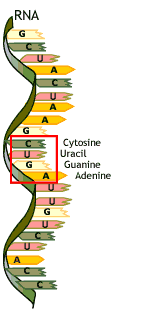
What process is going on in this photo? 
a)
Transcription 
b)
Translation 
c)
Replication 
d)
All the above 
10.
The survival of a species depends on its ability to adapt to changes in the environment. Which statement correctly describes a way that mutations increase the likelihood that a species will survive in a changing environment?
a)
Mutations are a source of variation in the species
b)
Mutations are the cause of disease in the species
c)
Mutations are not harmful when they occur in somatic cells
d)
Mutations are always passed on to subsequent generations
11.

Sequence of DNA that determines structures of proteins

a)

Mutation

b)

Gene

c)

Molecule

d)

Protein

12.

Use the mRNA below to select the correct amino acid sequence:

AUG-UCA-AAA-UAG

a)

MET-SER-LYS-STOP

b)

MET-THR-LYS-TYR

c)

LEU-SER-CYS-STOP

d)

ILE-LYS-SER-STOP

13.

What is natural selection?

a)

process in which helpful traits become more common over time

b)

a trait that helps an organism survive better
14.
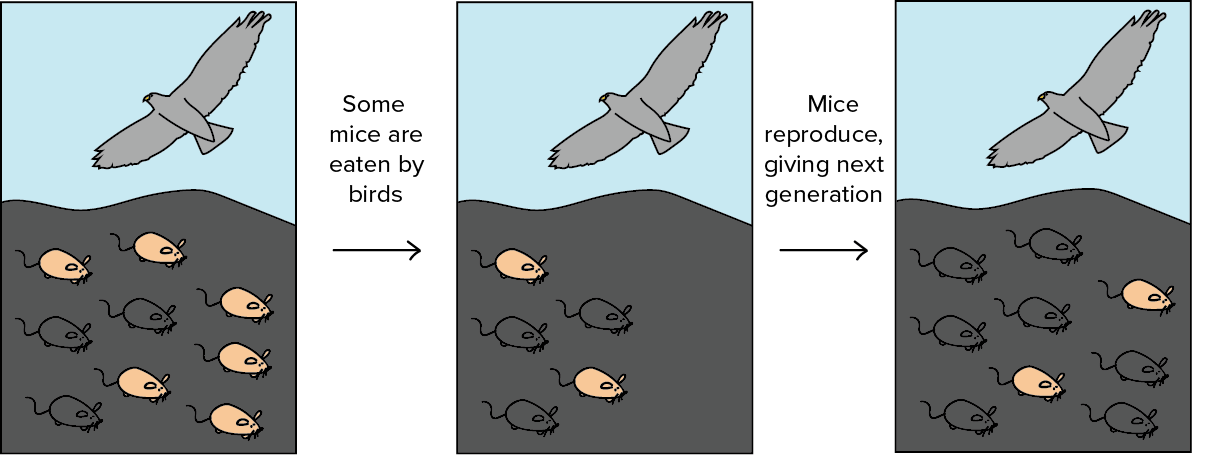
Why is the mouse population changing over time?
a)
The light mice can reproduce more successfully than the dark mice
b)
The hawks eat more dark mice than light mice because the dark mice taste better
c)
The hawks eat more light mice than dark mice because they can see the light mice more easily
d)
The hawks eat more dark mice than light mice because they can see the dark mice more easily
15.

Ancient farmers in Mexico took the first steps in domesticating maize when they chose which kernels (seeds) to plant. These farmers noticed that not all plants were the same. Some plants may have grown larger than others, or maybe some kernels tasted better or were easier to grind. The farmers saved the kernels from plants with desirable characteristics and planted them for the next season's harvest. This is an example of

a)

natural selection

b)

artificial selection

16.

Which best describes the role of mutations in natural selection?

a)

Mutations help an organism to better survive in their environment

b)

An organism may acquire a helpful mutation by interacting with the environment

c)

A mutation may result in a beneficial trait that makes an organism more likely to survive and reproduce

d)

Organisms with certain traits are more likely to win competitions for mutations

17.

Why is competition important for natural selection?

a)

It shows which variations are more successful, allowing the organisms with those variations to survive.

b)

It causes organisms, regardless of which traits they have, to die out, reducing the population size.

c)

It causes organisms to get stronger due to having to outcompete other species.

d)

Competition is not important for natural selection.

18.
A flash flood carried a raft of Amazon ants away from their original population. There is enough distance between the two groups, that they will never meet in nature again. What type of reproductive barrier is this?
a)
behavioral isolation
b)
temporal isolation 
c)
gametic isolation
d)
geographic isolation 
19.
The term for the formation of new and distinct species over the course of evolution is...
a)
speciation
b)
biological species concept
c)
reproductive barrier
d)
natural selection
20.
The flowers of pink tulips open in the morning, while the flowers of lavender tulips open in the early afternoon. The bees that pollinate these tulips cannot carry pollen back & forth between the two types of tulips because of their flowers being closed at different times of day. What type of reproductive barrier is this?
a)
behavioral isolation
b)
hybrid sterility 
c)
temporal isolation
d)
mechanical isolation 
21.
What determines the code, or information, of a DNA molecule?
a)
the shape (structure) of the nitrogen bases
b)
the order (sequence) of the nitrogen bases
c)
the color of the nitrogen bases
d)
the frequency (number) of nitrogen bases
22.
What are the three components of a nucleotide?
a)
sugar, hydrogen, nitrogen base
b)
sugar, oxygen, nitrogen base
c)
sugar, phosphate, nitrogen base
d)
sugar, phosphate, protein
23.
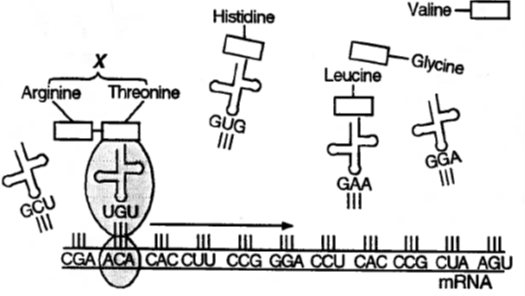
What process is shown in the diagram?
a)
replication
b)
transcription
c)
mitosis
d)
translation
24.

In which of the following ways do people increase the concentration of greenhouse gases in the atmosphere?

a)

Cutting down trees

b)

Driving gasoline-powered cars

c)

Burning coal to create electricity

d)

All of the above

25.
Which is a nonrenewable natural resource?
a)
Trees
b)
Solar energy
c)
Oil
d)
Oxygen
26.

Methane (CH4), carbon dioxide (CO2) and ozone (O3) are classified as

a)

Dominance gases

b)

Greenhouse Gases

c)

Acidic gases

27.
An offspring will receive how many alleles from each parent to determine a specific trait?
a)
one
b)
two
c)
three
d)
five
28.
G = green, g = yellow
The genotype for a yellow plant is...
a)
GG
b)
Gg
c)
gg
d)
all of the choices result in yellow
29.
W=white hair
w= non-white hair
If you cross a horse with WW and a horse with ww what fraction of the offspring would be expected to have white hair?
a)
none
b)
3/4
c)
1/2
d)
all
30.

During which phase of the cell cycle does the cell spend the most time?

a)

Mitosis

b)

Cytokinesis

c)

Interphase