
Font size
 Worksheets
heat and thermodynamics
Total questions: 147
Worksheet time: 3hrs 28mins
Thermodynamics is the study of...
Movement and Vectors
Atoms and Magnetism
Temperature, Heat and Energy
None of above
These are all examples of temperature scales except...
Celsius
Fahrenheit
Kelvin
Rader
Energy is often transferred from one object to another when they have different amounts of energy.
True
False
Liquids and gases expand as the temperature increases.
True
False
Water freezes at...
Zero Degrees Celsius
273 Kelvin
32 Degrees Fahrenheit
All of the Above
When an object is heated, energy is removed.
True
False
Thermodynamic reactions play critical roles in all of the following except...
Refrigerators
Car Engines
Hitting Baseballs
Polar Icecaps Melting
What is the name of the process where energy is transferred during molecular collisions?
Conduction
Convection
Radiation
none of above
Energy naturally moves from a heat source to a heat ______.
Vacuum
Hole
Sink
None of the Above
Energy and heat can be transferred through a vacuum.
True
False
The average kinetic energy of the molecules in a substance is called what?
Temperature
Heat
Motion
Potential energy
Moving molecules in a substance have what type of energy?
Heat energy
Radiant energy
Temperature energy
Potential energy
Which of the following is an accurate comparison between a small glass of water and a large one, both poured from the same pitcher?
They have the same heat energy, but the larger glass of water has a greater temperature
They have the same temperature, but the larger glass of water has a greater amount of heat energy.
They have the same temperature and heat energy
They have the same temperature, but the smaller glass of water has a greater amount of heat energy.
An endothermic reaction is:
when the system gains heat as the surroundings cool down.
when the system loses heat as the surroundings heat up.
when one or more substances are changed into one or more different substances.
when energy is either created or destroyed
when the reaction involves subatomic particles
An example of an exothermic reaction is:
the lighting of a match
when two chemicals are added together
≈
evaporation of water
the breaking of bonds
Enthalpy change is
the amount of energy as heat that is lost or gained by a system
the total amount of energy in a system
a chemical reaction
when one or more substances are changed into one or more different substances.
Which of the following is the best definition of thermal expansion?
Molecules moving faster
An object increasing in size due to increased temperature
An object decreasing in size due to increased temperature
An object never changing in size
Why does running a jar under hot water make it easier to open?
Because the metal expands into the spaces between the glass threads
Because the gaps between the threads and the lid get larger as it expands
Because hot things are more malleable
It doesn't.
What are the laws of thermodynamics?
Laws that govern the movement of heat -- why and how it moves.
Laws that govern the stationary heat energy.
Laws that describe how molecules are distributed statistically.
Laws that describe how objects move.
Why is the zeroth law of thermodynamics important or necessary?
Because you have to first define your terms, in particular: temperature.
Because you have to first define your terms, in particular: pressure.
It isn't important or necessary, because it's too obvious.
Because you have to understand what thermal equilibrium is.
The second law of thermodynamics states that:
I. Energy can neither be created nor destroyed
II. All free energy cannot be converted into usable energy
III. The entropy of a system increases over time
II and III
I and II
III
I
Which of the following concepts best describes a chlorophyll molecule absorbing light and changing it into chemical energy?
Bernoulli's Principle
Boyle's Law
The Second Law of Thermodynamics
The Law of Conservation of Energy
The fact that energy can be neither created nor destroyed is _____.
Not true
Newton's First Law of Motion
The First Law of Thermodynamics
Einstein's Law
What is a heat engine?
A device that produces motion from heat, and includes gasoline engines and steam engines.
A device that produces heat from motion, and includes gasoline engines and steam engines.
A device that produces heat from motion, and includes a bicycle.
A device that produces motion from heat, and includes a bicycle.
What is thermal energy?
The energy of a substance or system in terms of the motion or vibrations of its molecules.
The energy of a substance or system in terms of the potential energy of its molecules.
The energy of a substance or system in terms of the pressure of its molecules.
The energy of a substance or system as a whole object.
What is heat transfer?
The movement of energy through collisions and movements of molecules, from hot places to cold places.
The movement of energy through collisions and movements of molecules, from cold places to hot places.
The movement of energy through two objects colliding.
The movement of energy through collisions and movements of molecules, from hot places to other hot places.
How are temperature and phase different in terms of molecules?
Temperature is the average movement energy of molecules, whereas phase is related to the potential energy (position) of molecules.
Phase is the average movement energy of molecules, whereas temperature is related to the potential energy (position) of molecules.
Temperature is the average movement energy of molecules, whereas phase is related to how much the molecules stick to each other.
Temperature is a smaller increase in the kinetic energy of molecules than phase.






The biggest heat source for our planet is the ______________________.
Earth
fire
Moon
Sun
Heat is a form of _______.
fuel
matter
electricity
energy
If you dropped a hot rock in a bucket of cold water, the rock will _____________________________.
melt
stay the same temperature
become cooler
become hotter

Temperature and Heat are the same thing?
True
False
Which of the following is NOT a heat source?


What is temperature?
a form of heat
a form of energy
a measure of how old or cold something is
something to measure how hot or cold an object is
What happens when something gains heat?
it becomes hotter
it becomes colder

Which cup contains more heat?
Cup B
Cup C
This is a form of energy that causes materials to become warmer or hotter.
Temperature
Heat
Thermometer
Which of the following statements is true?
The faster the particles move, the lower the temperature.
The faster the particles move, the higher the temperature.
The slower the particles move, the higher the temperature.
Heat travels from cooler objects to warmer objects.
True
False
Which of the following measures temperature?


How does heat travel?
from North to South
from South to North
from cold to hot
from hot to cold
What is temperature scales that used to measure temperature?
Grams
Celsius
Meter
How does heat travel?
Heat travels from a hot place to a cold place.
Heat travels from a cold place to a hot place.
Heat travels in a straight line.
Instrument that can be used to measure how hot or cold an object is ...
heater
Stop watch
thermometer

Rahma got an ice cream from her mom. The ice cream melts under the sun because the ice cream ___________.
gains heat from the sun
loses heat to the sun
produce too much heat

How is heat useful to us?Choose 4 correct options.
It keeps us warm
It dries our clothes.
It helps the roots to absorb water.
It is used to cook our food.
It is the energy needed for water cycle to occur.

What happens to water if it gains heat?Choose 3 correct options.
It boils.
It freezes.
It changes its state.
It turns to steam.
It changes its property.
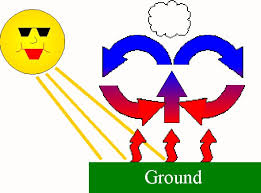
What is the transfer of heat by circulation of the heated parts of a liquid or gas?
Conduction
Convection
Coriolis Effect
Radiation
Which best explains how the Earth’s atmosphere is warmed?
Radiation from the sun warms the surface and the atmosphere is heated through conduction and convection.
Radiation from the sun warms the surface and the atmosphere is heated through evaporation and convection.
Convection from the sun warms the surface and the atmosphere is heated through conduction and radiation.
Convection from the sun warms the surface and the atmosphere is heated through evaporation and conduction.
What two processes of heat transfer would cause the water in a pot on the stove to boil?
radiation and convection
conduction and radiation
radiation and evaporation
conduction and convection
What type of energy transfer occurs when two things are in direct contact (touching)?
Condensation
Conduction
Convection
Radiation
Which of the following shows a transfer of energy by means of conduction?
Standing near a warm fire.
Watching a microwave oven cook your food.
Grabbing a metal seat belt buckle after a car has been closed up in the sun all day.
Feeling the breeze that blows over the land during the day and toward the sea later that night.
What is the transfer of heat by the circular movement of molecules?
Condesation
Conduction
Convection
Radiation
To check if an iron is hot, you place your hand near the iron and feel that it is warm without touching it. What type of heat transfer is this?
Condensation
Conduction
Convection
Radiation
When you play outside in the sun too long and receive a sunburn, which type of heat transfer is this?
Conduction
Convection
Evaporation
Radiation
A student must choose three items to demonstrate conduction, convection, and radiation from solar energy. The student quickly chooses water and a metal bowl. Which of the following items should the student choose to complete the experiment?
Rubber ball
food coloring
heat lamp
ice cube
What is the main source of energy that drives all weather patterns?
Sun
Moon
Oceans
Mountains
Heat is _____ if heat is removed from a system
Positive
Negative
Neutral
Work is _______ when work is done BY the system ON the surroundings
Positive
Negative
Neutral
Energy cannot be created or destroyed.
0th law
1st law
2nd law
3rd law
As temperature reaches absolute zero, the entropy of a system approaches a constant minimum.
0th law
1st law
2nd law
3rd law
If two systems are in thermal equilibrium with a third system, than they are in thermal equilibrium with each other.
0th law
1st law
2nd law
3rd law
Which is an example of the 0th law?
0 Kelvin
Chaos cannot decrease
A=B=C
U = W - q
The amount of chaos in a system will always increase.
0th law
1st law
2nd law
3rd law
Which is an example of the 2nd law?
0 Kelvin
Chaos cannot decrease
A=B=C
U = W - q
Chemical reaction where heat is released into the environment
endothermic
exothermic
spontaneous
nonspontaneous
Chemical reaction where heat absorbed into the system
endothermic
exothermic
spontaneous
nonspontaneous
SI unit of heat and energy
kg
°c
J
km
Which of these shows the arrangement of the molecules of a solid?


If all the molecules below are from the same element, which one has more temperature?
(if the pressure does not change)
Which one is an example of potential energy?


What is heat? Mark the correct option.
Molecular average kinetic energy
Molecular thermal energy
Molecular kinetic energy of only one molecule
Transfer of molecular thermal energy because of a difference in temperature.
What does the word "transfer" mean? Mark the best option.


What method of heat transfer do solar panels rely on?
Conduction
Convection
Radiation
Nucleation
Which law of Thermodynamics helps to explain how car engines work?
Zeroth Law
1st Law
2nd Law
3rd Law
How many types or thermal energy transfer are there?
1
2
3
4

When thermal energy is added to a substance, the substance's particles move:
faster and get farther apart.
faster and get closer together.
More slowly and get farther apart.
More slowly and get closer together.
The Zeroth Law of Thermodynamics states that if 3 objects are in contact with one another, their temperatures will balance with one another. We call this state:
Thermal Equilibrium
Thermal Expansion
Thermal Conduction
Thermal Blanket
The amount of entropy is a substance/object is related to its temperature. As the temperature of an object APPROACHES absolute 0, what happens to its level of entropy?
It increases
It stays the same
It decreases
It never had any entropy to begin with
What do we call the phase change of a SOLID turning directly into a VAPOR?
Sublimation
Melting
Condensation
Boiling/Evaporation
What do we call the state where all 3 phases of water can exist in equilibrium?
Triple Play
Triple Dipper
Triple Point
Triple Cheeseburger

A student is on the Phase Change Gizmo on Explore learning. Their teacher has asked them to find the boiling point of the mystery liquid in the beaker (it is not water).
How will they know that they have reached the boiling point of the substance?
They will see bubbles forming and the temperature will continue to go up.
They will see bubbles forming and the temperature will go up and down
They will see bubbles forming and the temperature will not change
I have no idea. I did not pay attention when we did this in class.
Thermal expansion only occurs in solids and gases. It doesn’t happen in liquids.
True
False

At the base camp of Mt Everest, the altitude is 5365m above sea level. How does this altitude effect the boiling point of water?
The boiling point is lower because the pressure is higher as altitude increases.
The boiling point is higher because the pressure is higher as the altitude increases.
The boiling point is lower because the pressure is lower as the altitude increases.
The boiling point is higher because the pressure is lower as the altitude increases.
When a hot air balloon is given more heat, the size of the balloon increases and it floats higher in the air. What law explains this?
Boyle's Law
Charles' Law
Temperature is a measure of the amount of the _________________ energy of the molecules
potential
kinetic
chemical
mechanical
Colorado has a elevation of 5,280 ft. In Colorado, its takes 3 extra minutes to cook a hard boiled egg. Why?
The water boils at a lower temperature because their is less pressure. This is why it takes longer to cook.
The water boils at a higher temperature because their is less pressure. This is why it takes longer to cook.
The water boils at a higher temperature because there is less pressure. This is why is takes longer to cook.
The water boils at a lower temperature because their is more pressure. This is why is takes longer to cook.
According to Boyle’s Law, as the pressure on a gas decreases, its volume .
increases
decreases
stays the same
Study on the relationship of ___________including energy and deformation properties of the substance
heat, work and energy
power, work and energy
heat, system and energy
heat, work and boundary

Describe about the picture below
zero law of thermodynamic
Zeroth’s Law of Thermodynamics
Law of thermodynamics
Which has the MOST thermal energy?
HUGE iceberg, the size of a small town
ice cube
cup of hot coffee
5 gallon bucket of room temperature water
Consider 2 blocks of Aluminium (one of 1kg and one of 10 kg) and being supplied with thermal energy.
Which one heats up the fastest?
1 kg
10 kg
They both heat up at the same rate
They don't heat up.

An old car with a lot of mileage is more likely to break down than a new car that has not been driven a lot. This is an example of...
1st Law of Thermodynamics
2nd Law of Thermodynamics
3rd Law of Thermodynamics

Convert 320F to Celsius
273 K
00 C
0 K
12 o F
Which scale has no negatives units?
Kelvin
Celsius
Fahrenheit
My Scale

