
 Worksheets
WORK ENERGY QUIZ
Total questions: 177
Worksheet time: 3hrs 46mins
Which of the following statements are true about potential energy?
Both gravitational and elastic potential energy are dependent upon the speed of an object.
Moving objects cannot have potential energy.
None of these
Potential energy is the energy stored in an object due to its position.
Which Equation matches:
"A moving object speeds up."
KE + W = KE
W = PEel
PE −W = KE
KE −W = 0
Which Equation matches:
"A spring shoots an object."
PEel= KE
W = PEel
PE −W = KE
KE −W = 0
Which Equation matches:
"A moving object is stopped."
PE = KE
W = PEel
PE −W = KE
KE −W = 0

Two equal mass marbles are at the top of a ramp. One marble falls to the ground off the back while the other rolls down the ramp. What is true about the marbles when they reach the ground?
The marble that rolled down the ramp is moving faster than the marble that fell.
The marble that fell down the back of the ramp is moving faster than the marble that rolled.
The marble that rolled down the ramp is not moving when it reaches the ground.
The two marbles are moving with the same speed.

Suppose a cart has a kinetic energy of 0.5 J. If you add enough mass to double the mass and make the cart go three times as fast, its kinetic energy is now ---.
6 J
3 J
18 J
9 J

At which point of this roller coaster is the energy 1/2 kinetic and 1/2 potential?
A
B
C
D
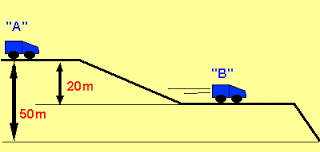
In diagram 2, if the mass of the car is 600 kg, what is the change in potential energy from point A to point B?
411,600 J
294,000
176,400 J
117,600 J
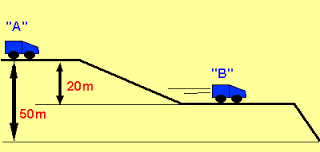
In diagram 2, if the 600 kg cart is initially at rest, what is its velocity at point B?
19.8 m/s
15.0 m/s
10.3 m/s
3.8 m/s

Each of the boxes shown is pulled for 10 m across a level, frictionless floor by the force given. Which box experiences the greatest change in its kinetic energy?
A
B
C
D
E

Rank in order, from largest to smallest, the gravitational potential energies of the balls.
1 > 2 = 4 > 3
1 > 2 > 3 > 4
3 > 2 = 4 > 1
3 > 2 > 4 > 1

Rank in order, from largest to smallest, the gravitational potential energies of the balls.
1 > 2 = 4 > 3
3 > 2 = 4 > 1
1 > 2 > 3 > 4
3 > 2 > 4 > 1

Starting from rest, a marble first rolls down a steeper hill, then down a less steep hill of the same height. Ignoring friction, for which is it going faster at the bottom?
Faster at the bottom of the steeper hill
Faster at the bottom of the less steep hill
Same speed at the bottom of both hills
Can’t say without knowing the mass of the marble

A block starts at rest at point P at the top of a ramp which is height h above the ground. The block slides down one side and up the other, stopping at a point less than h above the ground.
The block did not go as high on the other side because gravity pulls down.
The block did not go as high on the other side because potential energy always has to decrease.
The block did not go as high on the other side because work from friction made the mechanical energy less.
The situation as described is impossible to happen.

A box of mass m is pulled by a force F, which makes
an angle 𝜙 with the horizontal. A frictional force f is
applied on the box as it slides on a horizontal surface,
as shown in the figure below. Which of the following
represents the net work on the box when it covers a
distance d?
𝐹𝑑
(𝐹 − 𝑓)𝑑
𝐹 cos 𝜙 𝑑
(𝐹 cos 𝜙 − 𝑓)𝑑
(𝐹 sin𝜙 − 𝑓)𝑑
A boy pushes a 35 kg crate across a horizontal floor
with a force of 250 N. The coefficient of kinetic
friction between the crate and the floor is 0.30. How
far does the crate move if the net work on it is
2400 J?
8.5 m
12 m
16 m
21 m
26 m

The net force on an object is represented in the
force-position graph shown below. Find the work
done on the object as it moves from x = –20 m to x =
40 m.
20 J
30 J
40 J
60 J
90 J

A 10 𝑘𝑔 block is released from rest at the top of an
inclined plane of height h = 2m, as shown in the
figure below. The coefficient of kinetic friction
between the block and the surface of the incline is
0.2.
What's the work done by the normal force?
-350 J
-200 J
0 J
200 J
350 J
The velocity of a 2.00 kg object, which starts
moving from rest, is given by the equation:
𝑣 = 4.00𝑡2 + 7.00𝑡
Find the net work done on the object between
t = 0.00 s and t = 3.00 s.
5.70 × 101 𝐽
1.14 × 10² J
1.09 × 10³ J
3.25 ×10³ J
6.50 × 10³ J
A particle moving on the x-axis has a potential energy
given by the equation below.
𝑈 = 8𝑥2 − 4𝑥 + 400.
The force on the object at x = 1.00 m is _______.
0.00 N
12.0 N in the (+) x-axis
12.0 N in the (–) x-axis
20.0 N in the (+) x-axis
20.0 N in the (–) x-axis
A particle moving on the x-axis has a potential energy
given by the equation below.
𝑈 = 8𝑥2 − 4𝑥 + 400.
Its state of equilibrium will be at ____.
𝑥 = 0.025 𝑚
𝑥 = 0.25 𝑚
𝑥 = 2.5 𝑚
𝑥 = 25 𝑚
𝑥 = 250 𝑚
The net force acting on a particle moving on the xaxis
is given by:
𝐹 = −9𝑥2 + 4𝑥 + 2
Find the change in the potential energy of the particle
as it moves from x = 0.00 m to x = 2.00 m.
-36.00 J
-12.00 J
0.00 J
12.00 J
36.00 J
A certain one-dimensional conservative force is
given as a function of 𝑥 by the expression 𝐹 = −𝑘𝑥3,
where 𝐹 is in newtons and 𝑥 is in meters. A possible
potential energy function 𝑈 for this force is ____.
𝑈 = −1/2 𝑘𝑥4
𝑈 = 1/2 𝑘𝑥4
𝑈 = −1/4 𝑘𝑥4
𝑈 = 1/4 𝑘𝑥4
𝑈 = −3 𝑘𝑥4

A block slides from rest with negligible friction
down the track below, descending a vertical height of
5.0 m to point 𝑃 at the bottom. It then slides on the
horizontal surface. The coefficient of friction between
the block and the horizontal surface is 0.20. How far
does the block slide on the horizontal surface before
it comes to rest?
0.4 m
1.0 m
2.5 m
10 m
25 m

Find the work done by the force F on the body in the diagram
FΔx
−FΔx
Zero
mgΔx


A person carries a 2.50-N pebble through the path shown in the figure, starting at point A and ending at point B. The total time from A to B is 405s. How much work did gravity do on the rock between A and B?
45 J
-45 J
37.5 J
-37.5 J
A person carries a 2.50-N pebble through the path shown in the figure, starting at point A and ending at point B. The total time from A to B is 405s. How much work did the person do on the rock between A and B?
45 J
-45 J
37.5 J
-37.5 J
Two objects, one of mass m and the other of mass 2m, are dropped from the top of a building. If there is no air resistance, when they hit the ground _______.
the heavier one will have half the kinetic energy of the lighter one
the heavier one will have twice the kinetic energy of the lighter one
the heavier one will have one-fourth the kinetic energy of the lighter one
the heavier one will have four times the kinetic energy of the lighter one
Three cars (car A, car B, and car C) are moving with the same speed when the drivers slam on their brakes. The most massive car is car A, and the least massive is car C. If the tires of all three cars have identical coefficients of kinetic friction with the road surface, for which car is the amount of work done by friction in stopping it the greatest?
The amount of work done by friction is the same for all cars.
Car A
Car B
Car C

The graph plots velocity against time. During which interval is no work done?
Between A & B
Between B & C
Between C & D
Between D & E
The graph plots velocity against time. What feature of the graph shows negative work?
Velocity increases
Velocity remains constant
Velocity decreases
Cannot be determined
A ball is tossed straight up and later returns to the point from which it was launched. If the ball is subject to air resistance as well as gravity, which of the following statements is correct?
The speed at which the ball returns to the point of launch is less than its speed when it was initially launched.
The time for the ball to fall is the same as the time for the ball to rise.
The force of air resistance is directed down-ward both when the ball is rising and when it is falling.
The net work done by air resistance on the ball during its flight is zero.
The net work done by gravity on the ball during its flight is greater than zero.

An amusement park ride has two identical carriages that revolve around the center of the ride’s axle, as shown in the figure. Both carts travel at a constant tangential speed at all points along the circular path. At what position is the total mechanical energy of the cart-cart-Earth system at its maximum value?


The total energy of the Earth-ferris wheel ride is constant

A crane carries an 8-m long steel girder weighing 2600 N out 12 m to the end of the crane. The crane did ___ of work.
0 J
2600 J
20800 J
31200 J

The roller coaster car has a mass of 500 kg. It is pulled from position 1 to 2 (30 m) by a motor. At the top of the ride the vertical distance top to bottom is 20 m. The motor pulls the car with a 4000 N force. Calculate the work done getting the car to the top of the ride.
100 000J
120 000J
800 000J
90 000J

Bob (80 kg) uses 180 N of force to get him up the slope. The vertical distance is 2 m and the diagonal is 10 m. Calculate the work he does.
1600 J
160 J
3600 J
1800 J

A force of 80 N is used to pull a 10-kg block at an angle of 60 degrees (shown above) to the right. If the block moves 5 meters to the right, how much work was done on the block.
4000 N*m
200 N*m
2000 N*m
346.4 N*m
400 N*m

How much work is done?
9 J
18 J
27 J
36 J
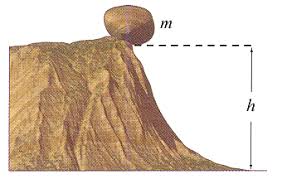
What is the mass of an object with 1200 J of PE when it is 5 meters above the ground?
10 kg
24 kg
100 kg
240 kg


If 68 Joules of work were necessary to move a 4 Newton crate, how far was the crate moved?
272 m
17 m
4.05 m
68 m

A spring is compressed by a force F against a wall as shown. Which of the following describes the sign of work done by the spring as it is being compressed?
The spring does positive work since it is gaining potential energy.
The spring does zero work since all the work is done by force F.
The spring does negative work since it applies a force against the direction of its compressing motion.
The spring works part-time at Chik Fil-A.
In which of the following situations is kinetic energy decreasing?
A lit tinsel llama is dropped from a building.
A satellite is moving in a circular orbit around the moon.
A baseball is headed upward after being thrown up in the air.
An elevator is moving upward at a constant velocity.

A roller coaster car of mass m has a speed of 0 m/s just before it starts to go down a hill as show above. Assume the roller coaster does not encounter any friction or air resistance. What is the speed of the roller coast car at point B?
gh
2gh
2gh
m2gh

A dude drags a car mass M across a rough floor with a force of magnitude directed at an angle theta of above the horizontal as shown. If he drags the crate for a distance D, which of the following is equal to the work by the force of friction?
−FcosθD
−μmgD
−μ(mg−Fsinθ)D
−μ(mg+Fcosθ)D
A car of mass m is traveling at a speed of when the driver applies the brakes. The car moves a distance of d before it stops completely. What is the magnitude of the braking force required?
v22d
2dmv2
d2v2
dmv
A beat is dropped from the edge of a cliff. Which of the following graphs best represents the beat's kinetic energy KE as a function of time t?


Jared holds a book still two feet above his desk. He then lowers the book at a constant speed and places it on the desk. Which of the following describes the change in total mechanical-energy of the book?
The total mechanical energy is unchanged since there is no net work done as the book is lowered.
The total mechanical energy decreases because Jared does positive work on the book.
The total mechanical energy is unchanged because no work is done on the book while it is lowered.
The total mechanical energy decreases, because Jared does negative work on the book.

The system shown consists of two objects of unequal masses, M1 and M2, and pulley with negligible mass and friction. Which of the following is true about the changes in the gravitational potential energy and kinetic energy of the system soon after the objects are released from rest?
ΔU = 0 and ΔK>0
ΔU>0 and ΔK>0
ΔU<0 and ΔK>0
ΔU=0 and ΔK=0

A stick figure of mass running at speed grabs a light rope that hangs from a ceiling of height H and swings to a maximum height of In another room with a ceiling of height H/2, a second stick figure with mass running at the same speed grabs a light rope hanging from the ceiling and swings to a height of . How does the maximum height reached by the two stick figures compare and why?
The first stick figure swings to a higher height since he swings from a higher rope.
The second stick figure swings to a higher height since he has more mass.
The two stick figures reach the same height, because the length of the second rope offsets the mass of the second stick figure.
Both stick figures swing to the same height because they have the same initial speed.

The graph on the right shows the kinetic energy over time for a lit tinsel llama in motion. At time t = 0, the potential energy of the llama is 10 J. Determine the potential energy of the object at time t = 9 s.
4 J
10 J
8 J
2 J

A box of oranges slides from rest down a frictionless incline from a height of 5.0 m. A constant frictional force, introduced at point A, brings the block to rest at point B, 19 m to the right of point A. What is the coefficient of kinetic friction of the surface from A to B?
0.11
0.26
0.33
0.47

A pendulum bob swings from potential C to D as indicated in the diagram. There is no friction or air resistance. Which of the following is not true?
Kinetic Energy decreases from C to D
Potential Energy decreases from C to D
The Total Energy stays constant from C to D.
The bob is fastest at point C.

The 70 kg skier starts from a height of 20 m. If there is no friction, what is his velocity at the bottom of the incline?
37 m/s
20 m/s
14 m/s
10 m/s
A basketball that is dropped bounces back up to its original height. Pick the correct energy transformation from the point when it was dropped until it returns to the original height.
KE --> PE --> Elastic
PE --> KE --> Elastic --> KE --> PE
KE --> PE --> Elastic --> PE --> KE
Elastic --> PE --> KE --> Elastic
You lift a suitcase from the floor and keep it on a table.
The work done by you on the suitcase does not depend on the path taken by the suitcase.
The work done by you on the suitcase depends on the path taken by the suitcase
The work done by you on the suitcase is the same as the work done by gravity on the suitcase
The work done by you on the suitcase depends upon the time you took to lift and keep it on the table.
Which of the following is correct ?
The work done by a non-conservative force does not depend upon the path taken.
Work done by gravity is always negative
If the work done by non-conservative forces is zero, then the mechanical energy of the system remains conserved
Work done by friction is always negative.
Statement 1: Work done by all the forces on a body is equal to change in its kinetic energy.
Statement 2: Energy can neither be created nor destroyed.
Both statements are correct and Statement 2 is the correct explaination of Statement 1.
Both statements are correct but Statement 2 is NOT the correct explaination of Statement 1
Only Statement 1 is correct
Only Statement 2 is correct
A ball of mass 2 kg is thrown vertically upward with a speed 20 m/s and it reaches a maximum height of 15 m. Find the work done by air friction on the ball during this journey. Take g = 10 m/s2
50 J
100 J
150 J
-100 J

Consider the situation shown in the figure. Initially the spring is unstretched when the system is released from rest. Assuming no friction in the pulley, the maximum
elongation of the spring is
Kmg
K2mg
K3mg
K4mg
A particle moves under the effect of a force F = cx from
x = 0 to x = x1. The work done in the process is
cx12
21cx12
cx13
21cx13
A block of mass m slides down along the surface of the
bowl (radius R) from the rim to the bottom. The velocity
of the block at the bottom will be
gR
πgR
2gR
2πgR

Statement 1: In the figure show, work done by tension due to string is zero when the ball is allowed to fall a height h
Statement 2: Tension is non-conservative in nature.
Both statements are correct and Statement 2 is the correct explaination of Statement 1.
Both statements are correct but Statement 2 is NOT the correct explaination of Statement 1
Only Statement 1 is correct
Only Statement 2 is correct

A pendulum bob of mass m on a cord of length L is pulled sideways until the cord makes an angle θ with the vertical as shown in the figure to the right. The change in potential energy of the bob during the displacement is:
mgL(1–cos θ)
mgL(1–sin θ)
mgLsinθ
mgLcosθ
A softball player catches a ball of mass m, which is moving towards her with horizontal speed V. While bringing the ball to rest, her hand moved back a distance d. Assuming constant deceleration, the horizontal force exerted on the ball by the hand is:
2dmv2
dmv2
d2mv
dmv

A pendulum is pulled to one side and released. It swings freely to the opposite side and stops. Which of the following might best represent graphs of kinetic energy (Ek), potential energy (Ep) and total mechanical energy (ET)?
A
B
C
D
A car of mass m slides across a patch of ice at a speed v with its brakes locked. It the hits dry pavement and skids to a stop in a distance d. The coefficient of kinetic friction between the tires and the dry road is µ. If the car has a speed of 2v, it would have skidded a distance of:
4d
d
1.41d
2d

From the top of a high cliff, a ball is thrown horizontally with initial speed vo. Which of the following graphs best represents the ball's kinetic energy K as a function of time t?
D
A
B
C

The figure shows a rough semicircular track whose
ends are at a vertical height h. A block placed at
point P at one end of the track is released from rest
and slides past the bottom of the track. Which of the
following is true of the height to which the block
rises on the other side of the track?
It is equal to 2πh
It is equal to 4h
It is equal to 2h
It is equal to h
It is between zero and h; the exact height depends on how much energy is lost to friction.
A block of mass m slides on a horizontal frictionless table with an initial speed vo. It then compresses a spring. How much is the spring compressed from its natural length?
2gv02
v0 kmg
v0 km
v0km
v0mk
A frictionless pendulum of length 3 m swings with an amplitude of 10°. At its maximum displacement, the potential energy of the pendulum is 10 J. What is the kinetic energy of the pendulum when its potential energy is 5 J ?
3.3 J
5 J
6.7 J
10 J
15 J
There are 4 laws of thermodynamics; the zeroth law describes the direction that energy passes between systems. Which of the following correctly shows the heat transfer between the objects shown?


A
B
C
D

A
B
C
D

A
B
C
D

A
B
C
D

A
B
C
D

A
B
C
D

A
B
C
D

A
B
C
D

A
B
C
D

A
B
C
D

What is the work done by the 75-N force?
15-J
60-J
375-J
2.4-J
What is the work done by friction?
375-J
125-J
-125-J
-375-J
What is the total work done on this box?
15-J
250-J
0-J
625-J
What is the work done by the weight of the box?
-338-J
60-J
0-J
588-J
What is the gravitational potential energy of a 10-kg rock precariously perched on a cliff that is 50-m above the ground?
98-J
4,900-J
500-J
51.02-J
What is the potential energy of a 30-kg rock that is at a height of 3-m above the surface of Ceres (g = 0.27-N/kg)?
24.3-J
333.3-J
882-J
90-J

The diagram shows the mass & velocity of four carts. Which cart has the greatest kinetic energy? Read the answer choices carefully as they may not be in alphabetical order.
Cart A
Cart B
Cart C
Cart D
The diagram shows the mass & velocity of four carts. If you brought each cart to a stop, which cart would require the least work to stop it? Read the answer choices carefully as they may not be in alphabetical order. NOTICE THAT CART C IS NOT AN OPTION!!!
Cart A
Cart B
They all would require the same amount of work to stop them.
Cart D
A 2250-kg car is traveling at 26-m/s. What is the car’s kinetic energy?
29,250-J
58,500-J
1,521,000-J
760,500-J
In bowling, if you want to cause the pins to move around more as the ball hits them, what about the ball should
you try to increase? {READ THE ENTIRE ANSWER!!!}
You should increase the speed of the ball only.
You should increase the mass of the ball only.
You should increase the speed of the ball and its mass, but the mass is more important.
You should increase the speed of the ball and its mass, but the speed is more important.
In archery, when you pull the bow back you store elastic potential energy.
If you have pulled the bow back storing 500-J of elastic potential energy in the bow, how much work was done on the bow?
500-J
0-J
250-J
This cannot be determined without knowing the force applied to the bow and the distance it was pulled.

566 J
34 J
52 J
-55 J
If M represents units of mass, L represents units of length, and T represents units of time, the dimensions of power would be:
T2ML
T2ML2
T3ML2
TML
TML2
A person pushes a box across a horizontal surface at a constant speed of 0.5 meter per second. The box has a mass of 40 kilograms, and the coefficient of sliding friction is 0.25. The power supplied to the box by the person is
0.2 W
5 W
50 W
100 W
200 W
A horizontal force F is used to pull a 5-kilogram block across a floor at a constant speed of 3 meters per second. The frictional force between the block and the floor is 10 newtons. The work done by the force F in 1 minute is most nearly:
0 J
30 J
600 J
1350 J
1800 J
A weight lifter lifts a mass m at constant speed to a height h in time t. What is the average power output of the weight lifter?
mg
mh
mgh
mght
tmgh
A car of mass 700kg is at rest and begins to accelerate forward with a power of 80hp. Ignoring all rotational accelerations, what is the instantaneous linear acceleration of the car?
1hp = 745.7 W
5.2 s2m
9.8 s2m
13 s2m
0 s2m

A force of 20 N is used to pull this box to the left for a distance of 100 m. What is the value of work done on the box?
1300.6 Joule
1519.4 Joule
2000.0 Joule
30 000 Joule

A picture of a plane of mass 80 000 kg is flying in the air at velocity of 900 kmh-1. The height of the planes is 35 000 feet from the ground level.
Calculate it gravitational energy and kinetic energy at that time.
PE = 2.74 x 10¹⁰ J, KE = 2.50 x 10⁹ J
PE = 2.74 x 10¹⁰ J, KE = 3.24 x 10¹⁰ J
PE = 8.37 x 10⁹ J, KE = 3.24 x 10¹⁰ J
PE = 8.37 x 10⁹ J, KE = 2.50 x 10⁹ J
What is the principle of conservation of energy principle?
energy can be created and destroyed. Energy can be transferred from one another
energy can be created but it cannot be destroyed. Energy can be transferred from one another.
Energy can be transferred from other forms and other object. Energy cannot be created or destroyed.
Total energy for the system is not constant, It will depends on the value of gravitational energy and kinetic energy.

A fan of power of 80 Watt has mass of the blades and motor of 1.2 kg. The fan blades moves at 18 ms-1 in 45 seconds. Find the efficiency of the fan.
5.4 %
5.9 %
54 %
59 %

A 10 kg box is pulled a distance of 3m by a force of 30 N.
The work done is
9 J
30 J
90 J
900 J

If your teacher falls down these stairs, what would happen to his potential energy?
Increase
Decrease
Remain constant

A plastic marble rolls along this rollercoaster ramp without friction or air drag. Where will it have the most potential energy?
A
B
C
D
If the mouse-trap car from the previous question was rolling twice as fast, which statement would be true?
It would have 2× times as much potential energy
It would have 2× as much kinetic energy
It would have 4× as much potential energy
It would have 4× as much kinetic energy

This graph describes the motion of a 60 kg dog. Calculate its kinetic energy.
1,800 J
27,000 J
54,000 J
432,000 J
864,000 J

A man pushes this 50ºF box 5 meters across the floor. He does this by applying 20 N for 4 seconds. How much work did he do?
16 J
25 J
80 J
100 J
125 J

A 0.2 kg ball move from point A to B and to C, as shown in the figure. Calculate its velocity, when it reach point C.
1.67 ms-1
6.67 ms-1
2.67 ms-1
7.67 ms-1

A
B
C
D

A
B
C
D

Mass of the object
Force acting on the object
Speed of the object
Accelereration of the object
Distance moved by the object

A
B
C
D

A
B
C
D

A
B
C
D

A
B
C
D

A
B
C
D

A
B
C
D

A
B
C
D

A
B
C
D
A
B
C
D
A
B
C
D

A car’s engine produces a useful output power of 6.5 × 10⁴ W
The car of mass 950 kg is moving up a hill at a steady speed. The slope of the hill is 12° to the horizontal. Resistive forces on the car are negligible.
What is the steady speed of the car?
7.0 m s–1
12 m s–1
34 m s–1
68 m s–1

A mass of 2.5 kg is released from rest at X and slides down a ramp, of height 3.0 m, to point Y as shown.
When the mass reaches Y at the bottom of the ramp it has a velocity of 5.0 m s–1.
What is the average frictional force between the mass and the ramp?
8.5 N
10.6 N
14.7 N
24.5 N

The units of physical quantities can be expressed in terms of the fundamental (base) units of the SI system. In which line in the table are the fundamental units correctly matched to the physical quantity?
A
B
C
D

Two unpowered toy cars, P and Q, are released from rest from X and travel down the track to Y. Car P has twice the mass of car Q. There is negligible friction.
What quantity is the same for car P and car Q?
The gravitational potential energy at X.
The accelerating force at X.
The velocity when they arrive at Y.
The momentum when they arrive at Y.

A firework rocket is fired vertically into the air and explodes at its highest point. What are the changes to the total kinetic energy of the rocket and the total momentum of the rocket as a result of the explosion?
A
B
C
D
Which of the following is not a unit of power?
N m s–1
kg m2 s–3
J s–1
kg m–1 s–1
A car exerts a driving force of 500 N when travelling at a constant speed of 72 km h–1 on a level track. What is the work done in 5 minutes?
3.0 × 10⁶ J
2.0 × 10⁶ J
2.0 × 10⁵ J
1.1 × 10⁵ J
An electric motor of input power 100 W raises a mass of 10 kg vertically at a steady speed of 0.5 m s–1. What is the efficiency of the system?
5%
12%
50%
100%
Which of the following is not a unit of power?
N m s−1
J s
W
kg m2 s−3

Two ice skaters, initially at rest and in contact, push apart from each other.
Which line, A to D, in the table states correctly the change in the total momentum and the total kinetic energy of the two skaters?
A
B
C
D
Which one of the following could not be used as a unit of force?
A T m
W s–2
kg m s–2
J m–1
A 10 mF capacitor is charged to 10 V and then discharged completely through a small motor. During this process, the motor lifts a weight of mass 0.10 kg. If 10% of the energy stored in the capacitor is used to lift the weight, through what approximate height will the weight be lifted?
0.05 m
0.10 m
0.50 m
1.00 m
Which of the following does not give a value in seconds?
capacitance × resistance

half-life


A load of 4.0 N is suspended from a parallel two-spring system as shown in the diagram.
The spring constant of each spring is 20 N m–1. The elastic energy, in J, stored in the system is
0.1
0.2
0.4
0.8

The diagram shows a metal rod suspended in a magnetic field by two vertical conducting springs. The cell and rod have negligible resistance.
When the switch S is closed the effect of the magnetic field is to displace the rod vertically a distance y.
y/2
y/4
y
4y

The force on a sample of a material is gradually increased and then decreased. The graph of force against extension is shown in the diagram
The increase in thermal energy in the sample is represented by area
R
P + Q
P + Q + R
P + Q − R
The main difference between kinetic energy and potential energy is that
kinetic energy involves position, and potential energy involves motion.
kinetic energy involves motion, and potential energy involves position.
although both energies involve motion, only kinetic energy involves position.
although both energies involve position, only potential energy involves motion.
A student and a teacher lift a book from the floor and place it on the same shelf. The book lifted by the student has a greater mass than the book lifted by the teacher. Which of the following compares the work performed by the student and the teacher?
The student did more work than the teacher because the student lifted a heavier book
The student and the teacher did the same amount of work because they each moved a book the same distance
The teacher did more work than the student because the teacher lifted a lighter book
The student and the teacher did the same amount of work because the each lifted the same amount of books
Which of the following best demonstrates kinetic energy?
light bulb
book on a shelf
bird in flight
flashlight battery
An archer pulls back the bowstring to prepare to shoot an arrow. She uses an average force of 40 N, moving the bowstring 0.2m. How much energy is stored in the bow?
4 J
8 J
24 J
36 J
A motor does 30,000 J of work to lift an elevator in 11s. What is the average power generated by the motor?
2,300 Watts
2,700 Watts
28,000 Watts
30,000 Watts

A pendulum swings back and forth several times, as shown in the diagram above. Assume friction is negligible.
Which of the following graphs best illustrates the potential energy (PE) and the kinetic energy (KE) of the pendulum over a period of several swings?


The diagram above shows the path of a student on a sled starting from rest at point W. The student slides down a frictionless, snow-covered hill past point Z, which is at ground level. Which of the following statements best describes the energy of the student and sled from point W to point Z?
The total energy at point W is less than at point Z
The total energy at point W is greater than at point Z
The potential energy at point W becomes all kinetic energy at point Z
The kinetic energy at point W becomes all potential energy at point Z

The diagram shows two bowling balls of equal mass. Ball A is resting near the edge of a shelf. Ball B is resting on the ground below. Which of the following statements best describes the diagram above?
Ball A has more kinetic energy than Ball B
Ball B has more kinetic energy than Ball A
Ball A has more potential energy than Ball B
Ball B has more potential energy than Ball A

A skateboarder travels from location 1 to location 4 as shown above. At which location does the skateboarder have the most kinetic energy and the least potential energy?
1
2
3
4

While playing a game at a fair, a person lifts a mallet above her head. She then lets the mallet fall toward a target, as shown above. Which of the following statements describes an energy change that takes place as the person lifts the mallet and then lets it fall towards the target?
Potential energy converts to kinetic energy as the mallet falls toward the target
Potential energy decreases as the mallet reaches its highest point
Kinetic energy converts to potential energy as the mallet falls toward the target
Kinetic energy increases as the mallet reaches its highest point

Balok bermassa 10 kg berada di atas lantai licin seperti gambar. Balok ditarik dengan gaya F =25 N membentuk sudut 37° terhadap arah horizontal. Setelah berpindah ke kanan 2 m besar usaha oleh gaya F sebesar .... (cos 37 = 0,8)
30 J
40 J
50 J
100 J
200 J

Sebuah benda m = 3 kg bekerja gaya mendatar yang berubah terhadap jarak yang ditempuhnya, seperti grafik di bawah. Jika arah gaya searah dengan perpindahannya. hitung usaha yang dilakukan hingga berpindah sejauh 7 m sebesar ....
110 J
135 J
140 J
170 J
200 J

Sebuah balok dengan massa M berada pada bidang datar, balok tersebut ditarik oleh gaya sebesar 120 N ke kanan. Jika balok berpindah sejauh 70 cm maka hitunglah usaha yang dilakukan oleh gaya tersebut!
16 J
34 J
84 J
360 J
840 J

Perhatikan grafik gaya (F) terhadap perpindahan (S) berikut ini!nbesarnya usaha hingga detik ke 12 adalah ...
16 J
63 J
68 J
73 J
90 J

Perhatikan gambar berikut !
Benda sebesar 10 N berada pada bidang miring yang licin, dengan sudut kemiringan 30o. Jika benda meluncur sejaum 1 m, maka usaha yang dilakukan oleh gaya berat adalah
10 sin 30 Joule
10 cos 30 Joule
10 sin 60 Joule
10 cos 60 Joule
10 tan 30 Joule
Sebuah pesawat terbang mempunyai massa 105kg. Mesinnya mampu menghasilkan gaya 2.105 N. Pesawat tersebut bergerak dari keadaan diam dan untuk lepas landas diperlukan laju 100 m/s. Maka panjang lintasan minimum yang diperlukan agar pesawat tersebut lepas landas adalah
1500 m
2500 m
3500 m
4500 m
5500 m
Sebuah benda bermassa 4 kg mula mula diam, kemudian bergerak lurus dengan percepatan 3 m/s2. Usaha yang diubah menjadi energi kinetik setelah 2 detik adalah
6 J
12 J
24 J
48 J
72 J
Sebuah benda dengan massa 1 kg jatuh bebas dari ketinggian 10 meter di atas tanah. Usaha yang dilakukan sampai benda berada 2 meter di atas tanah adalah
20 J
40 J
60 J
80 J
100 J
Sebuah tongkat yang panjangnya 40 cm dan tegak di atas tanah, dijatuhi martil 10 kg dari ketinggian 50 cm di atas ujungnya. Jika gaya tahan rata –rata tanah 103 N, maka banyaknya tumbukan martil yang perlu dilakukan terhadap tongkat agar menjadi rata dengan permukaan tanah adalah
4 kali
5 kali
6 kali
8 kali
10 kali

Sebuah balok ditahan di puncak bidang miring seperti gambar. Ketika dilepas, balok meluncur tanpa gesekan sepanjang bidang miring. Kecepatan balok ketika tiba di dasar bidang miring adalah ….
6 m/s
8 m/s
10 m/s
12 m/s
16 m/s

Sebuah peluru dengan massa 20 gram ditembakkan pada sudut elevasi 60o dan kecepatan awal 40 m/s seperti gambar. Jika gesekan dengan udara diabaikan, maka energi kinetik peluru pada titik tertinggi adalah ….
0 joule
4 joule
8V2 joule
12 joule
24 joule

Sebuah benda bermassa 0,5 kg digantung dengan benang (massa benang di abaikan) dan diayunkan hingga ketinggian maksimum 20 cm dari posisi awal (lihat gambar). Bila g = 10 m/s2, kecepatan benda di titk A adalah ….
2 m/s
0,4 m/s
0,2 m/s
0,04 m/s
0,02 m/s

Sebuah balok bermassa m kg dilepaskan dari puncak bidang miring yang licin seperti pada gambar. Perbandingan energi potensial dan energy kinetik balok ketika berada di titik M adalah ….
Ep : Ek = 1 : 3
Ep : Ek = 1 : 2
Ep : Ek = 2 : 1
Ep : Ek = 2 : 3
Ep : Ek = 3 : 2
Untuk mengangkat benda bermassa 50 kg setinggi 300 meter dalam waktu 20 sekon, diperlukan daya sebesar… (g = 10 m/s2)
15000 W
7500 W
1000 W
750 W
500 W

When stickman pushes the box up the hill, he is doing ___________ work on the box.
positive
negative
zero

A car is driving along the ground as shown in the picture. What type(s) of energy does it have at this moment?
kinetic energy
kinetic and gravitational potential
kinetic and elastic potential
gravitational and elastic potential
A car is driving along the ground as shown in the picture. What will happen to its energy when it crashes into the barrels
its kinetic energy will become gravitational energy
its energy will disapear
the car will lose energy, but its surroundings will gain energy
A car is driving along the ground as shown in the picture. How would you find how much energy the car has at this moment?
21(1600)(42)
(4)(10)(1600)
21(1600)(42)+(4)(10)(1600)
21(1600)(42)−(4)(10)(1600)

This graph shows the velocity of a hockey puck that is being passed back and forth across the ice. Where is the puck's energy the greatest?
A
B
C
D
This graph shows the velocity of a hockey puck that is being passed back and forth across the ice. Where positive work being done on the puck?
A
B
C
D

This roller coaster doesn't work. What one thing could be done so that a marble released from the start would reach the finish?
make the first hill taller than the loop
make the first hill steeper
make the loop less steep
make the first hill more slippery
What is the common formula for work?
W=F v cos (angle between the direction of motion and the force)
W=F d cos (angle between the direction of motion and the force)
W=F m cos (angle between the direction of motion and the force)
W=F t cos (angle between the direction of motion and the force)

What's the total work done of a force equal to 450 N at 35 ° and which moved the object for 3.5 m. Neglect friction
1575 J
903.38
1290.16 J
1000 J

The pendulum on a clock swings back and forth. At top of a swing the pendulum has maximum potential energy. When does the pendulum next have maximum potential energy? (16)
When the pendulum the top of its swing on the other side (5)
When the pendulum reaches the lowest location of its swing (3)
When the pendulum returns to the current location (1)
When the pendulum is halfway between the starting and bottom position (2)
The pendulum on a clock swings back and forth. At top of a swing the pendulum has maximum potential energy. When does the pendulum next have maximum kinetic energy? (16)
When the pendulum the top of its swing on the other side (5)
When the pendulum reaches the lowest location of its swing (3)
When the pendulum returns to the current location (1)
When the pendulum is halfway between the starting and bottom position (2)

