wayground logo

Free Printable Worksheets

Font size

S
M
L
XL
Worksheets

9 Weeks Review Part 2

Total questions: 182

Worksheet time: 9hrs 44mins
Name
Class
Date
1.
 Jermaine runs exactly 2 laps around a 400 meter track. What is the displacement?
a)
800
b)
400
c)
0
d)
200
2.
1.  Amy runs 2 miles south, then turns around and runs 3 miles north. What is displacement?
a)
5 miles
b)
1 miles
c)
2 miles
d)
3 miles
3.
1.  Ray runs 30 feet north, 30 feet west, and then 30 feet south. What is the displacement?
a)
30 feet west
b)
90 feet 
c)
30 feet south
d)
0 feet
4.
1.  Ray runs 30 feet north, 30 feet west, and then 30 feet south. What is the displacement?
a)
30 feet west
b)
90 feet 
c)
30 feet south
d)
0 feet
5.
What kind of quantity has both a magnitude and a direction?
a)
scalar
b)
vector
c)
frame of reference
d)
time
6.
Bill runs 400 meters to Andy's house, turns around, and runs 400 meters back home.  What is Bill's displacement?
a)
0 meters
b)
400 meters
c)
800 meters
d)
1600 meters
7.
A persons walks 50 meters directly north, stops, and then travels 32 meters directly south.  What is their displacement?
a)
82 meters
b)
18 meters
c)
28 meters
8.

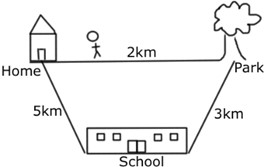
Jerry walked from home to school, then from the school to the park. What is his total displacement?

a)

2 km

b)

5 km

c)

8 km

d)

10 km

9.
A person walks 50 meters directly north, stops, and then travels 32 meters directly south.  What is their displacement?
a)
82 meters
b)
18 meters
c)
28 meters
10.
1.  Amy runs 2 miles south, then turns around and runs 3 miles north. What is displacement?
a)
5 miles
b)
1 miles
c)
2 miles
d)
3 miles
11.
A person walks 10 miles east, then 5 miles west, and then 10 miles east.  What is the person's displacement?
a)
25 miles east
b)
20 miles west
c)
15 miles east
d)
10 miles west
12.
A car drives 20 miles west, 5 miles north, 10 miles east, then 5 miles south.  What is the total displacement?
a)
40 miles east
b)
20 miles south
c)
10 miles west
d)
o miles
13.
A person walks 3 blocks south, 3 blocks west, 3 blocks north, and then 3 blocks east.  What is the total displacement?
a)
0 miles
b)
12 blocks
c)
6 blocks south
d)
6 blocks north
14.
A person rides a bike 10 blocks east, then 5 blocks south.  What is the bikers displacement?
a)
15 blocks east
b)
11.2 blocks southeast
c)
10 blocks southeast
d)
5 blocks south
15.
Scott travels north 5 miles and then goes west 3 miles before coming straight back south 2 miles. What is his displacement?
a)
10
b)
6
c)
7
d)
8
16.
1.  Amy runs 2 miles south, then turns around and runs 3 miles north. What is displacement?
a)
5 miles
b)
1 miles
c)
2 miles
d)
3 miles
17.
1.  Ray runs 30 feet north, 30 feet west, and then 30 feet south. What is the displacement?
a)
30 feet west
b)
90 feet 
c)
30 feet south
d)
0 feet
18.
Jerry walked from home to school, then from the school to the park.  What is his total displacement?
a)
2 km
b)
5 km
c)
8 km
d)
10 km
19.
Vector quantities need both a magnitude and a _____.
a)
distance
b)
displacement
c)
direction
d)
velocity
20.
30 m/sec, East. Scalar or Vector
a)
Scalar
b)
Vector
c)
Neither
21.
A deer running 15 meters per second due west.Vector or scalar?
a)
Scalar
b)
Vector
22.
 Jermaine runs exactly 2 laps around a 400 meter track. What is the displacement?
a)
800
b)
400
c)
0
d)
200
23.
A person walks 50 meters directly north, stops, and then travels 32 meters directly south.  What is the magnitude of their displacement?
a)
82 meters
b)
18 meters
c)
28 meters
24.
Bill runs 400 meters to Andy's house, turns around, and runs 400 meters back home.  What is Bill's displacement?
a)
0 meters
b)
400 meters
c)
800 meters
d)
1600 meters
25.
Vector quantities need both a magnitude and a _____.
a)
distance
b)
displacement
c)
direction
d)
velocity
26.
Bill runs 400 meters to Andy's house, turns around, and runs 400 meters back home.  What is Bill's distance?
a)
0 meters
b)
400 meters
c)
800 meters
d)
1600 meters
27.
Displacement and distance are always the same number.
a)
True
b)
False
28.
Scott travels north 5 miles and then goes west 3 miles before coming straight back south 2 miles. What is his distance?
a)
10
b)
7
c)
8
d)
6
29.
A person walks 50 meters directly north, stops, and then travels 32 meters directly south.  What is their displacement?
a)
82 meters
b)
18 meters
c)
28 meters
d)
0 meters
30.
A person walks 50 meters directly north, stops, and then travels 32 meters directly south.  What is their distance traveled?
a)
82 meters
b)
18 meters
c)
32 meters
d)
0 meters
31.
1.  Amy runs 2 miles south, then turns around and runs 3 miles north. What is displacement?
a)
5 miles
b)
1 miles
c)
2 miles
d)
3 miles
32.
Find the length of the missing side. 
a)
17 cm
b)
22 cm
c)
15 cm
d)
13 cm
33.
30 m/sec, East. Scalar or Vector
a)
Scalar
b)
Vector
c)
Neither
34.
Wind blowing at 20 mph.Vector or scalar?
a)
Scalar
b)
Vector
35.

A roller coasters accelerates from an initial speed of 6.0 m/s to a final speed of 70 m/s over 4 seconds. What's the acceleration?

a)

24 m/s2

b)

18 m/s2

c)

16 m/s2

d)

16 m/s

36.
A car accelerates from a standstill to 70 m/s in 10 seconds.  What is the acceleration?
a)
0.7m/s2
b)
7m/s2
c)
14m/s2
d)
none of the above
37.
The SI unit for acceleration is
a)
mph
b)
ft/sec2
c)
m/s2
38.
A dog runs with an initial speed of 7.5 m/s on a waxed floor.  It slides to a stop in 15 seconds.  What is the acceleration?
a)
-7.5 m/s
b)
-7.5 m/s2
c)
-0.5 m/s2
d)
7.5 mi//hr
39.
A car starts from rest at a stop light and reaches 20 m/s in 3.5 s. Determine the acceleration of the car.
a)
2.2m/s2
b)
7.0m/s2
c)
5.7m/s2
d)
70m/s2
40.
A drag racer accelerated from 0 m/s to 200 m/s in 5 s.  What was the acceleration?
a)
0 m/s
b)
40 m/s2
c)
-40 m/s2
d)
40 m/s
41.
A ball of clay is thrown at a wall at a velocity of 28.0 m/s.  After it hits the wall, it takes 0.020 s to stop.  What is the acceleration of the clay when it hits the wall?
a)
1400 m/s2
b)
-1400 m/s2
c)
0.56 m/s2
d)
-0.56 m/s2
42.
A box sliding down an inclined plane attains a velocity of 27 m/s in 3 seconds from rest.  Find the acceleration.
a)
30 m/s
b)
24 m/s2
c)
9 m/s2
d)
81 km/hr
43.
A roller coasters accelerates from an initial velocity of of 6.0 m/s to a final velocity of 70 m/s over 4 seconds.  What's the acceleration?
a)
24 m/s2
b)
18 m/s2
c)
16 m/s2
d)
16 m/s
44.
A dog runs with an initial speed of 7.5 m/s on a waxed floor.  It slides to a stop in 15 seconds.  What is the acceleration?
a)
-7.5 m/s
b)
-7.5 m/s2
c)
-0.5 m/s2
d)
7.5 mi//hr
45.
A car starts from rest at a stop light and reaches 20 m/s in 3.5 s. Determine the acceleration of the car.
a)
2.2m/s2
b)
7.0m/s2
c)
5.7m/s2
d)
70m/s2
46.
A bicyclist begins moving with a velocity of 10 m/s and then decreases his velocity to 6 m/s in 2 seconds. What is the acceleration of the bicyclist?
a)
4 m/s2
b)
-4 m/s2
c)
2 m/s2
d)
-2 m/s2
47.
A car accelerates from a standstill to 70 m/s in 10 seconds.  What is the acceleration?
a)
0.7m/s2
b)
7m/s2
c)
14m/s2
d)
none of the above
48.
A drag racer accelerated from 0 m/s to 200 m/s in 5 s.  What was the acceleration?
a)
0 m/s
b)
40 m/s2
c)
-40 m/s2
d)
40 m/s
49.

what is another name for ''slowing down?''

a)

depression

b)

regression

c)

retreating

d)

deceleration

50.
A drag racer accelerated from 0 m/s to 200 m/s in 5 s.  What was the acceleration?
a)
0 m/s
b)
40 m/s2
c)
-40 m/s2
d)
40 m/s
51.
A dog runs with an initial speed of 7.5 m/s  to a stop in 15 seconds.  What is the acceleration?
a)
-7.5 m/s
b)
-7.5 m/s2
c)
-0.5 m/s2
d)
7.5 mi//hr
52.
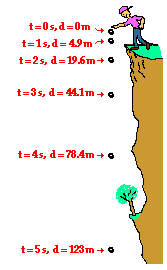
A free falling objects falls under the influence of 
a)
force of air
b)
force of gravity
c)
force of resistance
d)
force of 
53.
Approximately how far can an object fall in 5 seconds? 
a)
5 m
b)
25 m
c)
50 m/s
d)
125 m
54.

Kenyatta drops on object and it free falls for 5.00 seconds and has a final velocity of 49.0 m/s. What was the height of the cliff the object was dropped from?

a)

122.5 m

b)

250 M

c)

24.5 m

d)

0 m

55.
A free falling object falls for 1.6 s. What is the final velocity?
a)
-15.68 m/s
b)
- 9.8 m/s
c)
- 6.125 m/s
d)
- 25.088 m/s
56.
A ball is thrown downward from the top of a roof with a speed of 25 m/s. After 2 s, its velocity will be (down is considered a negative direction):
a)
19.6 m/s
b)
-5.4 m/s
c)
-44.6 m/s
d)
44.6 m/s
57.
A ball is thrown up in the air with an initial velocity of 40 m/s. What is the ball's velocity after 6 seconds? 
a)
20 m/s traveling upward.
b)
10 m/s traveling downward.
c)
20 m/s traveling downward. 
d)
30 m/s traveling downward. 
58.
A free falling object falls for 1.6 s. What is the final velocity?
a)
-15.68 m/s
b)
- 9.8 m/s
c)
- 6.125 m/s
d)
- 25.088 m/s
59.
What values are always known for a free falling object?
a)
vi = 0 m/s
 a = -9.8 m/s2
b)
vi = -9.8 m/s
 a = -9.8 m/s2
c)
vi = -9.8 m/s
 a = 0 m/s2
d)
d = -9.8 m
vi = 0 m/s
60.
Do free falling objects move at constant velocity or do they accelerate?
a)
Falling objects accelerate at -9.8 m/s2
b)
Falling object move at constant velocity
c)
Falling objects accelerate at 100 m/s2
d)
It depends on the mass: heavy objects accelerate, light objects do not
61.
A freely falling object starts from rest. After falling for 6  seconds, it will have a speed of about 
a)
6m/s
b)
30m/s
c)
60m/s
d)
300m/s
62.
Free fall is
a)
Only when an object travels downward, or is falling
b)
Changes based on which object is in free fall. A heavier object will have a greater free fall than a lighter one
c)
When the object is only experiencing the force of gravity
d)
When objects have zero forces acting upon them
63.
A free falling object falls for 2.4 s. What is its displacement?
a)
-28.2 m
b)
-11.76 m
c)
-56.45 m
d)
-9.8 m
64.
Why can't you use v = d/t for free fall problems?
a)
Because free falling objects are accelerating;
v = d/t is for constant motion
b)
Because free falling objects have constant motion; 
v = d/t is for accelerating objects
c)
You never know how far an object  will fall, so you can't put anything in for "d"
65.
What happens to the velocity of a ball as it is dropped off a cliff? 
a)
It decreases at a uniform rate 
b)
It increases at a uniform rate 
c)
It is constant 
d)
It increases at a non-uniform rate
66.

A free falling object falls for 2.4 s. What is its final speed? (ignore air resistance)

a)

23.52 m/s

b)

0.24 m/s

c)

It cannot be calculated because there is no distance.

d)

9.8 m/s

67.
A pumpkin is dropped from a 35 m building. What is its initial velocity (vi)?
a)
9.8 m/s2
b)
35 m
c)
0 m/s
d)
9.8 m/s
68.
A freely falling object starts from rest. After falling for 6 seconds, it will have a speed of about:
a)
6m/s
b)
30m/s
c)
60m/s
d)
300m/s
69.

A book falls off a 1 meter tall table. How long will it take for the book to hit the floor?

a)

70 s

b)

.79 s

c)

1.37 s

d)

.451 s

70.

A rock is dropped out of a volcano. When it started to fall, it took 9.5 s to hit the ground. How fat was the rock traveling as it struck the ground?

a)

93.2 m/s

b)

39 m/s

c)

5.87 m/s

d)

107.91 m/s

71.

A plane drops a CARE package to some needy people in the jungle from a height of 1000m. How long will it take the package to strike the ground?

a)

1.27 s

b)

15.04 s

c)

40.08 s

d)

14.3 s

72.
If Steve throws the football 50 meters in 3 seconds, what is the average speed (velocity) of the football?
a)
0.06 m/s
b)
16.7 m/s
c)
150 m/s
d)
53 m/s
73.
If Justin races his Chevy S-10 at the track for 2,560 meters in 60 seconds, what is his average speed?
a)
0.023 m/s
b)
153,600 m/s
c)
42.7 m/s
d)
60 m/s
74.
If Mike rides his motorcycle at an average speed of 20 m/s for 500 seconds, how far does he ride?
a)
10,000 m
b)
25 m
c)
0.04 m
d)
250 m
75.
Lauren's car was detected exceeding the posted speed limit of 60 km/hr. How much over the speed limit was she going if she covered a distance of 10 km in 0.08 hours?
a)
40 km/hr Over
b)
65 km/hr Over
c)
15 km/hr Over
d)
20 km/hr Over
76.
Tina's calculations of a tarantula found that the spider was able to cover 20 cm in 5 seconds. What was the average speed of the spider?
a)
4 m/min
b)
4 m/s
c)
4 cm/min
d)
4 cm/s
77.
What is the formula to calculate speed?
a)
S = t/d
b)
S = d/t
c)
S = d x t
d)
S = t x d
78.
A runner races in the 100 meter dash.  It takes her 10 seconds to finish.  What is her average speed?
a)
10 m/s
b)
1000 m/s
c)
100 seconds
d)
10 seconds
79.
The correct equation to calculate speed is
a)
distance/time
b)
time/distance
c)
distance x time
d)
distance/time2
80.
Alan travels 100 km in 5hrs. Find his average speed in km/h
a)
5km/hr
b)
10km/hr
c)
50km/hr
d)
20km/hr
81.
Find speed when distance is 142 km and time is 2 hours.
a)
71km/hr
b)
52km/hr
c)
17km/hr
d)
90km/hr
82.

Newton's 2nd Law of Motion states which of the following?

a)

Objects at rest tend to stay at rest and objects and motion tend to stay in motion unless an outside force acts on it.

b)

Force = mass x acceleration

c)

For ever action there is an equal and opposite reaction.

83.

Newton's 1st Law of Motion states which of the following?

a)

Objects at rest tend to stay at rest and objects and motion tend to stay in motion unless an outside force acts on it.

b)

Force = mass x acceleration

c)

For ever action there is an equal and opposite reaction.

84.

Newton's 3rd Law of Motion states which of the following?

a)

Objects at rest tend to stay at rest and objects and motion tend to stay in motion unless an outside force acts on it.

b)

Force = mass x acceleration

c)

For ever action there is an equal and opposite reaction.

85.

Which of following describes Newton's 2nd Law of Motion

a)

V = d/t

b)

a = v/t

c)

F=m*a

d)

Vf = vi + (a*t)

86.

Complete the following Equation:

Force =____*acceleration

a)

Mass

b)

Energy

c)

Newtons

d)

Velocity

87.

Complete the following Equation:

Force =____*acceleration

a)

Mass

b)

Energy

c)

Newtons

d)

Velocity

88.

Which of the following must occur in order for an object to have Force? hint: F=m*a

a)

Changing Displacement

b)

Changing Mass

c)

Changing Time

d)

Changing Velocity

89.

Which of the following must occur in order for an object to have Velocity?

a)

Changing Displacement

b)

Changing Mass

c)

Changing Time

d)

Changing Velocity

90.
Alan travels 100 km in 5hrs. Find his average speed in km/h
a)
5km/hr
b)
10km/hr
c)
50km/hr
d)
20km/hr
91.
What is the speed of an object that travels 60 meters in 4 seconds?
a)
240 m/s
b)
15 m/s
c)
0.067 m/s
d)
15 mph
92.
What is the speed of a car that travels 400 m in 20 minutes?
a)
20 miles/hr
b)
20 m/min
c)
800 m/min
d)
200 miles/hr
93.
What is the equation to calculate speed?
a)
speed = distance/time
b)
speed = time/distance
c)
speed = time x distance 
d)
speed = speed/time 
94.
Mr. Rudman speed walked 2 miles in 10 minutes, what is his speed?
a)
0.2 miles/min
b)
2 miles/min
c)
20 miles/min
d)
40 miles/min
95.
If a bird flied a distance of 600m, and has a time of 60s. How fast did they run?
a)
10 m/s
b)
3600 m/s
c)
0.1 m/s
96.
If a 2kg bird is pushed by the wind with a force of 2N, how fast does the bird accelerate?
a)
1 m
b)
2 m/s2
c)
4m/s2
d)
1 m/s2
97.
How much force is needed to accelerate a 3kg skateboard at 5m/s2. 
a)
8N
b)
1.6N
c)
0.6N
d)
15N
98.
How much force is needed to accelerate a 25kg bowling ball at 2m/s2
a)
50N
b)
5N
c)
12.5N
d)
100N
99.

Acceleration is measured in

a)

Newtons

b)

Kilograms

c)

m/s

d)

m/s2

100.
Force = Mass x Acceleration
a)
Newton's 1st Law
b)
Newton's 2nd Law
c)
Newton's 3rd Law
d)
Newton's 4th Law
101.
If you exert a net force of 8 N on a 2-kg object, what will its acceleration be?
a)
2 m/s2
b)
4 m/s2
c)
16 m/s2
d)
10 m/s2
102.

An object of mass 30 kg is falling in air and experiences a force due to air resistance of 50 newtons. Calculate the acceleration of the object.

a)

8.1 m/s/s

b)

.666 m/s/s

c)

11.5 m/s/s

d)

.83 m/s/s

103.

If you exert a net force of 8 N on a 2-kg object, what will its acceleration be?

a)

2 m/s/s

b)

4 m/s/s

c)

16 m/s/s

d)

10 m/s/s

104.

If you exert a net force of 20 N on a 2-kg object, what will its acceleration be?

a)

2 m/s/s

b)

4 m/s/s

c)

16 m/s/s

d)

10 m/s/s

105.

If you exert a net force of 32 N on a 2-kg object, what will its acceleration be?

a)

2 m/s/s

b)

4 m/s/s

c)

16 m/s/s

d)

10 m/s/s

106.

A force of 20 N acts upon a 5 kg block. Calculate the acceleration of the object.

a)

100 m/s/s

b)

4 m/s/s

c)

.20 m/s/s

d)

10 m/s/s

107.
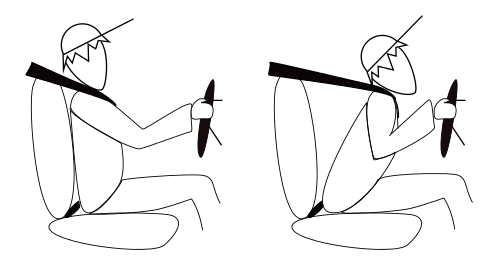
An automobile you are riding in suddenly stops, but you continue to go forward.
a)
Newton's
1st
Law of Motion
b)
Newton's
2nd
Law of Motion
c)
Newton's
3rd
Law of Motion
108.
What is the standard unit force is measured in?
a)
Newtons
b)
pounds
c)
grams
d)
meters
109.
What is Newton's First Law known as? The Law of
a)
Friction
b)
Mass
c)
Inertia
d)
Gravity
110.
What Newtons law does this picture represent
a)
Newtons 2nd law 
b)
Law of gravity 
c)
Newtons 1st law
d)
Newtons 5th law
111.
What is the horizontal acceleration of a projectile?
a)
0 m/s2
b)
-9.8 m/s2
112.
What is the vertical acceleration of a projectile?
a)
0 m/s2
b)
-9.8 m/s2
c)
0 m/s
d)
-9.8 m/s
113.

What does it mean for an object to be in free fall?

a)

Only air resistance acting on the object.

b)

Gravity is the only force acting on the obejct.

c)

Any object that is in downward motion.

114.

If an object is free falling onto the Moon, which of the following would be correct?

a)

It would accelerate at 9.8 m/s2

b)

It would not encounter any air resistance.

c)

It would not fall because the Moon has no gravity.

d)

It would impact the surface and bounce back into space.

115.
What values are always known for a free falling object?
a)
vi = 0 m/s
 a = -9.8 m/s2
b)
vi = -9.8 m/s
 a = -9.8 m/s2
c)
vi = -9.8 m/s
 a = 0 m/s2
d)
d = -9.8 m
vi = 0 m/s
116.
If you drop a banana, how fast is it going after 2 seconds?
a)
4.9m/s
b)
9.8m/s
c)
19.6m/s
d)
29.4m/s
117.
What is the horizontal acceleration of a projectile?
a)
0 m/s2
b)
-9.8 m/s2
c)
0 m/s
d)
-9.8 m/s
118.
A bullet is fired horizontally at a height of 1.3 meters at a velocity of 950 m/s. Assume no air resistance. How long until the bullet reaches the ground?
a)
0.52 s
b)
0.27 s
c)
0.13 s
d)
0.36 s
119.
A ball is thrown horizontally at a height of 2.2 meters at a velocity of 65 m/s. Assume no air resistance. How long until the ball reaches the ground?
a)
0.45 s
b)
0.67 s
c)
0.22 s
d)
0.47 s
120.
If a bullet is horizontally shot at the same moment another bullet is dropped from the same height, which will hit the ground first?
a)
Shot Bullet
b)
Dropped Bullet
c)
Hit at Same Time
121.
What acts on a projectile in the y direction that causes an object to travel in a parabolic arc?
a)
Friction
b)
Gravity
c)
Tension
d)
No force acting.
122.
An object is released from rest and begins freefalling. How far has the object fallen in three seconds?
a)
9 m
b)
44 m
c)
55 m
d)
60 m
123.
A brick dropped from a roof hits the ground 3.49 seconds later. How high was the roof?
a)
17.10 m
b)
59.68 m
c)
584.89 m
d)
27.10 m
124.
A rock is thrown straight off a cliff with a velocity of 2.73 m/s and falls for 1.56 s before landing on the ground. What is the height of the cliff?
a)
3.32 m
b)
116.86 m
c)
11.92 m
d)
36.52 m
125.
A cat chases a mouse across a 3.0 m high table. The mouse steps out of the way, and the cat slides off the table and strikes the floor 5.0 m from the edge of the table. What was the cat’s speed when it slid off the table?
a)
6.4 m/s2
b)
2.97 m/s
c)
6.4 m/s
d)
2.97 m/s2
126.
1.  An object free falls for 3.5 seconds. How far does it fall?
a)
120.05 m
b)
17.15 m
c)
60.03 m
d)
34.3 m
127.
A ball is thrown up in the air with an initial velocity of 40 m/s. What is the ball's velocity after 2 seconds? 
a)
0 m/s 
b)
20 m/s traveling upward
c)
20 m/s traveling downward
d)
40 m/s traveling downward
128.

All free falling objects accelerate with a value of

a)

0m/s2

b)

9.8m/s2

c)

-9.8m/s2

d)

-5m/s2

129.
A free falling objects falls under the influence of 
a)
force of air
b)
force of gravity
c)
force of resistance
d)
force of 
130.
A free falling object falls for 1.6 s. What is the final velocity?
a)
-15.68 m/s
b)
- 9.8 m/s
c)
- 6.125 m/s
d)
- 25.088 m/s
131.

A free falling object falls for 1.6 s. What is the final velocity?

a)

15.68 m/s

b)

9.8 m/s

c)

6.125 m/s

d)

25.088 m/s

132.

Do free falling objects move at constant velocity or do they accelerate?

a)

Falling objects accelerate at 9.8 m/s2

b)

Falling object move at constant velocity

c)

Falling objects accelerate at 100 m/s2

d)

It depends on the mass: heavy objects accelerate, light objects do not

133.
Kenyatta free falls for 5.00 seconds and has a final velocity of 49.0 m/s. What was the height of the cliff she jumped off of?
a)
122.5 m
b)
250 M
c)
24.5 m
d)
0 m
134.
Which statement describes a vector?
a)
It has magnitude but no direction
b)
It has direction but no magnitude
c)
It has both direction and magnitude
d)
It has constant magnitude but no
 direction
135.

An object fall from a high building and hits the ground in 12 s. What is the distance that it fell?

a)

550 m

b)

706.32 m

c)

843.21 m

d)

657.89 m

136.

How fast will a brick be going after it falls for 2.5 seconds?

a)

30 m/s

b)

24.525 m/s

c)

17.17 m/s

d)

56.78 ms

137.

How high was the brick dropped from if it falls in 2.5 seconds?

a)

30.66m

b)

15 m

c)

20.32 m

d)

10.78 m

138.
What does this graph represent?
a)
Constant Speed
b)
Acceleration
c)
Not moving
139.
What is happening at D?
a)
Stationary
b)
Accelerating
c)
Fast steady speed; moving away from the starting position
d)
Slower steady speed; moving away from the starting position
140.
What is happening at E?
a)
Stationary
b)
Accelerating
c)
Fast steady speed; moving away from the starting position
d)
Steady speed; returning to start position
141.
What is happening at A?
a)
Stationary
b)
Accelerating
c)
Slower steady speed; moving away from the starting position
d)
Steady speed; returning to start position
142.
What is the person doing from 5 seconds to 10 seconds?
a)
Walking 
b)
Running
c)
Standing Still 
d)
Walking Fast
143.
How far is the person from the starting point after 3 seconds?
a)
0 m
b)
2 m 
c)
3 m
d)
6 m 
144.
This graph shows
a)
An object stopped
b)
An object slowing down
c)
An object speeding up
d)
An object moving at constant speed
145.
This graph shows
a)
An object stopped
b)
An object speeding up
c)
An object slowing down
d)
An object moving at constant speed
146.
This graph shows
a)
An object stopped
b)
An object moving at constant speed
c)
An object slowing down
d)
An object speeding up
147.
This graph shows
a)
An object speeding up
b)
An object slowing down
c)
An object stopped
d)
An object moving at constant velocity
148.
This graph shows
a)
An object stopped
b)
An object slowing down
c)
An object speeding up
d)
An object moving at constant speed
149.
This graph shows
a)
An object speeding up
b)
An object slowing down
c)
An object stopped
d)
An object moving at constant speed
150.
This graph shows
a)
An object  speeding up
b)
An object stopped
c)
An object speeding up
d)
An object slowing down
151.
This graph shows 
a)
An object stopped
b)
An object speeding up
c)
An object slowing down
d)
An object moving at constant speed
152.

For every ______ there is an equal and opposite Reaction.

a)

Force

b)

Action

c)

Inertia

d)

velocity

153.

If there is no force on an object, then its velocity would be ______.

a)

increasing

b)

decreasing

c)

Constant

d)

not exist

154.

What is the beginning speed of an object that is dropped from a cliff?

a)

9 m/s

b)

0 m/s

c)

20 m/s

d)

-9 m/s

155.

What is the beginning speed of an object that is dropped from a cliff?

a)

9 m/s

b)

0 m/s

c)

20 m/s

d)

-9 m/s

156.

If there is no force on an object, then its velocity would be ______.

a)

increasing

b)

decreasing

c)

Constant

d)

not exist

157.

For every ______ there is an equal and opposite Reaction.

a)

Force

b)

Action

c)

Inertia

d)

velocity

158.
The Law of Inertia
a)
Newton's
1st
Law of Motion
b)
Newton's
2nd
Law of Motion
c)
Newton's
3rd
Law of Motion
159.
For every action, there is an equal and opposite reaction.
a)
Newton's
1st
Law of Motion
b)
Newton's
2nd
Law of Motion
c)
Newton's
3rd
Law of Motion
160.
When the force on a car is doubled, the acceleration is doubled.
a)
Newton's
1st
Law of Motion
b)
Newton's
2nd
Law of Motion
c)
Newton's
3rd
Law of Motion
161.
A stationary bumper car is set in motion by the outside force of another bumper car colliding with it.
a)
Newton's
1st
Law of Motion
b)
Newton's
2nd
Law of Motion
c)
Newton's
3rd
Law of Motion
162.
A rocket in outer space continues to move.
a)
Newton's
1st
Law of Motion
b)
Newton's
2nd
Law of Motion
c)
Newton's
3rd
Law of Motion
163.
The harder you hit a baseball, the faster it accelerates.
a)
Newton's
1st
Law of Motion
b)
Newton's
2nd
Law of Motion
c)
Newton's
3rd
Law of Motion
164.
What is Newtons 1st law of motion?
a)
Force= Mass multiplied by acceleration 
b)
An object at rest stays at rest unless acted on an unbalanced force.
c)
For every action there is a equal and opposite  re-action.
d)
Law of gravity 
165.
What is Newtons 2nd law of motion?
a)
Force= Mass multiplied by acceleration
b)
An object at rest stays at rest unless acted on an unbalanced force.
c)
For every action there is a equal and opposite  re-action.
d)
Law of gravity 
166.
What is Newtons 3rd law of motion?
a)
Force= Mass multiplied by acceleration
b)
An object at rest stays at rest unless acted on an unbalanced force.
c)
For every action there is a equal and opposite  reaction.
d)
Law of gravity 
167.

Determine the accelerations that result when a 12-N net force is applied to a 3-kg object.

a)

3 m/s

b)

4 ft/s

c)

13 m/s2

d)

4 m/s2

168.
Mass is a measure of an object's inertia. Objects with greater mass have a greater inertia; objects with less mass have less inertia.
a)
true 
b)
false 
169.
The SI units for force are...
a)
Kilograms
b)
Newtons
c)
Meters per second
d)
Pounds
170.
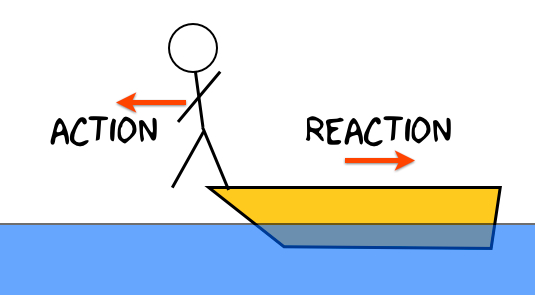
What law of motion does this picture represent?
a)
Newtons 1st law
b)
Newtons 4th law 
c)
Newtons 3rd law 
d)
Newtons 2nd law
171.
Speed =
a)
distance / time
b)
time / distance
c)
distance * time
172.
Change in speed over a given period of time is
a)
velocity
b)
motion
c)
speed
d)
acceleration
173.
Newton's first law of motion states that __________.
a)
when a force is applied on an object, there is an equal force applied by the object in the opposite direction
b)
hen a force acts on an object, its acceleration is in the same direction as the force
c)
an object will remain at rest or keep moving with a constant velocity unless a force acts on it
d)
cceleration is calculated by dividing the force exerted on an object by the mass of the object
174.

An object is thrown horizontally from a cliff. The height of the cliff is 2m. It took the object 25 s to hit the ground and it landed 50 meters away. What is the horizontal velocity of the object?

a)

100 m/s

b)

2 m/s

c)

50 m/s

d)

75 m/s

175.

An object is thrown horizontally from a cliff. The height of the cliff is 2m. It took the object 25 s to hit the ground and it landed 50 meters away. What is the horizontal velocity of the object?

a)

100 m/s

b)

2 m/s

c)

50 m/s

d)

75 m/s

176.

An object is thrown horizontally from a cliff. The height of the cliff is 5m. It took the object 25 s to hit the ground and it landed 100 meters away. What is the horizontal velocity of the object?

a)

100 m/s

b)

4 m/s

c)

50 m/s

d)

75 m/s

177.

An object is thrown horizontally from a cliff. The height of the cliff is 5m. It took the object 25 s to hit the ground and it landed 100 meters away. What is the horizontal velocity of the object?

a)

100 m/s

b)

4 m/s

c)

50 m/s

d)

75 m/s

178.
The picture of the position vs. time graph shows an object that is...
a)
accelerating/speeding up
b)
moving at a constant speed 
c)
not moving 
d)
accelerating/slowing down. 
179.
A runner races in the 100 meter dash.  It takes her 10 seconds to finish.  What is her average speed?
a)
10 m/s
b)
1000 m/s
c)
100 seconds
d)
10 seconds
180.

Look at the diagram below:

105 N <------- M ------> ___ N

How much net force, F, is needed to keep the object at rest and at which direction?

a)

0 N to the Right (East)

b)

105 N to the Left (West)

c)

105 N to the Right (East)

d)

0 N to the Left (West)

181.

Look at the diagram below:

___N <-----M-----> 35 N

How much net force, F, is needed to keep the object at rest and at which direction?

a)

35 N to the left (west)

b)

35 N to the right (east)

c)

0 N to the right (east)

d)

0 N to the left (west)

182.

Look at the diagram below:

55 N <------ M ------>___ N

How much net force, F, is needed to keep the object at rest and at which direction?

a)

0 N to the Right (East)

b)

0 N to the Left (west)

c)

55 N to the Left (West)

d)

55 N to the Right (East)