wayground logo

Free Printable Worksheets

Font size

S
M
L
XL
Worksheets

Review: 1st Semester Physics

Total questions: 177

Worksheet time: 15hrs 45mins

Name
Class
Date
1.

A feather is dropped on the moon from a height of 1.40 meters. The acceleration of gravity on the moon is 1.67 m/s2. Determine the time for the feather to fall to the surface of the moon.

Which number represents time?

a)

t = 1.40m

b)

t = 1.67m/s2

c)

t = 0m/s

d)

t = ?

2.

A bike accelerates uniformly from rest to a speed of 7.10 m/s over a distance of 35.4 m. Determine the acceleration of the bike.

What number represents initial velocity?

a)

v0 = 0m/s

b)

v0 = 7.10m/s

c)

v0 = 35.4m

d)

v0 = ?

3.
A _________ quantity is completely described by magnitude alone. A _________ quantity is
completely described by a magnitude with a direction.
a)
vector, scalar
b)
scalar, vector
4.
Speed is a __________ quantity and velocity is a __________ quantity.
a)
scalar, vector
b)
vector, scalar
5.
A car slows down from +32 m/s to +8 m/s in 4 s. The acceleration is 
a)
6 m/s/s opposite the motion
b)
2m/s/s in the direction of motion
c)
8 m/s/s opposite the motion
6.
An airplane accelerates down a runway at 3.20 m/s/s
for 8 s until it finally lifts off the ground.
Determine the velocity at take-off.
a)
0.4 m/s
b)
25.6 m/s
c)
2.5 m/s
7.
A change in velocity over time is known as:
a)
acceleration
b)
constant speed
c)
average speed
d)
displacement
8.
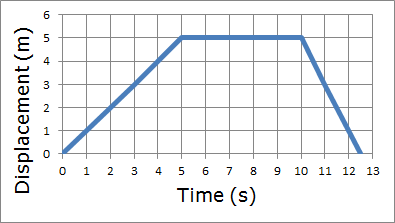
What is this graph representing?
a)
Constant Speed
b)
Acceleration (speeding up)
c)
Deceleration (slowing down)
d)
No motion
9.
At 60 seconds, how far had this object traveled? 
a)
0 m
b)
10 m
c)
20 m
d)
40 m
10.
What is the person doing from 5 seconds to 10 seconds?
a)
Walking 
b)
Running
c)
Standing Still 
d)
Walking Fast
11.
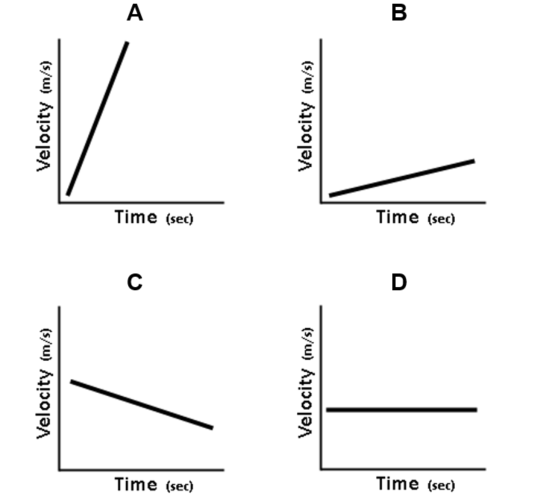
Which graph represents zero acceleration (constant velocity)?
a)
A
b)
B
c)
C
d)
D
12.
What is happening at D?
a)
Stationary
b)
Accelerating
c)
Fast steady speed; moving away from the starting position
d)
Slower steady speed; moving away from the starting position
13.
What is happening at A?
a)
Stationary
b)
Accelerating
c)
Slower steady speed; moving away from the starting position
d)
Steady speed; returning to start position
14.
What is happening at B?
a)
Stationary
b)
Accelerating
c)
Slower steady speed; moving away from the starting position
d)
Steady speed; returning to start position
15.
Which runner won the race?
a)
A
b)
B
c)
C
16.
Motion sensors recorded the following data about a runner during a cross-country race. During which segment of the race did the runner have the greatest speed?
a)
W
b)
X
c)
Y
d)
Z
17.
Which runner got a head start?
a)
red line runner
b)
blue line runner
18.
What is happening between 2 and 3 seconds?
a)
The object is not moving.
b)
The object is not accelerating.
c)
The object is slowing down.
d)
The object is speeding up.
19.

Find the displacement in the first 5 seconds.

a)

8 meters

b)

4 meters

c)

2 meters

d)

5 meters

20.
A dog runs with an initial speed of 7.5 m/s to a stop in 15 seconds.  What is the dog's acceleration?
a)
-7.5 m/s
b)
-7.5 m/s2
c)
-0.5 m/s2
d)
7.5 mi//hr
21.
A roller coasters accelerates from an initial velocity of 6.0 m/s to a final velocity of 70 m/s over 4 seconds.  What's the acceleration?
a)
24 m/s2
b)
18 m/s2
c)
16 m/s2
d)
16 m/s
22.
The SI unit for length or distance is
a)
foot (ft)
b)
inch (in)
c)
mile (mi)
d)
meter (m)
23.
The SI unit for time is
a)
second (s)
b)
minute (min)
c)
hour (hr)
d)
year (yr)
24.
What is the SI unit for speed and velocity?
a)
Km
b)
s
c)
m/s
d)
m/s2
25.
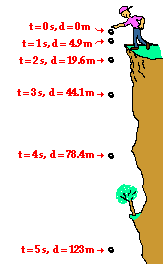
What happens to the velocity of a ball as it is dropped off a cliff? 
a)
It decreases at a uniform rate 
b)
It increases at a uniform rate 
c)
It is constant 
d)
It increases at a non-uniform rate
26.

What is the physical significance of the slope of this graph?

a)

Distance

b)

Displacement

c)

Acceleration

d)

Velocity

27.
During which interval is the object slowing down?
a)
A to B
b)
D to E
c)
E to F
d)
G to H
28.

What happened during A to B point?

a)

not moving

b)

increasing speed at a constant rate

c)

moving at a constant speed

d)

acceleration

29.
According to the graph how far does the person travel in the first 5 seconds?
a)
2 m
b)
10 m
c)
0 m
d)
5 m
30.
Describe the motion
a)
Speeding up;    Moving in negative direction
b)
Speeding up;   Moving in positive direction
c)
Slowing down;   Moving in positive direction
d)
Slowing down;   Moving in negative direction
31.
Describe the motion
a)
Speeding up;    Moving in negative direction
b)
Speeding up;   Moving in positive direction
c)
Slowing down;   Moving in positive direction
d)
Slowing down;   Moving in negative direction
32.
What is the speed of the object from 4-10 seconds?
a)
2 m/s
b)
3 m/s
c)
8 m/s
d)
16 m/s
33.
Suppose an object is in free fall. Each second the object falls 
a)
the same distance as in the second before.
b)
a larger distance than in the second before.
c)
with the same instantaneous speed.
d)
with the same average speed.
34.
If you drop a feather and a coin at the same time in a tube filled with air, which will reach the bottom of the tube first?
a)
the feather
b)
neither
c)
the coin
35.
Consider drops of water leaking from a water faucet. As the drops fall they 
a)
remain at a relatively fixed distance from each other
b)
get farther apart
c)
get closer together
36.
In the absence of air resistance, objects fall at constant 
a)
speed
b)
velocity
c)
acceleration
d)
all of the above
37.

A bike traveled 90 m in 10 seconds, 150 m in 20 seconds and then 110 m in 15 seconds to reach its destination. What is the bike's average speed?

a)

7.33 m/s

b)

7.78 m/s

c)

7.94 m/s

d)

9 m/s

38.

An object is thrown into the air at 60 m/s, straight up. What is its velocity at the highest point?

a)

0

b)

-9.8

c)

60

d)

-60

39.

An object is thrown into the air at 60 m/s, straight up. What is its acceleration at the highest point?

a)

0

b)

-9.8

c)

60

d)

-60

40.

Given a position vs. time graph, the slope of the line is equal to...

a)

position

b)

velocity

c)

acceleration

d)

area

41.

Given a velocity vs. time graph, the slope of the line is equal to...

a)

position

b)

velocity

c)

acceleration

d)

area

42.

Given a velocity vs. time graph, the area under the graph is equal to the objects'...

a)

displacement

b)

velocity

c)

acceleration

d)

area

43.

A flat, horizontal line on a position vs. time graph means...

a)

no motion

b)

moving at a constant velocity

c)

moving at a constant acceleration

44.
A scalar is a quantity that is fully described by ____
a)
magnitude alone
b)
both its magnitude and its direction
c)
both its displacement and its velocity
d)
both its distance and its speed
45.
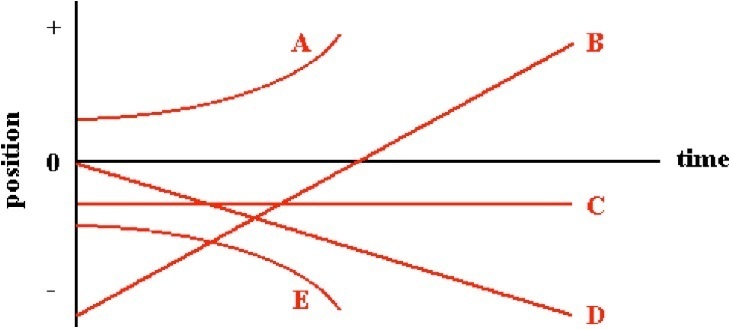
The motions of five objects - A, B, C, D, and E - are represented by lines on a position-time graph. Write the letter for the object that has the greatest constant velocity.
a)
B
b)
C
c)
D
d)
E
46.
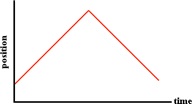
As represented by this position-time graph, this object is ____.
a)
speeding up, changing directions, and then slowing down
b)
accelerating, first with a positive and then with a negative acceleration
c)
speeding up and then slowing down, all while moving in the same direction
d)
moving in the positive direction and then in the negative direction, both at constant speed
47.
Acceleration is defined as ____.
a)
the rate at which the position changes
b)
the rate at which the displacement changes
c)
the rate at which the speed changes
d)
the rate at which the velocity changes
48.

Mack was skating to the park. He went 1.5 mi north, west for 0.75 mi, south 3 mi, and east 1.25 mi. What is Mack's total displacement?

a)

1.58 mi NW

b)

2.5 mi NE

c)

1.58 SE

d)

1.75 SW

49.
What variable letter is range?
a)
X
b)
Y
c)
Vx
d)
Vy
50.
What variable letter is altitude?
a)
X
b)
Vx
c)
Y
d)
Vy
51.
What variable letter is horizontal velocity?
a)
X
b)
Y
c)
Vx
d)
Vy
52.
What variable letter is vertical velocity?
a)
X
b)
Y
c)
Vx
d)
Vy
53.
Does horizontal velocity change if you ignore air resistance?
a)
yes
b)
no
54.
Does vertical velocity change as a projectile rises and falls?
a)
yes 
b)
no
55.
Does the vertical velocity have any effect on the horizontal velocity?
a)
yes
b)
no
56.
If you throw a baseball straight up, what is its velocity at the highest point?
a)
9.8 m/s2
b)
9.8 m/s
c)
0 m/s2
d)
0 m/s
57.
If a bullet is horizontally shot at the same moment another bullet is dropped from the same height, which will hit the ground first?(neglect air resistance) 
a)
Shot Bullet
b)
Dropped Bullet
c)
Hit at Same Time
58.
In the absence of air friction, the vertical component of a projectile's velocity doesn't change as the projectile moves. 
a)
True
b)
False
c)
Sometimes true
d)
Sometimes false
59.
In the absence of air friction, the horizontal component of a projectile's velocity doesn't change as the projectile moves. 
a)
True
b)
False
c)
Sometimes true
d)
Sometimes false
60.
What is the horizontal acceleration of a projectile?(neglect air resistance)  
a)
0 m/s2
b)
9.8 m/s2
61.
What force acts in the y direction that causes an object to travel in a parabolic arc?
a)
Friction
b)
Gravity
c)
Tension
d)
No force acting.
62.

A cannonball is fired at a 45.0° angle and an initial velocity of 625 m/s. Assume no air resistance. What is the vertical component of the cannonball’s velocity?What is the horizontal component of the cannonball’s velocity?

a)

-625 m/s; 625 m/s

b)

441.9 m/s; 441.9 m/s

c)

-441.9 m/s; 441.9 m/s

d)

0 m/s; 625 m/s

63.
The more mass an object has, the faster it will fall.
a)
True
b)
False
64.
What is the vertical acceleration of a projectile?
a)
0 m/s2
b)
-9.81 m/s2
65.
Two objects of the same mass are launched from the ground. Object A has a launch angle of 45, while Object B has a launch angle of 65. Which object has the greatest maximum height?
a)
A
b)
B
c)
Both objects reach the maximum height
d)
unable to determine with the given information
66.
A ball is thrown horizontally at a height of 2.2 meters at a velocity of 65 m/s. Assume no air resistance. How far did the ball travel horizontally when it hit the ground? 
a)
14 m
b)
30 m
c)
65 m
d)
43 m
67.
If I throw a crayon straight up at 12 m/s, how fast is its speed when i catch it at the same height?
a)
-6 m/s
b)
-12 m/s
c)
-18 m/s
d)
-24 m/s
68.
If you drop a banana, how fast is it going after 2 seconds?
a)
-4.9m/s
b)
-9.8m/s
c)
-19.6m/s
d)
-29.4m/s
69.
If the horizontal component of the ball is 5 m/s, how far does the ball travel from point A to point B in the 6 seconds?
a)
30 m
b)
6 m
c)
1.2 m
d)
176 m
70.

Which of the following statements are TRUE about the horizontal motion of a projectile?

a)

Projectiles have a constant horizontal velocity.

b)

Projectiles have a constant non-zero horizontal acceleration.

c)

The horizontal velocity of a projectile is unaffected by the vertical velocity; these two components of motion are independent of each other.

d)

The final horizontal velocity of a projectile is always equal to the initial horizontal velocity.

e)

As a projectile rises towards the peak of its trajectory, the horizontal velocity will decrease.

71.

A projectile is launched horizontally from the top of a 45.2-meter high cliff and lands a distance of 17.6 meters from the base of the cliff. Determine the magnitude of the launch velocity.

a)

5.8 m/s

b)

3 m/s

c)

52.8 m/s

d)

1.9 m/s

72.

Determine the magnitude of the resultant R in the image shown above.

a)

15.0 km

b)

11.2 km

c)

125 km

d)

None of the others are right.

e)

13.8 km

73.

Which equation would correctly give you the angle Θ for the resultant in the image above?

a)

tan Θ = (5/10)

b)

tan Θ = (10/5)

c)

sin Θ = (5/10)

d)

cos Θ = (5/10)

e)

none of the other answers are correct

74.

Which graph best represents the relationship between the pair of velocities of an object thrown upward at an angle from Earth’s surface and the time that elapses while it is in the air?

a)
b)
c)
d)
75.

A marble traveling at 3 m/s rolls off the edge of a 1 m high table. What is its initial vertical speed?

a)

-10 m/s

b)

0 m/s

c)

-3 m/s

d)

-15 m/s

76.

A soccer ball is kicked horizontally off a cliff. What information is needed to find the time to fall?

a)

The height of the cliff

b)

The initial speed of the ball

c)

The mass of the ball

d)

All of these

77.

Which vector pair (arrow pair) correctly represents the acceleration and velocity at point P?

a)
b)
c)
d)
78.
F=ma
a)
Newton's
1st
Law of Motion
b)
Newton's
2nd
Law of Motion
c)
Newton's
3rd
Law of Motion
79.
For every action, there is an equal and opposite reaction.
a)
Newton's
1st
Law of Motion
b)
Newton's
2nd
Law of Motion
c)
Newton's
3rd
Law of Motion
80.
An automobile you are riding in suddenly stops, but you continue to go forward.
a)
Newton's
1st
Law of Motion
b)
Newton's
2nd
Law of Motion
c)
Newton's
3rd
Law of Motion
81.
When the force on a car is doubled, the acceleration is doubled.
a)
Newton's
1st
Law of Motion
b)
Newton's
2nd
Law of Motion
c)
Newton's
3rd
Law of Motion
82.
A stationary bumper car is set in motion by the outside force of another bumper car colliding with it.
a)
Newton's
1st
Law of Motion
b)
Newton's
2nd
Law of Motion
c)
Newton's
3rd
Law of Motion
83.
A skater pushes another skater forward, but the one pushing moves backwards.
a)
Newton's
1st
Law of Motion
b)
Newton's
2nd
Law of Motion
c)
Newton's
3rd
Law of Motion
84.
A magician pulls a table cloth from under a table of dishes.
a)
Newton's
1st
Law of Motion
b)
Newton's
2nd
Law of Motion
c)
Newton's
3rd
Law of Motion
85.
The harder you hit a baseball, the faster it accelerates.
a)
Newton's
1st
Law of Motion
b)
Newton's
2nd
Law of Motion
c)
Newton's
3rd
Law of Motion
86.
You push against a wall and the wall is pushing back on you.
a)
Newton's
1st
Law of Motion
b)
Newton's
2nd
Law of Motion
c)
Newton's
3rd
Law of Motion
87.
The acceleration of a 4 kg bowling ball will be greater than the acceleration of a 6 kg bowling ball if the same force is applied to both.
a)
Newton's
1st
Law of Motion
b)
Newton's
2nd
Law of Motion
c)
Newton's
3rd
Law of Motion
88.
As the fuel in a rocket ignites, the force of gas expansion and explosion pushes out the back of the rocket and pushes the rocket forward.
a)
Newton's
1st
Law of Motion
b)
Newton's
2nd
Law of Motion
c)
Newton's
3rd
Law of Motion
89.
When you paddle a kayak, you push the paddle backwards in the water and the kayak goes forward.
a)
Newton's
1st
Law of Motion
b)
Newton's
2nd
Law of Motion
c)
Newton's
3rd
Law of Motion
90.
Determine the accelerations that result when a 12-N net force is applied to a 3-kg object. 
a)
3 m/s
b)
4 ft/s 
c)
13 m/s
d)
4 m/s 
91.
Mass is a measure of an object's inertia. Objects with greater mass have a greater inertia; objects with less mass have less inertia.
a)
true 
b)
false 
92.
Which has more Inertia? (so need more force to move) 
a)
Truck
b)
Ant
c)
A cat
d)
A skateboard
93.
Forces always act in equal and opposite pairs.
a)
Newton's 1st Law
b)
Newton's 3rd Law
c)
Newton's second law
94.
Match description with free-body diagram.
a)
A book is at rest on a tabletop.
b)
A gymnast holding onto a bar, is suspended motionless in mid-air. The bar is supported by two ropes that attach to the ceiling. Diagram the forces acting on the combination of gymnast and bar.
c)
An egg is free-falling from a nest in a tree. Neglect air resistance.
d)
A flying squirrel is gliding (no wing flaps) from a tree to the ground at constant velocity. Consider air resistance.
95.
Match description with free-body diagram.
a)
A rightward force is applied to a book in order to move it across a desk with a rightward acceleration. Consider frictional forces. Neglect air resistance. 
b)
A rightward force is applied to a book in order to move it across a desk at constant velocity. Consider frictional forces. Neglect air resistance. 
c)
A college student rests a backpack upon his shoulder. The pack is suspended motionless by one strap from one shoulder. 
d)
A skydiver is descending with a constant velocity. Consider air resistance.
96.

The diagram shows forces acting on a box.

Which statement best describes what will happen to the box as a result of these forces being applied?

a)

The box will accelerate to the right.

b)

The box will accelerate to the left.

c)

The box will move at a constant speed to the right.

d)

The box will move at a constant speed to the left.

97.
What is the net force?
a)
40 N left
b)
0 N Balalnced
c)
400 N right
d)
40 N right
98.
What is the net force?
a)
10 N
b)
0 N
c)
25 N
d)
1 N
99.

When the air is released from a balloon, the air moves in one direction, and the balloon moves in the opposite direction. Which law best explains the motion of the balloon?

a)

Newton's 1st Law of Motion

b)

Newton's 2nd Law of Motion

c)

Newton's 3rd Law of Motion

100.
If you double the mass of an object with the same force apply on it, the acceleration will
a)
double
b)
cut in half
c)
the same
d)
zero
101.
After a cannonball is fired into frictionless space, the amount of force needed to keep it going equals
a)
twice the force with which it was fired
b)
the same amount of force with which it was fired
c)
1/2 the force with which it was fired
d)
zero, since no force is required to keep it moving. 
102.
The acceleration produced by a net force on an object is
a)
inversely proportional to the mass of the object.
b)
directly proportional to the magnitude of the net force.
c)
in the same direction as the net force.
d)
 all of the above
103.
A book weighs 4 N. When held at rest in your hands, the net force on the book is
 
a)
0 N.
b)
 0.4 N.
c)
 4 N.
d)
 39 N.
104.
Which of the following shows the direction of the friction force?
a)
A
b)
B
c)
C
d)
D
105.
What type of friction is shown in this picture?
a)
Fluid
b)
Sliding
c)
Rolling
d)
Static
106.
If a car is travelling forwards but slowing down, then:
a)
The forward force must be larger
b)
The backwards force must be larger
c)
The forwards and backwards forces must be equal
d)
We can't compare the forces
107.

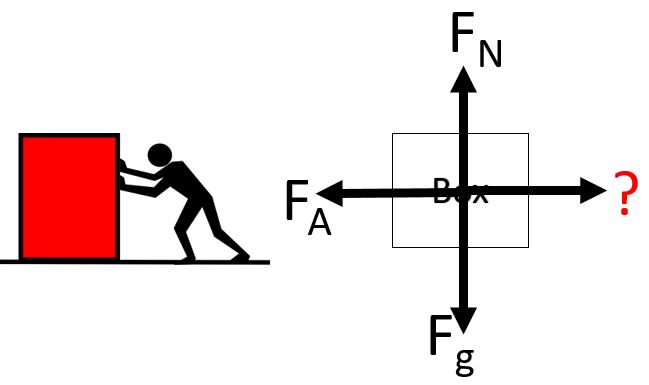
Name the missing force....

a)

Fw

b)

FN

c)

Fk

d)

FNet

108.

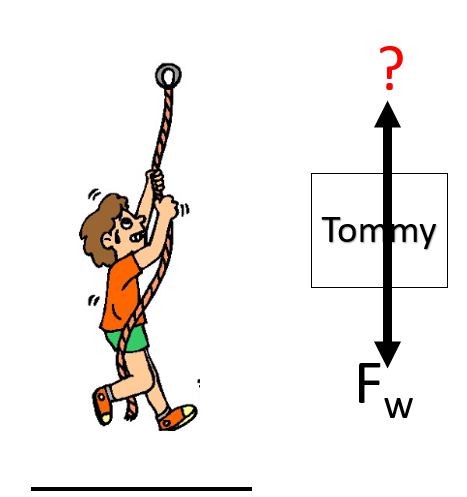
Name the missing force...

a)

Fa

b)

FW

c)

FT

d)

FN

109.

Name the missing force...

a)

Ff

b)

FW

c)

Fnet

d)

Fsp

110.

Name the missing force...

a)

FT

b)

FG

c)

FN

d)

Fa

111.
What is the net force?
a)
5000 N right
b)
4000 N right
c)
40 N left
d)
4000 N left
112.
Match description with free-body diagram.
a)
A rightward force is applied to a book in order to move it across a desk with a rightward acceleration. Consider frictional forces. Neglect air resistance. 
b)
A rightward force is applied to a book in order to move it across a desk at constant velocity. Consider frictional forces. Neglect air resistance. 
c)
A college student rests a backpack upon his shoulder. The pack is suspended motionless by one strap from one shoulder. 
d)
A skydiver is descending with a constant velocity. Consider air resistance.
113.

A 75-kg wagon is being pulled in the horizontal direction by a 225-N force. There is a frictional force acting on the wagon of 38-N. What is the net force on this wagon?

a)

187-N

b)

112-N

c)

225-N

d)

38-N

114.

A 135kg sled encounters a net force of 569N. What is the acceleration of the sled?

a)

76,815m/s/s

b)

0.24m/s/s

c)

4.21m/s/s

d)

not enough information.

115.
When an object receives unbalanced forces, the object may...
a)
change direction
b)
change speed
c)
starts to move
d)
All are correct 
116.
What is the definition of "weight"?
a)
measure of the force of gravity on your body
b)
the time it takes to get on a ride 
c)
the amount of matter in an object
d)
the size of an object
117.
How can you calculate the weight of an object?
a)
mass x gravity
b)
weight x gravity
c)
gravity x force
d)
gravity x acceleration
118.
What is the mass of a 150 N object? 
a)
150 kg
b)
15 kg
c)
1470 kg
d)
0 N
119.
The diagram above shows a box being pulled up the ramp. Which letter represents normal force?
a)
A
b)
B
c)
C
d)
D
120.

Name the missing force...

a)

Fsp

b)

FW

c)

FN

d)

Fnet

121.
What is the net force of an object that is not moving?
a)
0N
b)
100N
c)
Upward force
122.
Are forces balanced or unbalanced when a car is moving at a constant speed in a straight line?
a)
Balanced
b)
Unbalanced
123.
In physics, we define work as this
a)
force x time
b)
force x distance
c)
force / time
d)
force / distance
124.
In physics, power is identified as this
a)
force x distance
b)
distance / time
c)
work / time
d)
time / work
125.
A mason raises a 2,000 N bag of cement from the floor to over his head (2.0 meters) in 4 seconds. What is his average power input?
a)
1,000 W
b)
2,000 W
c)
500 W
d)
100 W
126.
A mason raises a 2,000 N bag of cement from the floor to over his head (2.0 meters) in 4 seconds. What is his average power input?
a)
1,000 W
b)
2,000 W
c)
500 W
d)
100 W
127.

3. Calculate the GPE of a 2 kg cat perched 10 meters above the ground.

a)

20 J

b)

100 J

c)

150 J

d)

196 J

128.
A 1 kg rock falls 20 meters, how fast is the rock going just before it hits the ground?
a)
14.0 m/s
b)
20.0 m/s
c)
10.0 m/s
d)
9.89 m/s
129.
Mechanical energy is equal to the sum of Kinetic energy and _________ energy
a)
Thermal
b)
Potential
c)
Electrical
d)
Chemical
130.
When my velocity triples, my kinetic energy increases by ______ times.
a)
9
b)
 3 
c)
1.5
d)
4.5
131.
Calculate the Kinetic Energy (KE) of a girl whose mass is 50 kg and who is moving at 4 m/s.
a)
200 J
b)
800 J
c)
400 J
d)
100 J
132.
Sue lowers a stack of books using a force of 20 N over a distance of 2 meters. Calculate work.
a)
20 J
b)
-40 J
c)
40 J
d)
-20 J
133.
The change in KE or change in PE is equal to Work.
a)
True
b)
False
134.
What type of energy is in this picture?
a)
Kinetic
b)
Potential
c)
Chemical
d)
Sound
135.
Energy of motion is which type of energy?
a)
Potential
b)
Kinetic
c)
Sound
d)
Gravitational
136.

When a pendulum swings, at which point is potential energy at its greatest?

a)

1

b)

2

c)

3

d)

4

137.

Rank the GPE from Greatest to Least.

a)

B=D=F>C>A

b)

A=C>E>B=D=F

c)

A>C>E.B=D=F

d)

E>C>A=B=D=F

138.

Determine the kinetic energy of a system when the total mechanical energy of the system is 180 J , and the potential energy is equal to 70 J.

a)

250 J

b)

110 J

c)

50 J

d)

0 J

139.

A 4.3 kg package topples from a 1.5 m high shelf. How fast was the package traveling just below it strikes the floor?

a)

1.5 m/s

b)

5.4 m/s

c)

12 m/s

d)

29 m/s

140.

Which has greater kinetic energy, an object traveling 10 km/h, or a half-as-massive car traveling at 20 km/h?

a)

the 10 km/h object

b)

the 20 km/h object

c)

both have the same kinetic energy

141.

How much work is done on a 2 N book that is held 0.50 m above the floor while a person walks 5 m across the room.

a)

0 J

b)

1 J

c)

10 J

d)

20 J

142.

The work done by gravity when an object falls to the ground is ___.

a)

positive

b)

negative

c)

gravity does not perform work

143.

The work done by a person to lift an object is ___ work.

a)

positive

b)

negative

c)

zero

144.

The work done by a person to lower an object is ___ work.

a)

positive

b)

negative

c)

zero

145.

Rank the change in kinetic energy from greatest to least, of these boxes, initially at rest, as each of them are pushed across the floor for 3 meters.

a)

F>C=E>A>B=D

b)

C=F>B=E>A=D

c)

A=E=F>C=D>B=

d)

B=D>A>E=C>F

146.

A forklift exerts an upward force of 3.60 x 10³ N to lift a crate 1.50 m in 5.20 s. What power does the forklift produce in kilowatts?

a)

1.04 kW

b)

10.4 kW

c)

104 kW

d)

1040 kW

147.

How much time does it take for a 520 N student, generating 289 W of power, to climb 3.0 m in the school's staircase?

a)

3.6 s

b)

5.4 s

c)

6.3 s

d)

7.4 s

148.

Which scenario best fits the Work-Energy Diagram below:

a)

A ball rolls down an incline and rolls to a stop on the floor

b)

A skier pushes off the top of a hill with their ski poles and continues forward to the top of the next hill

c)

A skateboarder slides down the stair railing and travels forward along level ground

d)

A trapeze artist falls to the safety net below and stops

149.

A 5 N force is applied to a 3 kg ball to change its velocity from +9 m/s to +3 m/s. The impulse on the ball is ______ N s.

a)

-2.5

b)

-10

c)

-18

d)

-45

150.
A 0.250 kg cart moving at 0.400 m/s has how much momentum?
a)
0.1 kg-m/s
b)
1 kg-m/s
c)
10 kg-m/s
d)
100 kg-m/s
151.
The difference between a car hitting a wall vs. a car hitting a hay stack is
a)
the Impulse on the car hitting the wall is greater
b)
the change in momentum of the car hitting the wall is greater
c)
the force on the car hitting the hay stack is greater
d)
the collision time of the car hitting the hay stack is greater
152.
A runner has a momentum of 670 kg m/s and is travelling at a velocity of 9 m/s. What is his mass?
a)
6030 kg
b)
0.0134 kg
c)
74.4 kg
d)
80 kg
153.
The units for Impulse are
a)
N/s
b)
N.s
c)
N
d)
m/s
154.
A boy kicks a football with a force of 20 N, the time the force acts for is 0.3 s.
Calculate the impulse on the ball.
a)
1 N.s
b)
6 N.s
c)
66 N.s 
d)
None of these
155.

In an isolated system, the net ____ on that system is zero.

a)

external force

b)

internal force

c)

time interval

d)

displacement

156.
The impulse-momentum theorem states that
a)
the impulse on an object is equal to the change in momentum it causes 
b)
the force on a moving object is equal to the magnitude of the impulse.
c)
the impulse on an object is greater than the change in momentum it causes 
d)
the impulse on an object is less than the change in momentum it causes
157.
A constant force of 4.5 N acts on a 7.2-kg object for 10.0 s. What is the     change in the object's velocity? 
a)
6.3 m/s
b)
3.2 m/s
c)
1.2 m/s 
d)
4.33 m/s
158.
The velocity of a 975-kg car is changed from 12.0 m/s to 27.0 m/s in 15s by an external, constant force. What is the magnitude of the force? 
a)
9.75×10² N
b)
1.46×10N
c)
9.75×10³ N
d)
975 kg·m/s
159.
The law of conservation of momentum states that, 
a)
p before is less than p after
b)
p before is the same as p after
c)
p before is more than p after
160.
If 2 objects collide and stick together, what will happen to their velocities?
a)
velocities will increase
b)
velocities will decrease
c)
velocities will stay the same
d)
none of the above
161.
A large box slides across a frictionless surface with a velocity of 12 m/s and a mass of 4 kg,  collides with a smaller box with a mass of 2 kg that is stationary.  The boxes stick together. What is the velocity of the two combined masses after collision?
a)
0 m/s
b)
4 m/s
c)
8 m/s
d)
12 m/s
162.
When the speed of an object is doubled, its momentum
a)
remains unchanged in accord with the conservation of momentum.
b)
doubles
c)
quadruples
d)
decreases
163.
In this type of collision, objects tend to "stick" together.
a)
elastic
b)
inelastic 
c)
They "stick" together in both types of collisions
164.
A 10kg toy truck moves at 5m/s East. It collides and bounces off of a 5kg toy car moving 10 m/s moving west. Which equation would you use to solve for the final velocity of the car?
a)
m1v1i+m2v2i=m1v1f+m2v2f
b)
(m1+m2)vi=m1v1f+m2v2f 
c)
m1v1i+m2v2i=(m1+m2)vf
165.
How can a tennis ball and a bowling ball have the same momentum?
a)
have the same speed
b)
have different speeds
c)
one is moving backwards
d)
they can't
166.

What is Newton's 2nd Law of Motion?

a)

Action - Reaction. If an object A exerts a force on object B, then object B must exert a force of equal magnitude and opposite direction back on object A.

b)

F = ma. An object acted on by an unbalanced force will accelerate in the direction of that force, in direct proportion to the strength of the force, and in inverse proportion to the mass of the object.

c)

Inertia: An object in motion tends to stay in motion, while an object at rest tends to stay at rest unless acted upon by an unbalanced force.

167.
Cart A has a mass of 2 kilograms and a speed of 3 meters per second. Cart B has a mass of 3 kilograms and speed of 2 meters per second. Compared to the inertia and magnitude of momentum of Cart A, cart B has
a)
The same inertia and the same magnitude of momentum
b)
The same inertia and a smaller magnitude of momentum
c)
Greater inertia and the same magnitude of momentum
d)
Greater inertia and a smaller magnitude of momentum
168.
The momentum of an object depends upon the object's ___________&_____________.  
a)
size and shape
b)
mass and speed
c)
mass and velocity
d)
mass and energy
169.
If two objects have the same mass, then the faster moving object has ____________ momentum.
a)
more 
b)
less
c)
the same
170.
Momentum is a ____________________ quantity
a)
science
b)
scalar
c)
vector
d)
energy
171.
Cart A is pulled with a 2 Newton force for 2 seconds, and Cart B is pulled with a 1 Newton force for 3 seconds.  Which cart experiences the greatest impulse?
a)
Cart B
b)
Cart A
c)
they are the same
172.
A 2.5 kg ball moving at 5 m/s collides with a 2.5 kg stationary ball in a perfectly elastic collision.  What is the velocity of the second ball after the collision? 
a)
5 m/s
b)
2.5 m/s
c)
10 m/s
d)
7.5 m/s
173.
Which of the following correctly explains why less force is required to stop a person using an airbag?
a)
hitting the airbag decreases the person's momentum
b)
the airbag changes the person's momentum over a longer time interval
c)
the airbag is very soft, like a pillow
d)
decreasing the time of the impact decreases the force of the impact
174.
Two skaters begin at rest. Skater 1 has a smaller mass than Skater 2. After they push off each other,...
a)
Skater 1 experiences a greater change in momentum
b)
Skater 2 experiences a greater change in momentum
c)
Skater 1 has a greater velocity than Skater 2
d)
Skater 1 experiences a greater force
175.

A tiger is running in a straight line. If we double both the mass and speed of the tiger, the magnitude of its momentum will increase by what factor?

a)

2

b)

4

c)

8

d)

16

176.

A small car meshes with a large truck in a head-on collision. Which of the following statements concerning the momentum during the collision are correct?

a)

The momentum of the truck is conserved.

b)

The momentum of the car is conserved

c)

The momentum of the car and the momentum of the car are each conserved.

d)

The momentum of the car-truck system is conserved, but the momentum of each one separately is not conserved

177.
A bug flies into the windshield of a car going the opposite way. Which of the following are true.
a)
the force of impact is the same for both
b)
the impulse is the same for both
c)
the acceleration of the bug is larger than the truck
d)
A, B, and C are all true