Wayground logo

Free Printable Worksheets

Font size

S
M
L
XL
Worksheets

Unit 6 - Waves

Total questions: 176

Worksheet time: 3hrs 56mins

Name
Class
Date
1.

Does this animation fulfill our conditions for what defines a wave? Explain below using evidence:

a)
Yes, it fulfills all the conditions for what defines a wave.
b)
No, it does not fulfill any of the conditions for what defines a wave.
c)
Not enough information to determine
d)
It partially fulfills the conditions for what defines a wave.
2.

Sounds can travel through different materials, why

a)
Due to the color of the materials
b)
Because the materials are all made of the same substance
c)
Because the materials are all transparent
d)
Varying densities and elastic properties of the materials
3.

Matter is made up of particles, but outer space is empty – it has no particles at all.

Propose a reason why sound from the Sun can't travel to the Earth

a)
The Sun is too far away for the sound to reach Earth
b)
The Earth's atmosphere blocks the sound from the Sun
c)
The Sun is not producing any sound
d)
Sound cannot travel through the vacuum of outer space.
4.

how clapping causes the salt to vibrate without touching it.

a)
Clapping creates an electric charge in the salt
b)
Salt crystals are magnetic
c)
Sound wave
d)
The force of clapping pushes the salt
5.

Why does sound make matter vibrate

a)
Sound waves cause matter to vibrate by creating a vacuum
b)
Sound waves cause matter to vibrate by cooling down the particles of the medium
c)
Sound waves cause matter to vibrate by repelling the particles of the medium
d)
Sound waves cause matter to vibrate by transferring energy to the particles of the medium.
6.

Speed is just distance over time

a)
time minus distance
b)
time multiplied by distance
c)
distance plus time
d)
distance divided by time
7.

What are the Characteristics of a Wave?

a)
Energy, power, force, and wavelength
b)
Intensity, pitch, duration, and amplitude
c)
Amplitude, wavelength, frequency, and speed
d)
Amplitude, wavelength, frequency, and velocity
8.

particles move perpendicular to the direction of  the wave.

a)
Sometimes
b)
False
c)
True
d)
Particles do not move
9.

Transverse: particles move perpendicular to the direction of  the wave.

a)
Longitudinal
b)
Parallel
c)
Stationary
d)
Transverse
10.

Examples: water, string, electromagnetic waves, earthquake S-waves

a)

Transverse

b)

Longitudinal

11.

Examples: sound, earthquake P-waves

a)

Longitudinal

b)

Transverse

12.

Wavelength (λ):  distance between the same two points on any two successive waves.  Units: m

a)
m
b)
km
c)
s
d)
cm
13.

Amplitude:  max displacement from equilibrium.  Units: m

a)
cm
b)
km
c)
s
d)
m
14.

Period (T): time per cycle.  Units: sec

a)
sec
b)
day
c)
hour
d)
min
15.

Period (T): time per cycle.  Units: sec

a)
day
b)
min
c)
hour
d)
sec
16.

Frequency (f): cycles per time. Units: sec-1 or Hertz, Hz

a)
kHz
b)
sec-1
c)
Hz
d)
m/s
17.

Compression:  The region where the particles are the closest together.

a)
The region where the particles are the farthest apart.
b)
The region where the particles are evenly spaced.
c)
The region where the particles are randomly distributed.
d)
The region where the particles are the closest together.
18.

Rarefaction:  The region where the particles are spread out.

a)
Dilution
b)
Concentration
c)
Compression
d)
Rarefaction
19.

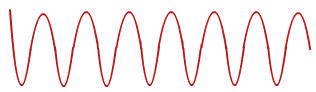
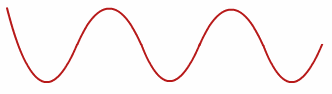
See the wave to the right, and imagine we doubled the frequency of the wave. 

How would this affect the period? Explain using a picture and description.

a)
The period would remain the same.
b)
The period would be halved.
c)
The period would be doubled.
d)
The period would be quadrupled.
20.

What are some sources of light?

a)
Sun, light bulbs, candles, fire
b)
Water, rocks, trees, animals
c)
Moon, stars, flashlights, lamps
d)
Books, pens, computers, phones
21.

Identify which object allows light to pass through it.

a)
Reflective objects
b)
Translucent objects
c)
Opaque objects
d)
Transparent objects
22.

Identify which object allows light to pass through it.

a)
Opaque objects
b)
Translucent objects
c)
Reflective objects
d)
Transparent objects
23.

The structure of the periscope explains why it can be used to see over obstacles.

Explain the function of the two mirrors in the periscope.

a)
Magnifying the image.
b)
Creating a 3D effect.
c)
Enhancing the brightness of the image.
d)
Reflecting light to change the direction of the image.
24.

Explain how light travels from the Sun to your eyes to allow you to see the cat's reflection in the window.

a)
Refraction
b)
Absorption
c)
Scattering
d)
Reflection
25.

The model shows that the microphone turns voice sounds into electrical signals. To achieve this, part of the microphone moves quickly back and forth in response to sounds.

Determine what this tells us about the nature of sound

a)
Sound is a form of matter that travels in waves.
b)
Sound is a form of light that travels in waves.
c)
Sound is a form of electricity that travels in waves.
d)
Sound is a form of energy that travels in waves.
26.

Determine the main energy transformation that takes place in a microphone.

a)
Conversion of sound waves into mechanical energy
b)
Conversion of sound waves into electrical signals
c)
Conversion of electrical signals into sound waves
d)
Conversion of light waves into electrical signals
27.

The first computer turns electrical signals from the microphone into digital information.

Identify the best description of the form of digital information.

a)
Binary code
b)
ASCII characters
c)
Hexadecimal code
d)
Analog signal
28.

Identify two advantages of digital information over non-digital information.

a)
Easily stored and accessed, Easily duplicated and shared
b)
Requires physical space, Prone to damage and loss
c)
Difficult to store and access, Difficult to duplicate and share
d)
Limited capacity, Difficult to search and organize
29.

The microphone, two computers, and the speaker form parts of a system. This system allows communication in one direction.

Explain why the system wouldn't work if the speaker was replaced by another microphone.

a)
Because the system only works with a speaker and not with another microphone.
b)
Because the speaker is an output device and the system allows communication in one direction.
c)
Because the two computers are not compatible with each other.
d)
Because the microphone is an input device and the system allows communication in one direction.
30.
The distance between one crest on a wave and the nearest one to it.
a)
Frequency
b)
Wavelength
c)
Wave speed
d)
Amplitude
31.
The bottom of a transverse wave is called the – 
a)
Crest
b)
Trough
c)
Rest Period
d)
Amplitude
32.
The substance the wave travels through (solid, liquid, gas)
a)
Seismic
b)
Medium
c)
Trough
d)
Crest
33.

The bending of a wave caused by a change in its speed as it moves from one medium to another.

a)

Reflection

b)

Absorption

c)

Refraction

34.
Sound waves travel slowest through this medium
a)
solid
b)
liquid
c)
gas
35.
The part of a longitudinal wave where the particles of the medium are close together.
a)
rarefaction
b)
compression
c)
crest
d)
trough
36.

Which wave is classified as a mechanical wave?

a)

microwave

b)

infrared wave

c)

sound wave

d)

radio wave

37.

Examine the wave.


Which region on this wave would correspond to rarefaction?

a)

W

b)

X

c)

Y

d)

Z

38.
Visible light is which type of wave?
a)
seismic
b)
mechanical
c)
longitudinal
d)
electromagnetic
39.
Light waves are arranged in the electromagnetic spectrum by
a)
wavelength and brightness.
b)
speed and color.
c)
brightness and color.
d)
wavelength and frequency.
40.
As the loudness of a sound wave increases, which will also increase?
a)
amplitude
b)
frequency
c)
velocity
d)
wavelength
41.
Which electromagnetic waves have the highest frequencies and the shortest wavelengths?
a)
microwaves
b)
visible light
c)
gamma rays
42.
How much of the electromagnetic spectrum is made up of visible light?
a)
only a small portion
b)
a very l;arge portion
c)
about half
43.
Which electromagnetic waves help doctors detect broken bones inside your body?
a)
gamma rays
b)
x-rays
c)
ultraviolet rays
44.
Which of the following lists the electromagnetic waves in order of increasing wavelength?
a)
X-rays, visible light, radio waves
b)
gamma rays, microwaves, UV rays
c)
infrared rays, radio waves, x-rays
45.

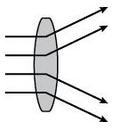
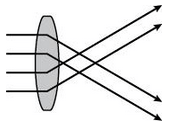
Which lens represents the path light takes through a diverging lens?

a)
b)
c)
d)
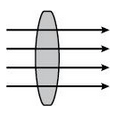
46.

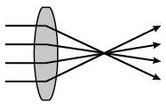
Which figure represents the path light takes through a converging lens?
a)
b)
c)
d)
47.

A shopkeeper wants to keep an eye on his store in order to prevent shoplifting. What could the shopkeeper hang on the wall in order to see a wider image of his store and his customers?

a)

a convex mirror

b)

a concave mirror

c)

a convex lens

d)

a concave lens

48.

Which optical device bends light inward?

a)

convex lens

b)

concave lens

c)

plane mirror

d)

convex mirror

49.

A shopkeeper wants to keep an eye on his store in order to prevent shoplifting. What could the shopkeeper hang on the wall in order to see a wider image of his store and his customers?

a)

a convex mirror

b)

a concave mirror

c)

a convex lens

d)

a concave lens

50.

A dentist uses a small dental mirror to help magnify teeth in your mouth. What type of mirror is this?

a)

a convex mirror

b)

a concave mirror

c)

a convex lens

d)

a concave lens

51.

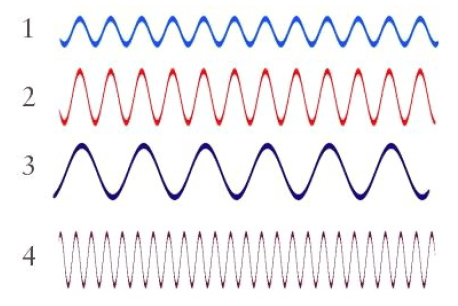
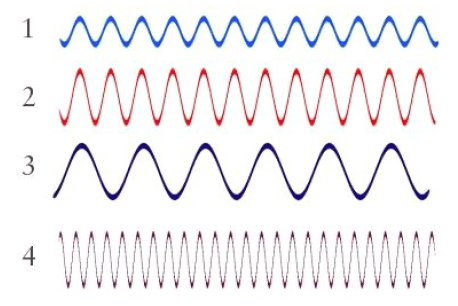
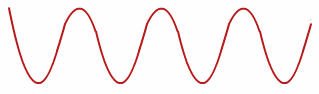
Which of these sound waves has the highest frequency?
a)
b)
c)
52.
When two waves combine to form a new wave with a smaller amplitude, it is called 
a)
Refraction
b)
Constructive Interference
c)
Resonance
d)
Destructive Interference
53.
A tuning fork starts to vibrate when a certain note is played on the piano, This is an example of _______.
a)
resonance
b)
refraction
c)
diffraction
d)
reflection
54.
In ________ interference, the energy of the combined wave is greater than the energy of each of the two waves.
a)
destructive
b)
rarefaction
c)
resonance
d)
constructive
55.
This image is representing what wave interaction?
a)
Refraction
b)
Diffraction
c)
Reflection
d)
Interference
56.
When a wave moves around a barrier or though an opening it is known as what?
a)
Diffraction
b)
Refraction
c)
Rarefaction
d)
Destruction
57.
What occurs when vibrations traveling through an object match the object's natural frequency?
a)
reflection
b)
diffraction
c)
resonance
d)
refraction
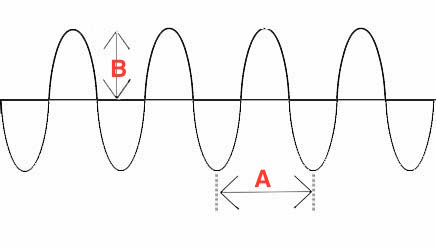
58.
What property of this wave is represented by the letter "A"
a)
amplitude
b)
crest
c)
trough
d)
wavelength
59.
What property of the wave is represented by the letter "B"?
a)
amplitude
b)
crest
c)
trough
d)
wavelength
60.
The highest point on a wave is:
a)
the crest
b)
the trough
c)
the top
d)
the coast 
61.
The lowest point on a wave is the:
a)
Amplitude
b)
Crest
c)
Trough
d)
Wavelength
62.
The number of wavelengths that pass a point each per second is:
a)
frequency
b)
period
c)
longitudinal 
d)
transverse wave 
63.
The type of waves that require medium to pass:
a)
Mechanical Waves
b)
Electromagnetic Waves
64.
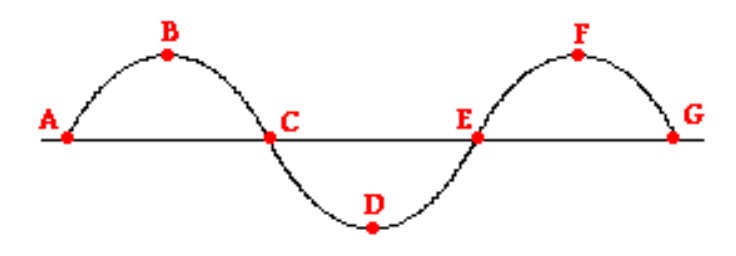
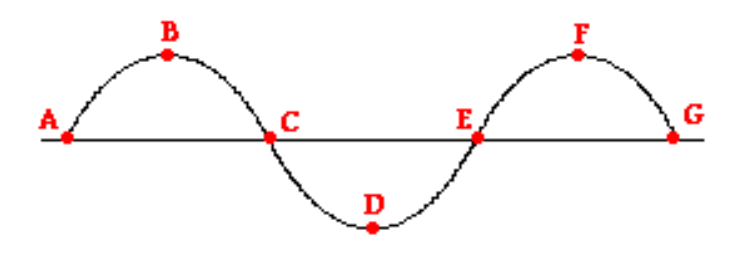
Which vocabulary term is used to identify the distance between points C & G?
a)
Amplitude
b)
Crest
c)
Frequency
d)
Wavelength
65.
When the frequency of a wave increases, what happens to the wavelength?
a)
The wavelength is not directly affected by the frequency of a wave.
b)
The wavelength increases.
c)
The wavelength decreases.
d)
More specific information is needed to form a conclusion about the wavelength.
66.
A mechanical wave cannot travel through...
a)
a vacuum(empty space).
b)
water.
c)
air. 
d)
glass.
67.
Which letter(s) represent the trough of the wave?
a)
A
b)
B & D
c)
D
d)
C & G
68.
Which letter(s) represent the crest of the wave?
a)
A
b)
B & D
c)
B & F
d)
F
69.
Which wave in the diagram has the greatest frequency?
a)
1
b)
2
c)
3
d)
4
70.
Which wave in the diagram has the greatest wavelength?
a)
1
b)
2
c)
3
d)
4
71.
Which of the following can sound travel through?
a)
solid
b)
liquid
c)
gas
d)
all of the above
72.
crest to crest or trough to trough
a)
crest
b)
trough
c)
amplitude
d)
wavelength
73.
Electromagnetic waves include the following except
a)
radio waves
b)
X-rays
c)
doing the wave at a football game
d)
microwaves
74.
regular disturbances that carry energy through matter or space
a)
crest
b)
energy
c)
wave
d)
trough
75.
which material does sound travel the fastest?
a)
solid 
b)
liquid 
c)
gases
76.
When a wave strikes and object and bounces off. (example echo)
a)
medium
b)
refraction
c)
reflection
d)
interference
77.
When a wave bends as it passes through at an angle from one medium to another.(example: pencil in a glass of water-)
a)
medium
b)
refraction
c)
reflection
d)
interference
78.
Which statement is true?
a)
The ability to do work - it makes things happen or causes changes.
b)
Energy is matter
c)
Energy is only ever potential
d)
Energy is only ever kinetic
79.
All waves carry
a)
energy
b)
light 
c)
matter
d)
particles
80.
What does it mean to refract?
a)
bounce off
b)
to bend
c)
curve outward
d)
reflect
81.
What happens when light hits a mirror?
a)
it makes a color
b)
it reflects
c)
it makes a rainbow
d)
it passes through
82.
A repeating disturbance or movement that transfers energy.
a)
Hertz
b)
Medium
c)
Wave
d)
Transverse
83.
The orange line is measuring the _________________________.
a)
wavelength
b)
amplitude
c)
crest
d)
trough
84.
Which letter shows reflection? 
a)
Pathway A
b)
Pathway B
c)
Pathway C
d)
Pathway D
85.
Which term explains the path of the light ray in this diagram?
a)
Convection
b)
Scattering
c)
Absorption
d)
Refraction
86.
Sound travels fastest through
a)
solids
b)
liquids
c)
gases
d)
empty space
87.
Which letter represents the wave trough?
a)
A
b)
B
c)
C
d)
D
88.
What is measured from crest to crest or trough to trough?
a)
Frequency
b)
Amplitude
c)
Wavelength
d)
Origin
89.
The heat from a hot burner to a pot is transferred by ______.
a)
convection
b)
insulation
c)
radiation
d)
conduction
90.
This is a lava lamp. When the light bulb heats the wax, the wax rises. When the wax cools, it falls. This cycle of rising/falling is an example of:
a)
Conduction.
b)
Convection.
c)
Radiation.
91.
What kind of heat transfer happens when the sun is heating your body?
a)
Conduction
b)
Radiation
c)
Convection
d)
Density
92.
How many kinds of heat transfer are there?
a)
1
b)
2
c)
3
d)
4 or more
93.

speed is also wavelength over period

a)
wavelength * period
b)
wavelength + period
c)
wavelength - period
d)
wavelength / period
94.

v = 𝛌 × f

a)
v = 𝛌 + f
b)
v = 𝛌 ÷ f
c)
v = 𝛌 × f
d)
v = 𝛌 - f
95.

v = wave speed (m/s)

a)
v = wavelength (m)
b)
v = wave speed (m/s)
c)
v = frequency (Hz)
d)
v = velocity (m/s)
96.

v = wave speed (m/s)

a)
v = velocity (m/s)
b)
v = frequency (Hz)
c)
v = wavelength (m)
d)
v = wave speed (m/s)
97.

𝛌 = wavelength (m)

a)
speed (m/s)
b)
amplitude (m)
c)
frequency (Hz)
d)
wavelength (m)
98.

f = frequency (Hz or s-1)

a)
Liters (L)
b)
Hertz (Hz) or s-1
c)
Kilograms (kg)
d)
Meters (m)
99.

f = frequency (Hz or s-1)

a)
f = frequency (Hz or s-1)
b)
f = mass (kg)
c)
f = force (N)
d)
f = wavelength (m)
100.

Each crest is moving — in what direction is it moving?

a)
Downward
b)

Right

c)
Sideways
d)
Backward
101.

Each coil of the spring is moving in what direction?

a)
Side to side
b)
Clockwise
c)
Back-and-forth
d)
Up and down
102.

What does traveling mean?

a)
Exploring new places and experiencing different cultures.
b)
Reading books about different countries
c)
Staying at home and watching TV
d)
Eating at new restaurants
103.

What does osculating mean in physics?

a)
Approximating a curve or surface with a circle or sphere at a specific point
b)
Studying the behavior of light in a vacuum
c)
Calculating the mass of an electron
d)
Measuring the temperature of an object
104.

Amplitude is ----- from the equilibrium of a wave

Wave length is the distance between two -----

Frequency is the occurrence of -----

A period is how much a cycle takes

a)

distance, peaks or troughs, wave lengths

b)
volume, hills, incidents
c)
speed, crests, intervals
d)
color, valleys, events
105.

Be accurate when finding your amplitude, sometimes its a bit less or more.

a)
False
b)
True
c)
Maybe
d)
Not sure
106.

When finding the distance between two crests, its important to understand when to find the same point from it and not just one that looks like it is at.

a)
Measure from random points on each crest
b)
Measure from the troughs instead of the crests
c)
Measure from different points on each crest
d)
Measure from the same point on each crest
107.

Waves with greater frequency

a)
Have longer wavelengths
b)
Have less energy
c)
Have more oscillations per unit time
d)
Travel at a slower speed
108.

When a pulse or coil move in the same direction, the type of wave is

a)
They cancel each other out
b)
They create interference
c)
They reverse the direction of the pulse
d)

longitudinal

109.

More higher amplitude has more energy?

a)
Not necessarily
b)
False
c)
True
d)
Depends on the frequency
110.

Higher compression are just higher amplitudes.

a)
False
b)
Depends on the situation
c)
Not sure
d)
True
111.

When using f = 1/T or T= 1/F its basically saying that period and frequency are recripical of each other or inversely proportional to each other.

a)
identical
b)
reciprocal
c)
opposite
d)
unrelated
112.

What relationship would you describe frequency with period?

a)
X
b)
Y
c)
Z
d)

Inversely proportional

113.

Write a summary sentence that explains how a change in one variable of the wave-speed equation will affect the other variables in the wave equation

a)
The change will cause the other variables to increase
b)
The change will cause the other variables to decrease
c)
The other variables will remain unaffected by the change
d)
The other variables in the wave equation will be affected directly by the change in one variable.
114.

Wave Length is a whole period

a)
Depends on the frequency
b)
True
c)
Partially true
d)
False
115.
One end of the rope is vibrated to produce a wave with a wavelength of .25 m.  The Frequency of the wave is 3.0 Hz.  What is the speed of the wave?
a)
3.00 m/s
b)
2.50 m/s
c)
.75 m/s
d)
1.25 m/s
116.
A tennis coach paces back and forth along the sideline 10 times in 2 minutes. The frequency of her pacing is 
a)
5 Hz
b)
5 s
c)
0.08 Hz
d)
0.08 s
117.
 A wave has frequency of 50 Hz and a wavelength of 10 m. What is the speed of the wave?
a)
500 m/s
b)
50 m/s
c)
5 m/s
d)
0.5 m/s
118.
 A wave has frequency of 5 Hz and a speed of 25 m/s. What is the wavelength of the wave?
a)
25 m
b)
125 m
c)
5 m
d)
25 m/s
119.
A wave has wavelength of 10 m and a speed of 340 m/s. What is the frequency of the wave?
a)
34 m/s
b)
3400 Hz
c)
3400 m/s
d)
34 Hz
120.

A guitar string vibrates with a frequency of 320 hz. If the wavelength of the vibration is 0.23 meters what is the speed of the wave?

a)

320.23 m/s

b)

1391.3 hz

c)

73.6 m/hz

d)

73.6 m/s

121.
The blue-throated hummingbird flaps its wings 300 times a minute.  What is its frequency?
a)
5 hz
b)
300 hz
c)
300/60 
d)
a lot?
122.
1.  Frieda the fly flaps its wings back and forth 121 times each second. The period of the wing flapping is 
a)
0.008 Hz
b)
0.008 s
c)
121 Hz
d)
121 s
123.

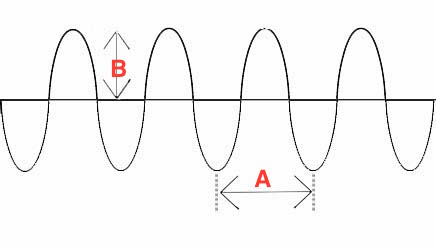
What property of this wave is represented by the letter "A"

a)

amplitude

b)

crest

c)

trough

d)

wavelength

124.
What property of the wave is represented by the letter "B"?
a)
amplitude
b)
crest
c)
trough
d)
wavelength
125.
The highest point on a wave is:
a)
the crest
b)
the trough
c)
the top
d)
the coast 
126.
The lowest point on a wave is the:
a)
Amplitude
b)
Crest
c)
Trough
d)
Wavelength
127.
The number of wavelengths that pass a point each per second is:
a)
frequency
b)
period
c)
longitudinal 
d)
transverse wave 
128.
A period is
a)
Amount of time it takes a wavelength to complete one cycle.
b)
How many wave lengths happen in a second.
c)
An indication of the amount of energy in a wave.
d)
The distance between two crests or two troughs.
129.

A geological disturbance in California produces seismic waves which are detected in Phoenix, approximately 968 km from the epicenter. If the waves travel 6.11 km/s, determine the time delay (in minutes) between the disturbance and the detection.

a)
1.98
b)
5.32
c)
3.75
d)
2.64
130.

The thickness of a string affects the velocity, frequency, period, and wave length.

a)
True
b)
False
c)
Partially true
d)
Not applicable
131.
  • Velocity Rule - the velocity of a wave depends upon the particles, or substance, or material (or medium) that it is traveling through. 

a)
Density Rule
b)
Color Rule
c)
Temperature Rule
d)
Velocity Rule
132.
  • The Frequency Rule - the frequency of a wave depends on the frequency of the source (f of a wave matches the vibrating f of the source). Once a wave leaves its source, the frequency never changes.

a)
The frequency of a wave depends on the amplitude of the source
b)
The frequency of a wave depends on the color of the source
c)
The frequency of a wave depends on the temperature of the source
d)
The frequency of a wave depends on the frequency of the source
133.
  • The Wavelength Rule - The wavelength of a wave depends on the frequency and the velocity. When a wave hits a new medium, 𝛌 will always adjust. So, the wave equation holds true!

a)
The wavelength of a wave does not depend on frequency and velocity
b)
When a wave hits a new medium, 𝛌 will not adjust
c)
The wave equation does not hold true
d)
The wave equation holds true
134.

What type of wave is pictured?

a)

Transverse wave

b)

Longitudinal wave

c)

Waving goodbye

d)

Stadium wave

135.

What type of wave is pictured?

a)

Transverse wave

b)

Longitudinal wave

c)

Wave, what wave?

d)

Slinky wave

136.

Material some waves travel through, such as the type of solid, liquid, or gas.

a)

Trough

b)

Peak

c)

Wavelength

d)

Medium

137.

The length of a crest (peak) or trough measured from the middle line.

a)

Wavelength

b)

Frequency

c)

Amplitude

d)

Medium

138.

The high points of a transverse wave.

a)

Crest (peak)

b)

Trough

c)

Wavelength

d)

Amplitude

139.

The low points of a transverse wave.

a)

Crest (peak)

b)

Trough

c)

Amplitude

d)

Wavelength

140.

The distance between any two crests (peaks) or troughs.

a)

Frequency

b)

Amplitude

c)

Wavelength

d)

Transverse

141.

The number of times the wavelength occurs in one second, measured in units called hertz.

a)

Amplitude

b)

Wavelength

c)

Medium

d)

Frequency

142.

Unit used to measure the frequency of wavelengths.

a)

Amplitude

b)

Hertz

c)

Joule

d)

Engergy

143.

All waves carry ______________.

a)

Sound

b)

Light

c)

Water

d)

Energy

144.

Sound travels in which kind of wave?

a)

Longitudinal waves

b)

Transverse waves

145.

Light waves and water waves travel in what type of waves?

a)

Transverse waves

b)

Longitudinal waves

146.

My science teacher is ______________________.

a)

Mr. Suchan

b)

Mrs. Wallace

c)

Mr. Leader

d)

Bill Nye

147.

My science teacher is __________________.

a)

cool

b)

over stressed

c)

trying very hard to teach me new things.

d)

not nice.

148.

We demonstrated waves by using ______________________.

a)

a ruler

b)

a slinky

c)

string telephones

d)

We demonstrated waves?

149.

This is an example of ______________________.

a)

Transverse waves

b)

Longitudinal waves

150.

What type of waves are these?

a)

Transverse waves

b)

Longitudinal waves

151.

This question is only here to make the number of questions even. What is an even number?

a)

A number that can be divided equally by 2.

b)

57

c)

3

d)

121

152.

How do you determine the number of wavelengths which is equal to the horizontal distance between points

a)
By adding the horizontal distance between points and the wavelength of the wave.
b)
By multiplying the horizontal distance between points and the wavelength of the wave.
c)
By subtracting the horizontal distance between points from the wavelength of the wave.
d)
By dividing the horizontal distance between points by the wavelength of the wave.
153.

You can determine the wave length of a wave by crests or troughs

a)
peaks or valleys
b)
high points or low points
c)
mountains or valleys
d)
crests or troughs
154.

When given a chart with a frequency of 4 harmony, you may want to use y = 1/2L to find wavelength. True or False?

a)
False
b)
y = 2L
c)
y = 1/L
d)
True
155.

If you see a bunch of wave lengths, what can make them unique is where they go. They should fall down and up in the same way since their frequency is the same from the source. Is this true?

a)
False
b)
Partially true
c)
Depends on the color of the waves
d)
True
156.

Lets look at Frequency and Wavelength, if you are measuring these waves to find the frequency needed, and by this, I mean multiplying the number to get one cycle, you multiply the frequency by it, but multiply the wavelength with its reciprocal

a)
Divide the frequency by the number of cycles and multiply the wavelength by its reciprocal
b)
Add the frequency to the number of cycles and divide the wavelength by its reciprocal
c)
Multiply the frequency by the number of cycles and divide the wavelength by its reciprocal
d)
Multiply the frequency by the number of cycles and multiply the wavelength by its reciprocal
157.

When looking at harmonics, what is the constant?

a)
speed of the fundamental wave
b)
frequency of the fundamental wave
c)
amplitude of the fundamental wave
d)
wavelength of the fundamental wave
158.

Standing waves are created by

a)

Two identical waves reflecting off each other

b)

Two identical waves being diffracted together

c)

Two identical waves move through each other in opposite directions

d)

Two identical waves are diffracted from two identical sources

159.

In the diagram which letters represent the nodes

a)

A B C

b)

A C E

c)

B D

d)

B D E

e)

A C D

160.
The moving black dot is called:
a)
a node
b)
an anti-node
c)
an anti-amplitude
d)
the wangy bit
161.
The stationary dot is called:
a)
a node.
b)
an anti-node.
c)
the amplitude.
d)
the not moving bit.
162.
Which harmonic is shown?
a)
1st
b)
2nd
c)
3rd
d)
4th
163.

How many antinodes does this standing wave have?

a)

5

b)

6

c)

7

d)

8

164.

The first harmonic has

a)

1 antinode

b)

1 node

c)

2 antinodes

d)

no nodes

165.

The second harmonic on a string fixed at both ends shows

a)

A wavelength

b)

Half a wavelength

c)

Two wavelengths

166.

The third harmonic on a string fixed at both ends shows

a)

A wavelength and a half

b)

Half a wavelength

c)

Two wavelengths

d)

A wavelength

167.
A wave in which the particles of the medium move perpendicularly to the direction the wave is traveling
a)
A. surface wave
b)
B. transverse wave
c)
C. electromagnetic  wave
d)
D. longitudinal wave
168.
When a guitar is tuned to adjust its pitch, what is it that is changed?
a)
The wavelength of the fundamental.
b)
The frequency of the fundamental.
c)
The amplitude of the fundamental.
169.
When two waves combine to form a new wave with a smaller amplitude, it is called 
a)
Refraction
b)
Constructive Interference
c)
Resonance
d)
Destructive Interference
170.

The figure represents a string of length L, fixed at both ends, vibrating in several harmonics. Which string shows the 4th harmonic?

a)

A

b)

B

c)

C

d)

D

e)

E

171.

The figure represents a string of length L, fixed at both ends, vibrating in several harmonics. Which string shows the 3rd harmonic?

a)

A

b)

B

c)

C

d)

D

e)

E

172.

The figure shows several modes of vibration of a string fixed at both ends. The mode of vibration that represents the fifth harmonic is

a)

1

b)

2

c)

3

d)

4

e)

None of these is correct.

173.

How do we change frequency?

a)
Altering the wavelength of a wave
b)
Changing the speed of light
c)
Increasing the amplitude of a wave
d)
Adjusting the number of cycles per second in a wave
174.

The medium in which an object travels impact frequency?

a)
Yes
b)
No
c)
Maybe
d)
Not sure
175.

Vibrating matter makes sound

a)
Still matter
b)
Solid matter
c)
Liquid matter
d)
Vibrating matter
176.

Explain how the sound of Elina's voice travels from her mouth and is detected by her phone. Use the analogy with the human ear to support your explanation

a)
Sound travels as waves through the air and is detected by the phone's microphone, similar to how sound waves travel through the air and are detected by the human ear.
b)
Sound is detected by the phone's camera
c)
The phone's screen emits the sound waves
d)
Sound travels through the ground to reach the phone