
 Worksheets
Dr.NC Mock Test 1
Total questions: 180
Worksheet time: 2hrs 57mins

What is the mathematical relationships between the number of chromosomes and the number of homologous pairs?
there is no mathematical relationship between the number of chromosomes and the number of homologous pairs
the number of chromosomes is related directly to the age of the organism, so the number of homologous pairs changes
there in only one chromosome in each homologous pair
there are one half as many homologous pairs as there are chromosomes
Hydra reproduce through ___________________, where the offspring grows from the body of the parent organism.
budding
DNA
thymine
mutations
If fission takes place every 20 minutes in some bacteria, then starting with one bacterial cell, how many bacterial cells would be produced in the span of 4 hours?
512
360
1024
4096
A sea star has one of its arms break off. That arm grows into its own separate organism through ____________________.
sexual reproduction
regeneration
spindle fibers
chromosomes
Which animals have developed capacity of regeneration ?
Hydra, Starfish
Plasmodium
Earthworm
Spongilla
Bryophyllum daigremontianum reproduces by
Vegetative propagation
Budding
Fission
Fragmentation
PARTHENOGENESIS OCCURS IN
ROTIFERS
HONEY BEES
TURKEY
ALL OF THE ABOVE
IF THE NUMBER OF CHROMOSOME IN POTATO LEAF IS 48 THEN WHAT WILL BE THE NUMBER OF CHROMOSOME IN ZYGOTE,GAMETE AND ENDOSPERM RESPECTIVELY?
24,24,72
48,24,72
24,48,72
72,48,24
Where are spermatozoa stored while they are maturing?
In the prostate
In the epidymis
In the testes
In the seminal vesicle
Where is the genetic material (DNA) located in the spermatozoa?
In the head
In the tail
In the middle piece
The ovarian cycle lasts about
14 days
28 days
one week
2 days
Which hormone stimulates follicle growth?
FSH
LH
Oestrogen
Which hormones cause the endometrium to grow?
LH and progesterone
FSH and LH
Oestrogens and progesterone

The diagram shows the changes in the thickness of the uterus lining of a woman during her menstrual cycle.
At which time is the woman most likely to be fertile?
A
B
C
D
What are the functions of LH and FSH in the menstrual cycle?
LH- causes ovulation,
FSH- causes menstruation
LH- causes ovulation,
FSH- stimulates an egg to mature in an ovary
LH- stimulates an egg to mature in an ovary, FSH -causes menstruation
LH- stimulates an egg to mature in an ovary, FSH -causes ovulation
After sexual intercourse, sperm can survive for 3 days in the uterus and oviducts.
Ovulation can occur any time from day 13 to day 15 and an egg cell can live for 2 days after ovulation.
How long is the longest possible fertile phase of the menstrual cycle?
2 days
3 days
5 days
7 days
What hormones do ovaries make?
Testosterone
Oestrogen and Progesterone
FSH
LH
On what day of the cycle is ovulation?
Day 14
Day 7
Day 1
Day 28
What is the role of FSH
(follicle-stimulating hormone)?
Causes an egg to mature in an ovary. Stimulates the ovaries to release oestrogen
Stimulates the pituitary gland to release LH.
Triggers ovulation (the release of a mature egg)
Maintains the lining of the uterus during the middle part of the menstrual cycle and during pregnancy.
What is the role of Oestrogen?
Stops FSH being produced (so that only one egg matures in a cycle). Repairs, thickens and maintains the uterus lining. Stimulates the pituitary gland to release LH.
Causes an egg to mature in an ovary. Stimulates the ovaries to release oestrogen.
Maintains the lining of the uterus during the middle part of the menstrual cycle and during pregnancy.
Triggers ovulation (the release of a mature egg)
What is the role of LH
(luteinising hormone)?
Triggers ovulation (the release of a mature egg)
Causes an egg to mature in an ovary. Stimulates the ovaries to release oestrogen
Stops FSH being produced (so that only one egg matures in a cycle). Repairs, thickens and maintains the uterus lining. Stimulates the pituitary gland to release LH.
Maintains the lining of the uterus during the middle part of the menstrual cycle and during pregnancy.
What is the role of Progesterone?
Maintains the lining of the uterus during the middle part of the menstrual cycle and during pregnancy.
Causes an egg to mature in an ovary. Stimulates the ovaries to release oestrogen.
Stops FSH being produced (so that only one egg matures in a cycle). Repairs, thickens and maintains the uterus lining. Stimulates the pituitary gland to release LH.
Triggers ovulation (the release of a mature egg).
What do oestrogen and progesterone do in the menstrual cycle?
They are involved in maintaining the uterus lining
They stimulate the release of the egg
They are involved in egg maturation in the ovaries
What hormone(s) is responsible for thickening the lining of the uterus (endometrium)?
estrogen
progesterone
FSH & LH
LH only
The hormone that stimulates the release of the egg.
Luteinising hormone
Oestrogen
Progesterone
Follicle stimulating hormone
oxytocin receptor formed during end of pregnancy induced by
low level progesterone
high level progesterone
low level estrogen
high level estrogen
Which of the following structures is formed from ectodermal tissues?
brain
muscle
testis
small intestine
formation of three germ layers during embryo known as
gastrulation
organogenesis
cleavage
fertilization
The hormone that induces labor and controls labor via a positive feedback mechanism is __________.
progesterone
estrogen
oxytocin
hCG
Which hormone is the basis for pregnancy test?
hCG
estrogen
LH
FSh
Ovulation in the human female normally takes place during the menstrual cycle
at the mind secretory phase
just before the end of the secretory phase
at the beginning of the proliferative phase
at the end of the proliferative phase.
The immature male germ cell undergo division to produce sperms by the process of spermatogenesis. Choose the correct one with reference to above.
Spermatogonia have 46 chromosomes and always undergo meiotic cell division.
Primary spermatocytes divide by mitotic cell division.
Secondary spermatocytes have 23 chromosomes and undergo second meiotic division.
Spermatozoa are transformed into spermatids.
Bulbourethral glands are situated –
On either side of vagina in humans
On either side of vas deferens in humans
On either side of membranous urethra in humans
Absent in humans
The fluid that provides energy for the sperm cells comes from the ________.
urethra
bulbourethral glands
prostate gland
seminal vesicles
Each seminiferous tubule is lined on its inside by :
A. Male germ cells
B. Interstitial cells
C. Leydig cells
D. Sertoli cells
A, B
A, B, C
A, D
A, B, C, D
which of the following is hormone releasing IUD
cervical cap
Vault
multiload 375
LNG 20
Following statements are given regarding MTP. Choose the correct options given below:
i. MTPs are generally advised during first trimester
ii. MTPs are used as a contraceptive method
iii. MTPs are always surgical
iv. MTPs require the assistance of qualified medical personnel
ii and iii
ii and iii
i and iv
i and ii
Assertion: There is a statutory ban amniocentesis on sex determination in India.
Reason: Amniocentesis is used to determine sex of foetus for female foeticide.
Assertion is incorrect but reason is correct
Assertion is correct but reason is incorrect
Both assertion and reason are incorrect
Both assertion and reason are correct
Statement I: Infection or diseases transmitted through sexual intercourse are called sexually transmitted disease or venereal disease.
Statement II: Tuberculosis is a sexually transmitted disease caused by bacteria.
Statement III: Hepatitis B is transmitted by use of contaminated water.
Only statement I is correct
All statements are wrong
Statement II and III are correct
Both statement I and II are correct
sex determination in humans is
male XX and female XY
male XY and female XX
female X0 and male XX
HCG , HPL , relaxin etc.. are ............
pitiutary hormones
placental hormones
ovarian hormones
____________ develop into pollensacs
MIcrosporangia
microsporophyll
microgametocyte
microspores
the correct sequence of wall layers in a typical anther is
endothecium, epidermis, middle layer, tapetum
Epidermis , Middle layer, Endothecium, Tapetum
Epidermis, Endothecium, middle layers, Tapetum
Endothecium, Tapetum, Middle layer, Epidermis
cells of sporogenous tissue under go which division to form microspore tetrad
mitosis
meiosis
amitosis
cleavage
size of pollen is approx _________ micrometers in diameter
25-30
25-50
25-100
25-45
The outermost layer of pollengrain is made up of a resistant substance called
sporogenous tissue
calcium pectate
sporopollenin
pollinium
intine is the inner wall of pollen grain and is made up of
cellulose and pectin
Calcium and pectin
Hemicellulose and cellulose
Hemicellulose and pectin
in what % of species pollengrains are shed in 2 celled stage
40%
50%
60%
70%
--------------is the cause of pollen allergy
chenopodium
amaranthus
wild oats
parthenium
Pollens are stored in liquid nitrogen at a temperature
-196 degree celcius
-200 degree celcius
-197 degree celcius
-192 degree celcius
Pollen deposits of another flower of same individual plant is called
Geitonogamy
Xenogamy
Homogamy
Cleistogamy
A dioecious flowering plant prevents both
Autogamy and Xenogamy
Xenogamy and Geitonogamy
Autogamy and Geitonogamy
Cleistogamy and Xenogamy
The morphological nature of the edible part of coconut is
Perisperm
Pericarp
Cotyledon
Endosperm
Attractants and rewards are required for
Anemophily
Entomophily
Hydrophily
Cleistogamy
How many microspore mother cells are required to produce 1000 microspores/pollen grains?
100
150
200
250
In a breeding experiment, the selected male parent is diploid and the female parent is tetraploid. What will be the ploidy level of the endosperm that will develop after double fertilisation?
Diploid
Triploid
Tetraploid
Pentaploid
The number of meiotic divisions, required to produce 400 seeds in a pea plant, is
100
200
400
500
A dicotyledonous plant bears flowers but never produces fruits and seeds. The most probable cause for the above situation is
plant is dioecious and bears only pistillate flowers.
plant is dioecious and bears both pistillate and staminate flowers.
plant is monoecious.
plant is dioecious and bears only staminate flowers.
What is the function of micropyle?
Protects the seed
Stores the food for germination
Grows and develops into roots
Allows air and water to enter the seed
The process of formation of embryo without fertilization is known as
(a) polyembryony
(b) apomixis
(c) amphimixis
(d) vivipary
The product of double fertilization is.
(a) endosperm
(b) embryo sac
(c) nucellus
(d) synergids
The water of tender coconut is:
Cellular endosperm
Helobial endosperm
Combination of cellular and helobial endosperm
Free nuclear endosperm
Which of the following is false about external fertilization?
Organisms showing external fertilization exhibit great synchrony between the sexes and release gametes
Gametes are produced in large number in water to enhance the chances of fertilization
A large number of gametes are wasted
A major advantage is that the offsprings are protected from predators and there is a great chance of their survival upto adult hood.
Internal fertilization occurs in –
Many fungi
Reptiles; mammals
Bryophytes, pteridophytes, gymnosperms, angiosperms
All
Which of the following is correct?
Asexual reproduction is an elaborate, complex and slow process as compared to sexual reproduction
Cockroach is bisexual
Strobilanthus kunthiana (neelakuranji) flowers every year in June
Date palm and Papaya are dioecious plant
Find out correct order of vegetative propagules of plants like Potato, Ginger, Agave, Bryophyllum and Water Hyacinth
Offset, bulbil, leaf bud, rhizome and eyes
Rhizome, bulbil, leaf bud, eyes and offset
Eyes, rhizome, bulbil, leaf bud and offset
Leaf bud, bulbil, offset, rhizome and eyes
Which of the following is correct?
I. The period of growth between the birth of an individual upto reproductive maturity is called Juvenile phase.
II. The type of parthenogenesis in which parthenogenetic egg may develop into individual of any sex is amphytoky.
III. No individual is immortal except single celled organisms.
IV. Mango tree has a much shorter life span as compared to a peepal tree.
I, II and IV
II and III
I, III and IV
All
___________ tissue is responsible for producing pollen grains in microsporangia.
Endothecium
Tapetum
Epidermis
Sporogenous
Coleorrhiza protects
Plumule
Radicle
Epicotyl
Hypocotyl
Residual and Persistant Nucellus is called
Endosperm
Perisperm
Pericarp
Endocarp
Which of the following statements about fruit is false?
Apple and strawberry are false fruits
Parthenocarpic fruits are seedless
True fruit develops from ovule after fertilisation
In some cases thalamus also develops into fruit.
Uterine cycle consist of 3 phases. Which one is correct order of sequence?
Proliferative > Menstrual flow > Secretory
Menstrual flow > Secretory > Proliferative
Secretory > Proliferative > Menstrual flow
Menstrual flow > Proliferative > Secretory
i. Condoms
ii. Spermicide
iii. Abstinence
iv. Intra Uterine Devices
Which of the following describes the main advantages of sexual reproduction?
requires lots of time/energy
no new gene combos can arise
genetic diversity
looks identical to the parent
What is the correct name for a sex cell?
The noise
Gamete
Ovary
Sperm
which of the following point defects are shown by AgBr(s) Crystals?
Schottky and impurity
Frenkel and schottky
Frenkel and impurity
Non stoichiometric defect
The percentage of empty space in a face centre cubic arrangement is
74
52
68
26
The electrons are trapped in anionic vacancies in metal excess defect are called
schottky defect
Frenkel defect
f-centre
Impurity defect
The Crystal having highest melting point is
Ionic Crystal
Covalent Crystal
Molecular crystal
Metallic Crystal
The number of atoms per unit cell in simple, fcc and bcc unit cells are
1, 4, 2
1, 2, 4
2, 1, 4
2, 4, 1
In 3D close packing the ABCABCABC.....pattern gives rise to which type of close packing?
Hexagonal Close Packing (hcp)
Cubic Close Packing (ccp)
Face Centred Cubic Packing (fcc)
Both ccp and fcc
The packing efficiency in simple, fcc, bcc unit cells will be respectively
74% 52.4% 68%
52.4% 68% 74%
68% 74% 52.4%
52.4% 74% 68%
The relationship between the atomic radius (r) and edge length (a) of a simple, fcc, bcc cubic unit cell will be respectively
2a 42a 43a
2a 43a 42a
42a 43a 2a
43a 2a 43a

What type of material is this one?
Crystal
Amorphous
Covalent Crystal
Ionic Crystal
Which of the following is an amorphous solid?
Copper(Cu)
Quartz glass (SiO2)
Silicon carbide (SiC)
Sodium Chloride (NaCl)
Which of the following is a network solid or covalent crystalline solid?
Diamond (C)
H2O (Ice)
Calcium Fluoride (CaF2)
Iron Metal (Fe)
A. Ionic solids are hard and brittle.
B. Covalent solids are good conductors.
A and B are correct.
A is correct
B is correct
Both A and B are wrong
The type defect observed in ionic crystals which large difference in the size of ions is:
Interstitial defect
Frenkel defect
Schottky Defect
Stoichiometric Defect
A mixed oxide has ccp arrangement in which the cations 'X' occupy 1/3rd of octahedral voids and the cations 'Y' occupy 1/3rd of tetrahedral voids.The formula of oxide is:
X 2Y 3O 2
XY 3O
X 2YO 3
XY 2O 3
An element with molar mass 64 gmol -1 and density 6.6 g cm -3 forms a cubic unit cell.The edge length of unit cell is 4 x 10 -8cm.The type of cubic unit cell formed is ?
fcc
ccp
bcc
hcp
A solid is made up of 2 elements P and Q. Atoms Q are in ccp arrangement,while P atoms occupy all the tetrahedral sites.The formula of the compound is:
PQ 2
P 6Q 4
P 2Q
PQ
A compound is formed by two elements X and Y. Atoms of the element Y (as anions) make ccp and those of the element X (as cations) occupy all the octahedral voids. The formula of the compound is :
X 2Y
X 4Y
XY
XY 2
An element with molar mass 2.7 x 10 -2 kg mol -1 forms a cubic unit cell with edge length 405 pm. If its density is 2.7 x 10 3 kg m -3,the nature of cubic unit cell is :
hcp
ccp
bcc
fcc
Given the following rate law,
rate = k[A]2[B]
if [A] were doubled, what must happen to [B] to keep the rate constant?
[B] must quadruple
[B] must double
[B] must be havled
[B] must be quartered
Which of the following are true of reaction rates?
I. The overall rate law is determined by the fastest step of a reaction
II. The presence of a catalyst will increase the number of molecules entering the transition state
III. An increase in temperature will increase the rate of a reaction
IV. Increasing the concentration of reactants will increase the rate at which products yield
II+III+IV
I+IV
II + III
I+II+III
X + Y → Z + Q ΔH = +22kj/mol
How can above reaction be classified in terms of energy exchange during chemical change?
Which of the following reactions uses increasing volume of gaseous product method to measure the its rate?
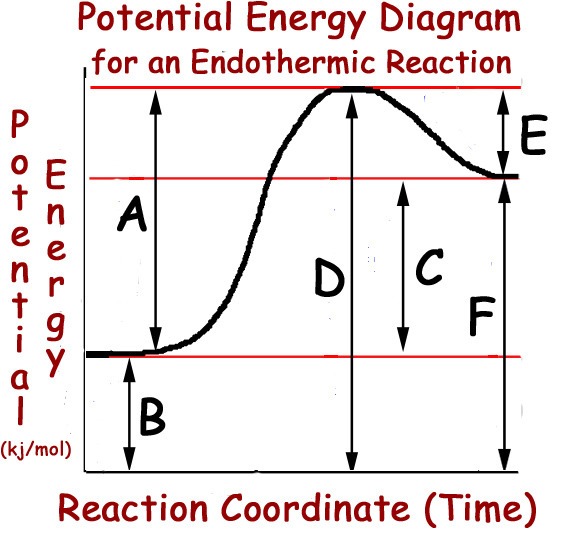
What letter represents the activation energy?
A
B
C
D
Given the following rate law,
rate = k[A]2[B]
if [A] were doubled, what must happen to [B] to keep the rate constant?
[B] must quadruple
[B] must double
[B] must be havled
[B] must be quartered
Which of the following best describes why increasing temperature increase reaction rate?
Activation energy is reduced.
Collisions become more frequent.
Collisions become more energetic.
Collisions become more frequent and more energetic.
What is the parameter to measure the rate or speed of a reaction beside time?
Change in volume
Change in concentration
Change in pressure
Change in temperature
Bronze is an alloy of __________
Cu and Sn
Cu and Zn
Cu and Fe
Fe and Ni
An alloy prepared from Fe, Ni and Cr is known as __________
Brass
Bronze
Stainless steel
amalgam
Which Metal prevents the rusting of iron?
Cu
Zn
Al
Ag
Which solution is used to react with bauxite as a first step in obtaining pure aluminum oxide
Conc. H2SO4 soln.
Dil. NaOH soln.
Conc. HCl
Conc. NaOH soln.
Electrolyte used in Hall Heroult's process
CuSO4 soln.
Mixture of fused alumina, cryolite and fluorspar
Molten lead bromide
Acidified water


How do you know when you have a saturated solution?
You don't see anymore material in the solution. It has dissolved.
The material dissolves and no more will dissolve because you see it collect at the bottom.
The solution is bubbling and cloudy.
The solution is clear and there is nothing at the bottom.
rate = k[A]
The rate constant in the rate law above is 0.5 L/mol·s. If the initial concentration of A is 0.1 M, how long will it take for [A] to drop to 0.025 M?
0.7 s
1.4 s
2.8 s
There is not enough information given.
Which of the following is not a characteristic of a crystalline solid?
Definite and characteristic heat of fusion.
Long range order or perfect arrangement of constituent particles
Isotropic in nature
clean cleavage or smooth edges on cutting with a knife
Schottky defect is observed when
unequal number of cations and anions is missing from the crystal lattice.
equal number of cations and anions is missing from the crystal lattice.
an ion leaves its normal site and occupy interstitial site.
density of the crystal increases.
Iron oxide crystallises in a hexagonal close-packed array of oxide ions with two out of every three octahedral holes occupied by iron ions. What is the formula of the iron oxide?
FeO
Fe2O3
Fe3O4
None of these
A cubic solid is made of two elements P and Q. Atoms of Q are at the corners of the cube and P at the body-centre. What is the formula of the compound?
PQ
P2Q
PQ2
PQ4
Gold (atomic radius = 0.144 nm) crystallises in a face-centred unit cell. What is the length of a side of the cell?
0.607 nm
0.407 nm
6.07 nm
4.07 nm
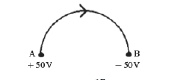
Electric potential due to a point charge –q at distance x from it is given by:
Kq/x2
Kq/x
-Kq/x2
-Kq/x
A positive charge +Q is placed a distance d from a negative charge −Q . Note these charges have the same magnitude but different sign. Which of the following is true about the electric field and the electric potential at a point midway between the two charges?
The electric field is zero and the electric potential is zero
The electric field is not zero and the electric potential is zero
The electric field is zero and the electric potential is not zero
The electric field is not zero and the electric potential is not zero
A positive charge Q is placed very close to the positive plate of a parallel plate capacitor that produces an electric field E . Once released, the positive charge reaches the negative plate a distance d away with a kinetic energy of
Ed
QEd
2Ed
2QEd
Electrostatic potential energy is recorded in units of electron-Volts (eV). What is equivalent to 1 eV?
1.602×10⁻¹⁹ 𝐽
100 𝐽
220 𝐽
0.003 𝐽
The air surrounding the sphere loses its insulating properties, causing a spark, when the electric field exceeds 20 kV cm-1. By reference to an atom in air, which of the following is not the mechanism by which the electric field causes the air to become conducting.
Electric field causes forces on the electrons and the nucleus in atoms of air to move in opposite directions.
The field causes electrons to be stripped off the atom.
We say the air breaks down.
The nucleus move in opposite direction to the field.
A capacitor of capacitance 30μF is fully charged from a 10 V d.c. supply. Calculate the charged stored by the capacitor
3.0 mC
0.30 mC
300 mC
330 kC

2.0 μF
2.9 μF
14 μF
26 μF
The capacitance of a sphere is 50 pF. The sphere is charged to a potential of 9.0x10⁵V. A spark occurs, partially discharging the sphere so that its potential is reduced to 3.6x10⁵V. What is the energy of the spark?
0.014 J
14 J
17J
2.4x10³J
An isolated metal sphere has a radius r. When charged to a potential V, the charge on the sphere is q. The charge may be considered to act as a point charge at the centre of the sphere.
What is the capacitance of this isolated sphere?
4πϵorq
4πϵor
4πϵor1
Vqr

A potentiometer wire of length 1 m is connected to a driver cell of emf 3 V as shown in the figure. When a cell of 1×5 V emf is used in the secondary circuit, the balance point is found to be 60 cm. On replacing this cell and using a cell of unknown emf, the balance point shifts to 80 cm.Calculate unknown emf of the cell.
1 V
1.5 V
3 V
2 V
2.2 V

The following graph shows the variation of terminal potential difference V, across a combination of three cells in series to a resistor, versus the current. Calculate the emf and internal resistance of each cell
E = 6 V & r = 3 ohm
E = 2 V & r = 1 ohm
E = 6 V & r = 1 ohm
E = 2 V & r = 3 ohm
E = 1 V & r = 1 ohm

Calculate the balance point of the cell. Resistance of the potentiometer wire is 20 ohm and length of the wire is 400 cm.
0.75 m
7.5 cm
25 cm
200 cm

How would the equivalent resistance be determined?
1 / Req = (1/5) + (1/8) + (1/3) Ω
120 Ω
1.5189873 Ω
1 / Req = (1/5) * (1/8) * (1/3) Ω

A 1.5 m length of wire has a cross-sectional area 5.0 × 10⁻⁸ m2. When the potential difference across its ends is 0.20 V, it carries a current of 0.40 A. The resistivity of the material from which the wire is made is
6.0 × 10⁷ Ω m
1.7 × 10⁻⁸ Ω m
1.1 × 10⁶ Ω m
9.4 × 10⁻⁷ Ω m

For the graph shown in the figure, what physical quantity does the slope of the graph represent for ohmic material?
power
resistivity
resistance
1/(resistance)
An electrical junction has three wires A, B and C connected to it. Wire A carries 4.2 A going in, wire B carries 2.6 A going out. What does wire C carry?
1.6 A going in
1.6 A going out
6.8 A going in
6.8 A going out

What is the current through R1?
10 A
5 A
7 A
2 A

Points P and Q are connected to a battery of fixed voltage. As more resistors R are added to the parallel circuit, what happens to the total current in the circuit?
increases
remains the same
decreases
drops to zero
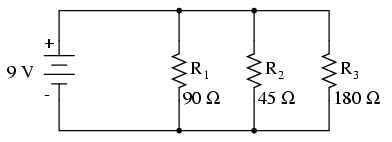

Two, point charges 𝑞1 = +5.00 𝑛𝐶 and 𝑞2 = − 3.00 𝑛𝐶 are separated by 35.0 cm.
What is the potential energy of the pair of charges?
-3.85 X 10⁻⁷ J
+3.85 X 10⁻⁷ J
+1.29 x 10² J
-7.71 x 101 J
Three charges are placed at the corners of an equilateral triangle of side 2.00 𝑚𝑚 as shown below. Calculate the electric potential energy associated with this configuration.
8.9 x 10⁻⁴ J
4.5 x 10⁻⁴ J
8.9 x 10⁻⁶ J
2.7 x 10⁻⁴ J

Four capacitors are connected in a circuit as shown below. If the voltage across the battery is 30V, then:
a) what is the total charge flowing through the circuit?
b) what is the charge flowing through the first capacitor on the left? (Think about the rules used in series and parallel circuits for charge)
a) 200 Micro Coulombs
b) 200 Micro Coulombs
a) 66.7 Micro Coulombs
b) 66.7 Micro Coulombs
a) 200 Micro Coulombs
b) 66.7 Micro Coulombs
a) 66.7 Micro Coulombs
b) 200 Micro Coulombs
Three capacitors of capacitances 3μF, 9 μF and
18 μF are first connected in series and then in parallel. The ratio of the net capacitances in series to that in parallel is _____.
1:1
1:3
1:15
3:1
15:1

Which of the following equations represent the current I in the circuit?


A battery has an emf ε = 43.0 V and an internal resistance r = 8.0 Ω, as shown in the figure. When the terminal voltage Vab is equal to 34.0 V, the current through the battery, including its direction, is closest to ___
1.1 A, from b to a.
4.2 A, from b to a.
1.1 A, from a to b.
4.2 A, from a to b.

What is the equivalent resistance of the resistors in the figure shown above?
7.5
10
16
18

What is the equivalent resistance for the resistors in the figure shown above?
1.3 Ω
2.2 Ω
3.0 Ω
12.0 Ω

Three resistors connected in parallel have individual values of 4.0 Ω , 6.0 Ω , and 10.0 Ω , as shown above. If this combination is connected in series with a 12.0 V battery and a 2.0 Ω resistor, what is the current in the 10.0 Ω resistor?
0.58 A
1.0 A
11 A
16 A
In any complex resistance circuit, the voltage across any resistor in the circuit is always
less than the voltage source.
equal to or less than the voltage source.
equal to the voltage source.
greater than the voltage source.
Two resistors with values of 6.0 Ω and 12 Ω are connected in parallel. This combination is connected in series with a 2.0 Ω resistor and a 24 V battery. What is the current in the 2.0 Ω resistor?
2.0 A
4.0 A
6.0 A
12 A

The energy of a charged capacitor is given by the expression (q= charge on the conductor and C = its capacity)
2Cq2
Cq2
2C2q
2qC
Two condensers of capacity 0.3 μ F and 0.6 μ F respectively are connected in series. The combination is connected across a potential of 6 Volts. The ratio of energies stored by the condensers will be
1/2
2
1/4
4

Three equal capacitors, each with capacitance are connected as shown in figure. Then the equivalent capacitance between and is
C
C/3
3C
3C/2

The resultant capacitance between and in the following figure is equal to
1 μ F
3 μ F
2 μ F
1.5 μ F
A 5uF, a 10uF and a 20uF capacitor are connected in SERIES to a 6V battery. Calculate the total equivalent capacitance of the circuit?
35uF
0,35uF
2,857uF
0,0286uF

Each of the four capacitors shown is 500 microF. The voltmeter reads 1000V. The magnitude of the charge on each capacitor plate is:
0.2 C
0.5 C
20 C
50 C


