wayground logo

Free Printable Worksheets

Font size

S
M
L
XL
Worksheets

Unit 1 Bio Exam Revision

Total questions: 183

Worksheet time: 3hrs 41mins

Name
Class
Date
1.

Has membrane bound organelles

a)

Prokaryote

b)

Eukaryote

c)

Both

2.

Which type of cell?

a)

Prokaryote

b)

Eukaryote

3.

Where is the DNA found in a prokaryotic cell?

a)

In the nucleus

b)

In the mitochondria

c)

Floating around in the cytoplasm

d)

In the ribosome

4.

What is the function of this organelle?

a)

Sac that stores water, nutrients, and waste products

b)

Regulates what enters and leaves the cell

c)

Structures that transport and ship proteins like UPS

d)

Cite of cellular respiration also known as the powerhouse of the cell

5.

I store water in both plant and animal cells. What am I?

a)

Mitochondria

b)

Lysosome

c)

Vacuole

d)

Cytoplasm

6.

Bacteria are a type of...

a)

Prokaryote

b)

Eukaryote

c)

Both

7.

What cell part is NOT found in all cells

a)

Cytoplasm

b)

Genetic material

c)

Cell membrane

d)

Cell wall

8.

What is the function of this part of the cell?

a)

Structure

b)

Flexability

c)

Regulates what comes in and out of the cell

d)

Stores genetic information

9.

Where are proteins made?

a)

Golgi Body

b)

Ribosomes

c)

Chromosomes

d)

Mitochondria

10.
For cells to stay alive they require what type of SA:V?
a)
Large SA, Large V
b)
Small SA, Large V
c)
Large SA, Small V
d)
Small SA, Small V
11.
High Surface area to volume ratio allows cells to do what quickly?
a)
Move materials around inside the cell
b)
Move materials in and out of the cell 
c)
Communicate to other cells
d)
Divide
12.
This image shows how materials move into various sized cells in a given amount of time.... why does one square cell have more pink coloring than the others? 
a)
The surface area was too larger to get through
b)
The volume of the other cells was too large for the dye to get through
c)
There was not enough surface area for the dye to get through
d)
The volume was too low for the dye to stay in the square
13.
Microvilli are tiny projections that extend off the cell to increase the Surface Area.  What purpose might that serve? 
a)
Increased absorption
b)
Better communication among cells
c)
Maintain homeostasis 
d)
Decreased oxygen use
14.

This egg has shrunk, what type of solution was it placed in?

a)

hypotonic solution

b)

hypertonic solution

c)

isotonic solution

15.
What type of solution is this cell in?
a)
Isotonic
b)
Hypertonic
c)
Hypotonic
d)
diffused
16.
What type of solution allows water to enter the plant cell?
a)
hypotonic solution
b)
hypertonic solution
c)
isotonic solution
d)
active transport
17.
What type of solution is this cell in?
a)
Isotonic
b)
Hypertonic
c)
Hypotonic
d)
diffused
18.

Elodea is a freshwater plant. When it is placed in saltwater what will happen to its cells?

a)

They will become turgid because water is entering the cell, making them firm

b)

They will become flaccid because water is entering and leaving the cell at equal rates, making them a little soft

c)

They will be plasmolyzed because water is leaving the cell, making them shrink significantly

19.

Fill in the blank:

Osmosis is the movement of ________ across a cell membrane from high to low.

a)

Carbon dioxide

b)

Starch

c)

Water

d)

Oxygen

20.

In an isotonic solution which way will the water flow

a)

it will not flow at all

b)

it will flow into the cell

c)

it will flow both ways at equal rates

d)

out of the cell

21.

Which Type of solution is the middle cell placed in?

a)

Hypertonic

b)

Hypotonic

c)

Isotonic

d)

Robotonic

22.

What would happen to a cell placed in a hypertonic solution

a)

The cell would shrink

b)

The cell would expand and possibly burst

c)

The cell would remain the same

d)

The cell would dance and do the Nay Nay!

23.
What is the cell cycle?
a)
The gradual development of something, especially from a simple to a more complex form.
b)
The study of heredity and the variation of inherited characteristics.
c)
The branch of biology that deals with the relations of organisms to one another and to their physical surroundings.
d)
The series of events that take place in a cell leading to its division and duplication of its DNA to produce two daughter cells.
24.
Which part of the Cell Cycle takes the longest?
a)
Interphase
b)
Mitosis
c)
Prophase
d)
Cytokinesis
25.
What happens in the first part of Interphase?
a)
Mitosis
b)
Cell Growth
c)
DNA Replication
d)
Anaphase
26.
What part of the cell cycle results in the splitting of the new cells?
a)
Interphase
b)
Mitosis
c)
Metaphase
d)
Cytokinesis
27.
What does DNA Replication mean?
a)
DNA is made.
b)
DNA makes new cells. 
c)
DNA copies itself.
d)
DNA starts the cell cycle.
28.
True or False. 
After a cell goes through cytokinesis, it starts mitosis all over again.
a)
True
b)
False
29.
What phase is this cell in?
a)
Cytokinesis
b)
Mitosis
c)
Prophase
d)
Metaphase
30.
What phase is this cell in?
a)
Mitosis
b)
Interphase
c)
Anaphase
d)
Telophase
31.
What phase is this cell in?
a)
Mitosis
b)
Cytokinesis
c)
Prophase
d)
Telophase
32.
What phase is this cell in?
a)
Mitosis
b)
Interphase
c)
Prophase
d)
Telophase
33.
What part of the cell cycle is this cell in?
a)
Mitosis
b)
Interphase
c)
Telophase
d)
Cytokinesis
34.
True or False.
Mitosis is made up of 5 phases.
a)
True
b)
False
35.
In what phase do the chromosomes line up in the middle of the cell?
a)
Cytokinesis
b)
Metaphase
c)
Prophase
d)
Telophase
36.
In what phase does chromatin condense to form chromosomes?
a)
Mitosis
b)
Interphase
c)
Prophase
d)
Anaphase
37.
BONUS:
How long is the whole cell cycle for most animal cells?
a)
2-3 days
b)
24 hours
c)
2-3 hours
d)
23 hours
38.

In which stage of the cell cycle does the cell duplicate its DNA?

a)

G1

b)

S

c)

G2

d)

Mitosis

39.

In which stage of the cell cycle does the cell grow in size?

a)

G1

b)

S

c)

G2

d)

Mitosis

40.

Select all stages of interphase?

a)

G1

b)

S

c)

G2

d)

Mitosis

41.

In which stage of the cell cycle is protein and organelle synthesis?

a)

G1

b)

G2

c)

S

d)

Cytokinesis

42.

_____ is the uncontrolled growth of cells, often resulting in a tumor or mass of abnormal cells

a)

Cancer

b)

Apoptosis

c)

Radiation

43.

Radiation is often used for cancer therapy because it can trigger __________________.

a)

the immune system

b)

apoptosis

c)

cells to skip the cell cycle

d)

further cell mutation

44.

Apoptosis is

a)

programmed cell death

b)

mysterious cell death

c)

programmed cellular mutation

d)

mysterious cellular mutation

45.

Which best explains why it is dangerous for a cell to become too large?

a)

it may crowd out other cells

b)

its volume exceeds its surface area, making transport difficult

c)

it will be unable to produce enough lipids for its plasma membrane

d)

it will require far less energy than a normal sized cell

46.

​Based on the data, which of these best describes why cells divide when they reach a certain size?

a)

The surface area-to-volume ratio of a cell remains constant during growth.

b)

The surface area of a cell increases more than its volume during growth.

c)

The volume of a cell increases more than its surface area during growth.

d)

The volume of a cell increases as the surface area decreases during growth.

47.
Neuron cells, like the one pictured, rarely replicate. Therefore, we consider them to be in the _____ phase.
a)
G0
b)
G1
c)
S
d)
Delay
48.
At the end of the G1 phase, there's a checkpoint. What is this checkpoint probably checking for?
a)
To see if the cell has grown enough
b)
To see if the DNA was correctly replicated
c)
To make sure the cell does not have cancer
d)
To make sure that the enzymes aren't amalyzed
49.
The "M" in M phase is referring to...
a)
Mitosis
b)
Membrane
c)
Mass
d)
Mangrove
50.
Put the following actions in order: DNA replicates, cell grows, cell divides, cell prepares for mitosis. 
a)
DNA replicates, cell grows, cell prepares for mitosis, cell divides
b)
cell grows, cell prepares for mitosis, DNA replicates, cell divides
c)
cell grows, DNA replicates, cell prepares for mitosis, cell divides
d)
DNA replicates, cell prepares for mitosis, cell grows, cell divides
51.
Fruit fly body cells have 8 chromosomes. After mitosis, you would expect a resulting fruit fly daughter cell to have ...
a)
16 chromosomes.
b)
46 chromosomes.
c)
8 chromosomes.
d)
4 chromosomes.
52.
Medical researchers are interested in stem cells because they?
a)
are found in all types of tissues
b)
can produce different cells types
c)
are highly specialized
d)
are found only in embryos
53.
The process by which cells become specialized is known as?
a)
stem cell research
b)
embryonic development 
c)
totipotent cell strucutre
d)
cell differentiation 
54.
Stem cells are
a)
cells that grow uncontrollably.
b)
undifferentiated and can develop into many types of cells.
c)
cells that never go through cell division.
d)
only found in embryos.
55.
Stem cells can be obtained from
a)
embryos
b)
some adult tissues
c)
umbilical cord blood
d)
all of the above
56.
What does "pluripotent" mean?
a)
able to divide and make many different types of cells
b)
not able to divide
c)
can only divide and make one cell type 
d)
if it divides, it will make a cancerous tumor
57.
Which best explains why muscle cells are different from blood cells?
a)
Muscle cells are produced by the brain, but blood cells are produced by the heart. 
b)
Different genes are activated in muscle cells than in blood cells. 
c)
Muscles cells experience different environmental influences than blood cells. 
d)
A mutation occurs during the development of muscle cells but not in blood cells. 
58.
What is the difference between embryonic stem cells and adult stem cells?
a)
Embryonic stem cells can differentiate into more cell types than adult stem cells
b)
Adult stem cells are pluripotent, just like embryonic stem cells
c)
Adult stem cells can differentiate into more cell types than embryonic stem cells
d)
Adult stem cells grow bigger than embryonic stem cells
59.
Which is true about embryonic stem cells?
a)
They no longer divide, their cell type is set and cannot change.
b)
They can develop into only one type of cell.
c)
They can become any cell type in the body.
d)
They are found in adults.
60.
what is the role of stem cells in the body 
a)
fight against infection 
b)
provide specialized roles in the body 
c)
used for fertility treatment 
d)
they produce new specialized cells in the body to replace old cells that are used up 
61.

_________ refers to a stem cell's ability to differentiate into other cell types

a)

potency

b)

potential

c)

dormancy

d)

aptitude

62.

a cell that has the most potential, able to become any type of cell.

a)

Totipotent

b)

Pluripotent

c)

Multipotent

63.

can become any of the three cell layers in a

developing embryo (endoderm, mesoderm, ectoderm), but not the placenta surrounding the embryo.

a)

Totipotent

b)

Pluripotent

c)

Multipotent

64.

partially differentiated, with only the capacity to become one cell type.

a)

Totipotent

b)

Pluripotent

c)

Multipotent

65.

Which has the lowest potency?

a)

Morula

b)

Blastocyst

c)

Fetus

d)

Adult

66.
Neural stem cells from the brain can differentiate into... 
a)
only specialized brain cells .
b)
specialized brain cells and specialized skin cells. 
c)
all types of specialized cells. 
d)
only specialized blood cells. 
67.
Stem cells are used to __________.
a)
make clones
b)
create new species of animals
c)
make babies
d)
grow different types of tissues
68.

Medical research involving stem cells is important for ...

a)

to test the effectiveness of new drugs

b)

the generation of cells and tissues that can be used in cell based therapies

c)

to understand the consequences of turning genes off and on

d)

All of the above

69.

Kidney shaped cells at the border of the stomata

a)

Lenticels

b)

Cuticle

c)

Guard cells

d)

Hydathodes

70.

The rate of transpiration increases with

a)

High atmospheric CO2 level

b)

Low water content of leaf

c)

Shedding of leaves

d)

Dry air

71.

Water molecules pull each other up the xylem due to ______________.

a)

capillary action

b)

root pressure

c)

osmosis

d)

active transport

72.

Transpiration is the process in which ______________.

a)

water moves through a plant and is later evaporated from the roots

b)

water moves through a plant and is later evaporated from the leaves

c)

mineral salts enter the roots

d)

none of the above

73.

Remember when you put the celery in the water? What happened to the water level by the next day?

a)

The level dropped A LOT, because the celery sucked it up.

b)

The level stayed the same, because the celery was dead.

c)

The level dropped a little, because of evaporation.

74.

Water transported from stems to leaves through what?

a)

xylem

b)

phloem

c)

stems

d)

roots

75.

Which of the following is NOT a factor that affects the rate of transpiration?

a)

sunlight

b)

humidity

c)

wind speed

d)

rain

76.

What is the name of the microscopic holes in leaves that are opened and closed to allow water to TRANSPIRE?

a)

water doors

b)

stomata

c)

leaf eyes

d)

transpiration holes

77.

Transpiration pull is ____________.

a)

a force used to get water molecules into the roots

b)

a pushing force

c)

a vacuum force

d)

none of the above

78.

Part of the water absorbed from the soil is lost via transpiration, some is used for photosynthesis and some used for .............?

a)

maintaining turgidity of cells

b)

stored in fruits

c)

stored in leaves

d)

stored in stem

79.

Mineral ions move from the soil into the roots by the process of ?

a)

osmosis

b)

diffusion

c)

active transport

d)

none of the above

80.

How does water move from the soil into the root hair cell and reach the xylem vessels?

a)

diffusion

b)

osmosis

c)

active transport

d)

none of the above

81.

This kind of arrangement of vascular bundles can be seen in the ............?

a)

leaf

b)

root

c)

stem

82.

Which of the following indicates the pathway of water through a plant?

a)

root hair cell --> xylem --> Mesophyll --> substomatal space --> stomata

b)

substomatal space -- > stomata --> root hair cell --> xylem --> Mesophyll

c)

xylem --> stomata --> root hair cell --> Mesophyll --> Substomatal space

83.

Choose the two statements that indicate what would be happening in the plant when stomata are open.

a)

Guard cells are turgid

b)

Guard cells are plasmolysed

c)

Transpiration increase

d)

Transpiration decrease

84.

Which of the following processes require energy?

a)

Osmosis

b)

Diffusion

c)

Active Transport

85.

Select all of the processes which are passive and do not require energy

a)

Osmosis

b)

Diffusion

c)

Active Transport

86.

Which of the following processes involve the movement of water molecules?

a)

Osmosis

b)

Diffusion

c)

Active Transport

87.

Which cell structure controls the entry and exit of molecules?

a)

Cell Wall

b)

Cell Membrane

c)

Nucleus

d)

Cytoplasm

88.

Which of the following molecules is too large to pass through a selectively-permeable membrane?

a)

Glucose

b)

Starch

c)

Salt

d)

Water

89.

Which two molecules make up the cell membrane?

a)

Protein and Lipids

b)

Protein and Phospholipids

c)

Starch and Protein

d)

Protein and Glucose

90.

Diffusion is the movement of molecules from...

a)

An area of high concentration to an area of low concentration.

b)

An area of low concentration to an area of high concentration.

91.

What happens to an animal cell when it is placed in a solution with a high water concentration?

a)

The cell swells up and bursts.

b)

The cell shrivels up.

c)

The cell becomes plasmolysed.

d)

The cell becomes turgid.

92.

What happens to an animal cell when it is placed in a solution with a low water concentration?

a)

The cell swells up and bursts.

b)

The cell shrivels up.

c)

The cell becomes plasmolysed.

d)

The cell becomes turgid.

93.

What happens to a plant cell when it is placed in a solution with a high water concentration?

a)

The cell swells up and bursts.

b)

The cell shrivels up.

c)

The cell becomes plasmolysed.

d)

The cell becomes turgid.

94.

Select all of the molecules which move into a cell.

a)

Carbon Dioxide

b)

Urea

c)

Glucose

d)

Oxygen

95.

Select all of the molecules which move out of a cell.

a)

Carbon Dioxide

b)

Urea

c)

Glucose

d)

Oxygen

96.
a)

A

b)

B

c)

C

d)

D

97.

What happens to an animal cell when it is placed in a solution with a high water concentration?

a)

The cell swells up and bursts.

b)

The cell shrivels up.

c)

The cell becomes plasmolysed.

d)

The cell becomes turgid.

98.

What happens to an animal cell when it is placed in a solution with a low water concentration?

a)

The cell swells up and bursts.

b)

The cell shrivels up.

c)

The cell becomes plasmolysed.

d)

The cell becomes turgid.

99.

What happens to a plant cell when it is placed in a solution with a high water concentration?

a)

The cell swells up and bursts.

b)

The cell shrivels up.

c)

The cell becomes plasmolysed.

d)

The cell becomes turgid.

100.

Which structure can prevent a plant cell from bursting when it gains water by osmosis?

a)

Cell membrane

b)

Cell wall

c)

Vacuole

101.

What could cause a plant cell to become plasmolysed?

a)

Gain of water

b)

Loss of water

c)

Vacuole swelling up

102.

A student noticed that placing wilted lettuce in a bowl of cool water caused the lettuce to become more crisp and firm. What is the best explanation for his observation?

a)

water was absorbed into the lettuce cells

b)

water moved into the lettuce cells by osmosis

c)

salt moved out of the lettuce cells by diffusion

d)

water moved out of the lettuce cells by osmosis

103.

How would you describe the state of these cells?

a)

turgid

b)

burst

c)

plasmolysed

d)

crenated

104.
Which of the following is NOT the system that regulate the blood sugar level?
a)
Circulatory system
b)
Muscle system
c)
Endocrine system
d)
Digestive system
105.
What is the name of the receptor that detect the rise and fall of body temperature?
a)
Thermoreceptor
b)
Osmoreceptor
c)
Baroreceptor
d)
Chemoreceptor
106.

When the body temperature drop below normal ranges, arterioles in the skin will

a)

dilate to allow less blood to flow to skin surface

b)

constrict to allow less blood to flow to skin surface

c)

dilate to allow more blood to flow to skin surface

d)

constrict to allow more blood to flow to skin surface

107.
When blood sugar level is low, which hormone is secreted by the pancreatic Langerhans?
a)
Beta cells secrete insulin
b)
Beta cells secrete glucagon
c)
Alpha cells secrete insulin
d)
Alpha cells secrete glucagon
108.
Failure in the production, secretion and intake of insulin by target cells can cause
a)
diabetes insipidus
b)
hypoglaecemia
c)
hyperglaecemia
d)
diabetes mellitus
109.
Insulin production in cells cause conversion of
a)
glucose to glucagon
b)
glucagon to glucose
c)
glucose to glycogen
d)
glycogen to glucose
110.
Which of the hormone control blood osmotic pressure?
a)
TSH
b)
aldosterone
c)
ADH
d)
FSH
111.
If the environment gets cold, we will often shiver in order to:
a)
keep body temperature the same as the external temperature
b)
decrease body temperature
c)
increase body temperature
d)
regulate blood pressure
112.

Which of the following is not regulated by homeostasis?

a)

body temperature

b)

blood sugar

c)

blood pH

d)

body movements

113.

which organ will balance the glucose level in the blood by releasing hormones like insulin or glucagon?

a)

Stomach

b)

Small intensine

c)

large intestine

d)

Pancreas

114.

Which hormone is released when blood sugar gets too low?

a)

glucose

b)

glucagon

c)

glycogen

d)

insulin

115.

Glucagon causes muscles and the liver to release _____ back into the bloodstream

a)

glucose

b)

glucagon

c)

glycogen

d)

insulin

116.

Which of the following correctly pairs the hormone and the response that it causes

a)

Glucagon - makes body cells take in glucose

b)

Insulin - makes body cells take in glucose

c)

Pancreas - makes liver release stored glucagon

d)

Liver - makes pancreas take in stored insulin

117.

This graph shows an example of...

a)

Blood sugar regulation

b)

Homeostasis

c)

Negative feedback

d)

Positive feedback

118.

According to this graph, what is the person doing during the event (blue region)

a)

Eating

b)

Exercising

c)

Type 1 Diabetes

d)

Type 2 Diaibetes

119.
Function of pituitary gland:
a)
produces the highest number of different hormones
b)
senses the hormone levels in the blood
c)
increase bone calcium levels
d)
decrease blood calcium
120.
What is the function of hypothalamus?
a)
the master gland
b)
controls all other endocrine glands
c)
senses the hormone levels in the blood
d)
helps you go to sleep
121.
Thyroid gland - 
a)
increase bone calcium levels
b)
produces a hormone (melatonin) that helps you go to sleep
c)
decreases bone calcium levels
d)
produces a hormone that stimulates the immune response in children
122.
Function of adrenal glands:
a)
produces hormones that control BSL (blood sugar level)
b)
control female characteristics and menstrual cycle
c)
control male characteristics and sperm production
d)
help prepare the body for stress
123.
Function of pancreas:
a)
control blood pressure
b)
produces hormones that control BSL (blood sugar level)
c)
control female characteristics
d)
control sperm production
124.
What is the target cell?
a)
A cell that a hormone is specifically directed towards
b)
produces a large number of different hormones
c)
secretes digestive juices including enzymes
d)
secretes molecular messengers
125.
What is the endocrine system?
a)
senses the hormone levels in the blood
b)
controls all other endocrine glands
c)
A group of glands that work together with the nervous system to coordinate all body functions
d)
decreases bone calcium levels
126.

What is this organ (the one in red)?

a)

Pancreas

b)

Kidney

c)

Liver

d)

Stomach

127.

What is the process of wave-like muscle contractions that moves food through the digestive tract?

a)

Pericardium

b)

Peristalsis

c)

Pepsin

d)

Pericoronitis

128.

Where does absorption primarily take place?

a)

Stomach

b)

Small intestine

c)

Large intestine

d)

Gall bladder

129.

Where is bile produced?

a)

Kidney

b)

Pancreas

c)

Liver

d)

Small intestine

130.

What is the term given to a ball-like mixture of food and saliva that forms in the mouth?

a)

Peristalsis

b)

Mucus

c)

Epiglottis

d)

Bolus

131.

What is the acidic fluid that passes from the stomach following churning?

a)

Bolus

b)

Chyme

c)

Hydrochloric acid

d)

Enzymes

132.

What are these structures call that are found on the lining of the small intestine?

a)

Gallbladder

b)

Villi

c)

Sphincter

d)

Duodenum

133.

Why do ruminants need multiple chambers within their stomach?

a)

To process animal proteins

b)

To process cellulose and fibre

c)

To process lipids

d)

To process animal and plant proteins

134.

Which of our focal animals are hindgut fermenters?

a)

Rabbits and guinea pigs

b)

Rabbits and hedgehogs

c)

Sheep, cows, and guinea pigs

d)

Cat, pig, sheep

135.
The part of the nephron where fluid is absorbed from the circulatory system is the:
a)
Ascending Loop of Henle
b)
Descending Loop of Henle
c)
Bowman's Capsule
d)
Malphigian Tubule
136.
The tube that carries urine from the kidney into the bladder is called the:
a)
Ureter
b)
Urethra
c)
Proximal Tubule
d)
Collecting Duct
137.
Blood flows into the kidney along the:
a)
Renal Venule
b)
Renal Artery
c)
Glomerulus
d)
Hepatic Artery
138.
The part of the nephron that primarily reabsorbs water is:
a)
Ascending Loop of Henle 
b)
Descending Loop of Henle
c)
Bowman's Capsule
d)
Vasa Recta
139.
The part of the nephron that primarily reabsorbs Na+ ions is:
a)
Ascending Loop of Henle 
b)
Descending Loop of Henle
c)
Bowman's Capsule
d)
Vasa Recta
140.
The part of the nephron that would have cells loaded with aquaporins would be:
a)
Ascending Loop of Henle 
b)
Descending Loop of Henle
c)
Bowman's Capsule
d)
Vasa Recta
141.
ADH acts mostly on the
a)
Distal Tubule
b)
Loop of Henle
c)
Proximal Tubule
d)
Collecting Duct
142.
Birds & Insects get rid of Nitrogenous waste by producing:
a)
Urea
b)
Ammonia
c)
Uric Acid
d)
NO2 gas
143.
Mammals get rid of Nitrogenous waste by producing:
a)
Urea
b)
Ammonia
c)
Uric Acid
d)
NO2 gas
144.
Fish release their nitrogen waste as:
a)
Ammonia
b)
Urea
c)
Uric Acid
d)
Uranium
145.
Glucose reabsorption occurs in the
a)
Proximal Tubule
b)
Distal Tubule
c)
Loop of Henle
d)
Glomerulus
146.
Water and Salt re-absorption into the circulatory system is mostly done by:
a)
Proximal Tubule
b)
Distal Tubule
c)
Loop of Henle
d)
Glomerulus
147.
The high pressure capillary network that pushes fluid out of the bloodstream is the:
a)
Proximal Tubule
b)
Distal Tubule
c)
Loop of Henle
d)
Glomerulus
148.
ADH is produced by the:
a)
Pituitary Gland
b)
Adrenal Gland
c)
Kidney
d)
Nephrone
149.
What is the job of the mitochondria?
a)
Makes Energy
b)
Uses Sunlight in Plants
c)
Creates Protein
d)
Protects the cell
150.
Where can you find the chloroplast? 
a)
Only Plants
b)
Only Animals
c)
Plants & Animals
d)
Animals & Bacteria
151.
What organisms have a cell wall? 
a)
Only Plants
b)
Only Animals
c)
Plants & Animals
d)
Animals & Bacteria
152.
Where in the cell are proteins made? 
a)
Ribosome
b)
Cell Membrane
c)
Chloroplast
d)
Nucleus
153.
Why is the nucleus important? 
a)
It give the cell its energy
b)
It stores genetic information
c)
It uses sunlight for food
d)
It makes the proteins
154.
What does the cell membrane do for cells? 
a)
Allows things in and out
b)
Protection & structure for plant cells
c)
Controls the cell
d)
Holds DNA 
155.
What does the chloroplast do in cells? 
a)
Allows things in and out of cell
b)
Controls the whole cell
c)
Uses sunlight for photosynthesis
d)
Makes energy for the cell
156.
What does the cell wall do for the cell?
a)
Allows things in and out
b)
Provides protection and structure
c)
Controls the cell
d)
Makes protein 
157.
If a cell had the following organelles: nucleus, mitochondria, ribosome, and cell membrane. And DID NOT have a chloroplast and cell wall, what kind of organism is the cell found in? 
a)
Animals only
b)
Plants only
c)
Both plants and animals
d)
Bacteria
158.
What is an organelle?
a)
Different types of cells
b)
Different parts of a cell
c)
Different types of organisms
d)
Different places that make energy for cell
159.
Why are organelles important? 
a)
Each have a specific function
b)
Each give the cell energy
c)
Each protect the cell
d)
Each uses the sunlight
160.
If an organism had the following organelles: mitochondria, chloroplast, ribosome, nucleus, cell wall, and cell membrane, what type of organism is the cell found in? 
a)
Only plants
b)
Only animals
c)
Plants and Animals
d)
Animals & Fungi
161.
stores bile produced by liver
a)
liver
b)
gallbladder
c)
pancreas
162.
Which organ releases digestive chemicals into the small intestine to help with digestion?
a)
gallbladder
b)
stomach
c)
liver
d)
pancreas
163.
What function do the kidneys perform?
a)
eliminate carbon dioxide
b)
supply oxygen to body cells
c)
remove urea and excess water
d)
play a role in gas exchange
164.
Tiny filtering structures where urine is produced in the kidneys are called
a)
ureters.
b)
alveoli.
c)
nephrons.
d)
bronchi.
165.

What is the point of a feedback loop?

a)

To provide the body with more energy

b)

To provide the body with more food

c)

To make sure the conditions in the body are always changing

d)

To make sure the conditions in the body remain stable

166.

A feedback loop best fits which characteristic of life?

a)

Cells

b)

Organization

c)

Homeostasis

d)

Adaptation

167.

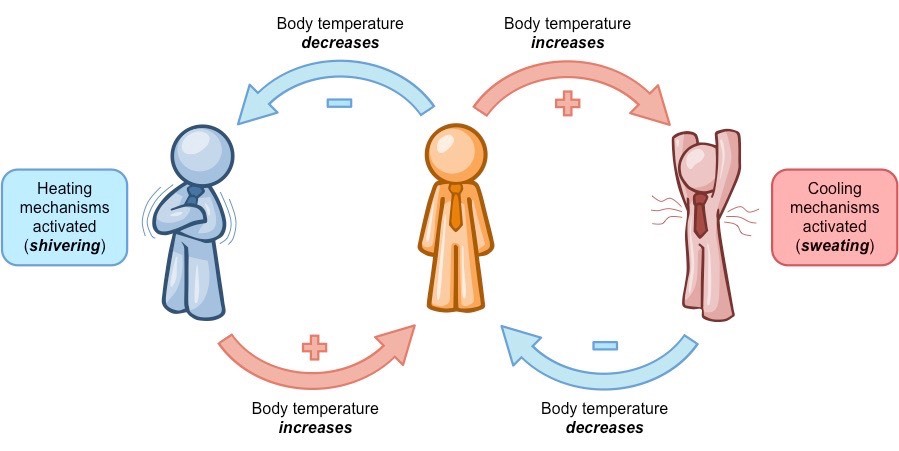
In this body temperature feedback loop, predict what would happen if cooling mechanisms were NOT activated?

a)

The body would not warm up.

b)

The body would not cool down.

c)

Your body would get colder and colder.

d)

Your body would release lots of heat.

168.

According to the feedback loop, what does high blood sugar promote?

a)

Insulin Release

b)

Glucagon Release

c)

Insulin Uptake

d)

Glycogen Uptake

169.

What is the difference between what will happen if their is too much Glucose or too little Glucose? SELECT ALL THAT APPLY

a)

With too much Glucose, Insulin is released. With too little Glucose, Glucagon is released.

b)

With too much Glucose, the pancreas produces insulin. With too little Glucose, the pancreas produces glucagon.

c)

With too much Glucose, Glucagon is released. With too little Glucose, Insulin is released.

d)

There is no difference.

170.
Failure to maintain homeostasis could result in:
a)
lack of internal balance
b)
eventual death
c)
difficulty carrying on metabolism 
d)
all three
171.
The two types of feedback systems that help organisms maintain homeostasis are:
a)
positive and negative 
b)
receptor and effector
c)
static and dynamic
d)
minor and major
172.
Maintaining body temperature is an example of a:
a)
negative feedback loop
b)
positive feedback loop
173.
The process of childbirth is an example of:
a)
negative feedback loop
b)
positive feedback loop
174.
Humans have ___ for body temperature, blood glucose concentrations, electrolyte concentrations, pH levels, tendon tension and variables.
a)
positive feedback mechanisms
b)
set points
c)
a wide internal range
d)
no regulation
175.
The "cause" for something to happen is the
a)
response
b)
effect
c)
stimulus
d)
homeostasis
176.
The "effect" of a given stimulus is the...
a)
response
b)
stimulus
c)
cause
d)
result
177.
The name for a chemical made by glands that tell cells to make something or respond in some way.
a)
acid
b)
enzyme
c)
perspiration
d)
hormone
178.
When you get cut, your skin cells release hormones that signal platelets to come and stop the bleeding. Platelets then release more hormones that signal even more platelets to help stop bleeding. The hormone signals continue until the cut is closed.
a)
Positive Feedback Response
b)
Negative Feedback Loop 
179.
When glucose levels in the blood rise, your brain sends a signal to your pancreas. The pancreas releases insulin, which opens channels in cell membranes to allow glucose to enter the cell, lowering blood sugar levels. 
a)
Positive Feedback Response
b)
Negative Feedback Loop 
180.
If the calcium in your blood decreases below homeostasis levels, a gland in the brain will sense the decrease and send a chemical message to your bones. Your bones will release calcium into the blood, bringing blood calcium levels back up.
a)
Positive Feedback Response
b)
Negative Feedback Loop 
181.
As you get dehydrated, your blood becomes thicker and harder to pump. Your kidneys will respond by stopping urine production, sending the water from urine into your bloodstream to thin your blood back to normal level.
a)
Positive Feedback Response
b)
Negative Feedback Loop 
182.
Negative Feedback Loops:
a)
amplify processes
b)
prevent small changes from getting larger
c)
are initiated during childbirth
d)
are found only in plants
183.
What does the term "steady state" refer to with respect to the process of homeostasis?
a)
balanced external environment
b)
balanced internal environment
c)
changing external environment
d)
changing internal environment