
 Worksheets
CP Biology - Semester Exam Review
Total questions: 178
Worksheet time: 2hrs 23mins
What is the first step in the scientific method?
Forming a hypothesis
Drawing a conclusion
Making an observation
Performing an experiment
A controlled experiment tests:
Many variables at once
Only one variable at a time
No variables
Any variable the scientist wants
The variable that is changed on purpose is called the:
Independent variable
Dependent variable
Control
Constant
The variable that is measured in an experiment is the:
Independent variable
Dependent variable
Control
Constant
The group in an experiment that does not receive the treatment is the:
Independent group
Dependent group
Control group
Experimental group
What is a hypothesis?
A proven fact
A testable explanation for a question or problem
The final conclusion
A type of experiment
Which of the following is an example hypothesis for: “Does increasing water affect the rate of photosynthesis?”
Select all that could apply.
Plants need sunlight
More water will increase the rate of photosynthesis
Plants make sugar
Photosynthesis happens in leaves
More water will decrease the rate of photosynthesis
Metric units: What unit measures length?
Liter
Gram
Meter
Celsius
Metric units: What unit measures mass?
Liter
Gram
Meter
Celsius
Metric units: What unit measures volume?
Liter
Gram
Meter
Celsius
Metric units: What unit measures temperature?
Liter
Gram
Meter
Celsius
Water molecules stick to other surfaces. This property is:
Adhesion
Cohesion
Solution
Suspension
Water molecules stick to each other. This property is:
Adhesion
Cohesion
Capillary action
Surface tension
Water moves upward through small tubes in plants. This is:
Adhesion
Cohesion
Capillary action
Surface tension
Ice is less dense than liquid water because:
Water molecules move faster
Molecules spread apart in a lattice
Water is heavier as a solid
Hydrogen bonds break
A proton has:
No charge, outside nucleus
Positive charge, in nucleus
Negative charge, in nucleus
Neutral charge, in orbitals
A neutron has:
Positive charge
Negative charge
No charge, in nucleus
Neutral charge, outside nucleus
An electron has:
Positive charge
Negative charge, outside nucleus
No charge, in nucleus
Neutral charge, in nucleus
Covalent bonds occur when atoms:
Share electrons
Transfer electrons
Split electrons
Lose electrons
Ionic bonds occur when atoms:
Share electrons
Transfer (steal) electrons
Split electrons
Ignore electrons
A solute is:
The substance that is dissolved
The substance that does the dissolving
Water
Salt
A solvent is:
The substance that is dissolved
The substance that does the dissolving
Sugar
Water only
Main function of carbohydrates:
Store genetic info
Main source of energy in living things. Stores short-term energy
Make membranes
Make proteins
Main function of lipids:
Long-term energy storage
Genetic info
Energy for immediate use
Structural protein
Main function of proteins:
Structural support, enzymes, transport
Energy storage
DNA
Photosynthesis
Main function of nucleic acids:
Store genetic information
Make membranes
Provide short-term energy
Build proteins
Ecology is the study of:
Cells
Organisms only
Interactions between organisms and their environment
Rocks and soil
Levels of ecological organization: species =
One individual
Organisms that can reproduce
Group of communities
Population =
One species
Group of same species in an area
All living things
All ecosystems
Community =
All populations in an area
One species
One individual
Entire planet
Ecosystem =
Nonliving environment only
All living and nonliving things in an area
Species
Population
Biosphere =
combined portions of earth in which all living things exist
One ecosystem
One biome
One species
A biome is:
A small pond
group of ecosystems that share similar climates and typical organisms
A type of ecosystem
One species
What is the main characteristic of a producer/autotroph?
Eats plants
Makes its own food
Breaks down dead material
Eats meat
Which statement best describes a consumer/heterotroph?
Makes food
Eats other organisms
Photosynthesizes
Produces energy
What does a herbivore primarily eat?
Eats plants only
Eats meat only
Eats plants and meat
Decomposer
Which of the following best describes a carnivore?
Eats plants only
Eats meat only
Eats plants and meat
Decomposer
What is the diet of an omnivore?
Eats plants only
Eats meat only
Eats plants and meat
Photosynthesizes
What is the role of a decomposer in an ecosystem?
Makes food
Eats plants
Breaks down dead organisms
Eats meat
What is the source of almost all energy in an ecosystem?
Water
Sunlight
Soil
Wind
In a food chain/web, arrows show:
Direction of energy flow
Who lives where
Species numbers
Biomass
Percent of energy passed to next trophic level:
1%
10%
50%
90%
"Predator-prey relationships". This describes:
Prey reducing predator numbers
Predators increasing prey numbers
Predators reduce prey numbers, prey abundance affects predator numbers
Prey abundance does not affect predator numbers
Symbiosis: mutualism =
Both benefit
One benefits, one harmed
One benefits, one neutral
Both harmed
Symbiosis: commensalism =
Both benefit
One benefits, one neutral
One benefits, one harmed
Both harmed
Symbiosis: parasitism =
Both benefit
One benefits, one neutral
One benefits, one harmed
Both harmed
Invasive species =
Native species
Non-native, causes harm
Producer
Decomposer
Biotic factor =
Nonliving factor
Living factor
Climate
Temperature
Abiotic factor =
Living factor
Nonliving factor
Plant
Animal
Niche =
Place where organism lives
An organism’s role in its ecosystem—how it gets food, interacts with other organisms, and contributes to the environment.
Type of prey
Type of predator
Who discovered cells? (specifically, cork cells)
Schleiden
Schwann
Hooke
Virchow
Who concluded all animals are made of cells?
Hooke
Schwann
Schleiden
Virchow
Who concluded all plants are made of cells?
Schleiden
Hooke
Schwann
Virchow
Who concluded all cells come from existing cells?
Hooke
Schleiden
Schwann
Virchow
Which is a principle of cell theory?
All living things are made of cells
Cells come from non-living matter
Cells can survive without DNA
Cells are always prokaryotic
Which is a principle of cell theory?
Cells are the basic unit of life
Cells are made of tissues
Cells only exist in animals
Cells reproduce without DNA
Which is a principle of cell theory?
Cells come from existing cells
Cells come from energy
Cells appear spontaneously
Cells can survive independently
How do you calculate total magnification on a microscope?
Eyepiece + Objective lens
Eyepiece × Objective lens
Objective lens – Eyepiece
Eyepiece ÷ Objective lens
Prokaryotes are…
Have a nucleus, complex
No nucleus, simple, e.g., bacteria
Only found in plants
Only found in animals
Eukaryotes are…
Nucleus, complex with many organelles, DNA, e.g., plant/animal cells
No nucleus, simple
Always unicellular
Only bacteria
Ribosome function:
Makes ATP
Packages proteins
Makes proteins
Stores DNA
Nucleus function:
Controls cell, stores DNA
Packages proteins
Makes ATP
Stores proteins
What is the primary function of the endoplasmic reticulum (ER)?
Modifies proteins/lipids
Makes proteins
Packages proteins
Controls cell
Which organelle is responsible for packaging proteins in the cell?
Ribosomes
Golgi Apparatus
Rough ER
Smooth ER
What is the main function of mitochondria?
Makes proteins
Produces ATP
Stores DNA
Photosynthesis
Which process occurs in the chloroplast?
Makes ATP
Photosynthesis
Packages proteins
Modifies lipids
What is the function of the cell membrane?
Photosynthesis
Controls cell, stores DNA
Cells boundary from the environment. Regulates entry/exit. It's made up mostly of phospholipids.
Produces ATP
What is the main function of the cell wall?
Support and protect the cell
Stores DNA
Makes proteins
Packages proteins
What is the difference between passive and active transport?
Passive requires energy
Active does not require energy
Active requires energy, passive does not
Both require energy
Diffusion is…
caused by molecules constantly move and collide with each other.
This causes molecules to naturally "spread out" and go from areas of molecules low → high
caused by molecules constantly move and collide with each other.
This causes molecules to naturally "spread out" and go from areas of molecules high → low
Movement of water only
Movement requiring energy
Osmosis is…
Movement of proteins
Diffusion of water across a selectively permeable membrane.
Active transport
Movement of ions only
Facilitated diffusion is…
Movement with the help of a protein channel
Active transport
Movement of water
Movement against gradient
Diffusion occurs due to…
Energy
Concentration gradient
Osmosis
Active transport
Equilibrium is…
Molecules stop moving
Molecules move, but in both directions. Resulting in a net change = 0
Molecules move faster
Molecules require energy

Red blood cells in pure water (no salt in the water)…
Water would rush out of the cell, causing it to shrink
Water would rush into the cell, causing it to burst.
Stays same
Produces ATP
Multicellular levels:
Cell → Organ → Tissue → System → Organism
Cell → Tissue → Organ → Organ system → Organism
Tissue → Cell → Organ → System → Organism
Organ → Tissue → Cell → Organ system → Organism
ATP consists of:
Adenine, ribose, 3 phosphates; energy released by breaking phosphate bond
Glucose, ribose, 2 phosphates
ATP only stores energy
Adenine, glucose, phosphate
Plants appear green because chlorophyll…
Reflect green light
Absorb green light
Reflect all light
Absorb all light
Organelle for photosynthesis:
Mitochondria
Ribosome
Chloroplast
Nucleus
Pigment in plants:
ATP
Chlorophyll
Glucose
NADH
Photosynthesis products:
Glucose + oxygen
ATP + CO₂
Water + CO₂
Glucose + CO₂
The oxygen produced by photosynthesis comes from…
CO₂
Splitting water
Glucose
ATP
Factors affecting photosynthesis:
Light intesity, CO₂ concentration, water availability
Oxygen, glucose, light
ATP, NADH, CO₂
Temperature only
Cellular respiration sequence:
Glycolysis → Krebs → Electron transport
Krebs → Glycolysis → Electron transport
Electron transport → Krebs → Glycolysis
Glycolysis → Electron transport → Krebs
Aerobic respiration occurs in:
Chloroplast
Nucleus
Mitochondria
Ribosome
Purpose of cellular respiration:
Convert food into ATP
Make glucose
Photosynthesis
Store DNA
NADH/FADH₂ function:
Carry electrons to the electron transport chain (ETC)
Make ATP
Make glucose
Store energy
Alcoholic fermentation produces:
Lactic acid
Ethanol + CO₂
ATP only
Oxygen
Lactic acid fermentation produces:
Lactic acid
Ethanol
CO₂
ATP
Immediate, short-term Muscle soreness (right after a workout) is caused by:
ATP buildup
Oxygen
Lactic acid buildup
CO₂
Yeast makes bread rise as it undergoes:
alcoholic fermentation
lactic acid fermentation
cellular respiration
photosynthesis
Heavy breathing after a race:
Removes lactic acid
Repay oxygen debt (taking in extra oxygen to restore balance, clear lactic acid buildup from anaerobic energy use)
Stores oxygen
Produces ATP
Cell growth issue:
Surface area increases faster than volume
Volume increases faster than surface area
Volume decreases
Cell cycle includes:
Growth, DNA replication, division
Mitosis only
Meiosis only
Photosynthesis
Interphase – G1 phase:
DNA replication
Growth
Prep for division
Cell division
Interphase – S phase:
Growth
DNA replication
Prep for division
Cell division
Interphase – G2 phase:
Growth
DNA replication
Prep for division
Cell division
Mitosis – Prophase:
Chromosomes line up
Chromosomes condense, spindle forms
Sister chromatids separate
Nuclear membrane reforms
During metaphase of mitosis, what happens to the chromosomes?
Chromosomes line up and meet in the middle
Chromosomes condense
Sister chromatids separate
Nuclear membrane reforms
What is the main event that occurs during anaphase of mitosis?
Chromosomes condense
Chromosomes line up
Sister chromatids separate
Nuclear membrane reforms
During telophase of mitosis, which of the following occurs?
Chromosomes condense
Chromosomes line up
Sister chromatids separate
Nuclear membranes reform
What is the primary function of spindle fibers during cell division?
Pull chromosomes apart
Store DNA
Make ATP
Package proteins
A replicated chromosome consists of:
Single chromatid
Two sister chromatids connected at centromere
Two separate chromosomes
DNA only
If a parent cell has 8 chromosomes, how many chromosomes will each daughter cell have after mitosis?
4
8
16
2
Why do cells in a petri dish stop growing?
They run out of food
They touch neighbors
They divide
ATP runs out
Which of the following best defines a tumor?
Mass of normal cells
Mass of abnormal cells
Organ
Tissue
What is the property of water called when it sticks to other surfaces?
Adhesion
Cohesion
Capillary action
Surface tension
Which organelle is responsible for making ATP in a cell?
Ribosome
Golgi
Mitochondria
Nucleus
If insects are able to walk on water, which property of water allows this phenomenon?
Adhesion
Cohesion
Capillary action
Surface tension, as a result of water cohesion
A scientist observes water moving up a thin tube against gravity. Which property of water is being demonstrated?
Adhesion
Cohesion
Capillary action
Surface tension
_____ Makes its own food.
Producer
Consumer
Decomposer
Herbivore
_____ Eats other organisms.
Producer
Consumer
Decomposer
Herbivore
_____ Breaks down dead organisms.
Producer
Consumer
Decomposer
Herbivore
_____ Eats plants.
Producer
Consumer
Decomposer
Herbivore
_____ Eats plants and meat.
Producer
Consumer
Decomposer
Omnivore

What do you notice about this climate graph?
temperature is warm year round
temperature is cold year round
dry summers
most rain in the winter

Which climate graph shows a LOWER temperature in June?
Graph A
Graph B
Which graph shows a place with a very dry climate all year long?


In which month do they get the most rain in this biome?
January
May
August
November


Which letter shows a complete phospholipid?
B
C
D
E
Which part of a phospholipid is on the outer border of the cell membrane?
fatty acid tail
phosphate head
hydrophobic phosphate
fatty acid head

Which best describes what is shown at letter B?
complete phospholipids
hydrophilic phosphate heads
hydrophobic fatty acid tails
transport proteins

Why are the heads of the phospholipids facing out?
they are hydrophobic and do not want to touch the cell fluid
they are hydrophilic and are attracted the fluid of the cell
they are intracellular receptors
they contain carbohydrate chains


Granum

What are the ecological levels of organization from smallest to the largest?
individual, species, population, community, ecosystem
individual, community, population, ecosystem, species
individual, population, community, species, ecosystem
individual, community, population, species, ecosystem
If you are testing how fertilizer affects plant growth, which one is NOT a constant?
amount of sunlight
temperature
amount of water
amount of fertilizer
Identify the following:
IF Plant A receives fertilizer, THEN it will grow larger than Plant B.
hypothesis
experiment
variable
data
How do you show that the following hypothesis is correct?
IF Plant A receives fertilizer, THEN it will grow larger than Plant B.
record and analyze plant measurement data
stop using fertilizer
look at plant growth, but do not measure it
use different species of plants
For the following hypothesis, what is being TESTED?
IF Plant A receives fertilizer, THEN it will grow larger than Plant B.
plants
fertilizer
plant growth
amount of soil
For the following hypothesis, what is being MEASURED?
IF Plant A receives fertilizer, THEN it will grow larger than Plant B.
plants
fertilizer
plant growth
amount of soil
The variable being TESTED is called . . .
hypothesis
independent variable
dependent variable
constant
The variable being MEASURED is called . . .
hypothesis
independent variable
dependent variable
constant

Randall wants to know if the amount of salt in the water has an effect on his goldfish. What is the independent variable?
amount of water
number of goldfish
amount of salt
health of the goldfish

Marilu wants to know the effect of the amount of pesticides on the size of apples
What is the independent variable?
amount of pesticides
size of apples
amount of apples
amount of pests

Marilu wants to know the effect of the amount of pesticides on the size of apples
What is the dependent variable?
amount of pesticides
size of apples
amount of apples
amount of pests

Jose wants to know if the diet of a rat affects the body weight of the rat.
What is the independent variable?
diet of a rat
body weight
weight of food
number of rats

Jose wants to know if the diet of a rat affects the body weight of the rat.
What is the dependent variable?
diet of a rat
body weight
weight of food
number of rats

Which of the following equations represents the overall chemical reaction for photosynthesis?
6O2+ 6H2O → C6H12O6+ 6O2
C6H12O6 + 6H2O→ 6O2+ 6O2
6CO2+ 6H2O→ C6H12O6+ 6O2
6O2 + 6H2O→ C6H12O6 + 6CO2

As a cell becomes larger, its ______ increases faster than its ______.
volume; surface area
surface area; volume
mass; density
density; mass
Cancer cells form masses called ______.
tumors
cysts
nodes
fibers
Label the picture
Interphase
Prophase
Metaphase
Anaphase
Telophase
Cytokinesis
Match the following steps of cell division
the nucleus fades away and chromosomes become visible
Prophase
the chromosomes line up in the middle of the cell
Metaphase
the sister chromatids move apart to separate sides of the cell
Anaphase
the division of the cytoplasm creating 2 daughter cells
Cytokinesis
the division (cleavage) of two cells appear. 2 nuclei are visible
Telophase
A red blood cell in salt water will:
Swell
Shrink
Stay the same
Divide
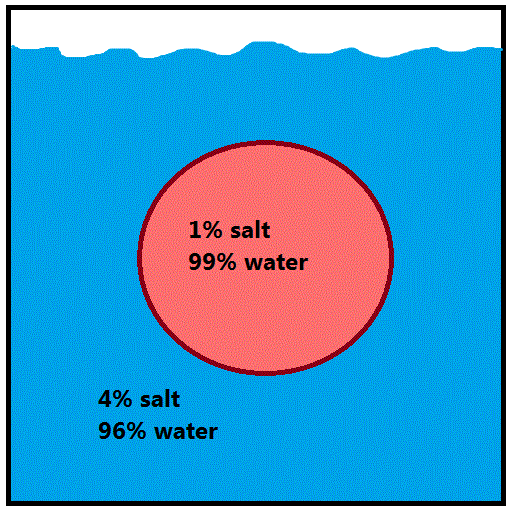
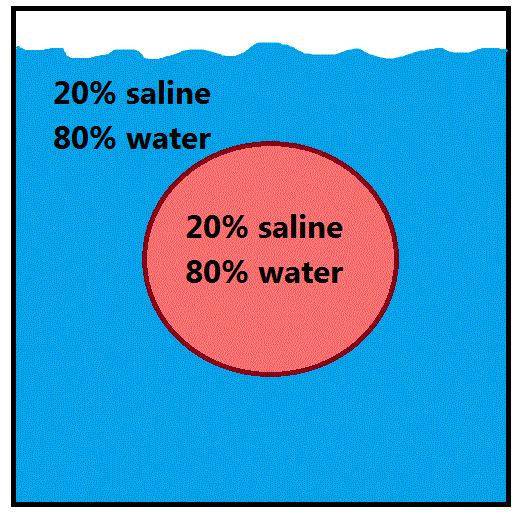
Which statement shows reasoning that connects claim and evidence?
If birds communicate with songs, then different songs will lead to specific behaviors
If birds sing, then they are related to insects
If birds communicate with songs, then people can understand them
If birds sing, then they should live in trees
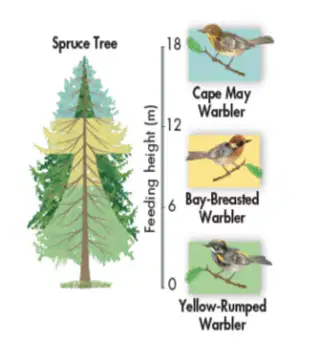
Several species of warblers live in the same forest and rely on insects found in trees for food. How do they avoid direct competition with one another?
By migrating to different forests during different seasons.
By feeding on different types of insects in separate regions of the trees, occupying different NICHES.
By eating plants instead of insects.
By hunting insects at night when other warblers are not feeding.
Match
An organism that makes its own food using sunlight or other energy sources.
Autotroph
An organism that cannot make its own food and must consume other organisms.
Heterotroph
An organism that makes its own food using energy from chemicals.
Chemotroph
Levels of Organization:
The basic unit of life.
Cell
A group of similar cells working together to perform a common function.
Tissue
A structure made up of different types of tissues working together.
Organ
A group of organs that work together to perform a specific function.
Organ system
An individual living thing.
Organism
Plants gather the sun's energy with light-absorbing molecules called
pigments
chloroplasts
glucose
thylakoids

Match the Following
Adenine
A
Ribose
B
Phosphate Groups
C & D
Using the figure, between which two parts of the molecule must the bonds be broken to form an ADP molecule?
A and B
B and C
C and D
all of the above
Organize these options into the right categories
Pear Tree
Lion
Mushroom
Grasshopper
Sunflower
Mouse
Algae
Elephant
Human
Frog
Bird
Cactus
Maple Tree
Seaweed
Fern
Grass
What process makes glucose in plant cells?
Photosynthesis
Cellular respiration
Osmosis
Transpiration
Which statement best explains why most plants appear green?
Chlorophyll reflects green light and absorbs violet, blue, and red light for photosynthesis.
Plants produce green pigments called carotenoids that absorb all colors except green.
Plants do not contain pigments that absorb light, so green is the default color.
Chlorophyll absorbs green light for energy and reflects all other colors.
What is the main role of pigments in autotrophs?
To give plants their color for decoration
To absorb specific wavelengths of light to provide energy for photosynthesis
To release energy stored in glucose molecules
To reflect all colors of visible light equally
Label the processes

Which of the following is NOT a product of the light reactions?
Oxygen
NADPH
ATP
Glucose (Sugar)
Label the following parts of the Light Independent Reaction (Calvin Cycle) of Photosynthesis:
Carbon Dioxide
Glucose (C6H12O6)
Stroma
Main products of the Calvin Cycle
Oxygen, NADP+, ADP
Glucose, CO2, ADP
ADP, NADP+, Glucose
ATP, NADPH, Oxygen
Label the diagram for photosynthesis.
Carbon DIoxide
NADPH
ATP
Sugars
Oxygen
Water
NADP+
ADP
Thylakoid Membrane
Stroma
Which type of fermentation occurs in muscle cells?
A) Alcoholic fermentation
B) Lactic acid fermentation
C) Glycolysis
D) Anaerobic respiration in mitochondria
A
B
C
D
Label the Diagram
Which of the following is the word equation for cellular respiration?
glucose + oxygen ---> ATP + carbon dioxide + water
carbon dioxide + water ---> ATP + glucose + oxygen
glucose + water ---> ATP + carbon dioxide + oxygen
glucose + carbon dioxide ---> ATP + oxygen + water

