
 Worksheets
Semester 2 Exam Review Practice
Total questions: 180
Worksheet time: 15hrs 0mins
What are the seven diatomic elements?
H2, Cl2, Br2, O2, N2, I2, F2
H2, Cl2, I2, F2, Hg2, Br2, Fe2
H2, Cu2, Ni2, B2, O2, I2, Fe2
What are diatomic elements?
Elements that form two-atom molecules when not combined in a compound.
Two elements that combine with one atom from each element.
Elements that are always in pairs no matter what.
Is Fe2 a diatomic element?
Yes
No
Is O2 a diatomic element?
Yes
No
What are the coefficient used to balance the equation below?
__Ag2O →__ Ag +___O2
2,4,1
1,1,1
2,1,2
2,2,2
Which problem is balanced?
PbO2 + 2H2
SO2 + H20 --> H2SO4
2Na + 2H2O --> 2NaOH + H2
Balance this equation.
_CH4 + _O2 --> _CO2 + _H2O
1,2,1,1
2,1,2,1
1,2,1,2
0,2,0,2
Balance this equation.
__Mg + __Cl2 --> __MgCl2
1, 2,1
already balanced
2,1,1
1,1,2
What type of reaction is Fe + Cl2 → FeCl3
Synthesis
Decomposition
Single Replacement
Combustion
None of these
What type of reaction is C2H2 + O2 → CO2 + H2O
Synthesis
Decomposition
Single Replacement
Combustion
None of these
What type of reaction is Ag2O → Ag + O2
Synthesis
Decomposition
Single Replacement
Combustion
None of these
Select each compound that can be produced by combustion reactions. (more than 1 answer)
Oxygen
Carbon Dioxide
Water
Glucose
Carbon
Classify the following chemical reaction
BaCl2(aq) + K2CrO4(aq) --> BaCrO4(s) + 2KCl(aq)
Composition/Synthesis
Decomposition
Single Replacement
Double Replacement
Combustion
Change from standard form to scientific notation: 12,000,000
12.0 x 10⁷
0.12 x 10⁷
1.2 x 10⁶
1.2 x 10⁷
Change from standard form to scientific notation: 0.000398
39.8 x 10⁻⁵
3.98 x 10⁻⁵
3.98 x 10⁻⁴
39.8 x 10⁻⁶
Change from standard form to scientific notation: 0.004078
4.078 x 10⁻³
4.078 x 10³
40.78 x 10⁻⁴
.4078 x 10-2
Try to change the number back to standard form: 6.79 x 10⁴
679,000
6,790
67,900
6,790,000
Which of the following is correct scientific notation?
20.35 x 10⁴
.2035 x 104
2035 4
2.035 x10⁴
If the exponent is a positive number the original number was...
a really big number.
a really small number.
If the exponent is a negative number the original number was...
a really large number.
a really small number.

The SI unit for measuring volume is the __?__.
meter (m)
liter (L)
cubic meter (m3)
gram (g)

The SI unit for measuring mass is the
__?__.
meter (m)
liter (L)
cubic meter (m3)
kilogram (kg)

The SI unit for time is the __?__.
meter (m)
liter (L)
gram (g)
second (s)
Which SI unit is used to measure length?
mol
m
kg
m2
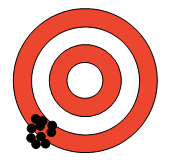
This bullseye demonstrates...
High Accuracy & High Precision
High Accuracy & Low Precision
Low Accuracy & High Precision
Low Accuracy & Low Precision
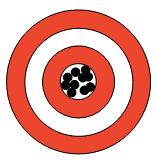
?
High Accuracy & High Precision
High Accuracy & Low Precision
Low Accuracy & High Precision
Low Accuracy & Low Precision

This image is an example of...
precision ONLY
accuracy ONLY
BOTH precision and accuracy
NEITHER precision and accuracy
Measurements: 24.9, 25.2, 25.1, 24.8
True Value: 25.0
These measurements are…
Accurate, but not precise
Precise, but not accurate
Both precise and accurate
Neither precise nor accurate
Measurements: 2.5, 14.5, 10.1, 45.3
True Value: 25.0
These measurements are…
Accurate, but not precise
Precise, but not accurate
Both precise and accurate
Neither precise nor accurate
What is Avogadro's Number? (measures molecules and atoms)
6.02 x 10²³
3.145
it changes
1
The molar mass is found by
adding the masses of all the atoms in the molecule.
dividing the total mass of all the atoms in the molecule by 6.02 x 10²³.
multiplying the total mass of all the atoms in the molecule by 6.02 x 10²³.
dividing the total mass of all the atoms in the molecule by the total number of atoms.
How many atoms are in 1.00 mole of Au?
6.02 x 10²³
5.8 x 1024
1.00 x10²³
79
To solve these mole conversion problems, which of the following is CORRECT?
multiply numbers on top and divide numbers on bottom
add numbers on top and subtract numbers on bottom
divide numbers on top and multiply numbers on bottom
subtract numbers on top and add numbers on bottom

The mole can be used to measure (SELECT ALL CORRECT ANSWERS)
The amount of atoms
The amount of molecules or compounds in a substance
The amount of particles
The amount of fission or fusion decay over time

What is the mole used for?
To measure the amount of grams in a substance
To measure the amount of atoms or molecules in a substance
To measure the amount of energy in a substance
To measure the amount of bonding in a substance

What is the mass of one mole of silver?
32.06 g
107.87 g
14.01 g
22.99 g

What are the units for molar mass?
grams
amu
grams/mole
liters
Which chemical formula below indicates that you have three molecules of water ( H2O )?
3H2O
H6O3
6HO
H2O

Which chemical formula below matches the image shown here?
2H2O
H4O2
4H2O
2HO

Which chemical formula below matches the image shown here?
2H2O
H2O2
4H2O
2HO
What does the number 4 represent in 4NH3?
Subscript
Coefficient
What does the number 3 represent in 4NH3?
Subscript
Coefficient
How many iron atoms are in
Fe(NO3)2
1
2
3
6

How many hydrogen atoms are in this chemical formula:
4 hydrogen atoms
1 hydrogen atom
2 hydrogen atoms
3 hydrogen atoms

True or False. In the equation above there are a total of 2 hydrogen and 2 oxygen
True
False
How many Magnesium atoms are in 10MgCl2?
10
5
20
What is a limiting reactant?
the reactant that determines how much product can be made
the reactant that is in excess
the product that you can make the most of
the amount of reactants that react with each other
You need 2 pieces of bread, 1 tablespoon of peanut butter and 2 tablespoons of jelly to make a sandwich. If you have 10 pieces of bread, 4 tablespoons of peanut butter and 20 tablespoons of jelly, what is the limiting reactant?
bread
jelly
peanut butter
sandwich
The limiting reactant
slows the reaction down
is used up first
is the reactant that is left over
controls the speed of the reaction
When does a chemical reaction stop?
When the lab is finished
When the excess reactant is used up
When the limiting reactant is used up
Chemical reactions never stop
In the equation 2 Al2O3 --> 4 Al + 3 O2, what is the mole ratio of aluminum to oxygen?
10:6
3:4
4:3
2:3
Given the reaction: 4Al + 3O2 --> 2Al2O3
How many moles of Aluminum oxide are produced if you have 2 moles of Al?
3 mole
2 mole
1 mole
0.5 mole
N2 + 3H2 → 2NH3
What is the mole ratio between Nitrogen and Ammonia in the above reaction?
1 moles NH3 / 2 moles N2
2 moles NH3 / 1 moles N2
2 moles N2 / 3 moles NH3
1 moles N2 / 3 moles NH3
6CO2 + 6H2O --> C6H12O6 + 6O2
What is the total number of moles of water needed to produce 2.5 moles of C6H12O6?
2.5
6
12
15
What is the SI Measurement for Amount of Substance?
mole (mol)
meter cubes (m3) liter (L)
meter (m) centimeter (cm)
joule (J) kJ
What is the SI Measurement for Pressure?
kelvin (K) *Celsius (*C)
pascal (Pa) kilopascal (kPa)
second (s)
meter (m) centimeter (cm)
Convert 20.0oC to Kelvin.
273 K
298 K
293 K
20 K
Convert 273K to oC
546 oC
-273 oC
0 oC
0 K
Convert: -45.9 C to K:
227.1 K
400 K
0 K
373 K
When a bottle is squeezed, the pressure increases and the volume __________.
increases
decreases
The volume of a hot air balloon will __________ as the temperature is raised.
increase
decrease
If the temperature of a can of hairspray is increased the pressure will _________ .
increase
decrease
Gases best obey the ideal gas law at _____ .
high temperatures and high pressures
low temperatures and low pressures
high temperatures and low pressures
low temperatures and high pressures
The volume of a sample of a gas at 273 oC is 200 liters. If the volume is decreased to 100 liters at constant pressure, what will be the new temperature of the gas?
0 K
546 K
273 K
100 K
Which statement is true?
Solids will conduct electricity.
Solutions (water with dissolved particles) will conduct electricity.
Which TWO classes of materials will dissolve in water? (SELECT BOTH)
acids & bases
metals
non-polar compounds
electrolytes
___________ refers to the amount of solute dissolved in a given amount per volume of solution
Concentration
Dilution
Precipitation
None of the above
Which solution is more concentrated?
Solution 1:
500 mL of water
100 g of salt
Solution 2:
500 mL of water
90 g of salt
Solution 1
Solution 2
They have the same concentration
I have no idea
Which solution is more diluted?
Solution 1:
1000 mL of water
60g of salt
Solution 2:
500 mL of water
60 g of salt
Not enough information to tell
Solution 1
Solution 2
They are equally diluted
A solution with the maximum amount of solute completely dissolved.
Saturated solution
Unsaturated solution
Supersaturated solution
A solution with less than the maximum amount of solute completely dissolved.
Saturated solution
Unsaturated solution
Supersaturated solution
A solution with more than the maximum amount of solute completely dissolved.
Saturated solution
Unsaturated solution
Supersaturated solution

How does a solution become supersaturated?
by pouring lots of solute in it then stirring.
dissolve a little solute in it and stir.
heat the solution to make it dissolve more solute and then cool it down.
dissolve a small amount of solvent in it then heat it up.

Which substance is MOST soluble at 0 ºC?
KClO3
NaNO3
NaCl
Ce2(SO4)3

At what temperature can you fully dissolve 140g of NaNO3?
62
73
81
100
Which solute is MOST likely a gas?
KNO3
NaNO3
KCl
Ce2(SO4)3
What type of a solution is 60g NaCl at 80ºC in 100g H2O?
Saturated
Unsaturated
Supersaturated
What type of a solution is 100g KNO3 at 70ºC in 100g H2O?
Saturated
Unsaturated
Supersaturated

How would you describe a solution where the plotted point falls on the line on a solubility curve?
unsaturated
saturated
supersaturated
How would you describe a solution where the plotted point falls below the line on a solubility curve?
unsaturated
saturated
supersaturated

What type of solution is made when 80 g of NaNO3 is dissolved in 100 g of water at 10°C?
saturated
unsaturated
supersaturated
Which of theses is not an electrolyte?
acids
bases
hydrocarbons
ionic compounds

In general, you cannot see through this mixture but you also cannot see any parts of it.
solution
colloid
suspension

In general, you usually cannot see through this type of mixture and you can notice layers or parts to it.
solution
colloid
suspension

Shaving Cream Foam
Solution
Suspension
Colloid

Muddy Water
Solution
Suspension
Colloid

Sugar Water
Solution
Suspension
Colloid
The particles in a suspension are _________ compared to the particles in a colloid.
smaller
larger
Rate of solvation for a SOLID in a liquid ___________ as temperature increases.
increases
decreases
Rate of solvation for a GAS in a liquid ___________ as temperature increases.
increases
decreases
Rate of solvation for a SOLID in a liquid ___________ as the mixture is stirred.
increases
decreases
Rate of solvation for a SOLID in a liquid ___________ as the solid is broken into smaller pieces.
increases
decreases
Rate of solvation for a GAS in a liquid ___________ as pressure is decreased.
increases
decreases
Pure water has a pH of 7. Pure water _______.
is an acid
is an base
could be either an acid or a base
is a neutral substance
Vinegar has a pH of 2. Vinegar _______.
is an acid
is a base
is a neutral substance
could be either an acid or a base
A solution of baking soda has a pH of 9. Baking soda _______.
could be either an acid or a base
is an acid
is a neutral substance
is a base
What is the formula of hydrochloric acid?
What is the formula for nitric acid?
CH3COOH
HNO4
NH3
HNO3
What is the formula for sulfuric acid?
H2S
H2SO4
H2SO3
H2SO5
What is the formula for carbonic acid?
H2C2O4
H2O
CO2
H2CO3
What is the formula for acetic acid?
C3H6O3
CH3COOH
C2H4O
C2H6O
What is the formula for phosphoric acid?
H2PO4
H3PO3
H4P2O7
H3PO4
What is the formula for sodium hydroxide?
Na(OH)2
What is the formula for ammonia?
NH2
N2H4
NH4+
NH3
What is the formula for calcium hydroxide?
Ca(OH)3
Ca(OH)2
CaO2H2
Ca(OH)4
Phenolphthalein in an acid is ______________ .
colorless
pink
Phenolphthalein in a base is ______________ .
colorless
pink
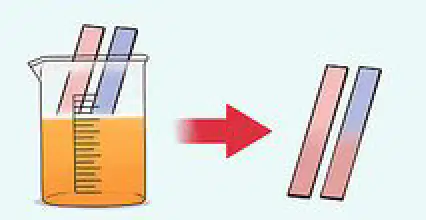
Blue litmus paper turning red indicates the substance is ____________.
acidic
basic
neutral
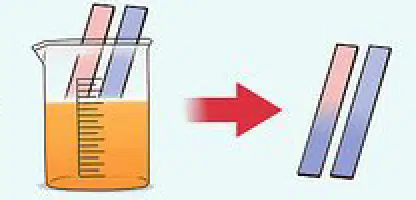
Red litmus paper turning blue indicates the substance is ____________.
acidic
basic
neutral
An acid tastes _______ while a base tastes ______.
soapy, sour
sour, soapy
salty, soapy
sour, salty
According to Bronsted-Lowry, what is the definition of an BASE?
a substance that donates a hydrogen (H+) ion
a substance that donates a hydroxide (OH-) ion
a substance that accepts a hydrogen (H+) ion
a substance that accepts a hydroxide (OH-) ion
What colour does litmus paper turn when added to an acid?
Blue
Red
Green
Colourless
Which type of acid/bases dissociate completely?
strong
weak
How does the concentration of hydrogen ions affect the pH of a solution?
Higher concentration of hydrogen ions leads to higher pH
Higher concentration of hydrogen ions leads to lower pH
Concentration of hydrogen ions has no effect on pH
Lower concentration of hydrogen ions leads to higher pH
A bronsted lowry acid
produces hydroxide ions in a solution
is a proton donor
produces hydrogen ions in a solution
is a proton acceptor
An Arrhenius base:
donates H+
accepts H+
produces H+
produces OH-
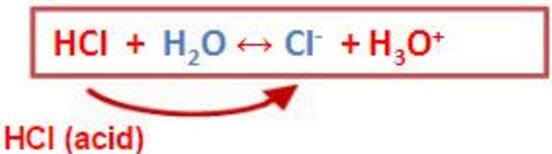
In the equation below, what is the conjugate base?
HBr + H2O ↔ Br- + H3O+
HBr
H2O
Br-
H3O+
NH3 + H2O --> NH4+ + OH-
What is NH4+ in this reaction?
acid
base
conjugate acid
conjugate base

What is the conjugate base of HCl in the following reaction?
HCO3-
HCl
H2CO3
Cl-

What is the conjugate acid of PO43- following equation?

Given the reaction above, which compound is the acid?
NH3
HCl
NH4+
Cl-
A solution with a pH of 2.0 has a hydrogen ion concentration ten times greater than a solution with a pH of:
1.0
3.0
0.20
20
H2SO4 + KOH -->
Complete the following reaction:
H3PO4 + NaOH -->
Na3PO4 + H2O
Na +H2O
Na3PO4 + H2
Na3PO4 + H2O + CO2
A __________ reaction is when an acid and a base are reacted together to produce water and a salt.
Neutralization
Volcanic
Decomposition
Single replacement
If a solution has a [H+] of 9.3x10⁻¹¹, what is the pH?
10.0
4.0
3.5
8.2
If a solution has a [OH-] of 2.3x10⁻⁴, it must be a(n)...
Acid
Base
Neutral
The amount of energy required to raise the temperature 1ºC for every gram is called____?
Thermal Energy
Specific Heat
Temperature
Kinetic Energy

The SI units J/g°C measures
Specific heat
mass
temperature
heat energy
An object with a higher specific heat requires _____ heat to raise its temperature.
more
less
An _____________ releases heat so the container would feel ________.
endothermic, warm
endothermic, cold
exothermic, warm
exothermic, cold
An _____________ reaction absorbs heat from the surroundings so the container would feel ________.
endothermic, warm
endothermic, cold
exothermic, warm
exothermic, cold
When a hot object is put in cooler water, the temperature of the object _______ and the temperature of the water.
rises, increases
falls, increases
rises, decreases
falls, decreases
The average kinetic energy of a substance's molecules ______ as it cools from 273K to 263K.
increases
decreases
It takes longer for substance to _____ because the heat of vaporization is typically _______ than the heat of fusion.
melt, higher
boil, higher
melt, lower
boil, lower
Gas particles are small compared to the volume thy occupy and in ______, ______ motion.
The volume of empty space between gas particles is __________ so they experience ________ attraction or repulsion forces.
large, a lot of
small, very little
large, very little
small, a lot of
According to the kinetic molecular theory (KMT), collisions between gas particles are elastic so kinetic energy is __________.
gained
lost
conserved
The average kinetic energy of a substance is expressed as a __________ .
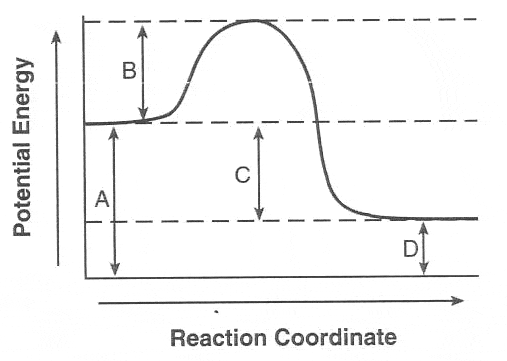
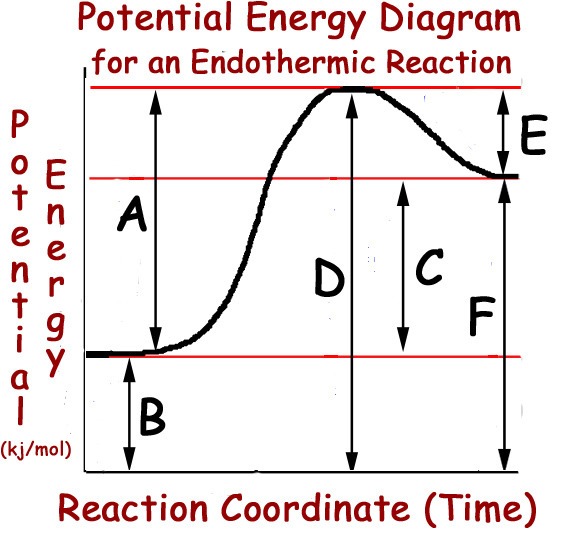

What is represented by interval C?
Potential energy of the reactants
Potential energy of the products
Activation Energy
Heat of reaction

What does A + B represent?
Reactants
Products
Activation Energy
Heat of reaction

Is this reaction endothermic or exothermic?
Endothermic
Exothermic


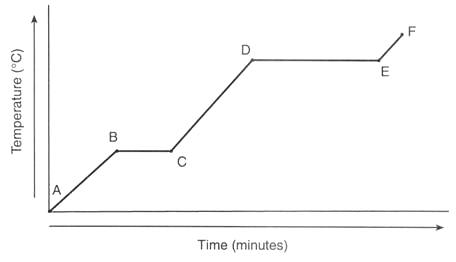

What part of the heating curve would ice be located at?
A
B
C
D
E
What part of the heating curve would liquid be located at?
A
B
C
D
E
What part of the heating curve would steam be located at?
A
B
C
D
E
Where are the phase changes located in the heating curve?
A
B
C
D
E
What happens to the kinetic energy of the substance in sections B and D?
KE increases
KE decreases
KE stays the same
The answer cannot be determined with the information provided.
What happens to the kinetic energy of the substance in sections A, C and E?
KE increases
KE decreases
KE stays the same
The answer cannot be determined with the information provided.
A catalyst _______ a reaction by _______ the activation energy
speeds up, raising
speeds up, lowering
slows down, raising
slows down, lowering
An inhibitor _______ a reaction by _______ the activation energy
speeds up, raising
speeds up, lowering
slows down, raising
slows down, lowering

