wayground logo

Free Printable Worksheets

Font size

S
M
L
XL
Worksheets

Final Review 2019

Total questions: 185

Worksheet time: 4hrs 53mins

Name
Class
Date
1.
When in the lab...
a)
long sleeves and loose clothing should be rolled up
b)
closed toe shoes should be worn
c)
long hair should be pulled back
d)
all of the above
2.
When should you wear safety goggles?
a)
When you look in the sun
b)
When working with chemicals, acids and bases and heating devices
c)
Anytime your in lab
d)
None of the above
3.

A substance that cannot be separated or broken down into simpler substances by chemical means is?

a)

Mixture

b)

Element

c)

Compound

d)

Molecule

4.

The smallest part of any substance is?

a)

Element

b)

Compound

c)

Atom

d)

Molecule

5.
What is the atomic number of this element? 
a)
19
b)
Potassium
c)
39.098
d)
K
6.

What is the atomic number?

a)

the number of protons

b)

the number of protons and neutrons combined

c)

the number of neutrons

d)

the number of protons and electrons combined

7.
What is the mass number defined as?
a)
the number of protons
b)
the number of protons and neutrons
c)
the number of neutrons
d)
the number of protons and electrons
8.
How many elements are in the Noble Gas family?
a)
24
b)
13
c)
6
d)
18
9.
Which of these is not a noble gas?
a)
Helium
b)
Argon
c)
Nitrogen
d)
Krypton
10.
Name group 18 on the periodic table.
a)
alkali metals
b)
alkaline earth metals
c)
transition metals
d)
noble gases
11.
Where are the nonmetals located on the periodic table?
a)
top left corner
b)
bottom left corner
c)
top right corner
d)
bottom left corner
12.
Name the group that contains inert (nonreactive) elements.
a)
noble gases
b)
halogens
c)
alkali metals
d)
alkaline earth metals
13.
________ are the COLUMNS on the periodic table and are organized by similar properties.
a)
Classifications
b)
Groups
c)
Periods
d)
Elements
14.
The blue atoms are called 
a)
metals
b)
nonmetals
c)
metalloids
d)
noble gases
15.
The atoms along the staircase are called 
a)
metals
b)
nonmetals
c)
metalloids
d)
noble gases
16.
Evidence of Chemical Change.
a)
New Substance 
b)
Size change
c)
State change
d)
Mixture 
17.
Evidence of a physical change.
a)
New substance
b)
Shape Change
c)
Light produced
d)
Gas released.
18.
Water boiling is a _______ change. 
a)
Physical Change 
b)
Chemical Change 
19.
Fireworks Exploding are a ________ change.
a)
Physical Change
b)
Chemical Change
20.
A chemical reaction accompanied by the absorption of heat. 
a)
Chemical Change
b)
Physical Change
c)
Endothermic Reaction
d)
Exothermic Reaction 
21.
A chemical reaction accompanied by the releasing of heat. 
a)
Endothermic
b)
Exothermic
c)
Mesothermic
d)
Misothermic
22.
A hot hand pack is an example of a _______________ reaction. 
a)
Endothermic
b)
Exothermic
c)
Mesothermic
d)
Misothermic
23.

Chemical or Physical:

A characteristic of matter that can be observed with your 5 senses is a ____________ property.

a)

Chemical

b)

Physical

24.

Chemical or Physical:

A characteristic of matter that can only be observed when matter is changed into a new kind of matter.

a)

Chemical

b)

Physical

25.

Chemical or Physical:

The words "blue", "large", and "soft" all describe __________ properties.

a)

Chemical

b)

Physical

26.

The ability of matter to change when heated is a _____________.

a)

Chemical

b)

Physical

27.
Which liquid is the least dense?
a)
oil
b)
water
c)
syrup 
d)
plastic bottle
28.
Which liquid is the most dense?  
a)
oil
b)
water
c)
syrup
d)
plastic bottle
29.
A object has a volume of 17 mL.  The same object has a mass of 212 g.  What is the density of this object?
a)
12.4 g/m3
b)
12.4 g/mL
c)
1.24 g/mL
d)
12/4 mL/g
30.
What is the volume of Object X?
a)
10.0 cm3
b)
15.0 cm3
c)
20.0 cm3
d)
25.0 cm3
31.

Which statement BEST describes the relationship between the weight and mass of an object?

a)

If mass increases, weight will decrease.

b)

Doubling mass reduces weight by half.

c)

An increase in mass will not affect weight.

d)

If mass increases, weight will increase.

32.
What is the density of an object with a volume of 4 cm3 and a mass of 8 g?
a)
4 g/cm3
b)
12 g/cm3
c)
2 g/cm3
d)
32 g/cm3
33.
What is the mass of an object that has a volume of 34 cm3 and density of 6 g/cm3?
a)
5.66 kg
b)
204 g
c)
0.176 kg
d)
40 g
34.
What is the density of an object with a mass of 60 g and a volume of 2 cm3?
a)
30 g/cm3
b)
62 g/cm3
c)
120 g/cm3
d)
0.033 g/cm3
35.
Transformation from a solid to a liquid is called...
a)
Freezing
b)
Melting
c)
Evaporating
36.
Transformation from a liquid to a solid is called...
a)
Melting
b)
Evaporation
c)
Freezing
37.
Transformation from a liquid to a gas is called...
a)
Freezing
b)
Evaporation
c)
Melting
38.
Which one takes the shape of its container?
a)
Solid
b)
Gas
c)
Liquid
d)
Gas and Liquid
39.
Which one has a definite shape?
a)
Gas
b)
Solid
c)
Liquid
d)
Solid and Liquid
40.
Transformation from a solid to a gas is called...
a)
Melting
b)
Freezing
c)
Evaporation
d)
Sublimation
41.
What is a solid?
a)
it keeps its shape and size
b)
it takes the shape of the container that holds it
c)
it has no shape, and spreads to fill the space they are in
d)
it changes with a temperature change
42.
What is a liquid?
a)
feels wet and have no shape of their own
b)
feels soft
c)
feels hard
d)
feels squishy
43.

What are Gases?

a)

Gases are soft?

b)

Gases spread to fill the space they are in.

c)

Gases are hard

d)

Gases are wet

44.
The amount of matter in a substance, or object, is its __________.
a)
volume
b)
length
c)
temperature
d)
mass
45.
__________ have a definite volume and tend to take the shape of their container. 
a)
solids
b)
liquids
c)
gases
46.
Warming hand over a radiator.
a)
Conduction
b)
Convection
c)
Radiation
47.
Eggs cooking in a frying pan.
a)
Conduction
b)
Convection
c)
Radiation
48.
Snowman melting in the sun.
a)
Conduction
b)
Convection
c)
Radiation
49.
Water boiling in a kettle.
a)
Conduction
b)
Convection
c)
Radiation
50.
What is the definition of CONDUCTION?
a)
When heat is transferred from objects like rays of light or electromagnetically.
b)
a  hot liquid or air that  expands, becomes less dense, and rises or becomes more dense, and sinks.
c)
When heat transfers from objects that are touching.
d)
When heat transfers through the heater or AC in your house.
51.
What is the definition of CONVECTION
a)
When heat transfers through waves.
b)
When heat transfers from objects that are touching.
c)
a  hot liquid or air that  expands, becomes less dense, and rises or becomes more dense, and sinks.
d)
Heat traveling from the sun
52.
Contains only one kind of atom.
a)
Element
b)
Compund
c)
Mixture
53.
Contains two or more atoms combined
a)
Elements
b)
Compounds
c)
Mixtures
54.
The air is a _________. 
a)
element 
b)
mixture 
c)
compound 
d)
energy 
55.
Is sugar (C12H22O11) an element or a compound?
a)
Element
b)
Compound
56.

Examples are diamonds (C) and Uranium (U)

a)

elements

b)

mixtures

c)

compounds

57.
Classify the picture with the correct label.
a)
Element
b)
Compound
c)
Mixture of Elements
d)
Mixture of Compounds
58.
Classify the picture with the correct label.
a)
Element
b)
Compound
c)
Mixture of Elements and Compounds
d)
Mixture of Elements
59.
Classify the picture with the correct label.
a)
Element
b)
Compound
c)
Mixture of Elements & Compounds
d)
Mixture of Compounds
60.
Classify the picture with the correct label.
a)
Compounds
b)
Mixture of Elements
c)
Mixture of Compounds
d)
Mixture of Elements & Compounds
61.

At what temperature would water on a stove gain enough energy to change to vapor?

a)

32 degrees Celsius

b)

0 degrees Celsius

c)

100 degrees Celsius

d)

212 degrees Celsius

62.

At what temperature in degrees Celsius does water freeze?

a)

150

b)

0

c)

200

d)

32

63.
At what temperature does water change from a liquid to a gas?
a)
0˚C freezing point
b)
100˚C boiling point
c)
100˚C melting point
d)
0˚C melting point
64.

What is energy?

a)

moving energy

b)

stored energy

c)

renewable energy

d)

The ability to do work.

65.

What is potential energy?

a)

moving energy

b)

stored energy

c)

renewable energy

d)

non renewable energy

66.

What is kinetic energy?

a)

moving energy

b)

potential energy

c)

stored energy

d)

renewable energy

67.

What is NOT a renewable energy source?

a)

coal

b)

wind

c)

solar

d)

water

68.

Which is NOT a non-renewable energy source?

a)

coal

b)

oil

c)

wind

d)

gas

69.
The Law of Conservation of Energy states:
a)
Energy can created or destroyed but not transformed 
b)
Energy cannot be created or destroyed, it can only transformed
c)
Energy can't be created, destroyed or transformed
70.
According to the Law of Conservation of energy, the amount of energy before and after a reaction must be the same. Which statement below is true?
a)
The total amount of energy is conserved
b)
The total amount of energy is less after a reaction
c)
The total amount of energy is more after a reaction
71.
When plants convert the sun's energy into food, which type of energy is it?
a)
kinetic
b)
chemical
c)
thermal
d)
radiant
72.
What kind of energy is represented in this picture?
a)
Thermal
b)
Potential
c)
Nuclear
d)
Mechanical
73.

What kind of energy does this device use?

a)

Solar

b)

Electrical

c)

Thermal

d)

Chemical

74.
What kind of energy is represented in the picture?
a)
Thermal
b)
Chemical
c)
Sound
d)
Nuclear
75.
A battery converts what type of energy to another?
a)
sound to kinetic
b)
light to heat
c)
mechanical to electrical
d)
chemical to electrical
76.
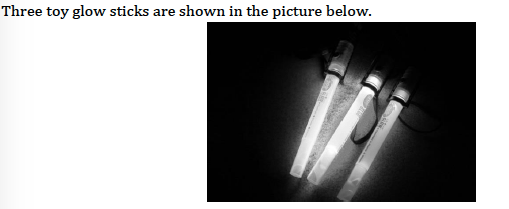
The glow sticks produce light for a short amount of time. The light from the glow stick is a conversion from what to what?
a)
thermal to light
b)
gravitational to potential
c)
radiant to electrical
d)
chemical to light
77.
What machine changes electrical energy into light and sound energy?
a)
battery
b)
lightbulb
c)
alarm clock
d)
apple
78.
On a roller coaster, where is maximum potential energy?
a)
At the bottom of a big hill
b)
When going around a corner
c)
When going upside down
d)
At the top of a big hill
79.
On a roller coaster, where is maximum kinetic energy?
a)
At the bottom of a big hill
b)
When going around a corner
c)
When going upside down
d)
At the top of a big hill
80.
Energy that comes from the nucleus of an atom. A form of potential energy.
a)
chemical energy
b)
Nuclear energy
c)
Sound energy
d)
Electrical energy
81.
What machine changes chemical energy into heat, light and sound energy
a)
blender
b)
firecracker
c)
lightbulb
d)
apple
82.
______________ are materials such as rubber that do not allow charges to flow.
a)
conductors
b)
circuits
c)
insulators
d)
amps
83.
A complete, unbroken path that charges can flow through is called an __________________.
a)
conductor
b)
electric circuit
c)
electric current
d)
insulator
84.
Metals such as copper and aluminum are good ______________. 
a)
insulators
b)
conductors
c)
circuits
d)
charges
85.
A circuit with only one path for the current to flow is a __________________.
a)
parallel circuit
b)
series circuit
c)
mini circuit
d)
device
86.
__________________ is the continuous flow of electric charges through a material.
a)
Electric current
b)
Resistance
c)
Voltage
d)
Static Discharge
87.
If an object has more positive than negative charges, its electrical charge is...
a)
positive
b)
negative
c)
neutral or no charge
d)
opposite
88.
If an object has more negative charges than positive charges, its electrcial charge is...
a)
positive
b)
negative
c)
neutral or no charge
d)
opposite
89.
Static means...
a)
not moving
b)
moving slowly
c)
moving quicky
90.
One example of static electricity is...
a)
rain
b)
thunder
c)
lightning
91.
Two objects that have opposite charges will...
a)
attract
b)
repel
c)
not move
92.
Two objects that have the same charges will...
a)
attract
b)
repel
c)
not move
93.
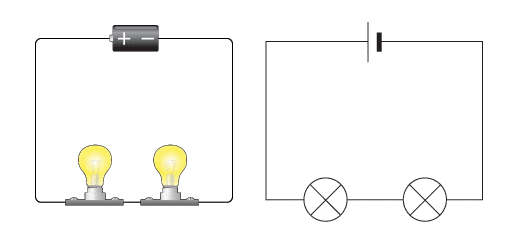
This is an example of a _______ circuit
a)
open
b)
series
c)
parallel
d)
square
94.
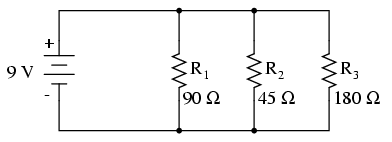
This is an example of a ______ circuit
a)
Series
b)
Parallel
c)
Open
d)
Dihexihedral
95.
What kind of circuit is this?
a)
Series
b)
Consecutive
c)
Parallel
d)
Training
96.
What kind of circuit is this?
a)
Series
b)
Consecutive
c)
Parallel
d)
Training
97.
wood is a _____?
a)
conductor
b)
insulator
98.
brass is a _____?
a)
insulator
b)
conductor
99.
This circuit does not work because…
a)
the bulbs are not connected properly
b)
the single cell is not powerful enough
c)
there is a break in the circuit
d)
there is a short crcuit
100.

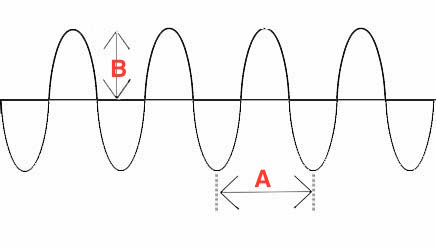
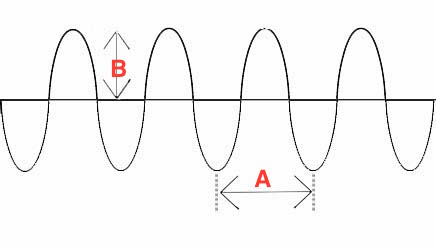
What property of this wave is represented by the letter "A"

a)

amplitude

b)

crest

c)

trough

d)

wavelength

101.
What property of the wave is represented by the letter "B"?
a)
amplitude
b)
crest
c)
trough
d)
wavelength
102.
The highest point on a wave is:
a)
the crest
b)
the trough
c)
the top
d)
the coast 
103.
The lowest point on a wave is the:
a)
Amplitude
b)
Crest
c)
Trough
d)
Wavelength
104.
The type of waves that require medium to pass:
a)
Mechanical Waves
b)
Electromagnetic Waves
105.
When the frequency of a wave increases, what happens to the wavelength?
a)
The wavelength is not directly affected by the frequency of a wave.
b)
The wavelength increases.
c)
The wavelength decreases.
d)
More specific information is needed to form a conclusion about the wavelength.
106.
A mechanical wave cannot travel through...
a)
a vacuum(empty space).
b)
water.
c)
air. 
d)
glass.
107.
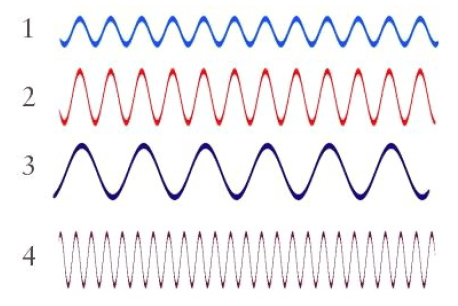
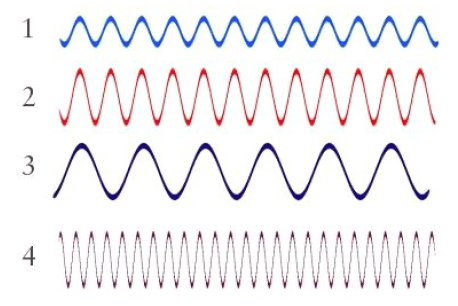
Which wave in the diagram has the greatest frequency?
a)
1
b)
2
c)
3
d)
4
108.
Which wave in the diagram has the greatest wavelength?
a)
1
b)
2
c)
3
d)
4
109.
regular disturbances that carry energy through matter or space
a)
crest
b)
energy
c)
wave
d)
trough
110.
which material does sound travel the fastest?
a)
solid 
b)
liquid 
c)
gases
111.
When a wave strikes and object and bounces off. (example echo)
a)
medium
b)
refraction
c)
reflection
d)
interference
112.
When a wave bends as it passes through at an angle from one medium to another.(example: pencil in a glass of water-)
a)
medium
b)
refraction
c)
reflection
d)
interference
113.
A wave carries...?
a)
energy only
b)
matter only
c)
energy and matter
d)
neither
114.
What kind of waves can travel through space?
a)
electromagnetic waves
b)
compressional waves
c)
longitudinal waves
d)
sound waves
115.
A compressional wave is another name for a 
a)
longitudinal wave
b)
electromagnetic wave
c)
radio wave
d)
hair wave
116.
In a longitudinal wave, the particles move...?
a)
back and forth
b)
up and down
c)
not at all
d)
at a 90 degree angle
117.
Amplitude is a measure of how much _________ the wave is carrying
a)
energy
b)
matter
c)
medium
d)
frequency
118.
When a wave's amplitude increases it means
a)
it's carrying more energy
b)
its wavelength gets longer
c)
its frequency increases
d)
its wavelength decreases
119.
Of the following, ________ have the greatest frequency of the electromagnetic spectrum.
a)
ultraviolet rays
b)
gamma rays
c)
radio
d)
visible waves
120.

What is the Doppler Effect

a)

Where the wavelength of a wave is shifted due to the source moving

b)

When a wave is shifted when a body pushes the wave

c)

Where the apparent wavelength of a wave is shifted due to the source moving

121.
Velocity= 600 m/s
Wavelength= 2.0m
Frequency= _________
a)
300 hertz
b)
.0033 hertz
c)
3000 hertz
122.
2 Parts: The interaction known for when waves bend while traveling through a new medium is called ______ and _____ (is or is not) shown in the picture?
a)
Reflection; is not
b)
Refraction; is
c)
Diffraction; is 
d)
Interference; is not
123.
2 Parts: The name of the wave interaction shown in the picture is called ________ and the planar waves to the left become circular waves because __________________. 
a)
Refraction; waves bend around a barrior
b)
Reflection; waves bounce off a barrier
c)
Diffraction; waves bend around a barrier
d)
Differentiation; waves bounce off a barrier
124.

What would you call this?

a)

Bounce back

b)

Reflection

c)

Diffraction

d)

Refraction

125.
A reflected sound wave
a)
frequency
b)
pitch
c)
echo
d)
rarefaction
126.
The term for how high or low a sound is:
a)
pitch
b)
volume
c)
sound
d)
medium
127.
The term for how loud or soft a sound is:
a)
pitch
b)
volume
c)
sound
d)
medium
128.
Which feature of sound is determined by amplitude?
a)
Pitch
b)
Smoothness
c)
Loudness
129.

Which feature of sound is determined by pitch?

a)

Frequency

b)

Amplitude

c)

Loudness

130.

88 m/s is an example of...

a)

Speed

b)

Velocity

c)

Acceleration

131.

88 m/s north is an example of...

a)

Speed

b)

Velocity

c)

Acceleration

132.

20 m/s west is an example of...

a)

Speed

b)

Velocity

c)

Acceleration

133.

88 m/s2 is an example of...

a)

Speed

b)

Velocity

c)

Acceleration

134.

In circular motion...

a)

Objects are accelerating

b)

Objects speed changes

c)

Objects travel in the same direction

d)

Objects really aren't moving

135.
What is happening at A?
a)
Stationary
b)
Accelerating
c)
Slower steady speed; moving away from the starting position
d)
Steady speed; returning to start position
136.
Which runner won the race?
a)
A
b)
B
c)
C
137.
Which runner had a head start?
a)
A
b)
B
c)
C
138.
At what time did runner A pass runner B?
a)
0 seconds
b)
1 second
c)
2 seconds
d)
3 seconds
139.
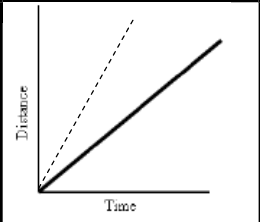
What does this graph represent?
a)
Constant Speed
b)
Acceleration
c)
Not moving
140.

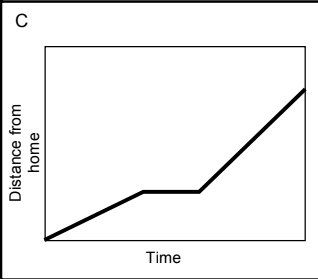
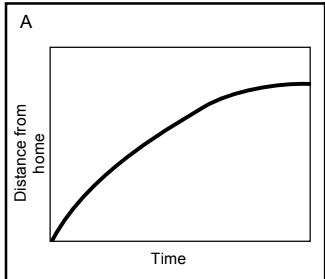
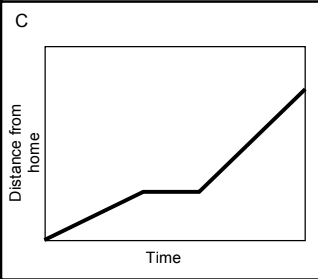
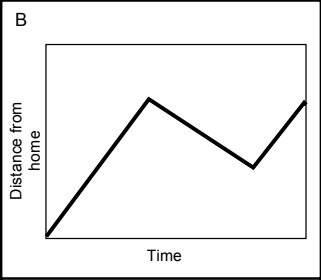
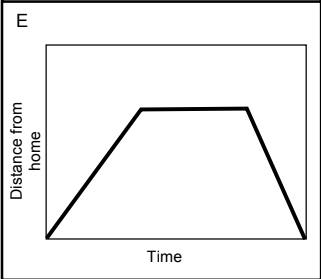
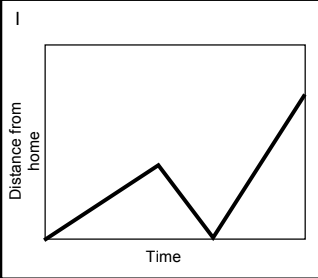
Susie went to the store, when she got there she realized that she forgot her wallet and returned home.


Which graph matches this motion?
a)
b)
c)
d)
141.

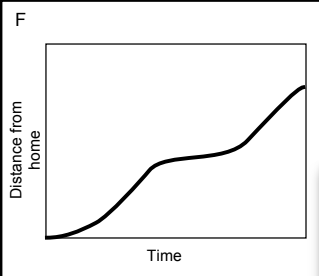
A runner was running the 400 meter dash. They started slowly, then ran at a faster pace, and then sprinted to the finish.


Which graph matches this motion?

a)
b)
c)
d)
142.

Deb walked to the ice cream shop. Sat and ate her ice cream and then went for a run.


Which graph matches this motion?

a)
b)
c)
d)
143.

A robber drove away from the bank, then made a U-turn and went back to the bank to pick up his accomplice. Then made another U-turn and speed away from the police.


Which graph matches this motion?

a)
b)
c)
d)
144.

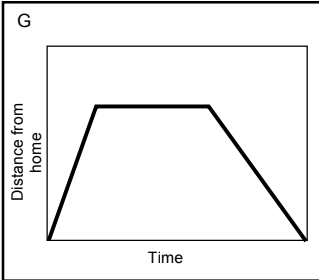
After school, Joe walked home.


Which graph matches this motion?
a)
b)
c)
d)
145.

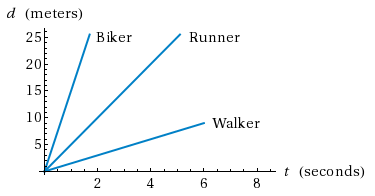
Which person moved the fastest in 3 seconds?

a)

biker

b)

runner

c)

walker

d)

they are all moving equally

146.
What is velocity?
a)
the quickness of an object
b)
the location of an object
c)
acceleration
d)
speed in a specific direction
147.
A runner races in the 100 meter dash.  It takes her 10 seconds to finish.  What is her average speed?
a)
10 m/s
b)
1000 m/s
c)
100 seconds
d)
10 seconds
148.
What is the unit to MEASURE force?
a)
Kilogram
b)
Meter
c)
Pascal
d)
Newton
149.
A ____________ is a push or a pull on an object.
a)
friction
b)
force
c)
magnet
d)
gravity
150.
What is the net force?
a)
10 N
b)
0 N
c)
25 N
d)
1 N
151.
Balanced or unbalanced?
a)
balanced
b)
unbalanced
152.
Forces that have a net force of zero 
a)
Balanced force
b)
Unbalanced force
153.
"For every action, there is an equal and opposite reaction."
a)
Newton's 1st Law
b)
Newton's 2nd Law
c)
Newton's 3rd Law
d)
Newton's 4th Law
154.
Force = Mass x Acceleration
a)
Newton's 1st Law
b)
Newton's 2nd Law
c)
Newton's 3rd Law
d)
Newton's 4th Law
155.
"An object in motion (or at rest) will to stay in motion (or at rest) until an outside force acts upon it."
a)
Newton's 1st Law
b)
Newton's 2nd Law
c)
Newton's 3rd Law
d)
Newton's 4th Law
156.
The tendency of an object to resist changes in its motion is...
a)
inertia
b)
force
c)
acceleration
d)
velocity
157.
The force that opposes motion between two surfaces in contact with each other.
a)
inertia
b)
friction
c)
momentum
d)
gravity
158.
A cannonball with a mass of 0.5 kg is flying at an acceleration of 10 m/sec/sec. What is it's force?
a)
50 Newtons
b)
5 Newtons
c)
20 Newtons
d)
9.5 Newtons
159.
Gravity is increased with...
a)
greater mass & shorter distance
b)
greater mass & farther distance
c)
lower mass & shorter distance
d)
lower mass & farther distance
160.

A car accelerates faster than a truck.

a)

Newton's 1st Law

b)

Newton's 2nd Law

c)

Newton's 3rd Law

161.

The air is let out of a balloon and it flies around the room.

a)

Newton's 1st Law

b)

Newton's 2nd Law

c)

Newton's 3rd Law

162.

A pencil on a table will stay there until someone picks it up.

a)

Newton's 1st Law

b)

Newton's 2nd Law

c)

Newton's 3rd Law

163.
The positive particles of an atom are 
a)
electrons 
b)
positrons 
c)
neutrons 
d)
protons 
164.
the central region of an atom where its neutrons and protons are is its 
a)
nucleus 
b)
electron cloud
c)
core 
d)
center 
165.
Particles in an atom that are neutral and have no charge are 
a)
negatrons 
b)
electrons 
c)
neutrons 
d)
protons 
166.
How many protons does this atom have?
a)
2.5
b)
6
c)
5
d)
10.811
167.
An atom is made up mostly of
a)
protons
b)
gravity
c)
empty space
d)
electricity
168.
Salt has a chemical formula of NaCl.  Salt is a...
a)
Compound
b)
Element
c)
Mixture
d)
None of the Above
169.
The electron has a ___.
a)
negative charge
b)
neutral charge
c)
positive charge
d)
static charge
170.

Where is most of the MASS of an atom located?

a)

In the nucleus

b)

Electron cloud

c)

In the electron

d)

Evenly spread throughout the atom

171.
Which statement correctly describes the relative masses of subatomic particles?
a)
Protons and neutrons have almost equal masses, and electrons have a much smaller mass.
b)
Neutrons and electrons have almost equal masses, and protons have a much larger mass.
c)
Protons, neutrons, and electrons all have roughly the same masses.
d)
Electrons and protons have the same masses, and neutrons have no mass.
172.
Iron is a good conductor, malleable and magnetic. What type of element is Iron? 
a)
Metal
b)
Nonmetal
c)
Metalloid
d)
Pretty
173.
Silicon is a semiconductor and has properties of both metals and nonmetals. What type of element is Silicon? 
a)
Metal
b)
Nonmetal
c)
Metalloid
d)
Pretty
174.
Which elements are found on the left to middle of The Periodic Table? 
a)
Metals
b)
Nonmetals
c)
Metalloids
d)
Candles
175.
Which elements are found on the right side of The Periodic Table?
a)
Metals
b)
Nonmetals
c)
Metalloids
d)
Water
176.
Which of these is a property of metals?
a)
Malleable
b)
Good Insulator
c)
Dull
d)
Very brittle
177.
Which of the following is typically a good conductor of heat?
a)
Metal
b)
Nonmetal
c)
Metalloid
178.
Non-metals are good conductors of heat and electricity. 
a)
TRUE
b)
FALSE
179.

Metalloids are found on the __________________ of the Periodic Table

a)

Right Side

b)

Left Side

c)

Step Line

d)

Back

180.
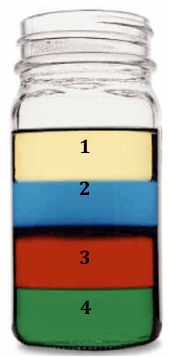
Put the liquids in order from most dense to least dense?
a)
4, 3, 2, 1
b)
1, 2, 3, 4
c)
3, 4, 2, 1, 
d)
4, 3, 1, 2
181.
Why does ice float?
a)
Liquid water is less dense than solid water.
b)
Solid water is less dense than liquid water.
c)
Gaseous water is less dense than solid water.
d)
Liquid water is less dense than gaseous water.
182.
What do we know about the density of lamp oil, rubbing alcohol, and vegetable oil?  
a)
The density is greater than 1.0 g/mL
b)
The density is less than 1.0 g/mL
c)
The density is equal to 1.0 g/mL
d)
The density can not be determined
183.
What is the formula for density?
a)
density = mass x volume
b)
density = mass / volume
c)
density = mass + volume
d)
density = mass - volume
184.
Jack has a rock. The rock has a mass of 14 g and a volume of 2 cm3. What is the density of the rock?
a)
7 mL
b)
7 g/cm3
c)
28 g/cm3
d)
1/7 g/cm3
185.

What is the density of water?

a)

1 g/cm3

b)

2 g/cm3

c)

7 g/cm3

d)

15 g/cm3