
 Worksheets
Earth Science Midterm Review
Total questions: 185
Worksheet time: 3hrs 35mins
What is the scientific method?
A step-by-step recipe for cooking food
A group of facts you remember without doing experiments
A way to use what you see, test ideas, and find answers
A random guess that you accept right away
When you grow plants using different colors of light, what thing do you change on purpose?
Amount of water given to each plant
Color of light used on each plant
Height of plants after two weeks
Type of soil in each pot
What is a hypothesis?
A group of opinions that are not connected
A list of things you need
A guess you can test, often written as If…then…because…
A rule in science that cannot be changed
Which things stay the same in a fair test about how fast something dissolves?
Time measured as the outcome
Cup size identical
Sugar brand intentionally changed
Stirring method consistent
Water temperature kept the same
How do you find density?
D equals M divided by V
D equals V minus M
D equals M plus V
D equals M times V
Which tool do you use to measure how much liquid there is in milliliters?
Thermometer
Overflow can
Graduated cylinder
Digital scale
A metal cube is put in a can of water. What does displacement mean?
Water temperature controls displacement
The water gets heavier from the cube
Water level goes up by the cube's size
The cube loses weight in the water
Convection in Earth’s mantle helps move tectonic plates. What drives this motion?
Cooling of the inner core only
Static pressure from the crust
Transfer of heat by flowing fluids
Movement of solids without heating
What does a topographic map show?
A map of population density
A map of climate and rainfall
A map showing elevation and land shape
A map showing roads and cities
A contour line connects places that are the same height. What happens because of this?
Lines cross at peaks often
Lines make a loop around hills
Lines show wind speed changes
Lines mark different heights at each place
What does contour interval mean?
Distance between map grid lines
Elevation change between neighboring contour lines
Slope angle of a mountain face
Total relief from valley to peak
What does it mean when contour lines are close together on a map?
Contour lines far apart
Contour lines close together
Contour lines forming perfect circles
Contour lines crossing streams
When contour lines make a V shape over a river, which way does the V point and where does the water go?
V points upstream; water flows downstream
V points downstream; water flows upstream
V points sideward; water meanders sideways
V points to lakes; water stops moving
Match each Earth layer with its key property.
Crust
Thin, solid outer layer
Mantle
Solid rock that can flow slowly
Outer core
Liquid iron and nickel
Inner core
Solid iron and nickel
Which statement about the lithosphere is correct?
It is the liquid core layer
It is crust plus uppermost mantle forming rigid plates
It is the softer asthenosphere beneath plates
It is entirely made of molten rock
What is the asthenosphere?
Thin crustal sedimentary layer
Solid inner core boundary
Rigid slabs moving as plates
Softer, flowing upper mantle beneath lithosphere
Seismic waves help scientists learn about the inside of Earth because they
Only show volcanoes on the surface
Measure rain that changes the land
Move through Earth and change with different materials
Take rock samples from the core
What is a tectonic plate?
A solid inner sphere beneath the mantle
A thin layer of liquid iron around the core
A big piece of the Earth's crust that moves
A map symbol showing mountain height
Which boundary is where plates move away from each other, making new ocean floor and rift valleys?
Transform boundary with sliding motion
Subduction boundary with arc volcanoes
Convergent boundary with trenches forming
Divergent boundary with seafloor spreading
What happens when an ocean plate and a land plate meet at a convergent boundary?
Tension pulls plates apart
Compression drives subduction zones
Shearing creates strike-slip motion
Elastic rebound forms rift valleys
What do transform boundaries usually make?
Folded mountain belts
Trenches and volcanic arcs
Mid-ocean ridges and rifts
Strike-slip faults and earthquakes
What does subduction mean?
One plate goes up over another plate
Two plates move away from each other
Two plates slide next to each other
One plate goes under another plate
Which fault happens because of pulling apart and is found where plates move away from each other?
Thrust fault with low-angle compression
Strike-slip fault with lateral offset
Normal fault with hanging wall down
Reverse fault with hanging wall up
Reverse faults happen mostly because of which kind of stress?
Torsion twisting rock layers
Elastic rebound after creep
Tension pulling the crust apart
Compression pushing plates together
Pair each term with its correct description.
Folded rock
Layers bent by compression
Faulted rock
Layers broken and displaced
Elastic rebound
Sudden release of built-up stress
Paleomagnetism
Ancient magnetism recorded in rocks
What are P-waves?
Reflected waves; bounce off boundaries
Fastest body waves; pass solids and liquids
Slower waves; travel only through solids
Surface waves; strongest ground motion
S-waves are different from P-waves because S-waves
Go faster and move only near the surface
Go slower and move only through liquids
Go slower and move only through solids
Go faster and move through liquids
Which tool is used to record shaking during an earthquake?
Seismogram showing printed lines
Seismograph recording vibrations
Barograph measuring air pressure
Magnetometer tracking field changes
What is a seismogram?
Printout produced by a seismograph
Instrument that senses ground motion
Map of epicenter locations
Signal from P-wave arrival
Match each igneous intrusion with its orientation.
Dike
Cuts across rock layers
Sill
Runs parallel to layers
Laccolith
Dome-shaped; pushes layers up
Batholith
Very large intrusive body
Which kind of volcano is wide with gentle slopes and has calm eruptions of runny lava?
Stratovolcano at subduction zones
Composite volcano with steep sides
Shield volcano with gentle slopes
Cinder cone of loose fragments
Composite (stratovolcano) eruptions usually happen in a strong way at places where one plate goes under another.
Explosive at subduction settings
Quiet with fluid basaltic flows
Nonexistent near convergent margins
Limited to hot spot chains
What is a hot spot?
A moving plume beneath spreading ridges
A surface pool of lava near rift valleys
A stationary mantle plume forming volcano chains
A cold slab producing trench earthquakes
Which kind of lava has a rough and bumpy surface?
Rhyolitic with glassy appearance
Basaltic with high silica content
Aa with sharp, broken crust
Pahoehoe with smooth, ropy texture
What is special about pahoehoe lava?
Smooth, ropy surface texture
Explosive, fragmental deposits
Jagged, blocky clinkers
High viscosity rhyolite
Match each earthquake term to its location description.
Focus (hypocenter)
Point inside Earth where rupture starts
Epicenter
Point on surface directly above focus
Fault
Break in rock where movement occurs
Which area around the Pacific has lots of earthquakes and volcanoes?
Pangaea supercontinent interior
Himalayan plateau margin
Ring of Fire circum-Pacific belt
Mid-Atlantic ridge system
Which kind of earthquake wave moves on Earth's surface and usually causes the most damage?
Body waves inside the mantle
Surface waves along the ground
S-waves moving through fluids
P-waves traveling through solids
What does magnitude show during an earthquake?
How fast waves move in the ground
How much energy is let out
How much damage in each town
How deep the break is
What does intensity mean during an earthquake?
The number of surface waves
The total length of rupture
How strong shaking is locally
The single energy rating
Shadow zones for earthquake waves show us what about the inside of the Earth?
A solid outer core
A liquid outer core
A frozen mantle
A hollow inner core
Triangulation uses three seismograph stations to find what?
Wave frequency
Fault type classification
Epicenter location
Magnitude category
What is a mineral?
Naturally occurring inorganic solid
Any natural solid without order
Man-made crystal with mixed atoms
Organic solid with variable form
On the Mohs scale, which number means the mineral is the hardest?
Number 1 on the scale
Number 5 on the scale
Number 7 on the scale
Number 10 on the scale
Why is streak usually better than outside color for telling what a mineral is?
It shows if there are radioactive parts
It always shows the powder color
It shows if the crystals change size
It tells the mineral's weight
What makes cleavage different from fracture?
Fracture ranks hardness values
Cleavage is powder color test
Cleavage breaks along flat planes
Fracture shows metallic luster
Which words tell how minerals can look?
Earthy or dull
Metallic appearance
Porous or foamy
Vitreous or glassy
How do igneous rocks form?
Metamorphism of shale
Cooling of magma or lava
Heat and pressure only
Weathering of sediments
Extrusive igneous rocks are most likely to show which feature?
Metallic luster from oxidation
Coarse crystals formed underground
Fine crystals formed at surface
Random fractures from pressure
Which statements are true about P-waves and S-waves?
P-waves travel through solids
S-waves move fastest of all waves
P-waves pass through liquids
S-waves cannot travel through liquids
What does uniformitarianism mean in geology?
Fossils make new rock right away
Things happening now help us understand the past
Rocks always form the same way
Earth only changes during big disasters
Relative dating tells us which happened first or last. What does it help us find out?
How fast a valley wears away
What sediments are made of
Which things are older or younger
The exact age of rocks
What does absolute dating tell us about a rock or fossil?
Actual numerical age in years
Description of rock texture
Relative order in a sequence
Position within a fold
What is the main difference between foliated and non-foliated metamorphic rock?
Amount of organic material present
How much the rock has changed
If the rock has layers or stripes
If the rock has fossils or shells
How do sedimentary rocks usually form?
Crystallization from magma
Melting then rapid cooling
Compaction and cementation
Extreme heat and pressure
Which statement about fossils is true?
Fossils show up in layers randomly
Fossils are not found in sedimentary rocks
Fossils are found in a certain order
Fossils only form in rocks changed by heat and pressure
Match each geologic term to its correct description.
Weathering
Breaking rock into smaller pieces
Erosion
Moving sediments to new locations
Deposition
Dropping sediments from transport
Compaction & cementation
Turning sediments into sedimentary rock
What is the first thing you should do when starting an investigation?
Make a graph of your results
Find out what things you will keep the same
Ask a question or say what the problem is
Look at the numbers you collected
In a fair test, what do controls/constants do?
They decide how many things you test
They stop things from mixing
They change to make results
They stay the same to compare
Pick which thing you change and which thing you measure: A student checks if more sunlight makes plants grow taller.
Independent: sunlight hours
Dependent: sunlight hours
Dependent: plant height
Independent: plant height
Which sentences show the difference between relative dating and absolute dating? Choose all that are right.
Relative dating tells if something is older or younger
Absolute dating gives the exact age in numbers
Relative dating only uses special isotopes
Absolute dating cannot give numbers
If something has a density of 0.8 g/mL, will it float or sink in water?
Float because less dense
Sink because heavier
Float because shape changes
Sink because more dense
What does an overflow can measure directly?
Weight by scale
Density by ratio
Mass by balance
Volume by displacement
On a map that shows hills and valleys, where are the lines closest together?
Evenly spaced
Crossing a stream
Farthest apart
Closest together
A stream crosses contour lines and makes a V shape. Which way does the V point?
Toward the mouth
Toward higher elevation
Downstream direction
Upstream direction
If the contour interval is 20 m, how much higher or lower is the ground between two lines next to each other?
10 meters
Varies with slope
20 meters
40 meters
Why can't S-waves go through the outer core?
They bounce off ridges
They get stopped by the crust
They need solids
They are too slow
What forms in the ocean where two plates move apart?
Fold mountain belt
Volcanic arc chain
Mid-ocean ridge
Deep ocean trench
Which boundary type makes big earthquakes and deep trenches?
Divergent spreading
Convergent subduction
Hot spot mantle
Transform sliding
What is a transform plate boundary?
Strike-slip faults
Volcanic arcs
Rift valleys
Island chains
Match each lava texture to its description.
Pahoehoe
Smooth and ropey
Aa
Jagged and rough
Pillow
Formed underwater
What do shield volcanoes usually look like?
Narrow and rhyolitic
Steep and andesitic
Broad and basaltic
Thin and ultramafic
Composite volcanoes often have:
Explosive potential
Low gas content
Quiet eruptions
No subduction link
How many stations do you need to find where an earthquake started?
One station
Four stations
Three stations
Two stations
If mineral A can scratch mineral B on the Mohs hardness scale, what does this mean?
A is harder than B
A is softer than B
Both have equal hardness
Hardness cannot be known
Which mineral property helps you tell what it is most easily?
Streak over color
Color over luster
Cleavage over streak
Fracture over hardness
Which terms correctly pair with mineral properties?
Luster
Light reflection quality
Cleavage
Smooth break along planes
Fracture
Uneven break surfaces
Streak
Color of powdered mineral
Place each rock cycle process with its outcome.
Weathering and erosion
Sediments then sedimentary rock
Heat and pressure
Metamorphic rock formation
Melting then cooling
Crystallization into igneous rock
How does sedimentary rock form?
Sediments get pressed together
Heat squeezes crystals
Magma comes out and cools
Pressure melts minerals
When magma cools slowly, what size are the crystals?
Very tiny crystals
Large visible crystals
Mixed crystal sizes
No crystals form
Fast cooling in extrusive environments leads to:
Glass-free textures
Large coarse crystals
Small fine crystals
Metamorphic banding
Relative dating mainly tells us:
What minerals are in rocks
The order things happened
How much radiation is there
The exact age in years
What does uniformitarianism mean?
The past is unlike today
The present is the key to the past
Future changes are unpredictable
Only catastrophes shape Earth
Which things change in a cooling-rate crystal experiment? Pick all that are true.
Cooling rate chosen
Type of magma used
Crystal size observed
Time to crystallize recorded
Which type of plate boundary is most likely to make a line of volcanoes along the coast?
Divergent boundary at mid-ocean ridge
Convergent boundary with subduction zone
Transform boundary along continental margin
Intraplate hotspot beneath stable craton
Match each plate boundary type to the landform or feature it commonly produces.
Divergent boundary
Mid-ocean ridge or rift valley
Convergent boundary
Volcanic arc and mountains
Transform boundary
Strike-slip fault and offset streams
What do contour lines show on a topographic map?
Lines connecting equal temperature values
Lines marking stream channel centers
Lines connecting equal elevation values
Lines connecting equal rainfall totals
How can you tell a hill is steep on a map?
Contour lines closely spaced together
Contour lines widely spaced apart
Contour lines colored darker green
Contour lines randomly curved
When a stream crosses contour lines, it makes V-shapes. Which way does the V point?
Downstream direction of water flow
Toward higher elevation upstream
Perpendicular to valley walls
Toward the nearest benchmark
Which type of earthquake wave gets to a seismograph station first?
S waves
Surface waves
P waves
Tsunami waves
Which pair correctly matches earthquake vocabulary?
Focus
Location inside Earth where rupture starts
Epicenter
Point on Earth’s surface above the focus
Seismogram
Recorded waveform of ground motion
Seismograph
Instrument that detects ground motion
Which combination best helps identify a mineral?
Streak on an unglazed tile
Crystal size after cooling
Hardness using the Mohs scale
Color alone in room lighting
What makes igneous crystals bigger?
Slow cooling deep underground
Rapid cooling at the surface
Weathering by wind and water
Metamorphism under pressure
Which statement shows the idea of uniformitarianism?
Past processes were completely random
Present processes never happened before
Present processes help explain the past
Earth changed only during rare disasters
Place Earth’s layers in correct order from surface to center.
Crust
Outermost solid shell
Mantle
Thick silicate layer below crust
Outer core
Liquid metallic layer
Inner core
Solid metallic center
A fossil is found in Layer B below Layer A in a stack of rocks that has not been moved. What does this mean?
Layer B was made after Layer A
Layer A and B were made at the same time
Layer A is older than Layer B
Layer B was made before Layer A

"If I hold the dropper 6 inches above the penny, I think I can put 10-20 drops on the penny." This is an example of: (a)
Hypothesis
Observation
Experiment
Theory
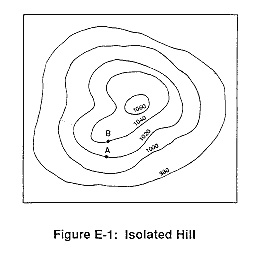

If sea level always equals (0), and the contour interval is 10 feet how tall is this mountain?
30 ft
40 ft
50 ft
60 ft

What type of volcano is this?
Shield
Cinder Cone
Composite

What type of volcano is this?
Shield
Cinder Cone
Composite
What is the difference between magma and lava?
lava is magma but it is on the surface of the Earth
lava is the chamber that magma flows
lava is the Earth's crust
lava has a different chemical composition than magma
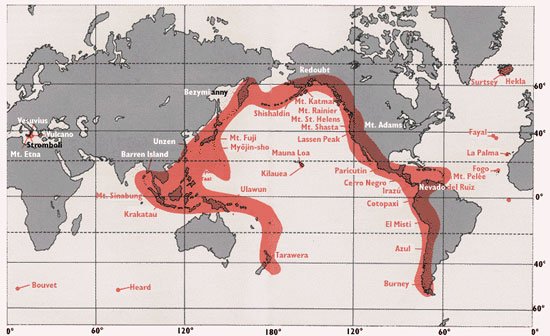
This is the name for the chain of volcanos around the edge of the Pacific Plate.
March Maddness
Earthquake Alley
Ring of Fire
Circle of Death

The huge pieces of the earth's crust are called ____________________________.
cups
plates
dishes
spoons

What are the puzzle pieces of the Earth's surface called?
Tectonic plates
Subductions
Earthquakes
Convergents


Describe the texture of the following igneous rock.
glassy
rough
vesicular
coarse

Describe the texture of the following igneous rock.
smooth
coarse
vesicular
glassy

Describe the texture of the following igneous rock (grain size 1-10 mm).
vesicular
glassy
fine
coarse

Describe the mineral composition of the following igneous rock.
felsic
mafic

Describe the mineral composition of the following igneous rock.
felsic
mafic

Describe the environment of formation for the following igneous rock (grain size > 10 mm).
intrusive
extrusive

Describe the environment of formation for the following igneous rock.
intrusive
extrusive

This igneous rock is
obsidian
basalt
pumice
granite

What igneous intrusion is labeled "C"
Batholith
Lacolith
Sill
Batholith

What igneous intrusion is labeled "E"
Sill
Dike
Lacolith
Batholith

#4 is a...
batholith
laccolith
dike
sill

What is letter H?
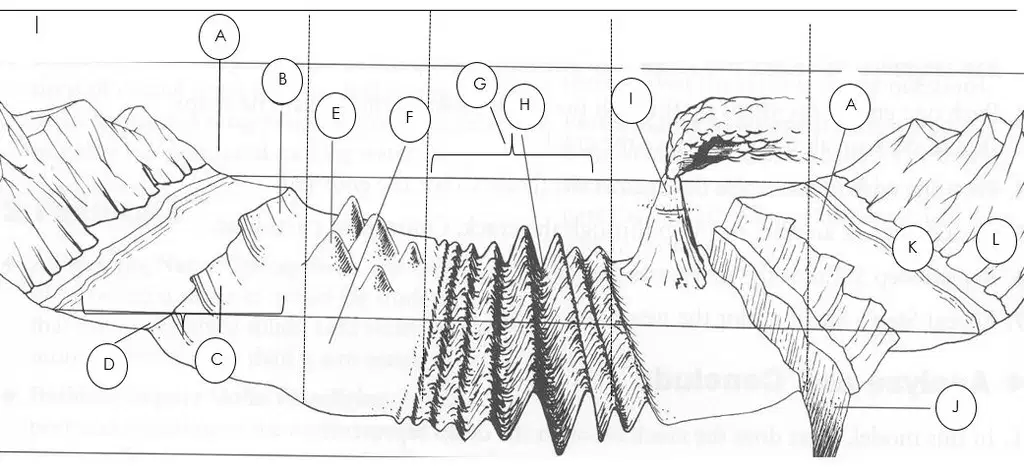
What is letter J?

___________ is the process by which
new oceanic lithosphere (sea floor) forms as magma rises to Earth’s surface and solidifies at a mid-ocean ridge.
Continental drift
Sea-floor spreading
Plate tectonics
Mid-ocean range
In the 1960s, scientists studying the ocean floor discovered _____________.
that the ocean floor had magnetic patterns
the Titanic
that the ocean floor had magical properties
that the ocean floor was as smooth as a desert
Magnetic reversal is the process by which ________________.
the Earth's north and south magnetic poles periodically change places
the continents once formed a single landmass, broke up, and drifted to their present locations
new oceanic lithosphere (sea floor) forms as magma rises to Earth’s surface and solidifies at a mid-ocean ridge
What technology did scientists use in the mid-1900s to map the mid-ocean ridge?
satellites
deep-sea diving
submarines
sonar
Most geologists think that the movement of Earth's plates is caused by __________________.
conduction
earthquakes
convection currents in the mantle
Earth's magnetic field
Who is the scientist that developed the Continental Drift Theory?
Anton Wagner
Alfred Wegener
Archie Bunker
Alfonso Ribeiro
What is the Theory of Continental Drift?
There is a gravitational force that is acting on Earth's land masses, pulling them apart at a rate of 1-2 cm per year.
The continents are located exactly where they will remain for the next 250 million years.
The Earth was once a molten mass that has since cooled and contracted, separating the continents by vast oceans.
The continents were once together in one large land mass but they have since drifted apart.
What do you call the supercontinent landmass formed million years ago?
Pangea
Panera
Polymorphism
Palendrome

What type of plates are colliding
oceanic - oceanic plates
oceanic - continental plate
continental - continental plates


Oceanic crust (sea floor) is destroyed at this boundary.
Convergent Oceanic
Divergent Oceanic
Convergent Continental-Continental
Divergent Continental
What is the name of the layer that contains the upper layer of the upper mantle and crust?
Asthenosphere
Mesosphere
Lithosphere
Transosphere


What kind of boundary is shown here?
convergent
divergent
transform

What kind of boundary is shown here?
divergent
convergent
transform


What is the process called when sediments are pressed together under their own weight?
Cementation
Compaction
Erosion
Weathering
Which type of sedimentary rock is formed from the accumulation of plant or animal debris?
Clastic
Chemical
Organic
Precipitate
Which of the following processes involves the breakdown of rocks into smaller pieces by physical or chemical means?
Erosion
Weathering
Deposition
Compaction
Which type of sedimentary rock is formed from fragments of other rocks?
Organic
Chemical
Clastic
Precipitate
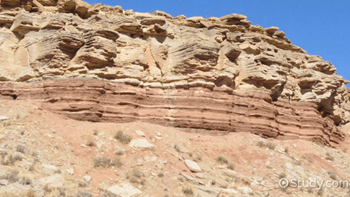
What factors can lead to the formation of a sedimentary rock?
melting and solidification
extreme heat and pressure
compaction and cementation

Describe the texture of breccia.
vesicular
clastic
crystalline
bioclastic
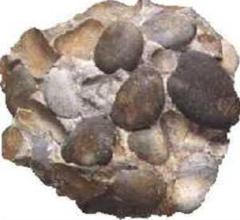
Which of the following is a land-derived sedimentary rock?
rock gypsum
limestone
gabbro
conglomerate
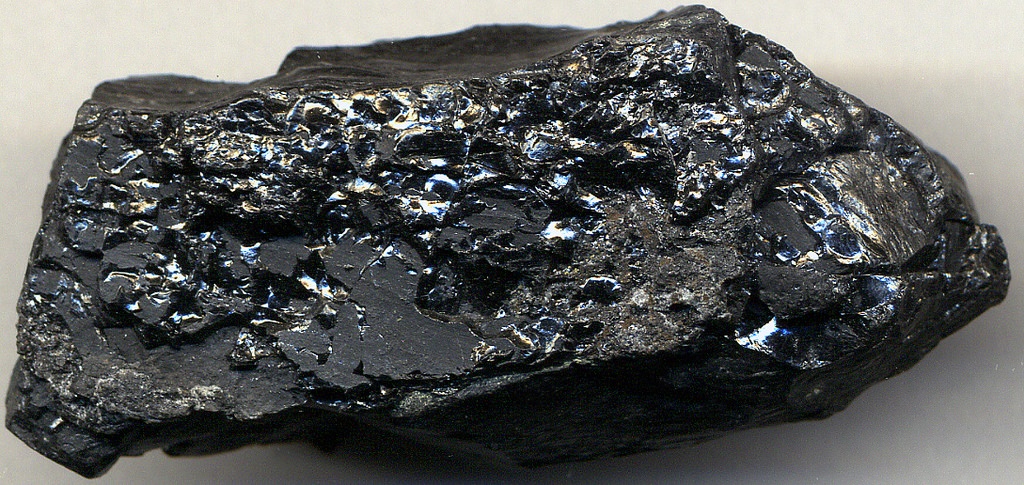
Which of the following is an organically formed sedimentary rock?
obsidian
coal
siltstone
shale


Granite

Pummice

Obsidian

Basalt

Marble

Gneiss

Quartzite

Slate

Schist
All rocks are made of
Minerals
Other Rocks
Dirt
Intergrown Crystals
Sediments
The smallest sediment size is that of
Pebbles
Cobbles
Sand
Silt
Clay

This is coal. Coal is formed from once living organisms They may form from carbon-rich plant material or from deposits of animals’ shells. This type of sedimentary rock is called:
Organic
Chemical
Clastic
This process "glues" the particles of sediment together:
cementation
compaction
calcification
weathering

A fast-moving river carries rocks downstream.
Weathering
Erosion
Deposition

Layers of sediment forming at the bottom of the ocean.
Weathering
Erosion
Deposition

Foliated or Non-Foliated?
Foliated
Non-Foliated

Rainwater enters the cracks of a rock, freeze, and causes the rock to break apart.
Weathering
Erosion
Deposition

The school is adding a new addition to the school buidling. Once the ground was dug up, a teacher brought her class out to examine the rock layers exposed. They were able to see fossils such as coral, clams, and fish. What did this tell them about the envrionment many year ago?
An ocean once covered the area.
The environment was cold and icy.
There was forest in this area.
Desert sand covered this area.


What is the process happening at R?
Deep ocean trench
mid ocean ridge
subduction
sea floor spreading

50 mL of water was added to the graduated cylinder. After we drop in the object, the new water level goes up to 60 mL. What is the volume of the blocks? (Hint: new volume- old volume)
8 mL
10 mL
60 mL
5 mL


Which location is farther from the epicenter?
Seismogram B (top)
Seismogram C (bottom)
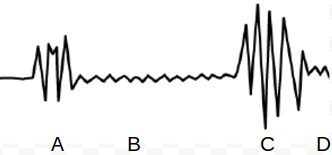

The San Andreas Fault is what kind of fault?
strike-slip
dip-slip
thrust
normal

Which type of rocks are most fossils found in ?
Igneous Rock
Sedimentary Rock
Metamorphic Rock

Which idea explains that older layers of rock are towards the bottom and youngest layers are towards the top?
Uniformitarianism Theory
The Law of Superposition
Historical Geology
Lithification

Which fossil is the oldest?
Gastropod
Ammonite
Crinoid
Trilobite


Describes the way the surface of a mineral reflects light: shiny, sparkling, dull, or dark.
Streak
Luster
Hardness

