
 Worksheets
Unit 11 Test Review: Classification & Diversity of Life
Total questions: 180
Worksheet time: 15hrs 0mins






Name this bacteria shape
bacillus
coccus
spirillum

Name this bacteria shape
coccus
bacillus
spirillum

Name this bacteria shape
coccus
spirillum
bacillus

True or False: Some types of bacteria eat and clean up oil spills
True
False

A disease causing organism
pathogen
poison
vaccine
What happens in the lytic cyle?
Virus goes in and leaves the host cell
Virus quickly causes the host cell to burst
Virus sleeps inside of the host cell
Virus stay dormant for a long time
A retrovirus is different from other viruses because retroviruses have __________ at their core.
RNA
DNA
Protein
The outside shell of a virus is called a(n)
capsid
flagellum
cell wall
cell membrane
Antibiotics are used to fight off
viral infections
bacterial infections
HIV infections
fungal infections
Bioremediation involves microbes
producing carbohydrates
converting nitrogen to usable forms
digesting pollutants
break down food
Which pathogen infects ONLY plants
virus
prion
viroid
bacteria
Prions are infectious particles that
cause other proteins to fold incorrectly
duplicate DNA
only infect plants
fit into the wrong receptors, causing problems
Chromosomes in a prokaryotic cell are
linear
circular
small
large
How does the DNA of a bacteriophage enter the host cell?
injection
endocytosis
binary fission
conjugation
Structures found in prokaryotic cells but NOT eukaryotic cells are
ribosomes
linear chromosomes
circular chromosomes
membrane bound organelles
Scientists use Gram Staining to determine
how big a bacterial cell is
differences in cell wall structures in bacteria
the rate that viruses reproduce
if someone has a disease
Patient Zero is
the first person who became infected with a disease
the last person who became infected with a disease
Antibiotic resistance
arises by mutation in an infected person
may prevent bacteria from making new cell walls
can be prevented by the widespread use of antibiotics
arises naturally in bacteria
The genetic material of a virus is
DNA only
DNA or RNA
capsids
proteins
Viruses can be transmitted through
sexual contact
direct or indirect contact
air
all of these
The main difference in the cell walls of bacteria is that they contain
proteins
lipids
sugars
peptidoglycan
What cell structures do prokaryotes and eukaryotes have in common?
mitochondria
nuclei
ribosomes
chloroplasts


The amoeba seen in the image engulfs large food particles through which process?
Phagocytosis
Pinocytosis
Osmosis
Diffusion
The disease malaria is caused by
a fly infected with a protist
a mosquito infected with a protist
a mosquito infected with a virus
a fly infected with a virus
Giardiasis is caused by
contaminated water through nose
contaminated water through mouth
mosquito
fly
A protist that caused the blight of potato crops and resulted in MANY deaths occurred in
England
Scotland
Ireland
Spain

A collective mass of hyphae that are underground are referred to as ____________
parasitic
fruiting
mycelium
spores
Fungi produce spores in
Hyphae
Orange peels
Sporangia
Mycelium
The molecule that is found in the cell wall of fungi AND in the exoskeleton of insects is
cellulose
peptidoglycan
sugar
chitin
White nose syndrome occurs in
bats
frogs
trees
Chytrid fungus can be deadly to
bats
frogs
trees
Dutch elm disease is deadly to which organisms
bats
frogs
trees
The main role of a fungus in an ecosystem is to be a
decomposer
producer
eat other animals
Lichen are useful as environmental indicators and are made of
protozoa & fungus
protozoa & algae
algae & fungus
algae & mold
The part of a fungi that grows above ground is called
sporangia
hyphae
mycelium
fruiting body
When the ovules of a flowering plant are fertilized they become:
fruit
pollen
petals
seeds
cones
The number of cotyledons distinguishes:
mosses and liverworts
angiosperms from gymnosperms
the classes of the angiosperms
vascular from nonvascular
Which of the following is NOT a characteristic of ALL plants?
composed of eukaryotic cells
are multicellular
produce seeds
contain cellulose in the the cell wall
Plants placed in the NONVASCULAR group are placed there because...
they have no protection from dehydration
they don't produce pollen or seeds
they don't contain xylem and phloem
they always have a dominant gametophyte generation
What is the dominant generation in the vascular plants?
sporophyte
sporangium
gametophyte
prothallus
In monocot STEMS the vascular bundles are usually arranged:
in parallel lines
in a random scatter
in multiples of three
in a ring
In Vascular plants, the products of photosynthesis are transported by the:
xylem
phloem
tracheids
cuticle
Which of the following is NOT common to ALL phyla of vascular plants?
the development of seeds
xylem and phloem
alternation of generations
the addition of lignin to the xylem cell walls
In bryophytes, water passes from cell to cell by:
absorption
transpiration
osmosis
mitosis
The following plant structures are all adaptations specifically for a terrestrial environment EXCEPT:
roots
xylem
cell walls
cuticle
Which of the following was NOT a problem for the first land plants?
animal predation
support against gravity
sperm transfer
sources of water
Plant spores give rise directly to:
seeds
gametophytes
gametes
sporophytes
Bryophytes have all of the following characteristics except:
mutlicellular
spores
specialized cells and tissues
lignified vascular tissue
Ferns are a Tracheophytes, but are still similar to the Bryophytes because..
they require water for fertilization
they don't have true roots, stems, or leaves
they don't have a dominant sporophyte generation
they don't have vascular tissue
All of the following are advantages to life on land except:
an abundance of available water
abundance of available light
carbon dioxide is plentiful
soil is rich in mineral nutrients
Plants that produce seeds
Angiosperms
gymnosperms
both angiosperm and gymnosperm
neither angiosperm or gymnosperm
Include the cone bearing plants
angiosperms
gymnosperms
both angiosperms and gymnosperms
neither angiosperms or gymnosperms
Include monocots and dicots
angiosperms
gymnosperms
both angiosperms and gymnosperms
neither angiosperms and gymnosperms
Have motile gametes
angiosperms
gymnosperms
both angiosperms and gymnosperms
neither angiosperms and gymnosperms
These plants are tied to a moist environment ONLY because of their reproduction.
Ferns
mosses
both ferns and mosses
neither ferns nor mosses
These plants are tied to a watery environment because they lack vascular tissue
ferns
mosses
both ferns and mosses
neither ferns nor mosses
These plants produce pollen and seeds.
Ferns
mosses
both ferns and mosses
neither ferns nor mosses
These plants have a dominant gametophyte generation.
ferns
mosses
both ferns and mosses
neither ferns nor mosses
The appearance of many new species in a relatively short period of time that occurs when ecological niches are made available.
adaptive radiation
alternation of generations
adaptive selection
evolution
Root like structures that do not contain vascular tissue
Tuber
rhizoids
cuticle
apical meristem
Openings in the leaf that allow for gas exchange...
ligin
cuticle
stomata
cotyledon
Name given to the haploid phase of the life cycle.
sporophyte
gametophyte
antheridia
sporangium
The movement of pollen by water, wind, or animal.
fertilization
ovulation
pollination
flower formation

Monocot or Dicot leaf?
Monocot
Dicot

Monocot or dicot flower?
Monocot
Dicot

Monocot or Dicot stem?
Monocot
Dicot

Monocot or Dicot Root?
Monocot
Dicot

Monocot or Dicot Seed?
Monocot
Dicot
Pollination occurs when the pollen is moved from the PISTIL to the STAMEN of the same flower or another flower of the same kind.
TRUE
FALSE

The MALE reproductive organ is the:
Corolla
Calix
Stamen
Pistil
Pollen grains are produced by
the anther
the stigma
the ovules
the ovary
When fertilization has occured the fertilized ovule changes and so does the ovary. What do they turn into?
The fertilised ovule turns into the fruit and the ovary turns into the seed.
The ovule grows bigger and the ovary withers.
The fertilised ovule turns into a seed and the ovary turns into the fruit or pod.
The fertilised ovule turns into honey and the ovary turns into nectar.
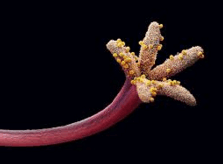
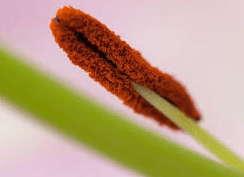
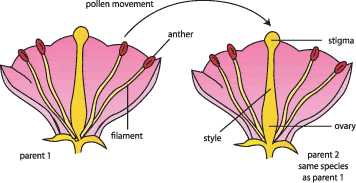
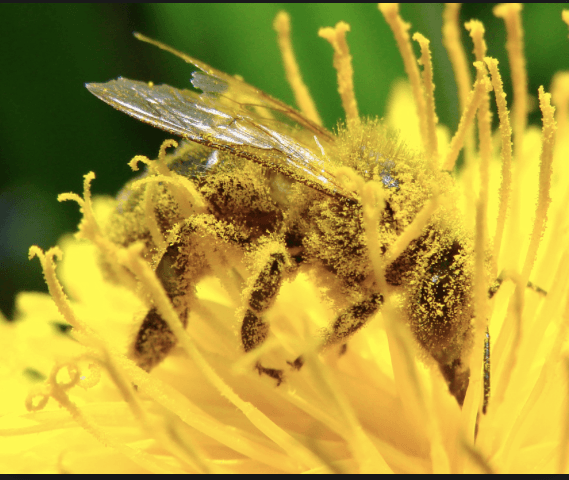


The pistil (or carpel) is the _______ part of the flower
Male
Female

The stamen is the ______ part of the flower
male
female


These are found inside of the ovary, they are tiny egg cells that will become seeds, also known as ______________
ovaries
ovules
anthers
sepals


The arrow points to a long stalk that leads to the ovary. This stalk is called ______
ovary
ovule
style
stigma

The arrow points to the green structures that enclose and protect the flower before it opens. These structures are called _____________
stigma
stamen
sepals
pistil

The arrow points to the colorful part of a flower that attracts pollinators. These are called the __________
pollen
sepals
petals
style

The yellow structures you see are pollen. Pollen is captured by the female, feathery structure called ___________. After it is captured it will travel down the style and into the ovary.
stigma
style
ovary
ovule

The arrow points to the stalk that holds the anther up. This structure is called ____________
stigma
style
anther
filament

The stalk supporting the anther.
stigma
style
sepal
filament
This will become the seed and is surrounded as it matures. In some plants, this becomes a fruit.
ovary with ovules
stem
stigma
anther
These are modified leaves that surround the flower when it is still a bud.
sepals
stigma
stem
petal
True or False: most animals are invertebrates.
True
False

Usual mode of reproduction: Sexual
Type of fertilization: External
Embryology: Blastopore contributes to the formation of anus; cleavage is radial
Symmetry: Immature form is bilateral; mature form is five-part radial
Body cavity: Lined with tissue derived from mesoderm
Segmentation: No evidence
Skeleton: Spiny exoskeleton secreted by the dermis and covered with a thin epidermis
Habitat: marine
Into what phylum should this organism be placed?
Chordata
Echinodermata
Mollusca
Nematoda
Coelomate, exoskeleton and jointed appendages are characteristics of
Annelida
Arthropoda
Mollusca
Chordata
Pharyngeal slits, endoskeleton derived from mesoderm and ventral heart are characteristics for
Annelida
Chordata
Cnidaria
Nematoda
Which of the following is not an arthropod characteristic?
Jointed appendages
Nonsegmented body
molting
exoskeleton
Which phylum is comprised of acoelomate, bilaterally symmetrical and tripoblastic organisms?
nematoda
chordata
porifera
platyhelminthes
Which of the following group of animals is sessile?
jellyfish
cockles
sponge
coral
Which phylum is comprised of coelomate, bilaterally symmetrical, non segemented and tripoblastic organisms?
platyhelminthes
mollusca
cnidaria
echinodermata
Which of the following features could be used to distinguish between an earthworm (annelid) and a tapeworm (platyhelminth)?
segmentation
germ layer
body coelom
organization level
The nematodes are also called _________________.
flatworms
roundworms
tapeworms
earthworms
Which phylum and species that has these characteristics
- triploblastic
- acoelomate
- specialized excretion cells called flame cell
- has mouth but no anus
- hermphrodite
Platyhelminthes - Ascaris sp
Annelida - Brugia sp
Platyhelmintes - Taenia sp
Annelida - Pheretima sp
Which phylum and species that has these characteristics
- bilateral symmetry
- have chaetae/ setae
- have paired of metanephridia
- coelomate
Annelida - Ascaris sp
Nematoda - Acatina sp
Arthropoda - Taenia sp
Annelida - Pheretima sp

This animal is classified under
Nematoda
Annelida
Chordata
Mollusca

Name this species
Saccharomyces cerevisiae
Achatina Fulica
Ascaris lumbricoides
Saccharomyces cerevisiae
The distinction between sponges and other animal phyla is based mainly on the absence or the presence of
a body cavity
a complete digestive tract
a circulatory system
true tissues
A radial symmetrical animal that has two embryonic tissue layers belongs to which phylum?
Porifera
Cnidaria
Platyhelminthes
Nematode
Which phylum is comprised of acoelomate, bilateral symmetrical and tripoblastic organisms?
Annelida
Nematode
Cnidaria
Platyhelminthes

This animal is a mollusc. Choose all the characteristics of a mollusc.
mantle
visceral mass
bilateral symmetry
muscular foot
Which of the followings are NOT an echinoderm?



