
 Worksheets
Unit 3
Total questions: 183
Worksheet time: 3hrs 25mins
Match the following definitions with the correct term.
A biomacromolecule made of amino acid chains folded into a 3D shape.
Protein
A long chain of amino acids.
Polypeptide
The entire set of proteins expressed by an organism at a given time.
Proteome
The smallest building block of a polymer.
Monomer
A large molecule that is made up of small, repeated monomer subunits.
Polymer
Match each of the following explanations to the correct protein function.
Speed up chemical reactions.
Enzymes
Control the entry and exit of substances from a cell.
Transport
Support cell and tissue shape.
Structural
Chemical messengers used to communicate and induce changes in cells.
Hormones
Match each of the following explanations to the correct protein function.
Receive signals from the environment.
Receptors
Recognise and destroy pathogens.
Defence
Involved in the contraction and movement of muscles, internal cell contents and cilia/flagella.
Motor/contractile
Acts as reserves for metal ions and other molcules in organisms.
Storage
How many different amino acids are there?
10
20
200
2 billion
Label the following diagram of an amino acid.
Which of the following parts of an amino acid is variable (i.e. different in different types of amino acid)?
Amino group
Central carbon
R-group
Carboxyl group
An amino acid with a hydrophobic R-group is most likely to form bonds with other amino acids that have:
Hydrophobic R-groups
Hydrophilic R-groups
No R-groups
Either hydrophobic or hydrophilic R-groups
Match each of the following descriptions to the correct level of protein structure.
The sequence (or order) of amino acids in a polypeptide chain.
Primary structure
The formation of alpha helices and beta pleated sheets due to hydrogen bonds between amino acids.
Secondary structure
The overall functional 3D shape of a protein.
Tertiary structure
The formation of a protein with two or more polypeptide chains joined together and/or with a prosthetic group.
Quaternary structure
Match each of the following pictures to the correct level of protein structure.

Tertiary structure

Secondary structure

Primary structure

Quaternary structure
Nucleic acids are large polymers made up of small units called monomers. The specific monomers for nucleic acids are:
Amino acids
Nucleotides
Monosaccharides
Fatty acids
Label the follow diagram of a nucleotide.
The bonds between the sugar of one nucleotide and the phosphate of another are called:
Phosphodiester bonds
Peptide bonds
Ionic bonds
Hydrogen bonds
DNA is composed of two polynucleotide strands, one running in a 3' to 5' direction and the other running in a 5' to 3' direction. The term used to describe this is:
complementary
universal
Which of these nitrogenous bases is not found in DNA?
Which of the following correctly summarises the rules of complementary base pairing?
A pairs with T
C pairs with G
A pairs with C
G pairs with T
A pairs with G
C pairs with T
Which of these nitrogenous bases is not found in RNA?
Match each type of RNA with its function.
Carries genetic information from the nucleus to the ribosomes for protein synthesis.
mRNA
Delivers specific amino acids to the ribosome after recognising specific nucleotide sequences on mRNA.
tRNA
Serves as the main structural component of ribosomes within cells.
rRNA
Sort the following based on whether they are characteristics of DNA, RNA or both.
Double-stranded
Deoxyribose sugar
Adenine, thymine, cytosine, guanine
Inherited, long-term storage
Single-stranded
Ribose sugar
Adenine, uracil, cytosine, guanine
Temporary and short-lived
Made of nucleotides
Phosphate-sugar backbone
Place the following steps in the order in which they need to occur for a protein to be produced.
Transcription
RNA processing
Translation
The genetic codes is read in groups of how many nucleotides?
2
3
5
10
In DNA, a group of three nucleotides is called a:
Triplet
Codon
Anticodon
Trio
In mRNA, a group of three nucleotides is called a:
Triplet
Codon
Anticodon
Trio
Each triplet or codon codes for a specific:
amino acid
nitrogenous base
sugar
protein
The start codon (AUG) also codes for the amino acid:
methionine
glycine
leucine
valine
Match each of the following properties of the genetic code to its description.
Nearly all organisms use the same codons to code for specific amino acids.
Universal
Each codon is capable of coding for one specific amino acid.
Unambiguous
Each amino acid may be coded for by multiple different codons.
Degenerate or redundant
Each triplet or codon is read independently.
Non-overlapping
Match each of the following regions of a gene with their description.
Binding site for RNA polymerase
Promoter
Regions of non-coding DNA
Introns
Regions of coding DNA
Exons
Binding site for repressor proteins
Operator
Signals for the end of transcription
Termination sequence
Place the following steps involved in gene expression in the correct order.
Transcription
RNA processing
Translation
In eukaryotes, transcription occurs in the:
Nucleus
Cytosol
Mitochondria
Ribosomes
In prokaryotes, transcription occurs in the:
Nucleus
Cytosol
Mitochondria
Ribosomes
Place the following steps (used to describe both transcription and translation) in the correct order.
Initiation
Elongation
Termination
Match the following steps involved in transcription with their description.
RNA polymerase binds to the promoter region ready to start transcription, and the DNA unwinds and unzips.
Initiation
RNA polymerase moves along the template strand, building a complementary pre-mRNA molecule.
Elongation
RNA polymerase reachs the termination sequence of a gene and detaches.
Termination
Match the following steps involved in translation with their description.
mRNA binds to the ribosome and is read until the start codon (AUG) is recognised, then a tRNA molecule delivers the amino acid methionine.
Initiation
The mRNA molecule is fed through the ribosome, the mRNA codons are read, and tRNA molecules with complementary anticodons deliver specific amino acids and add them to the growing polypeptide through a condensation reaction.
Elongation
The process continues until the ribosome reachs a stop codon on the mRNA, causing the ribosome to stop translating and release the polypeptide.
Termination
Label the following diagram of transcription.
Label the diagram showing the changes that occur during RNA processing.
A single gene can code for many different proteins. This is due to a process known as alternative splicing where the final mRNA strand can contain varying combinations of:
exons
introns
genes
amino acids
Translation occurs at the:
Nucleus
Cytosol
Mitochondria
Ribosomes
Label the following diagram of translation.
After translation, polypetides are folded and modified into a fully functional protein. This occurs at the:
Ribosome
Endoplasmic reticulum and Golgi apparatus
Mitochondria
Plasma membrane
Label the following diagram showing the input and output of each stage of gene expression.
True or false? Every cell somatic cell in the human body has the same DNA.
True
False
Match the following defintions to the correct term.
Responsible for producing proteins that are involved in the structure or function of a cell.
Structural gene
Responsible for the production of regulatory proteins (e.g. repressor proteins).
Regulatory genes
Multiple structural genes which share a common purpose and are arranged in groups.
Operon
The trp operon codes for proteins involved in the production of:
Carbohydrates
The amino acid tryptophan
ATP
Repressor molecules
REPRESSION: When there are high levels of tryptophan in a cell, tryptophan will bind to this molecule, causing it to change into its active form.
Repressor protein
Promoter
Operator
Leader
REPRESSION: When the repressor protein is in its active form it will bind to this part of the gene, thus preventing the transcription of the structural genes by blocking the path of RNA polymerase.
Operator
Promoter
Leader
RNA
True or false? Transcription and translation take place at different times in prokaryotes.
True
False
ATTENUATION: Put the following steps of attenuation in the correct order, reflecting a situation when there are high levels of tryptophan in a cell.
The process of transcription and translation of the trp operon being and occur simultaneously.
The ribosome involved in translation arrives at the attenuator sequence that codes for two tryptophan amino acids. The tRNA-bound tryptophan that is present in the cell travels to the ribosome and is added to the protein that is being made.
This causes the mRNA molecule being read by the ribosome to fold in a specific way via hydrogen bonds and form a terminator hairpin loop.
The folding of the terminator hairpin loops causes the mRNA molecule to separate from the template DNA at the attenuator sequence.
RNA polymerase detaches from the DNA, causing transcription to stop before any structural genes are transcribed – therefore, no new tryptophan is synthesised.
ATTENUATION: Put the following steps of attenuation in the correct order, reflecting a situation when there are low levels of tryptophan in a cell.
The process of transcription and translation of the trp operon being and occur simultaneously.
The ribosome involved in translation arrives at the attenuator sequence that codes for two tryptophan amino acids. Due to their being no tRNA-bound tryptophan, it pauses. Meanwhile, the RNA polymerase involved in transcription continues along the DNA.
This causes the mRNA molecule to fold in a specific way via hydrogen bonds and form an antiterminator hairpin loop.
The antiterminator hairpin loop does not cause the mRNA to separate form the template strand at the attenuator sequence.
RNA polymerase continues to read the DNA template strand, transcribing the structural genes for proteins involved in the synthesis of tryptophan, and translation can continue – therefore leading to more tryptophan being synthesised.
The attenuator sequence, crucial to the process of attenuation, is found in which part of the trp operon?
Promoter
Operator
Leader
Structural genes
The attenuator sequence consists of:
Two trp codons
Multiple structural genes
A hairpin loop
A regulatory gene
Exocytosis is:
The process by which the contents of a vesicle are released from a cell.
The process by which the contents of a vesicle are transported into a cell.
A passive process
Only peformed in prokaryotes.
Place the stages of exocytosis in the correct order.
A vesicle containing secretory products is transported to the plasma membrane.
The membrane of the vesicle fuses with the plasma membrane.
The secretory products are released from the cell into the extracellular environment.
Label the following diagram of exocytosis.
Match the following functions to the correct organelle involved in the protein secretory pathway.
Synthesises proteins
Ribosome
Folds and transports proteins
Rough endoplasmic reticulum
Transport vesicle
Transports proteins
Modifies and packages proteins
Golgi apparatus
Secretory vesicle
Releases proteins outside of the cell
Put the following organelles in the correct order in which they are involved in exocytosis.
Ribosome
Rough endoplasmic reticulum
Transport vesicle
Golgi apparatus
Secretory vesicle
Match the following functions to the correct organelles (that are involved in exocytosis, but to a lesser extent).
Provide the energy required
Mitochondria
Fuses with vesicles to faciliate the release of proteins from a cell.
Plasma membrane
Stores DNA which contains the instructions for mRNA and therefore protein synthesis.
Nucleus
Label the following diagram outlining the function of enzymes.
Match the following features of enzymes with their description.
An enzyme is not used up during a reaction, so it is free to catalyse future reactions.
Reusable
Most enzymes only bind to one specific substrate.
Specific
Most enzymes reactions can occur in either direction (building up molecules or breaking them down).
Reversible
Enzymes don't make reactions occur that wouldn't happen otherwise, they just make them faster.
Speed up, not create
Most enzymes are are made of one or more polypeptide chains.
Are proteins
Match the following features of enzymes with their description.
Each enzyme has a region that is complementary in shape to its substrate, allowing it to bind.
Have an active site
All enyzmes are catalysts, but not all catalysts are enzymes.
Are a subset of catalysts
Enzymes catalyse each step in pathways of reactions.
Act on entire biochemical pathways
Many enzymes have the same suffix (e.g. catalase, ligase, lactase).
End in '-ase'
When writing a chemical equation, enzymes aren't included in the reactants or the products.
Are drawn above the arrow
The (a) of enzyme activity involves the substrate fitting perfectly into the active site, whereas the (b) involves the active site conforming to its substrate's shape.
A different enzyme is generally needed for each step of a biochemical pathway, as each step will have a different:
substrate
product
activation energy
active site
As temperature increases, chemical reactions generally:
Speed up
Slow down
Are not affected
Enzymes found in the human body are likely to have an optimal temperature of about:
37°
70°
0°
20°
Classify the following as things that happen when enzymes are too hot or too cold.
Enzyme denatures
Active site changes shape
Irreversible change
Molcules move slower
Less collisons occur
Reversible change
Enzymes function best at their optimal conditions (e.g. optimal temperature), but also still function in a wider range of conditions known as their:
(a)
The main difference between how pH affects enzyme activity and how temperature affects enzyme activity is:
Only high temperature denatures enzymes whereas only low pH denatures enzymes
Only high temperature denatures enzymes whereas both high and low pH denatures enzymes
Only low temperature denatures enzymes whereas only high pH denatures enzymes
Only low temperature denatures enzymes whereas both high and low pH denatures enzymes
Assuming enzyme concentration remains consant, increasing substrate concentration will generally:
Increase the rate of reaction
Decrease the rate of reaction
Have no effect on the rate of reaction
The point at which increasing substrate concentration will no longer increase the rate of reaction (as all active sites of enzymes are occupied) is known as the:
(a)
Increasing enzyme concentration will generally:
Increase the rate of reaction
Decrease the rate of reaction
Have no effect on the rate of reaction
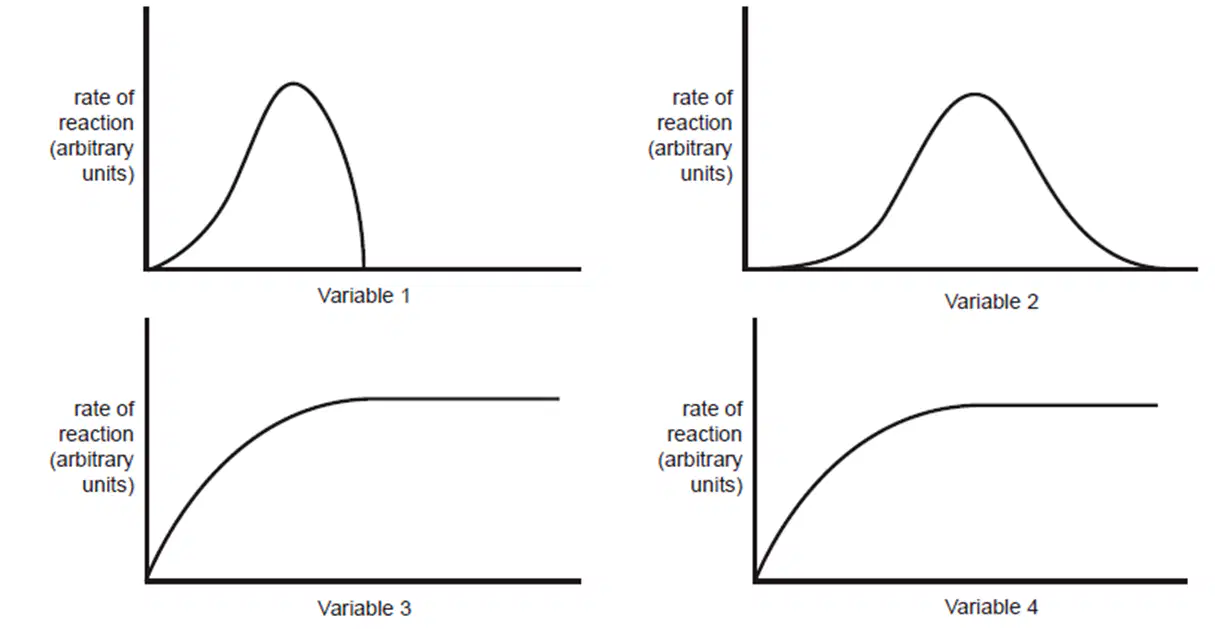
Which variable on these graphs is most likely to represent temperature?
Variable 1
Variable 2
Variable 3
Variable 4
Competitive inhibitors bind to an enzyme's (a) , blocking the substrate from attaching, whereas non-competitive inhibitors bind to an (b) , causing a change in the active site.
Reversible inhibitors bind to the enzyme with (a) bonds, meaing they can often be overcome by adding more (b) . Irreversible inhibtors bind to the enzyme with (c) bonds, meaning they can't be dislodged.
Coenzymes can be loaded or unloaded. Which of the following is an example of an unloaded coenzyme?
ADP
ATP
NADH
NADPH
Match each of the following enzymes that manipulate DNA with their function.
Cut DNA
Endonucleases
Join fragments of DNA or RNA
Ligases
Synthesise new molecules of DNA or RNA
Polymerases
The region of DNA targeted by a restriction endonuclease is known as the:
Recognition site
Active site
Allosteric site
Binding site
Label the following diagram showing the possible outcomes when endonucleases cut a DNA molecule.
If a circular DNA molecule is cut with a particular endocnuclease for which it has three recogntion sites, how many fragments of DNA will be produced?
1
2
3
4
If a linear DNA molecule is cut with a particular endocnuclease for which it has three recogntion sites, how many fragments of DNA will be produced?
1
2
3
4
When ligases join fragments of nucleic acids together, they do this by catalysing the formation of:
Hydrogen bonds
Phosphodiester bonds
Peptide bonds
A difference between ligases and endonucleases is:
Ligases are specific, endonucleases are not
Endonucleases are specific, ligases are not
The action of endonucleases is reversible, the action of ligases is not.
The action of ligases is reversible, the action of endonucleases is not.
Which of the following enzymes is used in the process of transcription?
RNA polymerase
DNA polymerase
DNA ligase
Restriction endonucleases
In which direction do polymerases synthesise a complementary strand of nucleic acid?
5' to 3'
3' to 5'
They can synthesise in either direction
The CRISPR-Cas9 system is naturally found in:
Bacteria
Humans
Plants
Viruses
What type of molecule is Cas9?
Endonuclease
Ligase
Polymerase
Amino acid
When a bacterium encounters a virus, it takes a 'mugshot' of its DNA and stores it within its own genome in a section called a:
Spacer
Repeat
Palindrome
Endonuclease
The two enzymes involved in cutting out the viral DNA so that it can be stored as a spacer are:
Cas1 and Cas2
Cas1 and Cas9
Cas2 and Cas9
CRISPR and Cas9
The short sequence that is easily recognisable by Cas9, therefore increasing its efficency, is called a:
PAM sequence
NGG sequence
CRISPR sequence
Palindromic sequence
Spacers stored in the bacterial genome are transcribed and converted into a molecule known as:
guide RNA (gRNA)
messenger RNA (mRNA)
ribosomal RNA (rRNA)
transfer RNA (tRNA)
Label the following diagram of a CRISPR-Cas9 complex.
Enzymes within the bacterium will naturally act to repair any cuts to viral DNA, so it will continue to be repaired and re-cut until what occurs?
Mutations in the viral gene occur making it non-functional
Cas9 enzme and gRNA separate
The cell runs out of energy
The viral DNA has disappeared
CRISPR-Cas9 can be harnessed by humans and used for gene editing. Put the following steps in order to outline how this process works.
Synthetic sgRNA is created in a lab that has a complementary spacer to the target DNA that scientists wish to cut, and a Cas9 enzyme is obtained with an approproate PAM sequence.
Cas9 and sgRNA are added together in a mixture and bind together to create the CRISPR-Cas9 complex, which is then injected into a specific cell.
The Cas9 finds the target PAM sequence and checks whether the sgRNA aligns with the DNA. If it does, it cuts the DNA.
The DNA has a blunt end cut that the cell will attempt to repair.
When repairing the DNA, the cell may introduce new nucleotides into the DNA at this site. Scientists may inject particular nucleotide sequences into the cell with the hope they will ligate into the gap.
Which of the following is easier to do when using CRISPR-Cas9 for gene editing?
Knock out (disrupt) a gene
Add in a new segment of DNA
The purpose of the polymerase chain reaction (PCR) is to:
Amplify DNA
Cut DNA
Compare sample of DNA
Edit DNA
Match the following descriptions with the correct materials required for PCR.
Contains the section of DNA that needs to be amplified
DNA sample
Type of DNA polymerase found in bacteria that will build new strands of DNA
Taq polymerase
Short DNA fragments used to initiate the synthesis of new DNA strands and allow Taq polymerase to attach
Primers
To be used by Taq polymerase to create a new strand of DNA
Nucleotides
Put the following steps outlining the process of PCR in the correct order.
Denaturation: DNA is heated to approximately 90-95°C to break the hydrogen bonds between the bases and separate the strands, forming single-stranded DNA.
Annealing: The single-stranded DNA is cooled to approximately 50-55°C to allow the primers to bind to complementary sequences on the single-stranded DNA.
Elongation: The DNA is heated again to 72°C, which allows Taq polymerase to work optimally. Taq polymerase binds to the primer (as a starting point) and begins synthesising a new complementary strand of DNA.
The previous steps are repeated multiple times.
Match the following pictures to the correct stage of PCR.

Denaturation

Annealing

Elongation

Repeat
Match the followings steps of PCR to the temperature at which they must occur.
Denaturation
95°C
Annealing
50-55°C
Elongation
72°C
Which end of a DNA strand will a primer attach to?
3' end
5' end
They can attach to either end
In which direction will Taq polymerase synthesis a new strand of DNA?
5' to 3' direction
3' to 5' direction
It can synthesis DNA in either direction
Gel electrophoresis is a process that is used to:
measure the size of DNA fragments
create many copies of a DNA fragment
insert a DNA fragment into a bacterial plasmid
edit human DNA
Place these steps involved in gel electrophoresis into the correct order.
DNA samples are loaded into wells at one end of the gel.
The gel is immersed in a buffer solution.
An electric current is passed through the gel using two electrodes.
DNA fragments move through the gel towards the positive electrode.
The gel is stained with a dye to allow visualisation of the DNA bands.
Label the following diagram outlining the process of gel electrophoresis.
What is the charge of a DNA molecule?
Positive
Negative
Neutral
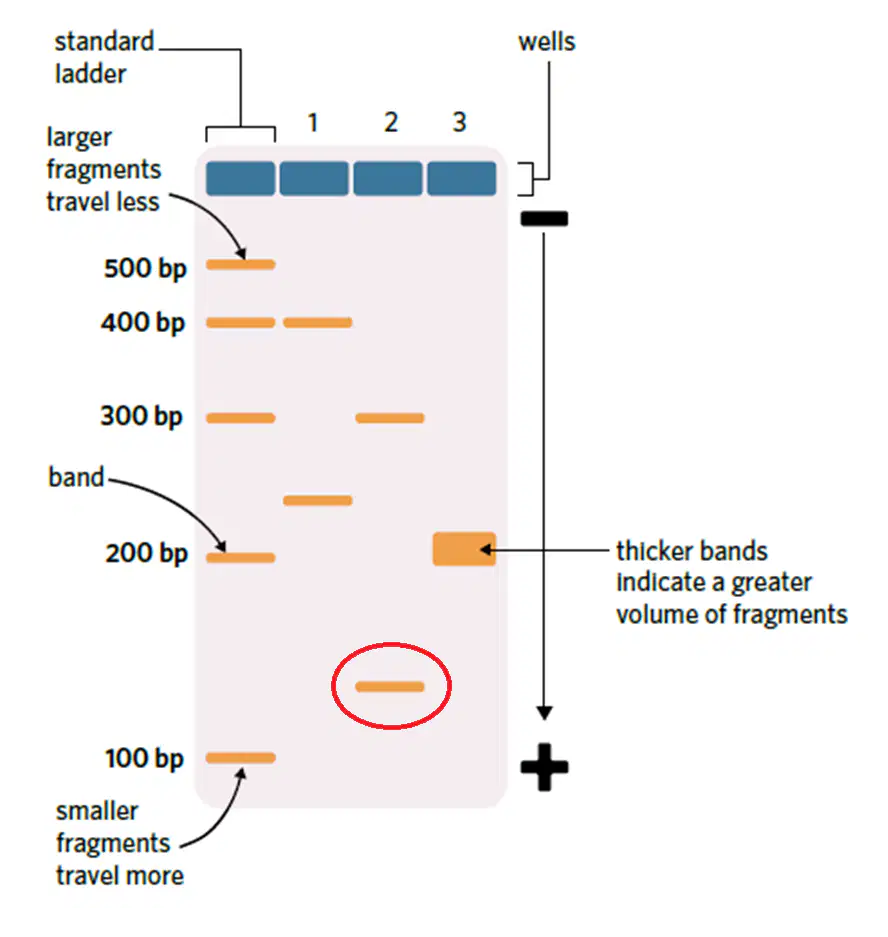
Using the standard ladder shown, what is the approximate size of the DNA fragment circled in red?
120 bp
220 bp
80 bp
300 bp
Gel electrophoresis can be used in the process of genetic testing due to different alleles often having a different:
size
base sequence
chromosome locus
If a person was homozygous for a particular gene, and you ran their DNA fragments through a gel, how many bands would you expect to see?
0
1
2
If a person was heterozygous for a particular gene, and you ran their DNA fragments through a gel, how many bands would you expect to see?
0
1
2
When using gel electrophoresis for DNA profiling, we analyse regions of DNA known as:
(a)
Match the following definitions to the correct term.
A plasmid that has had an extra gene added to it.
Recombinant plasmid
When bacteria take up a recombinant plasmid.
Bacterial transformation
A small, circular DNA molecule that can replicate independently of chromosomal DNA in bacteria.
Plasmid
An enzyme used to cut the plasmid and the gene of interest.
Endonuclease
An enzyme used to join the plasmid and the gene of interest.
DNA ligase
Place the following steps involved in transforming bacteria in the correct order.
A plasmid vector is selected into which the gene of interest will be inserted.
The gene of interest and the plasmid vector are both cut with the same endonuclease.
DNA ligase is used to join the gene of interest to the plasmid, creating a recombinant plasmid.
Recombinant plasmids are inserted into bacteria using either heat shock or electroporation.
Transformed bacteria are selected using antibiotics and/or a reporter gene, and then induced to produce the target protein.
What is the higest level of protein structure present in an inuslin molecule?
Primary
Secondary
Tertiary
Quaternary
Place the following steps involved in producing human insulin in the correct order.
Plasmid vectors which contain genes for resistance to ampicillin and tetracycline are prepared.
Two plasmid vectors (one for insulin A and one for insulin B) are cut with EcoR1 and BamH1 (disrupting the tetR gene), and insulin genes are joined using DNA ligase.
The plasmids are added to a solution of E. coli bacteria and some of the bacteria take up plasmids (recombinant and non-recombinant).
Bacteria are then cultured on an agar plate containing ampicillin, killing the bacteria that did not take up any plasmid.
Samples from suriving colonies are then cultured on an agar plate containing tetracycline, and the ones that die must have contained the recombinant plasmid.
Place the remaining steps involved in producing human insulin in the correct order.
Plasmids are then cut open again to add a lacZ gene next to the insulin gene, which produces a large protein and stops the insulin protein from being digested.
The recombinant plasmids containing lacZ are added to a new solution of bacteria and some of these plasmids are taken up.
Bacteria are then grown on an agar plate with ampicillin and X-gal. Those with the recombinant plasmid will survive and turn blue.
Transformed bacteria are placed in conditions where they will reproduce, insulin proteins are extracted, and the large protein attached to them is removed.
The two different insulin chains (A and B) are mixed together and will bond to form human insulin.
What is the name of the large protein that is produced attached to an insulin chain to stop it being digested?
β-galactosidase
X-gal
Cyanogen bromide
Methionine
Which of these processes would be it generally be necessary to perform before starting the process of bacterial transformation?
Polymerase chain reaction (PCR)
CRISPR-Cas9 gene editing
Protein synthesis
Transcription
What term describes the feature of the genetic code that means genes from one species (e.g. humans) can function in another (e.g. bacteria)?
Universal
Redundant
Degenerate
Match the following terms with their correct definition.
Any organism that has ben altered using genetic engineering technologies.
Genetically modified organism (GMO)
An organism with genes inserted from another species
Transgenic organism
An organism with genes inserted from the same species
Cisgenic organism
Label the following diagram.
A particular species of bacteria has had a gene from a species of jellyfish inserted, making it glow when placed under a UV light. This bacteria could be classified as:
A transgenic organism only
A cisgenic organism only
A transgenic organism and a genetically modified organism (GMO)
A cisgenic organism and a genetically modified organism (GMO)
Which of the following would not be a desirable characteristic in genetically modified crops?
Increased resistance to pesticides
Increased crop productivity
Decreased resistance to disease
Increased tolerance to drought
Categorise each of the following as a biological, social or ethical implication of genetically modified organisms.
Loss of genetic diversity
Reduced habitat loss due to crops
Better food security
Higher cost to farmers
Unnatural act, 'playing God'
Inhumane treatment of animals
Complete the following word equation showing the reactants and products of photosynthesis.
Which of these is not one of the possible uses of the glucose produced in photosynthesis?
Used as an amino acid when synthesising polypeptides
Used as a source of energy
Stored as starch
Used to form complex molecules such as cellulose
The main site of photosynthesis in a plant are the (a) , which are suited to this due to their (b) and the large numbers of
(c) (an organelle that contains (d) ) in their (e) cells.
Water enters a plant through (a) , and is transported through the (b) , while carbon dioxide enters through small pores in the leaf known as (c) .
Label the following diagram of a chloroplast.
The light-dependent stage of photosynthesis occurs in the (a) of the chloroplast.
Sort the following molecules into inputs and outputs of the light-dependent stage of photosynthesis.
12 water (H2O) molecules
12 NADP+
18 ADP + Pi
6 oxygen (O
2) molecules
12 NADPH
18 ATP
Label the following diagram with the missing inputs and outputs of the light-dependent reaction.
The light-independent stage occurs in the (a) of the chloroplast.
Sort the following molecules into inputs and outputs of the light-independent stage of photosynthesis.
6 water (H2O) molecules
12 NADP+
18 ADP + Pi
12 NADPH
18 ATP
6 carbon dioxide (CO2) molecules
1 glucose (C6H12O6) molecule
Label the following diagram with the missing inputs and outputs of the light-independent reaction.
Classify the following as loaded or unloaded coenzymes.
ATP
NADPH
ADP
NADP+
Fill in the missing labels on this diagram summarising the overall process of photosynthesis.
Which stage of photosynthesis is the enzyme Rubisco involved in?
Light-dependent stage
Light-independent stage
What molecule does Rubisco bind to, fixing the carbon into organic 3-PGA and initiating the calvin cycle?
CO2
Glucose
Water
Oxygen
When Rubisco binds to oxygen instead of carbon dioxide, this is known as:
Photorespiration
Photosynthesis
The Calvin cycle
Glycolysis
The combination of factors that make photorespiration most like to occur are:
Low CO2 concentration, high O2 concentration, high temperatures
Low CO2 concentration, high O2 concentration, low temperatures
High CO2 concentration, low O2 concentration, high temperatures
High CO2 concentration, low O2 concentration, low temperatures
The majority of plants on Earth, which have no adapatations to reduce photorespiration, are what type of plants?
C3
C4
CAM
To avoid photorespiration, C4 plants separate their initial CO2 fixation and remainder of the Calvin cycle over:
Space
Time
They don't separate these processes
To avoid photorespiration, CAM plants separate their initial CO2 fixation and remainder of the Calvin cycle over:
Space
Time
They don't separate these processes
Match the type of plant to its most suited environment.
C3
Moderate, or cool and wet environments
C4
Hot, sunny habitats
CAM
Very hot, dry habitats
Match the following definitions to the correct terms.
Specialised cell where Rubisco acts in C4 plants
Bundle-sheath cell
Specialised cell where initial carbon fixation (not involving Rubisco) takes place in C4 plants
Mesophyll cell
Intermediate, 4-carbon molecule used as a source of CO2 in C4 and CAM plants
Malate
Sort the types of plants in categories based on when they open their stomata.
CAM plants
C4 plants
C3 plants
Which of the following best describes the relationship between light intensity and the rate of photosynthesis?
As light intensity increases, rate of photosynthesis increases
As light intensity increases, rate of photosynthesis increases to a point, then plateaus
As light intensity increases, rate of photosynthesis decreases
There is no relationship between light intensity and the rate of photosynthesis
Which wavelengths of light result in the highest rate of photosynthesis?
Blue and red
Green and red
Green and blue
Red and yellow
Temperature and pH both affect the rate of photosynthesis due to the _______ involved.
enzymes
carbon dioxide
light energy
water
Which of the following best describes the relationship between carbon dioxide levels and the rate of photosynthesis?
As carbon dioixde levels increase, rate of photosynthesis increases
As carbon dioxide levels increase, rate of photosynthesis increases to a point, then plateaus
As carbon dioxide levels increase, rate of photosynthesis decreases
There is no relationship between carbon dioxide levels and the rate of photosynthesis
Match the following graphs to the factor(s) that affects the rate of photosynthesis.

Light intensity or carbon dioxide

Temperature

pH
Use CRISPR to modify plants in order to allow them to be grown in hot, dry areas would involve trying to minimise:
photorespiration
photosynthesis
the Calvin cycle
cellular respiration
CRISPR-Cas9 technology is useful for improving crops as it is:
precise and affordable
imprecise and affordable
imprecise and expensive
precise and expensive
Place the steps involved in using CRISPR-Cas9 to improve crops in the correct order.
Understanding the entire photosynthetic process of the crop (including the photorespiration pathway).
Utilising high-level computers to model the photosynthetic pathway and identify inefficiencies.
Using CRISPR-Cas9 technologies to target and edit the genes responsible for the identified inefficiencies.
Match the examples of improvements to crops with their broader category.
Modify Rubisco's activity
Calvin cycle
Longer shelf life
Production enhancement
Increase chloroplast efficiency
Plant organelles
Herbicide resistance
Chemical resistance
Immunity against viruses
Disease resistance
Which of these would not be a desired outcome of genetically modifying a crop?
Reduced insect resistance
Reduced disease susceptibility
Increased photosynthetic efficiency
Increased agricultural yield
Cellular respiration primarily involves the breakdown of:
glucose
ATP
carbon dioxide
oxygen
Label the following diagram to summarise the overall chemical equation for aerobic cellular respiration.
Place the following stages of aerobic cellular respiration in the correct order.
Glycolysis
The Krebs cycle
The electron transport chain
Label the following diagram of a mitochondrion.
Match each stage of aerobic respiration to the location in which it occurs.
Cytosol
Glycolysis
Mitochondrial matrix
The Krebs cycle
Cristae of the mitochondria
The electron transport chain
Classify the following molecules as inputs or outputs of glycolysis.
1 glucose (C6H12O6)
2 ADP + 2Pi
2 NAD+ + 2 H+
2 pyruvate
2 ATP
2 NADH
Between glycolysis and the Krebs cycle, a reaction called (a) converts (b) to (c) . (d) is also produced.
Classify the following molecules as inputs or outputs of the Krebs cycle.
2 ADP + 2Pi
6 NAD+ + 6 H+
2 ATP
6 NADH
2 acetyl-CoA
2 FAD + 4 H+
4 carbon dioxide
2 FADH2
The main purpose of glycolysis and the Krebs cycle is to produce what for use in the electron transport chain?
Loaded high-energy electron and proton carriers
ATP
Carbon dioxide
Pyruvate
Classify the following molecules as inputs or outputs of the electron transport chain.
26 or 28 ADP + 26 or 28 Pi
10 NAD+ + 10 H+
26 or 28 ATP
10 NADH
2 FAD + 4 H+
2 FADH2
6 oxygen (O2) + 12 H+
6 H2O
The overall output of ATP from one glucose molcule undergoing cellular respiration is:
30 or 32
26 or 28
30 - 32
30
Classify each of the following as loaded or unloaded coenzymes.
ATP
NADH
FADH2
ADP
NAD+
FAD
The term 'anaerobic' refers to a lack of (a) .
Which of these stages that make up the aerobic respiration pathway can still occur without the presence of oxygen?
Glycolysis
Kreb's cycle
Electron transport chain
None of them can occur
The anaerobic fermentation pathway allows cells to produce some (a) in the absence of oxygen by recycling (b) to produce a steady supply of (c) . This allows glycolysis to continue.
Label this diagram showing the anaerobic fermentation pathway in animals.
Add the missing labels to the diagram showing the aerboic fermentation pathway in yeast.
Temperature and pH both affect the rate of cellular respiration due to the ______ involved.
enzymes
oxygen
carbon dioxide
water
Which of the following best describes the relationship between glucose concentration and the rate of respiration?
As glucose concentration increases, rate of respiration increases
As glucose concentration increases, rate of respiration increases to a point, then plateaus
As glucose concentration increases, rate of respiraiton decreases
There is no relationship between glucose concentration and rate of respiration
Which of the following best describes the relationship between oxygen concentration and the rate of respiration?
As oxygen concentration increases, rate of respiration increases
As oxygen concentration increases, rate of respiration increases to a point, then plateaus
As oxygen concentration increases, rate of respiraiton decreases
There is no relationship between oxygen concentration and rate of respiration
Match the following graph shapes to the factor(s) that affect the rate of respiration.
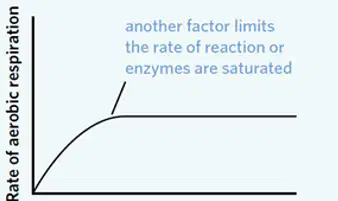
Glucose or oxygen concentration
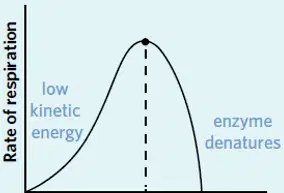
Temperature
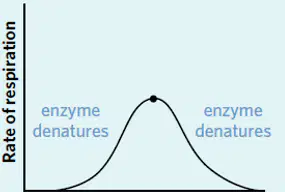
pH
Biofuels are fuels that can be made from organic material such as plant and animal waste called (a) .
Classify the following as characteristics of fossil fuels or biofuels.
Non-renewable
Sourced from fosslised organic matter
High carbon emissions
Renewable
Sourced from crops, waste and animal by-products
Carbon neutral
Biofuels are generally made by the process of (a) , which breaks down the starches and sugars in plants and converts that (b) into (c) and carbon dioxide.
Place the following steps involved in producing bioethanol into the correct order.
Deconstruction
Digestion by enzymes
Ethanol fermentation
Purification and dehydration
Match the following steps involved in producing bioethanol to the correct description.
Biomass is broken down to increase its surface area
Deconstruction
Biomass is further broken down to convert large sugars to glucose
Digestion by enzymes
Yeast is use to facilitate fermentation of the glucose, producing ethanol
Ethanol fermentaiotn
Ethanol is distilled via the removal of water
Purification and dehydration
Biodiesel is produced by the formation of (a) combined with short-chain alcohols (e.g. (b) ).
Classify the following as strengths or weakness of biofuels.
Reduce carbon emissions
Provide ongoing energy security
Allow energy to be produced locally
Could decrease amount of crops available for food
More expensive to produce than traditional fuels
Second-order environmental impacts
Using edible food crops creates (a) biofuels, whereas using non-food crops such as wood waste and other by-products creates (b) biofuels.
Classify the following as characteristics of first-generation or second-generation biofuels.
Competition with food crops
No competition with food crops
Easy to convert biomass to biofuel
Harder to convert biomass to bioefuel

