
 Worksheets
BIO S1 Final Review
Total questions: 175
Worksheet time: 4hrs 54mins
What is the substance that covers most of the Earth's surface and makes up the largest percent of cells?
carbon
water
hydrogen
nitrogen
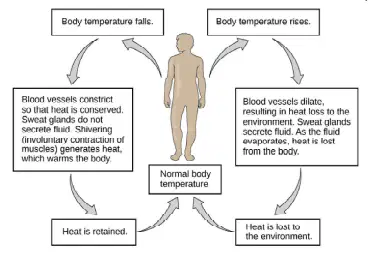
According to the diagram above, the regulation of body temperature is an example of which type of feedback loop?
Hormone Regulation
Negative Feedback Loop
Positive Feedback Loop
Osmoregulation
Which of these is a biotic factor?
frog
water
land masses
air
Students in Ms. Choi's class are using models to represent aspects of bacterial cells. Choose the correct type of model for the example below:
Charlotte made a flow chart to illustrate the process of ATP production in bacteria
simulation
conceptual model
physical model
Students in Ms. Choi's class are using models to represent aspects of bacterial cells. Choose the correct type of model for the example below:
Stella ran a computer program to predict the effects of a change in the shape of a bacterium.
simulation
conceptual model
physical model
Students in Ms. Choi's class are using models to represent aspects of bacterial cells. Choose the correct type of model for the example below:
Karen created a three-dimensional model of a bacteria cell showing its major structural features.
simulation
conceptual model
physical model
Which of these is the basic unit of life?
atom
cell
DNA
species
Choose the option that best shows the levels of organization of life from SMALLEST to LARGEST
Biosphere, Yellowstone National Park, Wolf pack, Amoeba
Yellowstone National Park, Wolf pack, Amoeba, Biosphere
Amoeba, Wolf pack, Biosphere, Yellowstone National Park
Amoeba, Wolf pack, Yellowstone National Park, Biosphere
Which of these is not a characteristic of living things?
They require an energy source.
They breathe.
The maintain stable internal conditions.
They respond to changes in the environment.
Which of these describes an individual living thing?
atom
cell
species
organism
What is Flathead Lake a part of?
hydrosphere
atmosphere
geosphere
biosphere
Paul is examining soil to determine its components. Which of the following is a component of the:
Atmosphere
Worm
Minerals
Moisture
Air Pockets
Paul is examining soil to determine its components. Which of the following is a component of the:
Hydrosphere
Worm
Minerals
Moisture
Air Pockets
Paul is examining soil to determine its components. Which of the following is a component of the:
Biosphere
Worm
Minerals
Moisture
Air Pockets
Paul is examining soil to determine its components. Which of the following is a component of the:
Geosphere
Worm
Minerals
Moisture
Air Pockets
Which of these describes the biosphere?
a group of living things that can interbreed to reproduce
all living things and the places on Earth where they are found
the variety of organisms on Earth or in a particular area of the biosphere
organisms interacting with each other and with nonliving things in a certain region
Which of these describes the levels of organization of an animal?
Tissues are composed of organs, which are composed of cells.
Organs are composed of cells, which are composed of tissues.
Organs are composed of tissues, which are composed of cells.
Tissues are composed of cells, which are composed of organs.
What organelle is responsible for housing DNA and controlling the cell?
chloroplast
mitochindria
vesicle
nucleus
Most starfish turn their cardiac stomach to digest food. Which term applies to the cardiac stomach?
cell
tissue
organ
organ system
What are the main differences between plant and animal cells?
Plant cells are eukaryotes; animal cells are not.
Plant cells have cell walls, and chloroplast; animal cells do not.
Animal cells are eukaryotes; plant cells are not.
Animal cells have cell walls and chloroplast; plant cells do not.
Blood clotting and ovulation, which cause the body to increase the rate of change away from homeostasis are examples of
cell differentiation
negative feedback loops
cell division
positive feedback loop
Which of the items below is an abiotic factor?
algae
sand
paramecium (a single-celled freshwater animal)
redwood tree
What do chloroplast and mitochondria have in common?
They are only found in bacteria.
They are both involved in energy transfer and have their own DNA & ribosomes.
Plants only have chloroplast, not mitochondria.
They have nothing in common.
Which of these is the maintenance of constant internal conditions in an organism?
adaptation
homeostasis
negative feedback
structure specialization
How does organization make it possible for the human body to carry out the wide range of interactions necessary for survival?
Cells are the foundation of the human body and each cell can carry out all interactions necessary for survival
Tissues are the highest level of organization in the human body and tissues are capable of carrying out specialized tasks necessary for survival.
Levels of organization make it possible for cells, tissues, organs, and organ systems to specialize and take on specific functions
There is no overlap in the organization and interaction of organ systems, making it possible for the body to fulfill a wide range of life functions
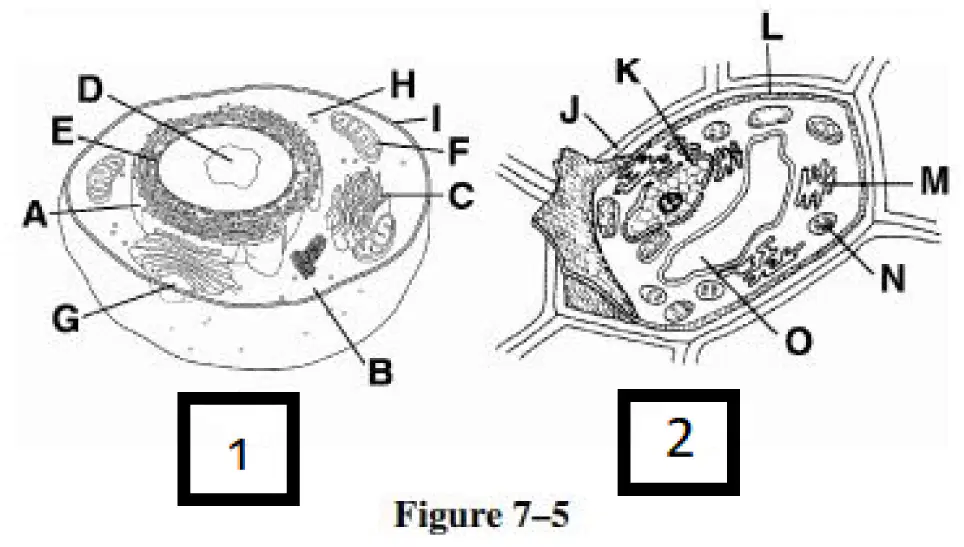
Which of the following is true? (Refer to Figure 7-5)
Cell 1 is prokaryotic
Cell 2 is an animal cell
Cell 1 is a plant cell
Cell 1 & 2 are both eukaryotic
An organ system is a group of organs that
are made up of similar cells
are made up of similar tissue
work together to perform a specific function
work together to perform all the functions in a multicellular organism
Which of the following organisms are prokaryotes?
plants
animals
bacteria
all of the above
Which of these best describes the function of the cell membrane?
controls the cell and houses DNA
produces energy for the cell
controls what goes in and out of the cell
development and growth of the cell
Which of these includes sugars and starches?
proteins
carbohydrates
phospholipids
unsaturated fatty acids
Which of these is true for the electrons of an atom?
have a positive charge
found in the nucleus along with the protons
found in the space surrounding the nucleus
are attached to the positive charge of neutrons
Which best describes the pH of stomach acid?
pH below 7
pH above 7
pH of 7
pH of 10
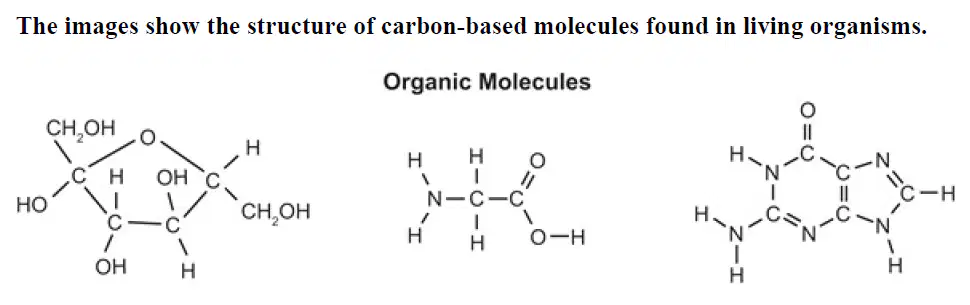
Based on evidence from the images, which statement about the bonding of carbon atoms is true?
Carbon has the ability to form up to four bonds.
Carbon atoms form ring structures each time they bond
Carbon containing compounds must contain double bonds
Carbon has the ability to bond with no more than one other carbon atom
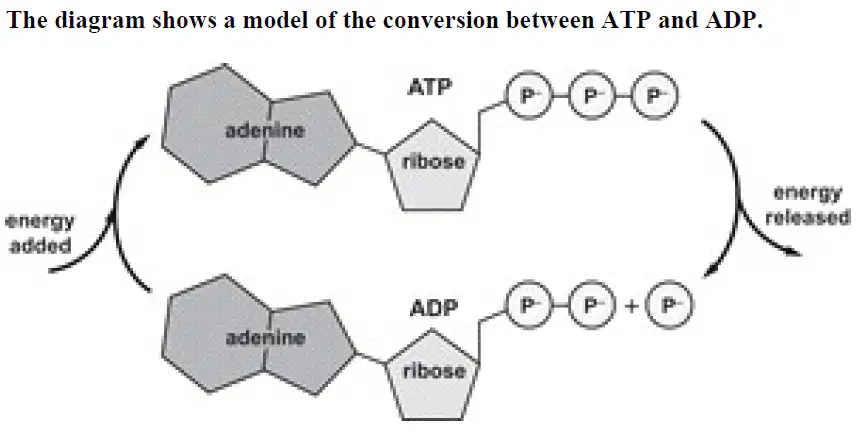
Which statement is supported by the model?
ATP and ADP do not contain energy
ATP contains more energy than ADP
ADP contains more energy than ATP
ATP and ADP contain the same amount of energy
Which element are all organic molecules composing living things based on?
carbon
oxygen
hydrogen
nitrogen
Which of these describes osmosis?
release of substance out of a cell by the fusion of a vesicle
moving substance through a membrane and using energy
water moving from low to high concentration
movement of water through a membrane from high to low concentration
What does an atom share when it bonds with another atom?
ions
protons
neutrons
electrons
Adenosine triphosphate (ATP) stores energy in the bonds between its ___________.
phosphates
carbon atoms
hydrogen atoms
nucleotides
What is the main function of phospholipid bilayer in a cell?
speed up reaction by lowering the activation energy
increasing the temperature range
changing the direction of a reaction
breaking down molecules into starch

Which of these explains how a large increase in temperature would most likely affect the function of the enzyme.
the enzyme's effectiveness would increase, because it would have more energy to catalyze the reaction
the enzyme's effectiveness would increase, because it would interact with more of the reactants
the enzyme's effectiveness would decrease, because it would change shape and be less able to catalyze the reaction
the enzyme's effectiveness would decrease, because it would no longer be able to provide the energy needed to bond the monomers
Life on Earth is ultimately powered by the sun. Solar energy is converted through a series of steps to power cellular functions in living organisms.
Name the molecule that stores energy in cells, and identify a cellular process that the molecule would provide energy for.
ATP, active transport
ATP, diffusion
ADP, passive transport
ADP, osmosis
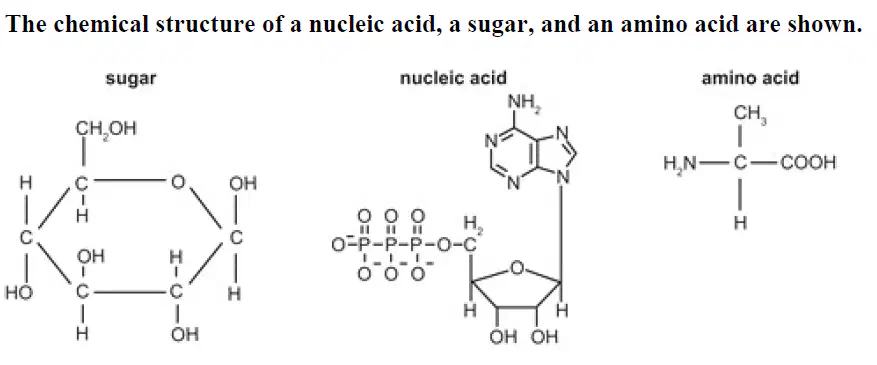
Explain why nucleic acids cannot be formed from sugars alone.
sugars are ONLY ring structures
sugar is only made up of carbon, hydrogen, and oxygen and does not contain phosphorous and nitrogen
they need amino acids in order to form
sugars are ONLY straight chain structures
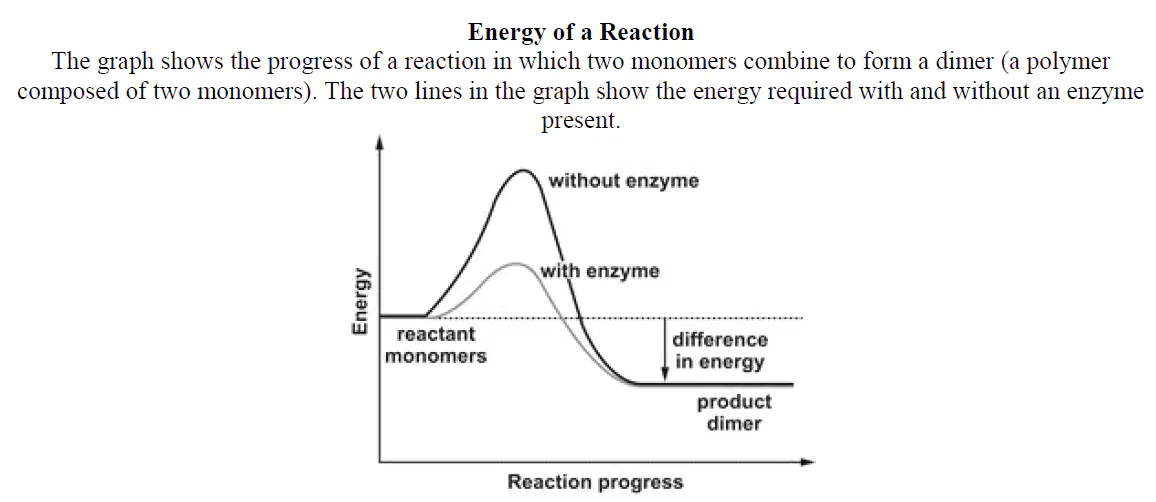
Using the information in the graph, chose the correct statement below.
more energy would be released than absorbed in the reaction
the enzyme raised the activation energy required for the reaction
the products in this reaction have more energy than the reactants
energy is absorbed in this reaction
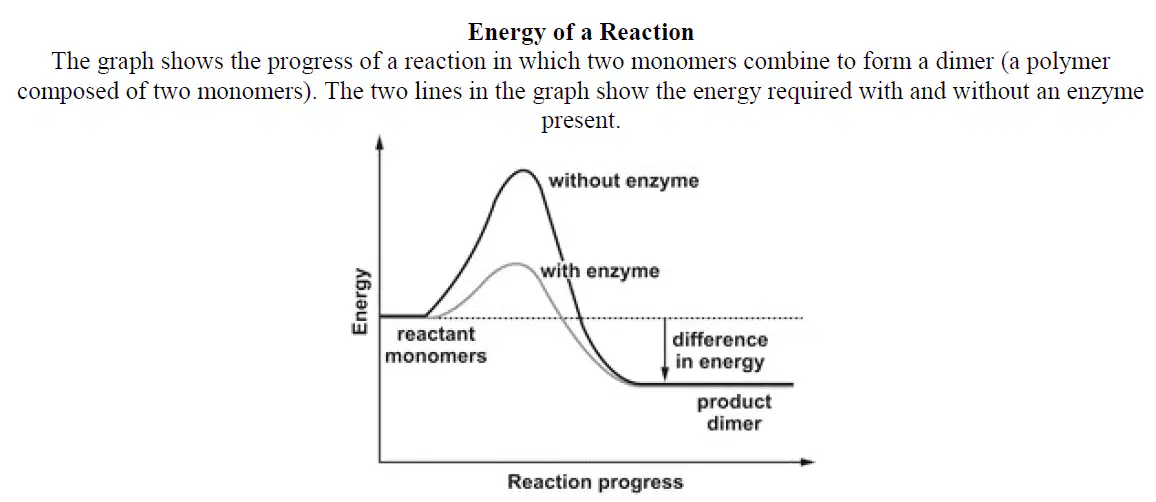
Using the graph pictured above, which statement is accurate when comparing the reactants with the products? Choose the letter of the correct answer.
the reactants have more mass than the products
the reactants form more quickly than the products
the bonds of the reactants contain more energy than the bonds of the products
the bonds of the reactants contain the same amount of energy as the bonds of the products
What is the smallest unit of matter?
atom
cell
molecule
compound
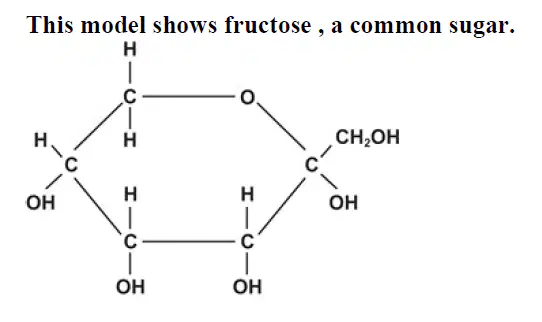
Decide whether each of the listed element would be expected to be found in fructose:
Phosphorous
In fructose
Not in fructose
Decide whether each of the listed element would be expected to be found in fructose:
Nitrogen
In fructose
Not in fructose
Decide whether each of the listed element would be expected to be found in fructose:
Oxygen
In fructose
Not in fructose
Decide whether each of the listed element would be expected to be found in fructose:
Hydrogen
In fructose
Not in fructose
Decide whether each of the listed element would be expected to be found in fructose:
Carbon
In fructose
Not in fructose
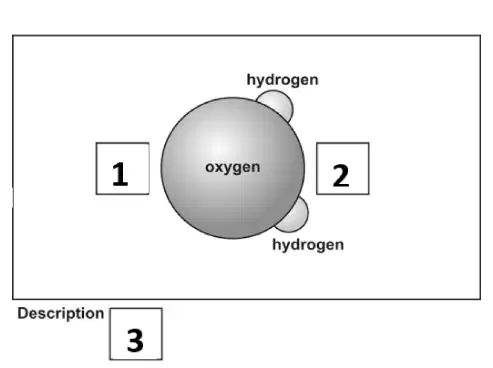
Which of the following accurately describes Box 1?
Positive
Negative
polar molecules that dissolves nonpolar molecules
nonpolar molecule that dissolves other nonpolar molecules.
nonpolar molecules that dissolves polar molecule
Which of the following accurately describes Box 2?
Positive
Negative
polar molecules that dissolves nonpolar molecules
nonpolar molecule that dissolves other nonpolar molecules.
nonpolar molecules that dissolves polar molecule
Which of the following accurately describes Box 3?
Positive
Negative
polar molecule that dissolves other polar molecules
nonpolar molecule that dissolves other nonpolar molecules.
nonpolar molecules that dissolves polar molecule
For the description below, choose the correct macromolecule:
Commonly called fats and oils
Carbohydrates
Nucleic Acids
Proteins
Lipids
For the description below, choose the correct macromolecule:
Made up of amino acids
Carbohydrates
Nucleic Acids
Proteins
Lipids
For the description below, choose the correct macromolecule:
Contain Carbon, Hydrogen, and Nitrogen
Carbohydrates
Nucleic Acids
Proteins
Lipids
For the description below, choose the correct macromolecule:
Most consist of 3 fatty acids bonded to a glycerol
Carbohydrates
Nucleic Acids
Proteins
Lipids
For the description below, choose the correct macromolecule:
Contain carbon, hydrogen, and oxygen in a 1:2:1 ratio
Carbohydrates
Nucleic Acids
Proteins
Lipids
For the description below, choose the correct macromolecule:
Used for long term energy storage
Carbohydrates
Nucleic Acids
Proteins
Lipids
For the description below, choose the correct macromolecule:
Lactose and cellulose are examples
Carbohydrates
Nucleic Acids
Proteins
Lipids
For the description below, choose the correct macromolecule:
DNA and RNA are examples
Carbohydrates
Nucleic Acids
Proteins
Lipids
For the description below, choose the correct macromolecule:
Form skin, blood, hair, and muscles
Carbohydrates
Nucleic Acids
Proteins
Lipids
A cell that requires a lot of energy might contain large numbers of __________.
vacuoles
lysosomes
mitochondrion
chromosomes
A student is making a model of the inputs and outputs of cell respiration. Choose one letter for each blank to correctly complete the passage about changes in matter and energy during the process of cellular respiration.
Step 1:
The inputs of cellular respiration are glucose and _____________, and bonds in these molecules are broken
ATP
oxygen
carbon dioxide
A student is making a model of the inputs and outputs of cell respiration. Choose one letter for each blank to correctly complete the passage about changes in matter and energy during the process of cellular respiration.
Step 2:
The outputs of cellular respiration are _________ and water, and new bonds are formed in these molecules.
glucose
oxygen
carbon dioxide
A student is making a model of the inputs and outputs of cell respiration. Choose one letter for each blank to correctly complete the passage about changes in matter and energy during the process of cellular respiration.
Step 3:
The energy stored in one molecule of glucose leads to many molecules of __________.
ATP
oxygen
carbon dioxide
Which phrase about fermentation is correct?
It is an aerobic process
It only happens in bacteria
It happens without oxygen
It uses the electron transport chain
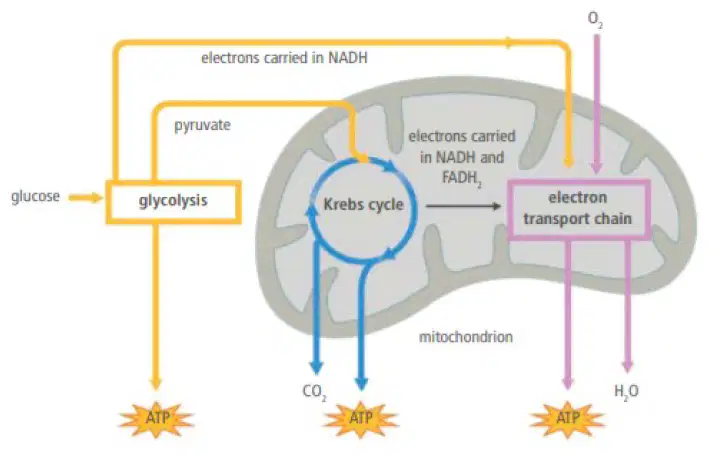
Which of the following is an input of glycolysis?
energy
oxygen
glucose
Which of the following is an output of the Krebs Cycle?
NADH & FADH2
ATP
CO2
all of the above
The part of cellular respiration that needs oxygen takes place inside the ______________________
nucleus
thylakoid
mitochondria
cytoplasm
Which process would bacteria living near a heat vent on the ocean floor use to build carbon-based molecules, such as sugars?
fermentation
chemosynthesis
cellular respiration
light-independent reactions
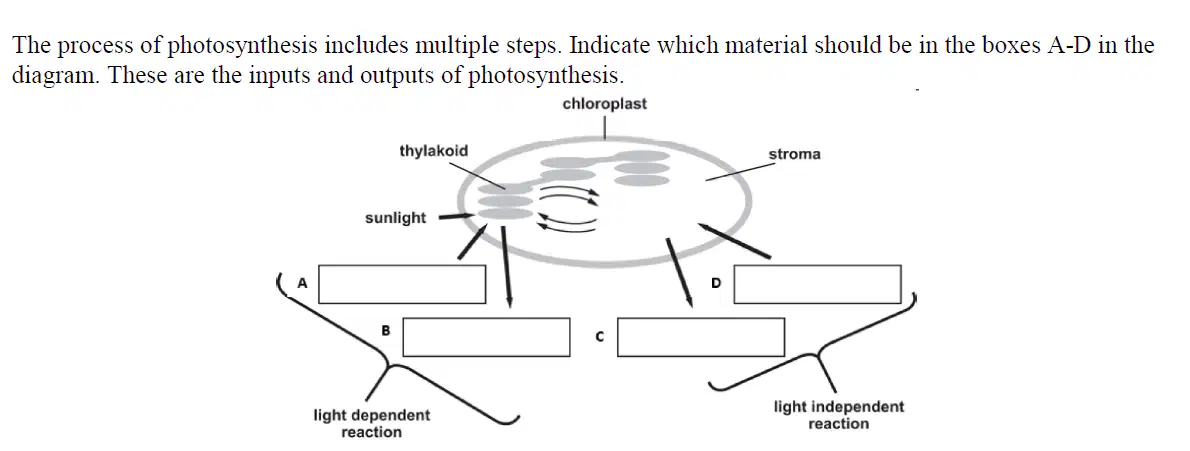
The process of photosynthesis includes multiple steps, as shown in the diagram. Indicate which of the boxes of the diagram the following material should be in:
Sugar
Box A
Box B
Box C
Box D
The process of photosynthesis includes multiple steps, as shown in the diagram. Indicate which of the boxes of the diagram the following material should be in:
Oxygen
Box A
Box B
Box C
Box D
The process of photosynthesis includes multiple steps, as shown in the diagram. Indicate which of the boxes of the diagram the following material should be in:
Carbon Dioxide
Box A
Box B
Box C
Box D
The process of photosynthesis includes multiple steps, as shown in the diagram. Indicate which of the boxes of the diagram the following material should be in:
Water
Box A
Box B
Box C
Box D
The reactants of photosynthesis are the ____________________
products of cellular respiration
reactants of cellular respiration
products of glycolysis
reactants of fermentation
Photosynthesis uses sunlight to convert water and carbon dioxide into
oxygen
high-energy sugars and starches
ATP and oxygen
oxygen and high-energy sugars and starches
Which of these is what the law of conservation of energy says cannot be done with energy?
changed from one form to another
taken from the surroundings in a reaction
released into the surroundings in a reaction
created or destroyed
The energy for most life originates from ________________
oxygen
carbon dioxide
water
sunlight
Each level in a food chain contains less energy than the one below it because some of the energy is _______________
lost as heat
added to the system
consumed by carnivores
incorporated into biomass
Food webs are models that show
stored energy in food chains
one sequence of producers and consumers
only primary consumers in an ecosystem
networks of feeding relationships
Which does a pyramid of numbers dispay?
a chain of feeding relationships
a network of feeding relationships
the amount of biomass in an ecosystem
the number of organisms in an ecosystem
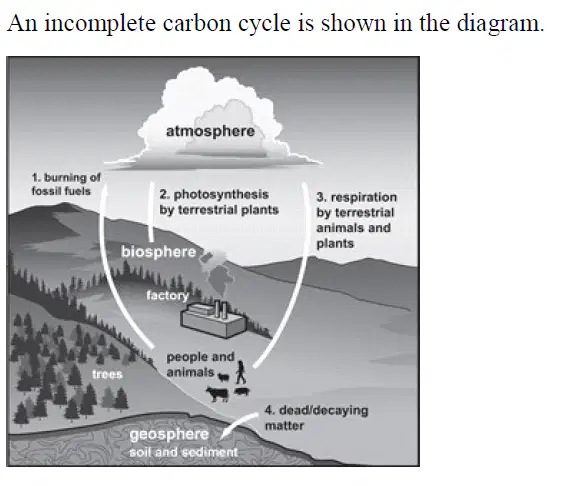
Two arrows do not show direction. How should the arrows be changed to complete the diagram?
Arrow 2 and 3 should both point up
Arrow 2 should point down, and arrow 3 should point up
Arrow 2 should point up and arrow 3 should point down
Arrow 2 and 3 should both point down
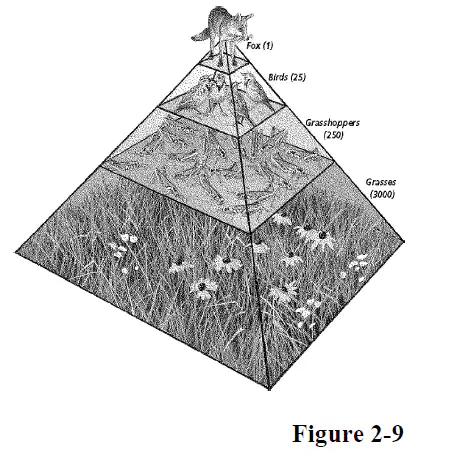
Which organism shown in the pyramid receives the highest percentage of energy from the sun?
fox
birds
grasshoppers
grass
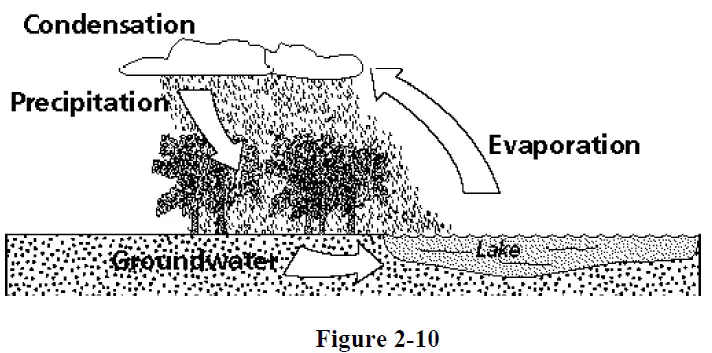
What type of cycle is depicted in the diagram?
carbon
water
phosphorus
nitrogen
Consumer are organisms that
produce food from inorganic molecules or sunlight
can survive without energy
must eat other organisms to get energy
none of the above
Energy flows from the sun through the living world when
plants capture sunlight and produce carbohydrates
animals eat plants
animals eat other animals that have eaten plants
all of the above
Which provides most of the energy in ecosystems?
carnivores
producers
generalists
keystone species
Leopard seals eat only meat. What are leopard seals?
carnivores
herbivores
omnivores
producers
Which organisms on the roots of bean and pea plants help convert nitrogen into ammonia in the nitrogen cycle?
trees
grasses
squirrels
bacteria
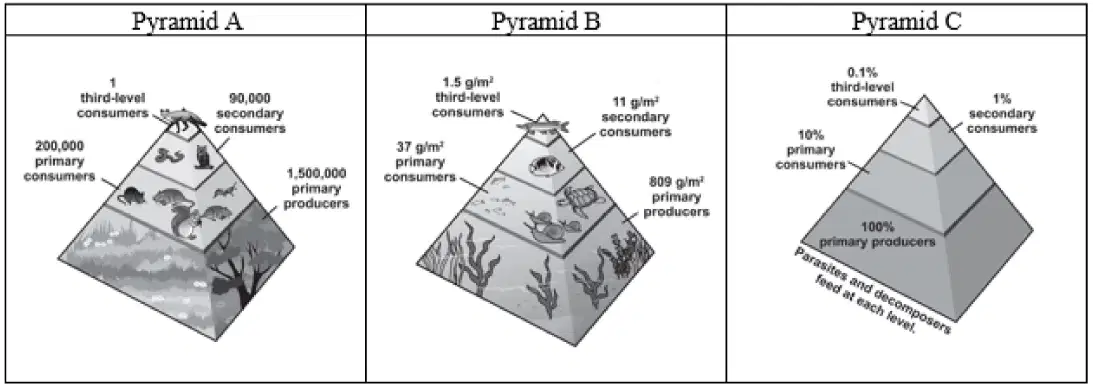
There are three major types of ecological pyramid models used for illustrating matter and energy transfer among organisms in an ecosystem. Indicate which pyramid correctly fits the description given.
shows how many organisms are present at each trophic level
Pyramid A
Pyramid B
Pyramid C
There are three major types of ecological pyramid models used for illustrating matter and energy transfer among organisms in an ecosystem. Indicate which pyramid correctly fits the description given.
Compares the biomass at different trophic levels
Pyramid A
Pyramid B
Pyramid C
There are three major types of ecological pyramid models used for illustrating matter and energy transfer among organisms in an ecosystem. Indicate which pyramid correctly fits the description given.
Models energy transfer among trophic levels
Pyramid A
Pyramid B
Pyramid C

Referring to the diagram, as matter and energy move from grasses to coyotes, the amount of available energy _____________________.
increases
decreases
decreases then increases
increases or decreases but population size remains the same
Many producers obtain the energy they need for metabolism through
fermentation
photosynthesis
cellular respiration
eating food
Which of the following activities would remove carbon from the atmosphere?
a factory burning fossil fuels
a plant undergoing photosynthesis
a caterpillar undergoing respiration
a forest fire

What is the first step in the scientific method?
Ask a question
Hypothesis
Conclusion
Analyze data

A student wants to perform a science experiment about plants. He wants to know if a certain type of soil will make plants grow taller. Each pot will receive a different type of soil, but will get the same type of seed, water amount, and sunlight amount.What is the Independent Variable in this story?
Amount of sunlight
How tall the plant will grow
Amount of water
Type of material the plant is growing in

What do you measure for results (outcome)?
Dependent variable
Hypothesis
Experimental Group
Constants

Why is it important to have constants in an experiment?
To make sure the experiment is fair
Constants are not needed for experiments.
To measure the dependent variables all at once
To test many variables at a time

Which of the following is not an example of quantitative data?
Temperature
Speed
Height
Texture

Why do many experiments include several trials instead of a single trial?
Repetition of trials increases the accuracy of the results
Repetition of trials decreases the sample size of the experiment.
Repetition of trials makes data easier to analyze.
It is not necessary to repeat trials

1. Aside from repeating a scientific experiment, what else must a scientist do to increase the accuracy of the results?
Change the hypothesis
Share data with other scientists for them to repeat or replicate
Analyze the data faster
Keep the data for themselves

Quantitative data can be
seen
measured
manipulated
heard

How is a hypothesis different from a theory?
A theory has evidence to back it up and a hypothesis is an educated guess as to what is going to happen.
They are both the same. They both are guesses as to what happens in the natural world.
A theory is an opinion about how something works but a hypothesis has scientific evidence to support it.
A hypothesis is used in science and a theory is used in society.

Qualitative data uses
a thermometer
your different senses
a test tube
a ruler


Living things are based on a universal genetic
code. What molecule is responsible for that code?
RNA
Lipid
Protein
DNA
The combination of chemical reactions through
which an organism builds up or breaks down
materials as it carries out its life processes is called ...
absorption
metabolism
digestion
consumption
Maintaining a stable internal
environment is called
homeostasis
equilibrium
balance
evenness
Identify the characteristic: when you step out into the cold, your body shivers in order to keep its temperature at 98.6oF.
All living things use energy
All living things contain cells
All living things maintain homeostasis
All living things grow and develop

Which of the following is a response?
a flashlight shined into the eye
a rubber band popping your hand
your pupils constricting when exposed to bright light
blood glucose levels drop significantly

A group of cells that have similar functions? Examples are nervous, epithelial, muscle and connective
cell
tissue
Organ
Organ system

A group of tissues that perform a similar function is called_____. (Examples include the heart, lungs or stomach)
cells
tissues
organs
organ systems
Made up of organelles. Known as the building blocks of life.
organ
organ system
cell
tissue

What is the smallest unit of an element that has the properties of that element
atom
compound
homogeneous mixture
heterogeneous mixture
A ecosystem is composed of both biotic (living) and abiotic (non-living) factors.
True
False

A community is ___________ types of species living together.
Same
Alternating
All
Different
A population is all the ____________ species.
Same
Different
Other
Alternating
Rocks are not living because
they never move
they do not excrete
they are not made of cells
All of the above

Enzymes function by -
lowering activation energy
lock & key model
essential component of metabolism
can be reused/recycled
all of the above
Which sugars are best providing consistent energy over time?
monosaccharides
disaccharides
polysaccharides
The pH of most of your body fluids would be -
6.5-7.5
3-4
9-11
12-14
4. Which biomolecules transport oxygen and other substances and also form part of most organelles?
Lipids
Carbohydrates
Proteins
Nucleic Acids
2. Which biomolecules contains your genetic information?
Proteins
Lipids
Carbohydrates
Nucleic Acids
6. The monomer of carbohydrates is known as _______.
Amino Acid
Fatty Acid
Nucleotide
Saccharide
Just under an orca's skin lies a thick layer of blubber. Blubber helps insulate a whale from heat loss. Based on this information, which biomolecule is blubber primarily made of?
Lipids
Nucleic Acids
Proteins
Carbohydrates
7. Glycerol and fatty acids are the monomers of _________.
Lipids
Carbohydrates
Proteins
Nucleic Acids
8. The monomer of Nucleic Acids is known as _________.
Amino Acid
Fatty Acid
Nucleotide
Saccharide
11. People with albinism do not produce the melanin protein. Melanin allows for people to be protected from the sun and thus people with albinism are prone to severe sunburns. Which biomolecule would you infer is responsible for albinism?
Carbohydrate
Protein
Lipid
Nucleic Acid
1. The four most common elements found in biomolecules are __________.
Sulfur, Phosphorus, Carbon, Oxygen
Carbon, Oxygen, Nitrogen, Hydrogen
Sulfur, Nitrogen, Carbon, Iron
Carbon, Nitrogen, Hydrogen, Sulfur

When we say a process requires oxygen, we call it what?
Anaerobic
Aerobic
Oxyphillic
Oxygenphilia
When we say a process that does not require oxygen, we call it what?
Anaerobic
Aerobic
Oxyphillic
Oxygenphilia
True or False: We call the first phase of cellular respiration glycolysis.
True
False
True or False: This is the cellular respiration equation:
C6H12O6 + O2 ------> CO2 + H2O
True
False
True or False: Only heterotrophs need to perform cellular respiration.
True
False
During which phase of cellular respiration is the most ATP harvested?
Glycolysis
Krebs Cycle
Electron Transport Chain
Citric Acid Cycle



