wayground logo

Free Printable Worksheets

Font size

S
M
L
XL
Worksheets

Biology Genetics Unit Test Review

Total questions: 179

Worksheet time: 4hrs 51mins

Name
Class
Date
1.
Which sequence of complementary DNA bases would pair with this partial strand
ATG TGA CAG?
a)
ATG TGA CAG
b)
TAC ACT GTC
c)
GTA AGT GAC
d)
CAT TCA CTG
2.
Which of the following best describes a DNA molecule?
a)
double helix
b)
contains ribose
c)
made of amino acids
d)
contains uracil
3.
Which of the following monomers are repeatedly joined together to form a strand of DNA?
a)
amino acids
b)
nucleotides
c)
fatty acids
d)
polysaccharides
4.
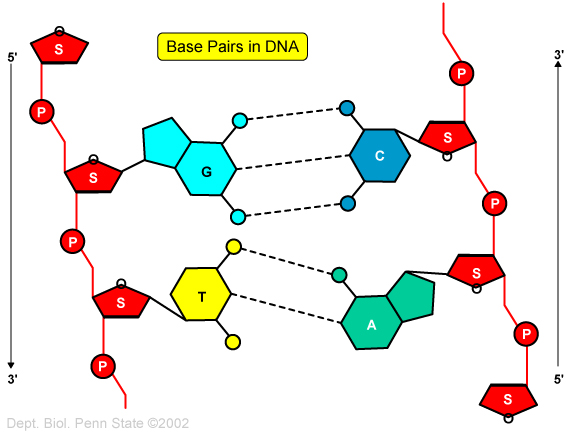
In a molecule of double-stranded DNA, the amount of adenine present is always equal to the amount of _________.
a)
cytosine
b)
guanine
c)
thymine
d)
uracil
5.
What determines the code, or information, of a DNA molecule?
a)
the shape (structure) of the nitrogen bases
b)
the order (sequence) of the nitrogen bases
c)
the color of the nitrogen bases
d)
the frequency (number) of nitrogen bases
6.
Which 2 molecules form the sides (backbone) of the DNA ladder?
a)
deoxyribose sugar and adenine
b)
deoxyribose sugar and a hydrogen bond
c)
deoxyribose sugar and the nucleus
d)
deoxyribose sugar and phosphate
7.
The two strands of nitrogenous bases in DNA are joined by which type of bond?
a)
polar bonds
b)
ionic bonds
c)
covalent bonds
d)
hydrogen bonds
8.

A process in which DNA has the unique ability to make an exact copy of itself.

a)

Replication

b)

Translation

c)

Transcription

d)

Protein Synthesis

9.
The drawing shows the structure of what molecule?
a)
A DNA molecule
b)
A lipid molecule
c)
A carbohydrate molecule
d)
A protein molecule
10.
What are the three components of a nucleotide?
a)
sugar, hydrogen, nitrogen base
b)
sugar, oxygen, nitrogen base
c)
sugar, phosphate, nitrogen base
d)
sugar, phosphate, protein
11.
Who was given credit for determining the shape of DNA? 
a)
Avery
b)
Watson and Darwin
c)
Watson and Crick
d)
Franklin and Crick
12.
Identify #2.
a)
nitrogen base
b)
phosphate group
c)
deoxyribose sugar
d)
nucleotide
13.
What process is shown in the diagram?
a)
replication
b)
transcription
c)
mitosis
d)
translation
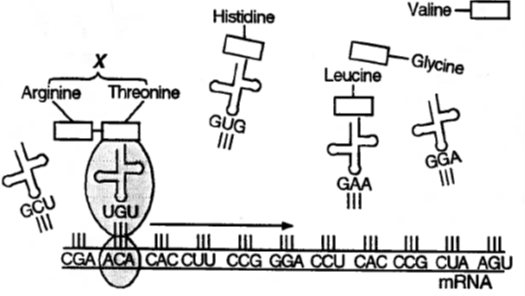
14.
X outlines a(n) ___________.
a)
amino acid
b)
nitrogen base 
c)
nucleotide
d)
nitrogen base pair
15.
The molecule pictured is a monomer of _______.
a)
RNA
b)
DNA
c)
a carbohydrate
d)
a protein
16.
Why is DNA important?
a)
it is very small and very complicated
b)
it's in everything
c)
it serves as the blueprint for traits of all living things
d)
because we eat it every day for energy
17.
Which organelle is DNA usually found in?
a)
cell membrane
b)
vacuole
c)
chloroplast
d)
nucleus
18.
Nitrogenous bases are joined by which type of bond?
a)
polar bonds
b)
ionic bonds
c)
covalent bonds
d)
hydrogen bonds
19.
Replicate the following strand of DNA: 
AATCATGGA
a)
AATCATGGA
b)
TTAGTACCT
c)
UUAGUACCU
d)
GGATAUCUA
20.
The enzyme that unzips the DNA to prepare for replication
a)
helicase
b)
replicase
c)
polymerase
d)
synthase
21.
order of replication
a)
3, 2, 1, 4
b)
2, 1, 4, 3
c)
2, 3, 1, 4
d)
3, 4, 1, 2
22.
In what phase of the cell cycle does DNA replication take place?
a)
G1
b)
S
c)
G2
d)
M
23.

What did Franklin help improve through her study of coal?

a)

a. x-rays

b)

b. gas masks

c)

c. surgeries

d)

d. a and b

24.

Which prestigious school did Franklin win a scholarship to study chemistry?

a)

Oxford

b)

Harvard

c)

Wellesley

d)

Cambridge

25.

Franklin was __________ due to the academic culture at the time?

a)

collaborating

b)

isolated

c)

clashed

d)

misunderstood

26.

What is the most famous photo of DNA?

a)

Photo 51

b)

Photo 22

c)

Photo 48

d)

Photo 35

27.
Who is responsible for producing this image?
a)
Francis Crick
b)
James Watson
c)
Rosalind Franklin
d)
Watson and Crick
28.
What does this image show?
a)
Double helical structure of DNA
b)
Triple Helical Structure of DNA
c)
Double helical structure of RNA
d)
Triple Helical Structure of RNA
29.
How did Rosalind Franklin's photo 51 affect the work of Watson and Crick?
a)
It was used to determine the physical structure of DNA
b)
It was used to identify the four bases that make up DNA
c)
It was used to determine the theory of independent assortment
d)
It was used to show DNA was the molecule of inheritance
30.
What did Erwin Chargaff conclude from his experiments?
a)
Nitrogen bases are held together by peptide bonds
b)
A and T, C and G always occur in equal amounts
c)
Proteins are the carriers of genetic information
d)
C and G rarely occur in eukaryotic organisms
31.
What was Watson and Crick's main scientific accomplishment?
a)
Building the first accurate model of DNA
b)
Isolating strains of pneumonia causing bacteria
c)
Determining base pairing rules
d)
Discovering the process of genetic transformation
32.
By using radioactive isotopes, Hershey and Chase were able to conclude that _____ is the carrier of genetic information.
a)
DNA
b)
Protein
c)
Carbohydrate
d)
Lipid
33.
Rosalind Franklin's "Photo 51" allowed Watson and Crick to determine the _______ of DNA.
a)
Shape
b)
Backbone
c)
Nitrogen bases
d)
Hydrogen bonds
34.
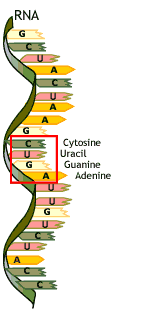
In RNA, Uracil pairs with ______. 
a)
cytosine
b)
adenine
c)
guanine
d)
thymine
35.
The process to go from DNA to mRNA is _______
a)
translation
b)
transcription
c)
replication
36.
The process to go from mRNA to a protein is called ____
a)
transcription
b)
rRNA
c)
replication
d)
translation
37.
DNA holds the code for
a)
lipids
b)
carbohydrates
c)
protein
d)
sugar
38.
Choose the nucleotide sequence of the RNA strand that would be complementary to the following strand: 
GTAGTCA
a)
UATUAGA
b)
ACGACTG
c)
CAUCAGU
d)
CATCAGT
39.
The main function of tRNA is to...
a)
carry a message that, when translated, forms proteins
b)
form a portion of ribosomes
c)
string together complementary RNA and DNA strands
d)
bring amino acids from the cytoplasm to the ribosomes
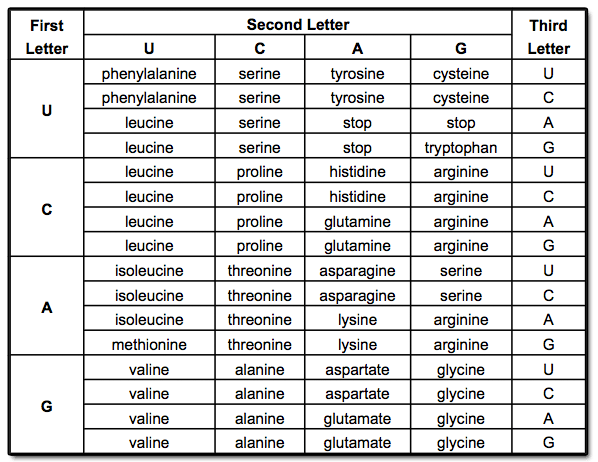
40.
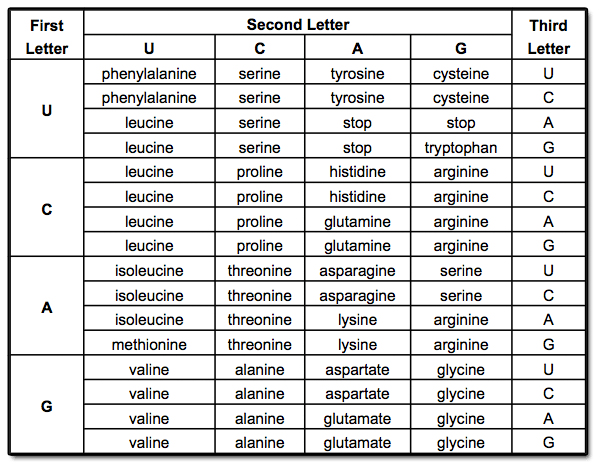
What amino acid is represented by the codon UUA?
a)
Phenylalanine
b)
Tyrosine
c)
Leucine
d)
Stop codon
41.
What process is going on in this photo? 
a)
Transcription 
b)
Translation 
c)
Replication 
d)
All the above 
42.
Which component of DNA determines the traits of an organism? 
a)
Nitrogen Bases
b)
Sugar-Phosphate Backbone
c)
Hydrogen bonds
43.
What is the location in the cell for translation?
a)
nucleus
b)
mitochondria
c)
ribosome
d)
chloroplast
44.
What is the three base sequence of mRNA that codes for a single amino acid?
a)
Anticodon
b)
Codon
c)
Protein
45.
What is the location in the cell for transcription?
a)
nucleus
b)
cytoplasm
c)
ribosome
d)
mitochondria
46.
Which is the mRNA molecule that would be transcribed from this DNA template:
TGGCAAGTACGT
a)
ACCGTTCATGCA
b)
UGGCAAGUACGU
c)
UCCGUUCUUGCU
d)
ACCGUUCAUGCA
47.
Translation is the process where
a)
mRNA is created in the Nucleus
b)
mRNA is decoded to form a protein 
c)
glucose molecules are made
d)
is where lipids are synthesised
48.
What is the correct amino acid sequence for the mRNA code AUGCCAGUAUGA
a)
Met-Pro-Ala-Val
b)
Met-Pro-Val
c)
Tyr-Gly-His
d)
Tyr-Gly-Arg-His
49.
How many amino acids are coded for by this sequence of nucleotides:
ATG GGA ACT CCA
a)
4
b)
2
c)
6
d)
12
50.

What amino acid serves as the "start" codon?

a)

alanine

b)

valine

c)

methionine (met)

d)

purine

51.

The anticodon can be found on ____________.

a)

transfer RNA

b)

messenger RNA

c)

DNA

d)

ribosomal RNA

52.

What mRNA sequence will code for met-thr-val?

a)

AUG GUG ACG

b)

AUG ACG GUG

c)

GUG AUG ACG

d)

TAC CGC GGG

53.

What amino acid sequence is dictated by the following code TAC TGC CGT

a)

thr-ala-met

b)

met-thr-ala

c)

pro-pro-val

d)

gly-pro-val

54.

When do genetic mutations get passed from parent to offspring?

a)

When the Gametes (sex cells) are mutated

b)

When the mutation changes the order of DNA

c)

When the mutation occurs randomly

55.

Many mutations...

a)

Occur randomly

b)

Occur because of bad eating habits

c)

Occur because of lack of exercise

56.

Mutations can be...

a)

Harmful

b)

Beneficial

c)

Neutral

d)

All of the Above

57.

Your enzymes can repair some mutations

a)

True

b)

False

58.

Mutations are...

a)

Changes in the sequence of DNA

b)

Broken chromosomes

c)

Bad genes

59.

Body Cell mutations can contribute to...

a)

Cancer

b)

Parkinson's Disease

c)

Bronchitis

d)

Heart Failure

60.

Mutations can be a result of...

a)

Environmental Exposure

b)

Lack of sleep

c)

Not enough exercise

61.

What is a type of Mutation?

a)

Deletions

b)

Insertions

c)

Base Substitutions

d)

All of the Above

62.
Mutations are a source of _______________. 
a)
Variation 
b)
Disease
c)
Polypeptide 
63.
DNA molecule segment is : TTACGCAAG
The mutated DNA segment is TTACGCAAC. This is an example of ___ mutation.
a)
Base Substitution
b)
Base Insertion
c)
Base Inversion
d)
Translocation
64.
Where do mutations occur?
a)
DNA and RNA
b)
DNA 
c)
RNA
d)
mRNA and tRNA
65.
What mutation has occurred here? 
T-G-A-C-C-A
T-G-A-G-C-A
a)
Substitution
b)
Deletion
c)
Insertion
d)
Frameshift 
66.
What causes mutations?
a)
Mistakes in replication or environmental substances
b)
The amino acids
c)
Passed down by genetics
d)
It's how your born
67.
Which of the following would result in a frameshift mutation?
a)
Insertions only
b)
Substitution only
c)
Deletion only
d)
Insertions and Deletions
68.
If a mutation occurs in an expressed gene, it will most directly affect the structure of a cell's
a)
ATP
b)
proteins
c)
energy source
d)
membrane
69.
Why is the order of amino acids so important?
a)
The order of amino acids dictates what shape the protein will fold into.
b)
It is not important. The protein folding chamber will force the protein to fold into the correct shape.
70.
DNA molecule segment is : TTACGCAAG
The mutated DNA segment is TTCGCAAG. This is an example of ___ mutation.
a)
Substitution
b)
Deletion
c)
Insertion
d)
Inversion
71.
ATTTGAGCC- Original
ATTGAGCC - Mutated
The example above is an example of a 
a)
Insertion- Frameshift
b)
Deletion- Substitution
c)
Deletion -Frameshift
d)
All of the above
72.
The order of nitrogen bases determines the order of __________.
a)
amino acids
b)
monosaccharides
c)
fatty acids
73.
DNA molecule segment is : TTACGCAAG
The mutated DNA segment is TTACGCAAC. This is an example of ___ mutation.
a)
Substitution
b)
Insertion
c)
Inversion
d)
Translocation
74.
What is a codon?
a)
It is a three letter section of bases that are read by ribosomes to stamp amino acids into a protein
b)
They are the codes on the DNA (hence "code-on"
c)
It is a type of mutation that occurs when there has been a substitution, deletion or insertion.
d)
It is a made up word for this quiz. Nice try, Wampler.
75.
What are the building blocks of proteins called?
a)
DNA
b)
RNA
c)
Ribosomes
d)
Amino Acids
76.
Why are insertion and deletion (frameshift) mutations so harmful?
a)
They change all of the codons from the mutation on down the line, which changes the amino acid sequence
b)
They insert things that an organism doesn't need.
c)
They often delete things that organisms need.
d)
Insertion and deletions are not any more harmful than substitution mutations.
77.
Would a mutation in the DNA of a skin cell be passed on to an organism's offspring?
a)
Yes, because any change to the DNA is passed on to the offspring
b)
Maybe. Sex cells only use half of the body's genetic code. It might get the copy of a gene that wasn't mutated.
c)
No. Only mutations that occur in the gametes (sex cells) are passed on to the offspring
d)
Without knowing the animal, it would be hard to tell whether or not the mutation would be passed on.
78.
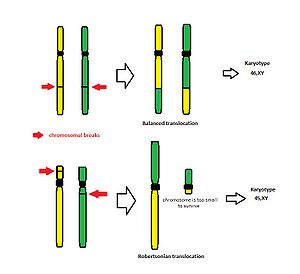
What type of chromosomal mutation is this?
a)
Inversion
b)
Translocation
c)
Deletion
d)
Duplication
79.
Gene: ABCDEF
Mutation: ACEFCD
What mutation occurred?
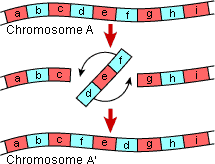
a)
deletion
b)
substitution
c)
inversion
d)
insertion
80.
What type of chromosomal mutation is this?
a)
Translocation
b)
Inversion
c)
Deletion
d)
Duplication
81.
Why are insertion and deletion (frameshift) mutations so harmful?
a)
They change all of the codons from the mutation on down the line, which changes the amino acid sequence
b)
They insert things that an organism doesn't need.
c)
They often delete things that organisms need.
d)
Insertion and deletions are not any more harmful than substitution mutations.
82.
DNA molecule segment is : TTACGCAAG
The mutated DNA segment is TTCGCAAG. This is an example of ___ mutation.
a)
Substitution
b)
Deletion
c)
Insertion
d)
Inversion
83.
Which of the following would result in a frameshift mutation?
a)
Insertions only
b)
Substitution only
c)
Deletion only
d)
Insertions and Deletions
84.
This type of substitution codes for a stop codon
a)
Missense
b)
Nonsense
c)
Silent
d)
Deletion
85.
A type of substitution in which no  amino acids change is called 
a)
Missense
b)
Nonsense
c)
Silent
d)
Deletion
86.
What disease is characterized by abnormally shaped red blood cells?
a)
hemophilia
b)
sickle cell anemia
c)
phenylketonuria
d)
Huntington's 
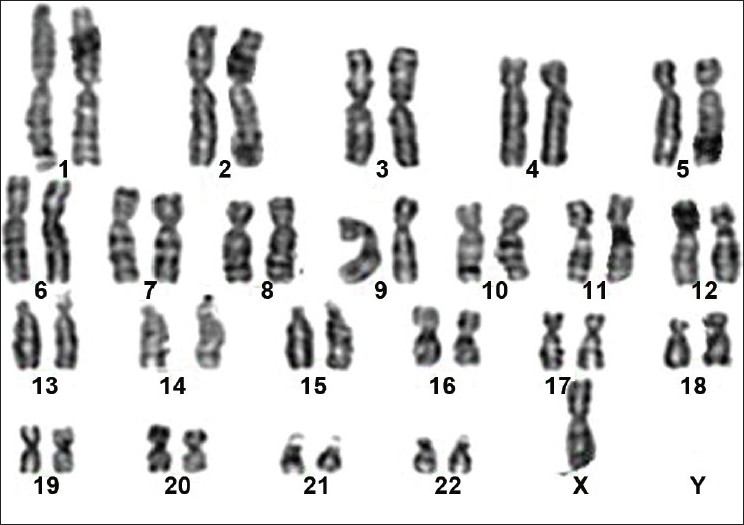
87.
This karyotype is taken from a  ___________.
a)
normal female
b)
normal male
c)
male with Klinefelter's syndrome
d)
female with Turner's syndrome
88.
Which disorder is characterized by the inability to break down a specific amino acid and can be treated by a special diet?
a)
Huntington's
b)
Tay Sachs
c)
Cystic fibrosis
d)
PKU
89.
Which genetic disorder is caused by a dominant allele?
a)
Huntington's
b)
Hemophilia
c)
Cystic fibrosis
d)
PKU
90.
This genetic disorder is inherited by a recessive allele found on the X chromosome.
a)
PKU
b)
Cystic fibrosis
c)
Down's syndrome
d)
Hemophilia
91.
This karyotype is taken from a  ________.
a)
female with Turner's syndrome
b)
male with Down's syndrome
c)
female with Down's syndrome
d)
normal female
92.
Which genetic disorder is sex-linked?
a)
Huntington's
b)
cystic fibrosis
c)
red-green colorblindness
d)
sickle cell anemia
93.
This karyotype was taken from a  ________.
a)
normal female
b)
female with Down's syndrome
c)
female with Turner's syndrome
d)
male with Turner's syndrome
94.
This karyotype was taken from a  _________.
a)
male with Turner's syndrome
b)
male with Klinefelter's syndrome
c)
female with Klinefelter's syndrome
d)
male with Down's syndrome
95.
Which disorder is characterized by degradation of the nervous system and usually results in death during infancy?
a)
Tay-Sachs
b)
Cystic fibrosis
c)
Huntington's
d)
PKU
96.

Which of the following is a result of a nondisjunction?

a)

Klinefleter syndrome

b)

Sickle cell anemia

c)

Cystic fibrosis

d)

Hemophilia

97.

Which of the following best describes the cause of cystic fibrosis?

a)

a mutated blood clotting protein

b)

a mutated transport protein

c)

an extra 21st chromosome

d)

an extra 13th chromosome

98.

Which of the following is an autosomal recessive disorder?

a)

Huntington's disease

b)

sickle cell anemia

c)

colorblindness

d)

Hemophilia

99.

Which of the following is a autosomal dominant disorder?

a)

Huntington's

b)

Cystic fibrosis

c)

Hemophilia

d)

Sickle cell anemia

100.

Which of the following is a sex-linked disorder?

a)

Hemophilia

b)

Sickle cell anemia

c)

Cystic fibrosis

d)

Huntington's

101.

Which of the following is a chromosomal mutation?

a)

insertion

b)

frameshirt

c)

substitution

d)

nondisjunction

102.

Which of the following cause frameshift mutations?

a)

insertions and deletions

b)

translocations and nondisjunctions

c)

duplicaitons and deletions

d)

inversions and substitutions

103.

Which of the following is NOT a chromosomal disorder?

a)

Turner's syndrome

b)

Downs syndrome

c)

Klinefelter's syndrome

d)

Huntingdon's

104.

Which of the following is NOT caused by a gene mutation?

a)

Turner's syndrome

b)

Sickle cell anemia

c)

Cystic fibrosis

d)

Hemophilia

105.

Identify the substitution mutation that results in an abnormally shaped protein and that causes a reduced ability to bind and transport oxygen.

a)

Cystic fibrosis

b)

Sickle cell anemia

c)

Huntington's

d)

Hemophilia

106.
Which disease or disorder is caused by the inheritance of two mutated alleles?
a)
Down Syndrome
b)
Colorblindness
c)
Cystic Fibrosis
d)
Hemophilia
107.
Which disease or disorder is the result of having an extra chromosome?
a)
Cystic Fibrosis
b)
Down Syndrome
c)
Colorblindness
d)
Sickle-cell Disease
108.
What is the name of the protein that is not normal in people with sickle-cell disease?
a)
mucus
b)
clotting protein
c)
karyotype
d)
hemoglobin
109.
A doctor may use a _________ to examine the chromosomes in a cell.
a)
x-ray
b)
blood test
c)
karyotype
d)
hemoglobin
110.
Which genetic disorder or disease is a sex-linked trait and carried on the X chromosome?
a)
Cystic Fibrosis
b)
Sickle-cell Disease
c)
Hemophilia
d)
Down Syndrome
111.
What chromosome is affected by hemophilia?
a)
x
b)
y
c)
21
d)
13
112.
In order to trace occurrence of a trait through several generations of a family, you could create a ____________.
a)
karyotype
b)
hemoglobin
c)
pedigree
d)
chromosomal map
113.
a)
Not affected Female
b)
Not affected Male
c)
Affected Male
d)
Affected Female
114.
In the second generation-how many people are carriers of the trait?
a)
2
b)
3
c)
5
d)
6
115.
a)
Not Affected Male
b)
Not Affected Female
c)
Affected Male
d)
Affected Female
116.
A couple that have a family history of a genetic disorder might wish to receive advice from a ___________.
a)
mutated allele
b)
genetic counsellor
c)
family dentist
d)
brother or sister
117.
Photograph of chromosomes grouped in ordered pairs
a)
pedigree
b)
Punnett Square
c)
Venn Diagram
d)
Karyotype
118.
What is the gender of the individual whose karyotype is seen in the image?
a)
Male
b)
Female
119.
a)
This karyotype shows Trisomy 21
b)
This karyotype has no abnormality
c)
This karyotype is missing a sex chromosome (monosomy x)
d)
This karyotype is from a gamete
120.
Which sex chromosomes would indicate a typical human male?
a)
XX
b)
X
c)
XY
d)
XXY
121.
What is the chromosomal condition of the individual whose karyotype is seen in the image?
a)
Trisomy 21 (Down's Syndrome)
b)
Trisomy 13 (Patau Syndrome)
c)
Trisomy 18 (Edward's Syndrome)
d)
XXY Sex Chromosomes (Klinefelter's Syndrome)
122.
Which of the following is true of your sex chromosomes?
a)
I have two Y chromosomes.
b)
I have at least one X chromosomes.
c)
They aren't developed until I turn 13.
d)
They are afraid of one another.
123.
What is the purpose of gel electrophoresis?
a)
helps cut DNA
b)
count the genes in DNA
c)
separates DNA based on size
d)
allows for an exact replicated organism
124.
Why do the fragments of DNA in gel electrophoresis travel away from the negative electrode?
a)
DNA is negatively charged so attracted to the positive end of the unit
b)
DNA is positively charged to attracted to the negative end of the unit
c)
the agarose gel in negatively charged
d)
the agarose gel is positively charged
125.
What applications can gel electrophoresis be used for?
a)
Parental Testing
b)
Criminal Investigations
c)
Sequence Endangered Species DNA
d)
All of the above
126.
Which DNA fragment bands move faster and farther in a gel electrophoresis? 
a)
there is no way to tell 
b)
the largest ones
c)
the smallest ones
d)
none of these
127.
In gel electrophoresis, the largest DNA fragment will appear
a)
closest to the starting wells
b)
farthest from the starting wells
c)
three quarters away from the starting wells
d)
it depends on how many fragments there are
128.
Which is the primary purpose of using restriction enzymes in gel elctrophoresis?
a)
It allows the strands of DNA to be cut into various lengths for testing
b)
It restricts the number of base pairs that can be tested in a sample
c)
It makes the testing simpler by moving the strands into the gel faster
d)
It charges the DNA strands
129.
Which two bat species are most closely related?
a)
 Bat 1 and Bat 2
b)
Bat 1 and Bat 3
c)
Bat 2 and Bat 3
d)
There’s no way to tell
130.
Based on these results whose blood was found in the blood stain at the crime scene?
a)
Bob
b)
Sue
c)
John
d)
Lisa
131.
Which suspect is linked to the crime scene by this DNA analysis
a)
Suspect A
b)
Suspect C
c)
Suspect D
d)
Suspect B
132.
Shannon does not know who her father is.  There are three possibilities:  Jack, Daniel and Bill.  Who is the father?
a)
Jack
b)
Daniel
c)
Bill
133.
In pea plants, the tall allele is dominant to the short allele. What key would demonstrate this?
a)
Tall = T
Short = S
b)
Tall = T
Short = t
c)
Tall = t
Short = T
d)
Tall = TT
Short = tt
134.
A heterozygous long-tusked elephant is crossed with a homozygous recessive short-tusked elephant. What is the probability of the offspring having short tusks?
a)
0%
b)
25%
c)
50%
d)
75%
135.
A heterozygous long-tusked elephant is crossed with a homozygous recessive short-tusked elephant. What is the probability of the offspring having short tusks?
a)
0%
b)
25%
c)
50%
d)
75%
136.
What is the probability of a purple-horned unicorn if a heterozygous pink-horned unicorn is crossed with a heterozygous pink-horned unicorn?
a)
0%
b)
25%
c)
50%
d)
75%
137.
A brown-furred ewok has 12 babies with a black-furred ewok. 9 ewok babies have black fur, while 3 ewok babies have brown fur. What are the probable genotypes of the parents?
a)
BB and bb
b)
BB and Bb
c)
Bb and Bb
d)
Bb and bb
138.
Identify the homozygous dominant genotype:
a)
FF
b)
Ff
c)
ff
139.
A green pea plant (Gg) is crossed with a yellow pea plant (gg). Describe the genotype of the offspring. (Be sure to remember that the capital letter is dominant).
a)
50% heterozygous and 25% homozygous recessive
b)
50% heterozygous and 50% homozygous recessive
c)
100% homozygous recessive
d)
25% heterozygous and 50% homozygous
140.
A tall plant (TT) is crossed with a tall plant (Tt). What is the phenotype of the offspring?
a)
50% homozygous dominant; 50% heterozygous; 100% tall
b)
100% homozygous dominant; 100% tall
c)
25% homozygous dominant; 75% heterozygous; 100% short
d)
50% homozygous dominant; 50% heterozygous; 100% short
141.
A tall plant (Tt) is crossed with a short plant (tt). What is the genotype of the offspring?
a)
25% heterozygous; 75% homozygous
b)
100% homozygous dominant
c)
100% heterozygous
d)
50% heterozygous; 50% homozygous dominant
142.
A white flower (rr) is crossed with a white flower (rr). What is the genotype of the offspring? Draw a Punnett square and answer the question.
a)
100% homozygous dominant
b)
100% heterozygous dominant
c)
100% homozygous recessive
d)
100% heterozygous recessive
143.
A white flower (rr) is crossed with a white flower (rr). What is the phenotype of the offspring? Draw a Punnett square and answer the question.
a)
100% white
b)
75% white; 25% red
c)
75% red; 25% white
d)
100% red
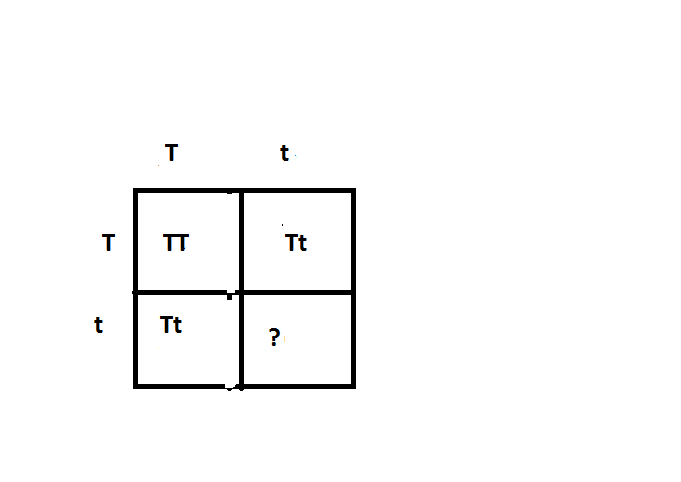
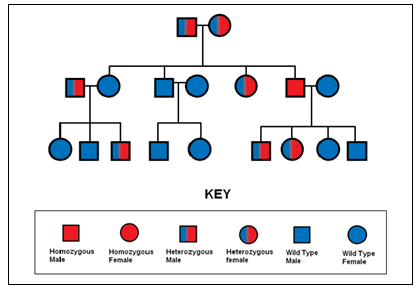
144.
T - tall and t = short
In the punnett square below, what belongs in the missing square
a)
tt
b)
Tt
c)
Bb
d)
TT
145.
aa always shows up as
a)
dominant
b)
recessive
146.
AA and Aa always show up as
a)
dominant
b)
recessive
147.
Which of the following genotypes is homozygous dominant?
a)
A
b)
Aa
c)
AA
d)
aa
148.
Which of the following genotypes is heterozygous?
a)
Bb
b)
BB
c)
bb
d)
B
149.
Which of the following is homozygous recessive?
a)
Tt
b)
tt
c)
TT
d)
T
150.
In a pedigree, what shape represents a male?
a)
circle
b)
square
c)
triangle
d)
diamond
151.
What type of heredity is shown in the pedigree?
(hint: check your notes - "modes of inheritance")
a)
Sex-Linked Dominant
b)
Sex-Linked Recessive
c)
Autosomal Dominant
d)
Autosomal Recessive 
152.
What gender has an X and a Y chromosome?
a)
male
b)
female
c)
transgender 
d)
all of the above
153.
W=white hair
w= non-white hair
If you cross a horse with WW and a horse with ww what fraction of the offspring would be expected to have white hair?
a)
none
b)
3/4
c)
1/2
d)
all
154.

AaBbCcDd X AaBbCcDd

What is the probability that this cross will produce offspring with the genotype AABBCCDD?

a)

1/4

b)

1/256

c)

4/16

d)

1/16

155.

AaBbCcDd X AaBbCcDd

What is the probability that this cross will produce offspring with the genotype AaBbCcDd?

a)

8/16

b)

1/16

c)

2/16

d)

1/32

156.

AaBbCcDd X AaBbCcDd

What is the probability that this cross will produce offspring with the genotype aabbccdd?

a)

1/256

b)

1/4

c)

4/16

d)

1/16

157.

AABBCCDD X aabbccdd

What is the percentage chance that this cross will produce offspring with the genotype AaBbCcDd?

a)

100%

b)

25%

c)

50%

d)

0%

158.

AaBbCcDd X aabbccdd

What is the percentage chance that this cross will produce offspring with the genotype aabbccdd?

a)

25%

b)

6.25%

c)

50%

d)

12.5%

159.

Cross two parents with the following genotypes: AaBb X AaBb

What is the chance that they will have offspring with the genotype AaBb?

a)

25%

b)

50%

c)

75%

d)

100%

160.

Cross two parents with the following genotypes: AaBb X AaBb

What is the chance that they will have offspring with the genotype AABB?

a)

1/4

b)

1/16

c)

9/16

d)

3/16

161.

Cross two parents with the following genotypes: AaBb X AaBb

What is the chance that they will have offspring with the genotype aabb?

a)

1/4

b)

1/16

c)

3/16

d)

1/32

162.
Which of the following is heterozygous
a)
FF
b)
tt
c)
Gg
d)
RR
163.
Which of the following is homozygous recessive?
a)
rr
b)
AA
c)
TT
d)
Ff
164.
What does the prefix homo- in homozygous mean?
a)
same
b)
different
c)
dating
d)
humans
165.
What does the prefix hetero- in heterozygous mean?
a)
same
b)
different
c)
dating
d)
human
166.
Which of the following is heterozygous
a)
Ww
b)
ii
c)
DD
d)
kk
167.
Which of the following is homozygous dominant?
a)
Jj
b)
Rr
c)
MM
d)
ee
168.
The physical appearance of a trait is known as the-
a)
genotype
b)
phenotype
c)
characteristics
d)
intelligence
169.
How many letters does a genotype contain?
a)
1
b)
2
c)
3
d)
4
170.
Mark is heterozygous. If B is for brown hair, and b is for blonde hair, what is Mark's phenotype?
a)
Brown Hair
b)
Blonde Hair
c)
Brown and Blonde Hair
d)
Black Hair
171.
Mark is heterozygous. If B is for brown hair, and b is for blonde hair, what is Mark's genotype?
a)
BB
b)
bb
c)
Bb
d)
bB
172.
In a punnet square where are the parent alleles written?
a)
Top and inside the boxes
b)
Only on the left and right side of the boxes. 
c)
outside of the boxes (top and left side)
d)
All on the top side of the boxes
173.
Aa, DD, bB, yy are all examples of
a)
genotypes
b)
phenotypes
174.
In a flowering plant species, red flower color (R) is dominant over white flower color (r). What is the genotype of any red-flowering plant resulting from this species?
a)
rr
b)
R
c)
RR
d)
RR or Rr
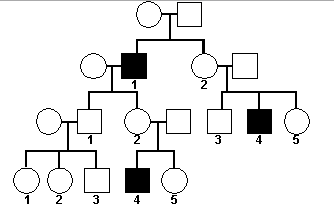
175.
T - tall and t = short
In the punnett square below, what belongs in the missing square
a)
tt
b)
Tt
c)
Bb
d)
TT
176.
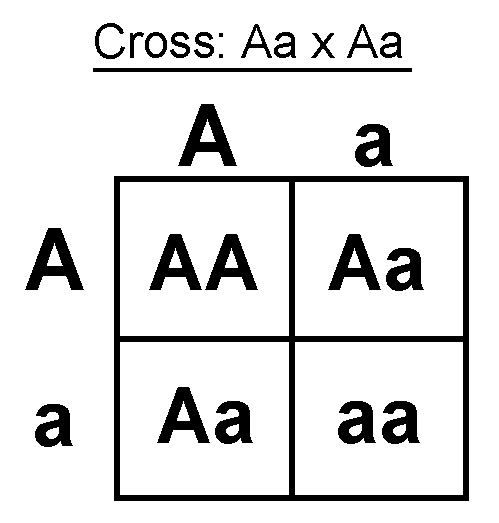
What is the phenotype of the offspring? (A-Brown hair; a-blond hair) 
a)
50 % Brown Hair and 50% Blond Hair 
b)
25 % Brown Hair and 75% Blond Hair 
c)
75 % Brown Hair and 25% Blond Hair 
d)
0% Brown Hair and 100% Blond Hair 
177.
What ratio of the offspring from the cross shown will be homozygous recessive for the  trait of tallness? 
a)
0 in 4
b)
1 in 4
c)
2 in 4
d)
4 in 4
178.
If B = brown hair and b = blonde hair, what is the probability of brown hair?
a)
25%
b)
50%
c)
0%
d)
75%
179.
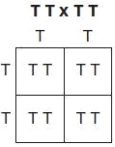
The dominant trait as seen in this punnett square is
a)
yellow pea seeds
b)
green pea seeds
c)
there is no dominant seed
d)
Jolly green giant