wayground logo

Free Printable Worksheets

Font size

S
M
L
XL
Worksheets

Semester 2 Final REVIEW

Total questions: 175

Worksheet time: 2hrs 21mins

Name
Class
Date
1.

The three stages of the cell cycle are __________, mitosis, and

cytokinesis.

a)

interphase

b)

anaphase

c)

metaphase

d)

prophase

2.
The following describes ________  during mitosis. The chromosomes line up along the center of the cell and the spindle fibers attach to each chromosome at the centromere.
a)
prophase
b)
metaphase
c)
anaphase
d)
telophase
3.
Fruit fly body cells have 8 chromosomes. After mitosis, you would expect a resulting fruit fly daughter cell to have ...
a)
16 chromosomes.
b)
46 chromosomes.
c)
8 chromosomes.
d)
4 chromosomes.
4.
Which phase comes NEXT?
a)
prophase
b)
metaphase
c)
anaphase
d)
telophase
5.
If the daughter cells each have 16 chromosomes after cell division, what was the number of chromosomes in the parent cell?
a)
4
b)
6
c)
16
d)
32
6.
Students were learning about the cell reproduction cycles of mitosis and meiosis. Which process creates two identical new cells?
a)
mitosis
b)
meiosis
7.
The cell in this figure is in which stage of mitosis?
a)
prophase
b)
anaphase
c)
metaphase
d)
telophase
8.
Which of the following has the correct order of phases of mitosis?
a)
telophase, metaphase, anaphase, prophase
b)
prophase, metaphase, anaphase, telophase
c)
metaphase, prophase, anaphase, telophase
d)
telophase, prophase, metaphase, anaphase
9.
During which phase in mitosis do the chromosomes pull away from the middle of the cell?
a)
metaphase
b)
telophase
c)
prophase
d)
anaphase
10.

Identify the mitosis stage in the picture.

a)

prophase

b)

metaphase

c)

anaphase

d)

telophase

e)

cytokinesis

11.

Identify the stage in the picture.

a)

interphase

b)

prophase

c)

metaphase

d)

anaphase

e)

teloophase

12.

Identify the stage of mitosis in the picture.

a)

interphase

b)

prophase

c)

metaphase

d)

anaphase

e)

telophse

13.

Identify the stage of mitosis in the picture.

a)

cytokinesis

b)

telophase

c)

anaphase

d)

metaphase

e)

interphase

14.

Identify the stage of mitosis in the picture.

a)

interphase

b)

prophase

c)

anaphase

d)

metaphase

e)

telophase

15.

Which of the following statements are TRUE ? (Choose all that apply.)

a)

Cells produced in mitosis are identical.

b)

Mitosis starts with 2 parent cells and ends with 4 daughter cells.

c)

Mitosis is used for asexual reproduction.

d)

Mitosis starts with 1 parent cell and ends with 2 daughter cells.

16.
During interphase, the DNA is in the form of
a)
chromatin
b)
chromosomes
c)
chromatids
d)
centromeres
17.
A chromatid is attached to a spindle fiber by the
a)
nucleolus
b)
deep furrow
c)
centromere
d)
centriole
18.
The structures that hold together sister chromatids
a)
tissues
b)
chromosomes
c)
spindle
d)
centromeres
19.
What is the name of the structure labeled X?
a)
Centriole
b)
Centrosome
c)
Chromatid
d)
Chromosome 
20.
Cells spend 90% of their time in this stage of the cell cycle. This is the reason you would see most cells in this stage if viewed under a microscope.
a)
Prophase
b)
Metaphase
c)
Anaphase
d)
Interphase
21.
Cell division occurs to allow for 
a)
Growth
b)
Reproduction
c)
Repair
d)
All of the above
22.
The sister chromatids of each chromosome are separated (come apart) and move to opposite ends of the cell. Name that Stage!
a)
Prophase
b)
Metaphase
c)
Anaphase
d)
Telophase
23.
The cytoplasm is divided between the cells splitting the cell into two. Name that Stage!
a)
Cytokinesis
b)
Interphase
c)
Prophase
d)
Metaphase
24.
Nucleolus and nuclear membrane start to disappear, chromatin condenses into chromosomes, and spindle fibers start to form. Name that Stage!
a)
Interphase
b)
Prophase
c)
Metaphase
d)
Anaphase
25.
What do the cells look like at the end of mitosis?
a)
different from original cell
b)
similar to the original cell
c)
identical to the original cell
d)
none of these
26.
Would a prokaryotic or eukaryotic cell be more likely to use mitosis as a means of reproduction?
a)
prokaryotic
b)
eukaryotic
27.
Structure (b) is a ____.
a)
chromosome
b)
chromatid
c)
centromere
28.
Mitosis is used for: 
a)
Growth, repair & replacement
b)
producing sex cells
c)
To make babies
d)
For photosynthesis
29.
What happens when the cell undergo Mitosis more than it is in Interphase?
a)
Cancer
b)
Nothing will happen
c)
The cell will grow
d)
Interphase will not occur
30.

Division of the cytoplasm

a)

Cell Cycle

b)

Interphase

c)

Cytokinesis

d)

Mitosis

31.

Thickened, condensed chromatin visible during late prophase and metaphase. Made of 2 chromatids.

a)

Chromosome

b)

Centriole

c)

Metaphase

d)

Centromere

32.
Cancer creates abnormal cells by disrupting
a)
the cell cycle
b)
red blood cell formation
c)
DNA replication
d)
ATP synthesis
33.
An abnormal mass of cancer cells is called a 
a)
tumor
b)
cyst
c)
lesion
d)
polyp
34.
Term for a group of more than 100 diseases in which abnormal cells divide without control.
a)
biopsy
b)
epiodemiology
c)
cancer
d)
mortality
35.
Cancer is
a)
a premature stop in the cell cycle.
b)
uncontrolled mitosis.
c)
programmed cell death.
36.
What is the phenotype in the bottom right square? (Yellow is dominant and green is recessive)
a)
yy
b)
Yy
c)
yellow
d)
green
37.
Which of the following is the genotype for a homozygous recessive trait?
a)
gg
b)
Gg
c)
GG
38.
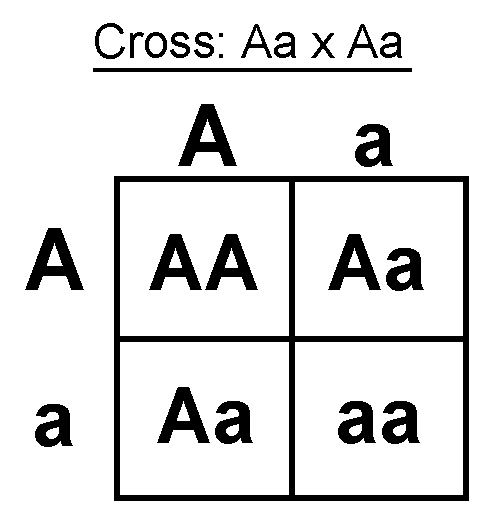
What % of the offspring in the Punnet square are heterozygous?
a)
25%
b)
50%
c)
75%
d)
100%
39.
What type of letters are used to show a trait is dominant?
a)
capital
b)
lowercase
40.
What are traits that aren't dominant over each other but whose heterozygous outcome is a combination of the two equally but separately?
a)
pure dominance
b)
incomplete dominance
c)
co-dominance
d)
simple dominance
41.
What is the type of dominance when the two traits aren't dominant over each other, but whose heterozygous outcome is blended?
a)
co-dominance
b)
simple dominance
c)
incomplete dominance
d)
non-dominance
42.
pp is an example of why type of genotype?
a)
homozygous recessive
b)
heterozygous recessive
c)
homozygous dominant
d)
heterozygous dominant
43.
What is one or more alternative forms of a gene?
a)
chromosome
b)
genotype
c)
phenotype
d)
allele
44.
PP is what type of genotype?
a)
homozygous recessive
b)
heterozygous recessive
c)
homozygous dominant
d)
homozygous recessive
45.
What type of letter show s a recessive trait?
a)
capital
b)
lowercase
46.
What is the study of heredity?
a)
genetics
b)
cell biology
c)
chemistry
d)
botany
47.
Who was the father of genetics?
a)
Mendel
b)
Einstein
c)
Redi
d)
Pasteur
48.
What is a trait that can be hidden?
a)
dominant
b)
recessive
c)
sneaky
d)
recess time
49.
What is the transmission of traits from parent to offspring?
a)
heredity
b)
genetics
c)
cell bio
d)
chem
50.
What is a trait that will always show itself?
a)
recessive
b)
dominant
c)
one from the dad
d)
one from the mom
51.
If there is a cross of a red and white chicken, and the trait is co-dominant, what will be the result?
a)
a blended color
b)
a speckled chicken
52.
If red and white have incomplete dominance for a trait, and a red flower is crossed with  a white flower, what will be the result?
a)
a spoted flower
b)
a blended flower
53.
Which of the following answers provides the correct parental genotypes for this Punnett Square?
a)
HH x Hh
b)
Hh x Hh
c)
HH x hh
d)
Hh x hh
54.
True or False: Traits can skip a generation.
a)
True
b)
False
55.
What organism did Gregor Mendel study?
a)
Flowers
b)
Bacteria
c)
Humans
d)
Pea Plants
56.
How many chromosomes are found in human body cells?
a)
0
b)
23
c)
46
d)
50
57.
How many chromosomes are found in human sex cells?
a)
0
b)
23
c)
46
d)
50
58.
Which of the following is an example of a phenotype?
a)
hh
b)
Red Hair
c)
Hh
d)
DNA
59.
An allele whose trait only shows up when no dominant allele is present.
a)
hidden allele
b)
dominant allele
c)
recessive allele
d)
present allele
60.
What is a phenotype?
a)
An organism that has the same genes for a trait (ex. TT or tt)
b)
refers to the genetic makeup of an individual
c)
the passing of traits from parent to offspring
d)
The expression of a trait; physical appearance.
61.
_______ is the genetic material that carries all the information about how a living thing will look and function.  It has a double helix shape. 
a)
Traits
b)
Recessive Allele
c)
Dominant Allele
d)
DNA
62.
_____ is the two letter genetic code that determines an organism's traits. 
a)
Phenotype
b)
Genotype
c)
Heredity
d)
Pistil 
63.

If W = black fur and w = white fur. The white fur would be an example of a(n)

a)

dominant trait

b)

recessive trait

c)

asexual reproduction

d)

sexual reproduction

64.

Which statement is true about dominant and recessive genes?

a)

Dominant genes mask recessive genes.

b)

Recessive genes mask dominant genes.

c)

They are equal.

65.

Homozygous means:

a)

Different alleles. Ex: Tt

b)

Same alleles. Ex: tt

66.

Heterozygous means:

a)

Same alleles. Ex: TT

b)

Different alleles. Ex: Tt

67.

Why do we use Punnett Squares?

a)

To learn times tables.

b)

To learn chemistry equations.

c)

To study probability of genes.

d)

To understand physics.

68.

Study the Punnett Square. What is the probability of a dominant trait showing up?

a)

0%

b)

25%

c)

50%

d)

100%

69.

Study the Punnett Square. What is the probability of having heterozygous dominant traits?

a)

0%

b)

25%

c)

50%

d)

75%

70.

What was Mendel's big discovery?

a)

Traits are Not passed on to offspring.

b)

Traits can be masked in one generation and show up in a future generation.

c)

Pea plants have flowers.

d)

Pea plants produce peas.

71.
B = brown eyes
b = blue eyes
What is true about these two brothers that have brown eyes?
One has genotype BB the other Bb.
a)
they have same phenotype and genotype
b)
they have different genotypes and phenotypes
c)
they have same phenotype but different genotypes
d)
they have same genotype but different phenotypes
72.
Aa, DD, bB, yy are all examples of
a)
genotypes
b)
phenotypes
73.

The genotype Aa is called . . .

a)

Homozygous recessive

b)

Hybrid

c)

Purebred

d)

Homozygous dominant

74.

Which of the following genotypes are Purebred? Select 2 answers.

a)

aA

b)

Aa

c)

AA

d)

aa

75.

In a flowering plant species, red flower color (R) is dominant over white flower color (r). What is the genotype of any white-flowering plant resulting from this species?

a)

rr

b)

rR

c)

RR

d)

Rr

76.

In a flowering plant species, red flower color (R) is dominant over white flower color (r). What is the genotype of any white-flowering plant resulting from this species?

a)

rr

b)

rR

c)

RR

d)

Rr

77.

How many alleles (letters) does a child get from EACH parent for each trait?

a)

1

b)

2

c)

3

d)

4

78.

What are the phenotype percentages of the offspring?

(A-Brown fur color; a-white fur color)

a)

50 % Brown fur and 50% White fur

b)

25 % Brown fur and 75% White fur

c)

75 % Brown fur and 25% White fur

d)

0% Brown fur and 100% White fur

79.
A heterozygous long-tusked elephant is crossed with a homozygous recessive short-tusked elephant. What is the probability of the offspring having short tusks?
a)
0%
b)
25%
c)
50%
d)
75%
80.
A heterozygous long-tusked elephant is crossed with a homozygous recessive short-tusked elephant. What is the probability of the offspring having short tusks?
a)
0%
b)
25%
c)
50%
d)
75%
81.

What is the phenotype in the bottom right square? (Yellow is dominant and green is recessive)

a)

yy

b)

Yy

c)

yellow

d)

green

82.

All cells in your body have genetic information (the code found within DNA). Sex cells (egg and sperm) have ________________ the amount of genetic information when compared to the body cells in your body

a)

twice

b)

equal

c)

half

d)

four times

83.

Cells that have pairs of every chromosome are called______________ while cells that have one copy of a chromosome are called____________________?

a)

complete, incomplete

b)

multiploid, monoploid

c)

diploid, haploid

d)

megaploid, uniploid

84.

Another name for sex cells, like egg and sperm, is ____________________

a)

oocytes

b)

chromoblasts

c)

fertilization

d)

gametes

85.

The process where body cells make exact copies of themselves for the purpose of growing, replacing worn out cells, or repairing damaged cells is called __________________?

a)

meiosis

b)

mitosis

c)

fertilization

d)

sexual reproduction

86.

The process of cell division that results in the production of either sperm or egg cells is called __________________

a)

mitosis

b)

meiosis

c)

sexual reproduction

d)

fertilization

87.

Which statement is true about the number of chromosomes in egg and sperm cells in humans?

a)

they have 23 pairs of chromosomes

b)

they have 23 chromosomes

c)

they have 46 pairs of chromosomes

d)

they have 46 chromosomes

88.

Meiosis results in the production of _________________

a)

4 diploid cells called gametes

b)

4 haploid cells called gametes

c)

1 cell which is a body cell

d)

millions of body cells

89.
During which phase of the meiotic cell cycle does DNA replication occur?
a)
Interphase
b)
Prophase
c)
Metaphase
d)
Anaphase
90.
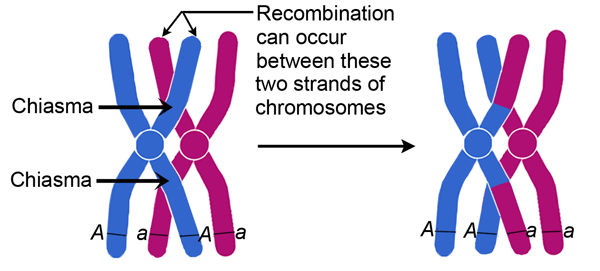
This image shows chromosomes during Prophase 1. Which of the following correctly describes the process shown?
a)
segregation of sister chromatids
b)
condensation and segregation of alleles
c)
mutationin which the DNA content of the gene is altered
d)
crossing - over in which alleles are exchanged
91.

If the diploid number of carrots is 18, the haploid number is

a)

18

b)

9

c)

27

d)

36

92.
Why do we need meiosis?
a)
To double the number of chromosomes going into sex cells
b)
To halve the number of chromosomes going into sex cells
c)
To triple the number of chromosomes going into sex cells
d)
To not change the number of chromosomes going into sex cells
93.

The chromosomes that pair up during meiosis, are called __________ chromosomes.

a)

heterozygous

b)

haploid

c)

homologous

d)

diploid

94.
What process, and which type of resulting cells are represented?
a)
mitosis, gametes
b)
mitosis, body cells
c)
meiosis, gametes
d)
meiosis, body cells
95.

At the end of mitosis you have _____ cells.

a)

identical

b)

different

c)

identical twins

d)

variety

96.

The products of meiosis are genetically...

a)

different.

b)

identical.

97.
What is it called when a sperm and egg meet?
a)
meiosis
b)
fertilization
c)
cell division
d)
mitosis
98.
What is one of the advantages, why is it better to reproduce sexually versus asexually?
a)
survival of the fittest
b)
overproduction
c)
genetic variation
d)
cloning
99.

How do mitosis and meiosis differ?

a)

Meiosis produces 2 identical cells, while mitosis produces 4 identical cells.

b)

Mitosis produces 2 identical cells, while meiosis produces 4 different cells.

c)

Mitosis produces 4 different cells, while meiosis produces 2 identical cells.

d)

Meiosis produces only 1 cell, while mitosis produces many.

100.

a photograph or picture of chromosomes grouped in ordered pairs is a ______________

a)

pedigree

b)

Punnett Square

c)

Venn Diagram

d)

Karyotype

101.
Which sex chromosomes would indicate a typical human male?
a)
XX
b)
X
c)
XY
d)
XXY
102.
What is the gender of the individual whose karyotype is seen in the image?
a)
Male
b)
Female
103.

Based on the karyotype, what is the sex of this baby?

a)

Male

b)

Female

104.
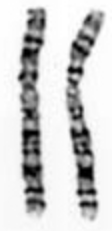
Is this Karyotype human?
a)
Yes
b)
No
c)
Impossible to Determine
105.

If the Diploid number for carrots is 18, the haploid number is

a)

18

b)

9

c)

27

d)

36

106.
A pair of identical chromosomes shown in a karyotype, one inherited from mom, and one inherited from dad are called
a)
sister chromotids
b)
centromeres
c)
homologous chromosomes
d)
autosomes
107.
A sperm contains
a)
Both an X and a Y chromosome
b)
Two X chromosomes
c)
An X OR a Y chromosome
d)
only a Y chromosome
108.
An egg contains
a)
22 autosomes and an X chromosome
b)
22 autosomes and an Y chromosome
c)
44 autosomes and 2 X chromosomes
d)
44 autosomes and an X and a Y chromosome
109.
What makes this individual's karyotype not normal?
a)
An extra sex chromosome
b)
An extra autosome
c)
A missing sex chromosome
d)
A missing autosome
110.
Chromosome pairs 1-22 are referred to as
a)
sex chromosomes
b)
sister chromatids
c)
a karyotype
d)
autsomes
111.

Purpose is sexual reproduction

a)

Mitosis only

b)

Meiosis only

c)

Both mitosis and meiosis

d)

Neither mitosis or meiosis

112.

Purpose is replacing of cells

a)

Mitosis only

b)

Meiosis only

c)

Both mitosis and meiosis

d)

Neither mitosis or meiosis

113.

Genetic variation is increased.

a)

Mitosis only

b)

Meiosis only

c)

Both mitosis and meiosis

d)

Neither mitosis or meiosis
114.

Starts with a single parent cell.

a)

Mitosis only

b)

Meiosis only

c)

Both mitosis and meiosis

d)

Neither mitosis or meiosis

115.
Change over time...
a)
Evolution
b)
Nucleotide 
116.
Charles Darwin came up with this theory 
a)
Natural Selection
b)
Mutation
117.
To adjust to a changing environment
a)
Mutation
b)
Adapt
118.
Darwin wrote that organisms with traits that are best suited to the environment will ________________
a)
increase in number
b)
become extinct
119.
Another word for adapt is ____________.
a)
change
b)
create
120.
Which of the following is NOT an example of natural selection? 
a)
People selectively breeding hamsters.
b)
Insect populations developing resistance to certain pesticides.
c)
Bacteria becoming resistant to antibiotics.
d)
Male birds of certain species developing colorful feathers to attract female mates.
121.
What characteristic did Darwin observe about the finches on the Galapagos Islands?
a)
Their feathers 
b)
Genotypes 
c)
Their beaks
d)
Their body sizes
122.
Which term refers to the process by which individuals that are better suited to the environment survive and reproduce therefore passing down their genes to their offspring? 
a)
Evolution 
b)
Variation 
c)
Adaptation
d)
Natural Selection 
123.
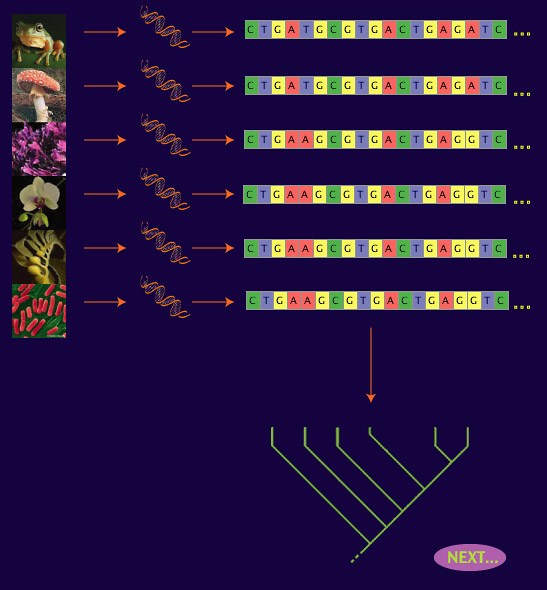
Which species’ DNA is most similar to the DNA of the toothed whale? 
a)
Hippopotamus 
b)
Baleen Whale
c)
Grazing Mammals
d)
Camels
124.
The environment around Manchester, England, changed during the Industrial Revolution.  How did this change affect peppered moths living in the area?
a)
Natural selection favored moths with dark wings because predators could not see them on the soot-colored trees.
b)
Natural selection favored moths with white wings that were easy for predators to see.
c)
Natural selection favored moths with white wings because predators could not see them on the soot-colored trees.
d)
Natural selection caused moths with white wings to become extinct.
125.
The separation of a group of individuals from the rest of the population is referred to as 
a)
genetic drift
b)
natural selection
c)
geographic isolation
d)
survival of the fittest
126.
Two organisms that are closely related would have
a)
very similar DNA sequence
b)
exactly the same DNA sequences
c)
no proteins in common
d)
completely different DNA sequence
127.
The scientific theory of evolution is supported by different types of evidence. The diagrams below show the skeletons of two different animal species. How does comparing the skeletons of these animals provide support for the scientific theory of evolution?
a)
 It provides information about the organisms' habitats.
b)
 It shows possible common ancestry between organisms.
c)
It provides information to determine the organisms' ages.
d)
It shows possible chromosomal similarities between organisms.
128.
According to fossil records, the horses that lived 50 million years ago were much smaller, weaker and slower than modern horses. Which process is most likely responsible for the changes that have led to the increased size, strength, and speed in horses?
a)
commensalism
b)
inbreeding
c)
migration
d)
evolution by natural selection
129.
The diagram illustrates an embryonic stage of two organisms.Which of the following can be determined by observing the embryos shown in the diagram? 
a)
The organisms share a common ancestry.
b)
The organisms belong to the same genus.
c)
The organisms are native to the same geographic areas.
d)
The organisms will grow into anatomically similar adults.
130.
Scientists have found evidence that about 2.4 million years ago a gene regulating jaw muscles mutated and may have led to the more graceful human jaw we see today. The diagram below shows the skulls of 3 hominid species.Which statement below most closely explains the link between jaw size and hominid evolution? 
a)
The jaws of hominids evolved to be smaller and less protruding over time. 
b)
The jaws of hominids evolved to be smaller and less protruding over time. 
c)
There appears to be no change in the jaws of hominids over time.
d)
The jaws of hominids changed over time due to a change in brain size. 
131.
Scientists are studying the evolutionary history of a group of plants in the United States, and they developed an evolutionary tree, as shown below.Which statement can be inferred from the evolutionary tree?
a)
Species 1 is most closely related to Species 8.
b)
Species 2 is most closely related to Species 3.
c)
Species 3 is most closely related to Species 7.
d)
Species 5 is most closely related to Species 6.
132.
Natural selection is best described as
a)
a change in an organism in response to a need of that organism
b)
a process of nearly constant improvement that leads to an organism that is nearly perfect
c)
differences in survival rates as a result of different inherited characteristics
d)
inheritance of characteristics acquired during the life of an organism
133.
What is the term for a feature that allows an organism to survive in its environment?
a)
adaptation
b)
variation
c)
homologous structure
d)
vestigial structure
134.
a)
analogous structures
b)
homologous structures
c)
vestigial structures
d)
none of the above
135.
Vertebrate embryos pass through similar stages of development is evidence for
a)
use and disuse
b)
homologous structures
c)
common ancestry
d)
acquired characteristics
136.
The remnant of an organ that had a function in an early ancestor is known as a(n)
a)
vestigial structure
b)
analogous structure
c)
homologous structure
d)
fossil structure
137.
What are the nucleotides made of?
a)
Sugar, Phosphate, nitrogen base
b)
Phosphate, Adenine, nitrogen base
c)
Thymine, Adenine, Cytomine
d)
Phosphate, Nitrogen, Adenine
138.
Adenine bonds with ______________.
a)
Guanine
b)
Thymine
c)
Cytosine
d)
Adenine
139.
Guanine bonds with ______________.
a)
Adenine
b)
Guanine
c)
Cytosine
d)
Thymine
140.
Why is DNA important?
a)
it is very small and very complicated
b)
it's in everything
c)
it serves as the blueprint for traits of all living things
d)
because we eat it every day for energy
141.
What are the 4 nitrogen bases?
a)
adenine, thymine, cytoplasm, and guanine
b)
adenine, thymine cytosine, and guanine
c)
adenine, thymine, cytosine, and gylcerol
d)
adenine, thymine, cytosine, and glucose
142.
Which sequence of DNA bases would pair with this partial strand
ATG TGA CAG
a)
ATG TGA CAG
b)
TAC ACT GTC
c)
GTA AGT GAC
d)
CAT TCA CTG
143.

In eukaryotes, which organelle is DNA usually found in?

a)

cell membrane

b)

vacuole

c)

chloroplast

d)

nucleus

144.
Which shows the correct complementary base pairing for DNA?
a)
C-A, T-G
b)
A-G, C-T
c)
C-G, U-A
d)
T-A, G-C
145.
What does DNA stand for?
a)
Deoxyribonucleic acid
b)
Denitrogenous acid
c)
Deribonucleic acid
d)
Diribonucleic acid
146.
The building block of nucleic acids are nucleotides.  Nucleotides are composed of a sugar, a phosphate group, and a _________________ base.
a)
oxygen
b)
hydrogen
c)
nitrogen
d)
carbon
147.
The sugar in DNA is ?
a)
sucrose
b)
glucose
c)
deoxyribose
d)
fructose
148.
Which of the following monomers are repeatedly joined together to form a strand of DNA?
a)
amino acids
b)
nucleotides
c)
fatty acids
d)
polysaccharides
149.
What determines the code, or information, of a DNA molecule?
a)
the shape (structure) of the nitrogen bases
b)
the order (sequence) of the nitrogen bases
c)
the color of the nitrogen bases
d)
the frequency (number) of nitrogen bases
150.
Which 2 molecules form the sides (backbone) of the DNA ladder?
a)
deoxyribose sugar and adenine
b)
deoxyribose sugar and a hydrogen bond
c)
deoxyribose sugar and the nucleus
d)
deoxyribose sugar and phosphate
151.
The drawing shows the structure of what molecule?
a)
A DNA molecule
b)
A lipid molecule
c)
A carbohydrate molecule
d)
A protein molecule
152.
X outlines a(n) ___________.
a)
amino acid
b)
nitrogen base 
c)
nucleotide
d)
nitrogen base pair
153.
Identify #2.
a)
nitrogen base
b)
phosphate group
c)
deoxyribose sugar
d)
nucleotide
154.
A long chain of amino acids is a/an
a)
protein
b)
nucleic acid
c)
tRNA
d)
mRNA
155.
If a DNA molecule consists of 29% Guanine, how much cytosine will it contain?
a)
29%
b)
58%
c)
21%
d)
I have no idea.
156.
_______ is made during transcription and ________ is made during translation.
a)
mRNA / a protein
b)
a protein / mRNA
c)
Ribosome / Nucleus
d)
mRNA / tRNA
157.
Which RNA bases would pair with TAC  in transcription
a)
AUG
b)
ATG
c)
GCA
d)
GCA
158.
One difference between DNA and RNA is that....
a)
Only RNA has the base Uracil
b)
only RNA contains the base Thymine
c)
only RNA contains the base Cytocine
d)
only RNA contained the base Guanine
159.
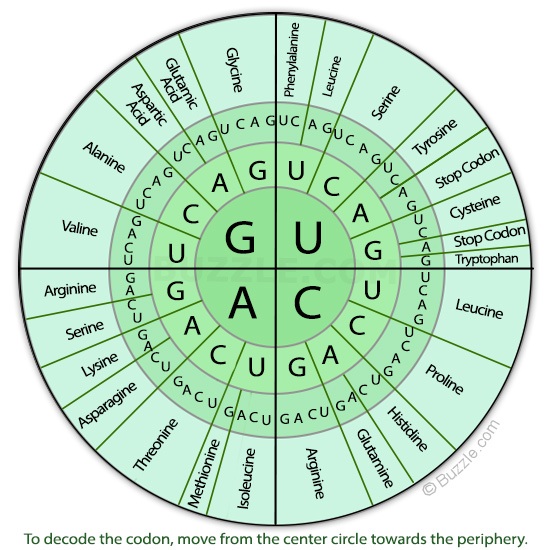
What amino acid is represented by the codon CAG?
a)
Aspartic Acid
b)
Histidine
c)
Glutamine
d)
Methionine
160.
Translation happens in the - 
a)
Nucleus
b)
Ribosome
c)
Chloroplast
d)
Smooth Endoplasmic Reticulum
161.

What are the building blocks of proteins called?

a)

nucleotides

b)

proteins

c)

amino acids

d)

carbohydrates

162.
An RNA molecule is
a)
double helix
b)
always double stranded
c)
usually double stranded
d)
single stranded
163.
Where does transcription take place?
a)
nucleus
b)
cytoplasm
c)
ribosome
164.

A is pointing at the

a)

mRNA

b)

nucleus

c)

tRNA

d)

codon

165.

B is pointing at the

a)

mRNA

b)

nucleus

c)

tRNA

d)

codon

166.

D is pointing at the

a)

mRNA

b)

nucleus

c)

tRNA

d)

codon

167.

F is pointing at the

a)

mRNA

b)

nucleus

c)

tRNA

d)

codon

168.

9 is pointing at a chain of amino acids, this creates a

a)

codon

b)

anticodon

c)

polypeptide chain (protein)

d)

rRNA

169.

If a strand of DNA had bases in the following order - ATCCGTC, what would be the replicated complementary strand?

a)

UAGGCAG

b)

ATCCGTC

c)

TAGGCAG

d)

TUGGCTG

170.

If a strand of DNA had bases in the following order - ATCCGTC, what would be the transcribed mRNA sequence?

a)

TAGGCAG

b)

UAGGCAG

c)

TUGGCUG

d)

None of the above are correct

171.

Which of the following base pairs with adenine in RNA?

a)

thymine

b)

guanine

c)

uracil

d)

cytosine

172.

A section of DNA contains the following bases in this order: GAT CCT

Which of the following mRNA sequences complements this section of DNA?

a)

CUA GGA

b)

TCG AAG

c)

CTA GGA

d)

AGC UUC

173.

How would the complementary strand of DNA appear in the original strand of DNA contained the bases TAGC respectively?

a)

UACG

b)

GCAT

c)

TACG

d)

ATCG

174.

What is the correct order for the following events that occur during protein synthesis?

a)

B,E,A,C,D

b)

B,A,E,C,D

c)

D,A,E,C,B

d)

C,B,A,E,D

175.

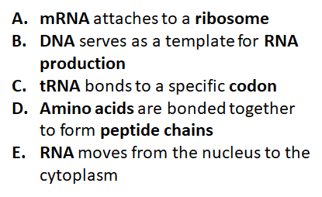
A sequence of a DNA template strand is shown.


3' TCC AAT GGC TTA TTT 5'


Which of these is the correct amino acid chain produced from the DNA template strand?

a)

Arginine, Leucine, Proline, Asparagine

b)

Tryptophan, Phenylalanine, Leucine

c)

Serince, Leucine, Proline, Asparagine

d)

Tryptophan, Phenylalanine, Leucine, Glycine