wayground logo

Free Printable Worksheets

Font size

S
M
L
XL
Worksheets

Cellular Reproduction Unit Test

Total questions: 170

Worksheet time: 3hrs 29mins
Name
Class
Date
1.
When comparing the offspring of sexually and asexually reproducing organisms, we would expect the genetic material (DNA) of the sexually reproducing organism to -
a)
contain fewer mutations
b)
be lesser in quantity
c)
be simpler overall
d)
show more variation
2.
Which is a type of Asexual Reproduction
a)
Sexual 
b)
Binary fission
c)
Cells 
d)
organism 
3.
What are some of the facts about asexual reproduction?
a)
Takes only one mate to reproduce and takes a longer time to reproduce
b)
Takes a shorter amount of time to reproduce and it takes two mates to reproduce
c)
Reproduces diverse offspring and takes a longer time to reproduce
d)
Takes only one mate to reproduce and takes a shorter time to reproduce
4.
What are some of the facts about asexual reproduction?
a)
Takes only one mate to reproduce and takes a longer time to reproduce
b)
Takes a shorter amount of time to reproduce and it takes two mates to reproduce
c)
Reproduces diverse offspring and takes a longer time to reproduce
d)
Takes only one mate to reproduce and takes a shorter time to reproduce
5.
What are some of the facts about sexual reproduction?
a)
Takes two mates to reproduce and takes a longer time to reproduce
b)
Takes one mate to reproduce and takes a shorter amount of time to reproduce
c)
Takes two mates to reproduce and takes a shorter amount of time to reproduce
d)
Takes one mate to reproduce and takes a shorter amount of time to reproduce
6.
What is an advantage of sexual reproduction?
a)
Allows genetic variation
b)
Only needs one parent
c)
Happens very quickly
d)
Offspring are exact copies of parent
7.
Why are favorable traits more likely to be passed onto offspring?
a)
Because they are more likely to survive and reproduce.
b)
Because they look cooler.
c)
Because they come from recessive alleles.
d)
Because the trait is an acquired phenotype.
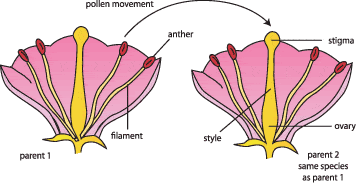
8.
What is #4 pointing to?
a)
anther
b)
style
c)
stigma
d)
ovary
9.
The Aztecs and Maya Tribes of Mexico where some of the first humans to slowly change wild corn to the corn we know today. What process did these tribes use?
a)
Natural Selection
b)
Artificial Selection "Selective Breeding"
c)
Mitosis
d)
Cell Membrane
10.
How are new traits introduced into a population?
a)
Photosynthesis
b)
Cell Membrane
c)
Turtles 
d)
Mutations 
11.
Scientist have created larger and sweeter strawberries for humans to consume (eat). What process was used?
a)
Natural Selection or Artificial Selection 
b)
Artificial Selection or Genetic Modification (GMO) 
c)
Cellular Respiration or Manipulation 
d)
Environmental Natural Selection 
12.
What is the definition of heredity?
a)
The passing of traits (genes) from sibling to sibling.
b)
The passing of traits (genes) from one generation to the next
c)
Chromosomes look like the letter "X"
d)
The passing of traits (genes) from mom to dad
13.
GMO stands for
a)
genetically made organism
b)
genetically modified organism
c)
gene manipulated organism
d)
Genetic mutant organism
14.
The part of the cell that contains the genetic information.
a)
Nucleus
b)
Cytoplasm
c)
Mitochondria
d)
Chloroplast
15.
Individuals which are genetically identical to each other are known as.
a)
Replicates
b)
Copies
c)
Duplicates
d)
Clones
16.
Which of the following are benefits of cloning?
a)
Can be used to increase numbers of animals with a desired characteristic.
b)
Could be used to save animals from extinction.
c)
Development of cloned animals that have been genetically modified to produce valuable proteins in milk.
d)
All of the above
17.

How many alleles does a child get from each parent for a trait?

a)

1

b)

2

c)

3

d)

4

18.

Dominant alleles are represented by a ---

a)

capital letter.

b)

lowercase letter.

19.

Aa, DD, Bb, yy are all examples of ---

a)

genotypes.

b)

phenotypes.

20.

In a heterozygous genotype, the _____ allele takes over in the phenotype.

a)

recessive

b)

dominant

c)

both

21.
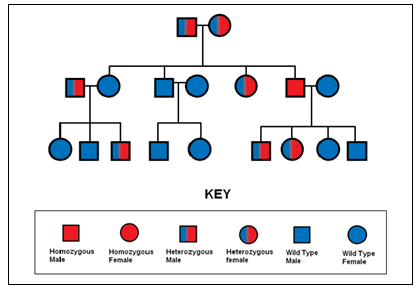
What do we use pedigrees for?
a)
To look at families
b)
To make determinations about the offspring
c)
To track traits in families
d)
Nothing
22.

In a pedigree, which shape represents a male?

a)

circle

b)

square

23.

On a pedigree, this symbol represents a ---

a)

not affected female.

b)

not affected male.

c)

affected male.

d)

affected female.

24.

On a pedigree, this symbol represents a ----

a)

not affected male.

b)

not affected female.

c)

affected male.

d)

affected female.

25.

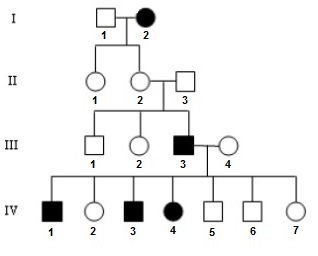
How many individuals are there in the 3rd generation?

a)

1

b)

2

c)

4

d)

6

26.

How are individuals III-2 and II-4 related?

a)

Brother and sister

b)

Dad and daughter

c)

Uncle and niece

d)

Grandfather and granddaughter

27.

What is the mode of inheritance shown here?

a)

Recessive because it "skips" a generation

b)

Dominant because it shows up in every generation

28.

On this pedigree, the allele for curly hair is dominant. The couple labeled 2 both have curly hair, but have a daughter who does not have curly hair. Therefore, we can tell from the chart that for the couple labeled 2 -

a)

the male is heterozygous and the female is heterozygous.

b)

the male is homozygous recessive and the female is homozygous dominant.

29.

Why do all the daughters in Generation II carry the colorblind gene?

a)

Because mom passed on the gene.

b)

Because dad passed on the X chromosome.

30.

The trait this pedigree traces is recessive because it skips a generation and individuals can be carriers. What is the most likely genotype for person III-3?

a)

GG

b)

Gg

c)

gg

31.

Which individual in the first generation is a carrier?

a)

I-1

b)

I-2

32.

If this pedigree shows a recessive disorder, what MUST the genotype of individual II-3 be?

a)

HH

b)

Hh

c)

hh

33.
AA and Aa always show up as
a)
dominant
b)
recessive
34.
How many kids did the mother and father from the first generation have?
a)
2
b)
4
c)
5
d)
6
35.
This pedigree represents the inheritance of hemophilia in this family. How many of the females have the hemophilia trait?
a)
8
b)
5
c)
2
d)
3
36.
Hemophilia is a recessive sex-linked trait. If H = normal & h = has hemophilia, which genotype represents a male with hemophilia. 
a)
XHY
b)
XHXh
c)
XhXh
d)
Xh
37.
Imagine the shaded individuals are those WITH a "hitchhikers thumb." What must be the genotype of individual II-1?
a)
TT
b)
tt
c)
Tt
d)
Impossible to tell
38.
Why do all the daughters in Generation II carry the colorblind gene?
a)
Because mom passed on the gene.
b)
Because dad passed on the X chromosome.
c)
Because their brother has it.
d)
Because their brother gave it to them.
39.
What you see, or the physical appearance.
a)
Genotype
b)
Phenotype
c)
Homozygous
d)
Heterozygous
40.
A dihybrid cross shows the possible outcomes of _______ 
a)
two alleles
b)
two parents
c)
two traits/characters
d)
a self pollination
41.
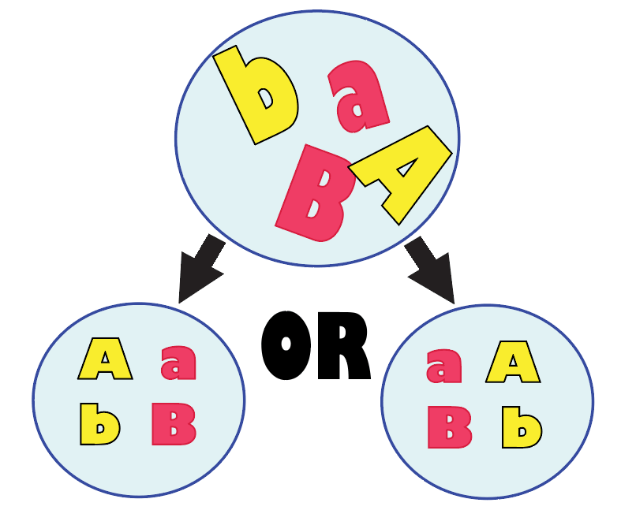
What gamete possibilities could come from this parent's genotype?
a)
AB, AB, aB, aB
b)
Ab, AB, Ab, ab
c)
Ab, Ab, Ab, Ab
d)
AB, aB, ab, aB
42.
What goes in box 1
a)
AABb
b)
AABB
c)
aabb
d)
AaBb
43.
What goes in box 3
a)
Aabb
b)
AABB
c)
AAbb
d)
aaBb
44.
What genotype is missing from this Punnett Square?
a)
RrYy
b)
RRYY
c)
rryy
d)
RrYY
45.
Based off this punnett square, what fraction of the offspring will have wrinkled, yellow seeds?
a)
9/16
b)
3/16
c)
1/16
d)
16/16
46.
Which of the following genotypes is heterozygous?
a)
Bb
b)
BB
c)
bb
d)
B
47.
Which of the following genotypes is homozygous dominant?
a)
A
b)
Aa
c)
AA
d)
aa
48.
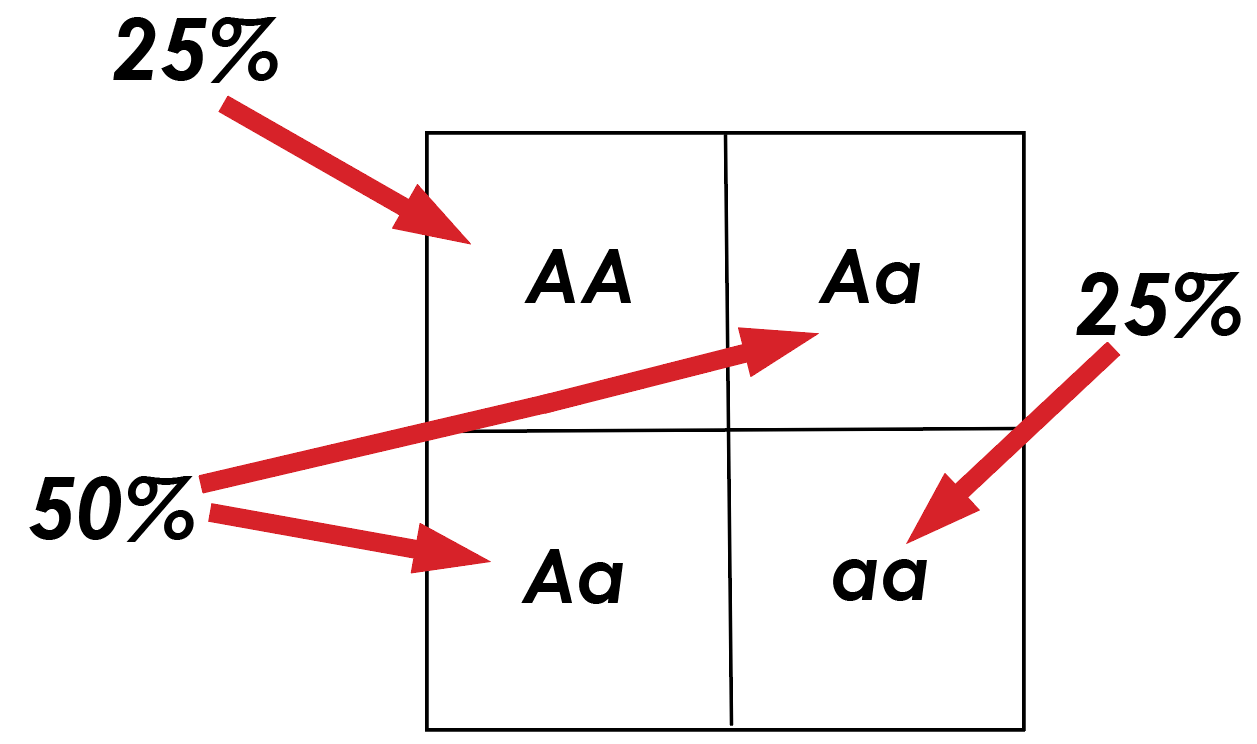
What are the possible genotypes for this cross?
a)
TT = 25% Tt= 50% tt=25%
b)
all tall
c)
TT= 75% tt = 25%
d)
Tt = 100%
49.
Using the dihybrid cross and key provided, what is the probability of the offspring being tall and white?
a)
9
b)
2
c)
3
d)
6
50.
In flowers, purple color is dominant to pink and short is dominant to tall. Cross a flower that is heterozygous for both traits with another flower that is pink and tall. What is the percentage of the flowers being pink and short?
a)
75%
b)
25%
c)
4
d)
1/2
51.
parent 1: GgBB
parent 2: ggBb
Find the gametes for parent 1.
a)
GB, GB, gB, gB
b)
gB, gb, gB, gb
c)
Gg, BB, GB, GB
d)
gg, Bb, gB, gb
52.
Cross Two Homozygous plants
(
RRYY x rryy)
R = round seeds, r  = wrinkled seeds Y = yellow seeds, y = green seeds
What percent will have Round and Yellow seeds? 
a)
0%
b)
25%
c)
50%
d)
100%
53.
What proportion of the offspring in Figure 11-4 would be expected to have white, smooth hair?
a)
9/16
b)
3/16
c)
4/16
d)
1/16
54.

What mutation has occurred here?

T-G-A-C-C-A

T-G-A-G-C-A

a)

Substitution

b)

Deletion

c)

Insertion

d)

Frameshift

55.
Any change in the sequence of DNA is...
a)
transgenic shift
b)
Single Genotype
c)
Monohybrid Trait
d)
Mutation
56.

What are the building blocks of proteins called?

a)

DNA

b)

RNA

c)

Ribosomes

d)

Amino Acids

57.

DNA molecule segment is : TTA-CGC-AAG

The mutated DNA segment is TTC-GCA-AG. This is an example of ___ mutation.

a)

Substitution

b)

Deletion

c)

Insertion

d)

Inversion

58.

Original DNA: CAT GAT CCA

New DNA: CAT TGA TCC A

What mutation occurred?

a)

deletion

b)

substitution

c)

tranverse

d)

insertion

59.
Are all mutations bad?
a)
Yes
b)
No
c)
Maybe?
60.
Mutated DNA sequences that can be passed from parent to offspring --
a)
occur in somatic cells (body cells)
b)
occur in gametic cells (sex cells)
c)
are rejected by meiosis
d)
only occur if the parent is exposed to harmful substances
61.

What is the building block of DNA

a)

Monosaccharide

b)

Amino Acid

c)

Fatty Acid

d)

Nucleotide

62.

What do gene mutations change?

a)

DNA

b)

RNA

c)

Proteins

d)

Lipids

63.

A mutation in which only one nucleotide is altered is called a:

a)

Frameshift Mutation

b)

Deletion Mutation

c)

Point Mutation

d)

Insertion Mutation

64.
Why are insertion and deletion (frameshift) mutations so harmful?
a)
They change all of the codons from the mutation on down the line, which changes the amino acid sequence
b)
They insert things that an organism doesn't need.
c)
They often delete things that organisms need.
d)
Insertion and deletions are not any more harmful than substitution mutations.
65.
What is a Gene?
a)
A segment of RNA that encodes for a protein
b)
A chromosome
c)
A segment of DNA that encodes for a protein
d)
Your genome
66.
What pairs with Adenine (A)? 
a)
Guanine (G)
b)
Cytosine (C)
c)
Adenine (A)
d)
Thymine (T)
67.
What pairs with Guanine (G)?
a)
Adenine (A)
b)
Thymine (T)
c)
Cytosine (C)
d)
Guanine (G)
68.
What do helpful mutations do? 
a)
Increases chances of survival 
b)
Decreases changes of survival 
c)
Increases chances of developing cancer
d)
Decreases skills
69.
How does RNA differ from DNA?
a)
RNA contains uracil and deoxyribose
b)
RNA contains ribose and thymine
c)
RNA contains uracil and ribose
d)
RNA contains adenine and ribose
70.
How would the DNA sequence GCTATA be transcribed to mRNA?
a)
GCUAUA
b)
CGATAT
c)
CGAUAU
d)
GCUTUT
71.
Promoters are
a)
genes that code for individual proteins
b)
proteins that bind with DNA and prevent transcription
c)
DNA sequences near operons that regulate transcription
d)
small molecules that bind with repressor proteins
72.
The process by which the genetic code of DNA is copied into a strand of RNA is called
a)
translation
b)
transcription
c)
transformation
d)
replication
73.
Which of the following describes RNA?
a)
RNA is usually double-stranded and contains the base thymine
b)
RNA is usually single-stranded and contains the base uracil
c)
RNA is longer than DNA and uses five bases to encode information
d)
RNA is made in the nucleus of eukaryotic cells and stays there to carry out its functions
74.
The process of making proteins on the ribosome based on instructions from messenger RNA is called
a)
transcription
b)
transformation
c)
translation
d)
molecular biology
75.
A substance that can cause a change in the DNA code of an organism is called a 
a)
toxin
b)
mutagen
c)
nitrogenous base
d)
nucleotide
76.

How many nucleotides make up a codon?

a)

1

b)

3

c)

5

d)

15

77.

How many nucleotides? AAU GCG AUG

a)

9

b)

3

c)

1

d)

15

78.

How many codons: AAU GCG AUG

a)

9

b)

1

c)

3

d)

15

79.
ATCAGTGAT A codon is a sequence of three nucleotides that code for an amino acid. If the DNA sequence shown here goes through transcription and translation, how many amino acids will result from this sequence?
a)
5
b)
4
c)
2
d)
3
80.
Cells spend 90% of their time in this stage of the cell cycle. This is the reason you would see most cells in this stage if viewed under a microscope.
a)
Prophase
b)
Metaphase
c)
Anaphase
d)
Interphase
81.
Cell division occurs to allow for 
a)
Growth
b)
Reproduction
c)
Repair
d)
All of the above
82.
The sister chromatids of each chromosome are separated (come apart) and move to opposite ends of the cell. Name that Stage!
a)
Prophase
b)
Metaphase
c)
Anaphase
d)
Telophase
83.
The cytoplasm is divided between the cells splitting the cell into two. Name that Stage!
a)
Cytokinesis
b)
Interphase
c)
Prophase
d)
Metaphase
84.
DNA is copied in the S part of this stage. Name that Stage!
a)
Interphase
b)
Prophase
c)
Metaphase
d)
Anapahse
85.
Nucleolus and nuclear membrane start to disappear, chromatin condenses into chromosomes, and spindle fibers start to form. Name that Stage!
a)
Interphase
b)
Prophase
c)
Metaphase
d)
Anaphase
86.
The chromosomes start to line up in the middle of the cell.
a)
Prophase
b)
Metaphase
c)
Anaphase
d)
Telophase
87.
What type(s) of cells undergo mitosis?
a)
sex cells
b)
gametes
c)
body cells
d)
sperm and egg cells
88.
What do the cells look like at the end of mitosis?
a)
different from original cell
b)
similar to the original cell
c)
identical to the original cell
d)
none of these
89.
Identify the stage of the cell cycle while looking at the picture.
a)
Prophase
b)
Metaphase
c)
Anaphase
d)
Telophase
90.
Identify the stage of the cell cycle while looking at the picture.
a)
Interphase
b)
Telophase
c)
Metaphase
d)
Cytokinesis
91.
Identify the stage of the cell cycle while looking at the picture.
a)
Early Prophase
b)
Late Propahse
92.
Identify the stage of the cell cycle while looking at the picture.
a)
Prophase
b)
Metaphase
c)
Anaphase
d)
Telophase
93.
*Identify the stage of the cell cycle while looking at the picture.
a)
Prophaese
b)
Metaphase
c)
Anaphase
d)
Telophase
94.
Cells that have only one chromosome from each pair
a)
meiosis
b)
haploid
c)
homologous
d)
diploid
95.
How many daughter cells are produced from meiosis ?
a)
10
b)
6
c)
4
d)
2
96.
The female sex cell is called
a)
zygote
b)
sperm
c)
fertilization
d)
egg
97.
The male sex cell is called
a)
egg
b)
zygote
c)
sperm
d)
mitosis
98.
Name the growth phase of the cell cycle.
a)
metaphase
b)
telophase
c)
interphase
d)
anaophase
99.
This type of cell has a nucleus.
a)
prokaryotes
b)
eukaryotes
c)
cytoplasm
100.
Crossing over occurs in which phase ?
a)
metaphase I
b)
anaphaseII
c)
telophaseII
d)
prohase I
101.
A fertilized egg is called
a)
egg
b)
lettuce
c)
zygote
d)
sperm
102.

CROSSING OVER INCREASES

a)

LIFE SPAN

b)

GENETIC VARIATION

c)

THE NUMBER OF OFF-SPRING

d)

ALL ARE TRUE

103.

MEIOSIS

a)

REDUCES THE NUMBER OF CHROMOSOMES BY ONE HALF

b)

PRODUCES UNIQUE SEX CELLS-1N

c)

ALLOWS TRAITS TO BE PASSED TO OFFSPRING

d)

ALL ARE TRUE

e)

INCREASE GENETIC VARIATION

104.

MEIOSIS PRODUCES 4 CELLS-THE CHROMOSOME NUMBER IS ...

a)

DIPLOID

b)

HAPLOID

105.

1N AND N MEAN THE SAME THING (LIKE MATH)

a)

TRUE

b)

FALSE

106.
How many chromosomes are in the new cells of mitosis?
a)
46
b)
23
107.
In meiosis, Prophase 1 is when chromosomes...
a)
cross over
b)
mutate
c)
hybridize
d)
fertilize
108.
If the Diploid number of Carrots is 18, the haploid number is
a)
18
b)
9
c)
27
d)
36
109.
If a somatic cell in a butterfly contains 24 chromosomes, a butterfly egg would contain
a)
3
b)
6
c)
12
d)
24
110.
Which process and type of resulting cells are represented?
a)
mitosis, gametes
b)
mitosis, body cells
c)
meiosis, gametes
d)
meiosis, body cells
111.
Which of the following represents chromosome # during fertilization?
a)
n+n=2n
b)
n=n
c)
2n=n+n
d)
2n=2n
112.

During which process do two bacterial cells join together to transfer genetic material?

a)

transduction

b)

conjugation

c)

binary fission

d)

asexual reproduction

113.

Which of the following occurs when a virus infects a bacterium and leaves behind new genes from a different bacterium?

a)

transduction

b)

conjugation

c)

transformation

d)

binary fission

114.

The study of heredity

a)

Genetics

b)

Genome

c)

Allele

d)

Punnett Square

115.

During meiosis and gamete formation, homologous (paired up) alleles split up

a)

Phenotype

b)

Law of Segregation

c)

Genotype

d)

Dihybrid Cross

116.

During meiosis, the homologous pairs of chromosomes and the matching alleles are lined up independently.

Offspring are a mix of maternal genes and paternal genes.

This increases genetic variation.

a)

Homozygous Dominant

b)

Law of Segregation

c)

Crossing Over

d)

Independent Assortment

117.

The genetic cross between two parents for one trait:

Example BB x bb

B = dominant for brown

b = recessive for blue

a)

Incomplete Dominance

b)

Dihybrid Cross

c)

Monohybrid Cross

d)

Iron Cross

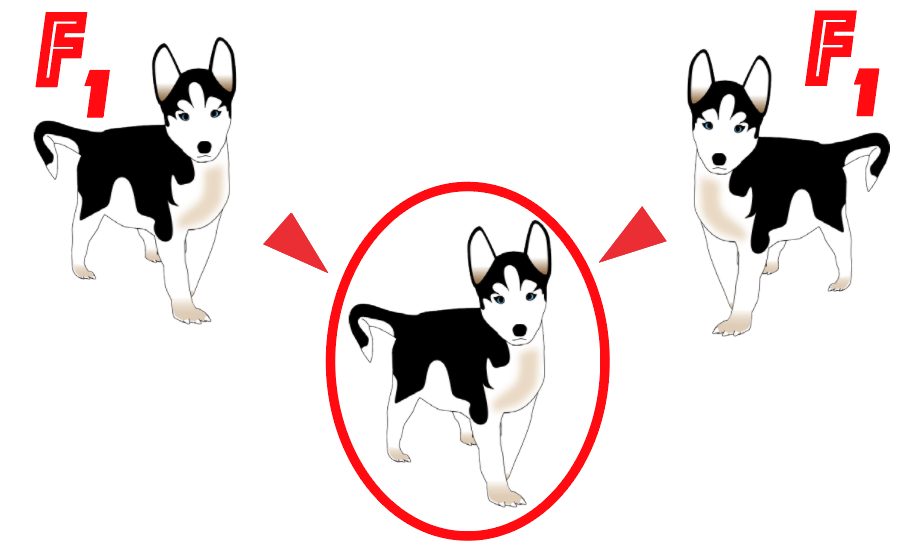
118.

First Filial (child) Generation: the offspring of P1

a)

P1

b)

F2

c)

F1

d)

Heterozygous

119.

Second Filial Generation: the offspring of F1

a)

P1

b)

F1

c)

F2

d)

Homozygous Recessive

120.

The chance that a genotype or phenotype

will actually occur in offspring

a)

Probability

b)

Phenotype

c)

Genotype

d)

Homozygous Recessive

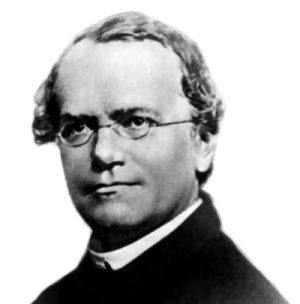
121.

The Italian monk/scientist who first showed

the principles of genetics

a)

Watson and Crick

b)

Linnaeus

c)

Darwin

d)

Mendel

122.

Some flowers are controlled by codominance. Red flowers (RR), blue flowers (BB) and Speckled flowers (RB).


Cross a red flower with a speckled flower. What is the phenotypic ratio?

a)

2 red, 2 speckled

b)

2 red, 2 blue

c)

2 blue, 2 speckled

123.

When one allele is not dominant over another, resulting in a blended phenotype for heterozygous offspring is considered....

a)

Incomplete Dominance

b)

Codominance

124.
Pollination can occur between flowers of the same plant. 
a)
True 
b)
False 
125.

The flower is the ............................ part of the plant

a)

digestive

b)

sensitive

c)

photosynthesis

d)

reproductive

126.
Who is responsible for producing this image?
a)
Francis Crick
b)
James Watson
c)
Rosalind Franklin
d)
Watson and Crick
127.
What did Erwin Chargaff conclude from his experiments?
a)
Nitrogen bases are held together by peptide bonds
b)
A and T, C and G always occur in equal amounts
c)
Proteins are the carriers of genetic information
d)
C and G rarely occur in eukaryotic organisms
128.
What was Watson and Crick's main scientific accomplishment?
a)
Building the first accurate model of DNA
b)
Isolating strains of pneumonia causing bacteria
c)
Determining base pairing rules
d)
Discovering the process of genetic transformation
129.
From his work with mice and pneumonia-causing bacteria, Frederick Griffith discovered what?
a)
Replication
b)
Transcription
c)
Transformation
d)
Translation
130.
Rosalind Franklin's "Photo 51" allowed Watson and Crick to determine the _______ of DNA.
a)
Shape
b)
Backbone
c)
Nitrogen bases
d)
Hydrogen bonds
131.
What are the chemical components of DNA?
a)
A phosphate, nitrogenous base, and an amino acid
b)
A nitrogenous base, a sugar, and an amino acid
c)
A phosphate, a sugar, and a nitrogenous base
d)
A nitrogenous base, sugar, and a helix
132.
Why is DNA important?
a)
it is very small and very complicated
b)
it's in everything
c)
it serves as the blueprint for traits of all living things
d)
because we eat it every day for energy
133.
The sugar in DNA is ?
a)
sucrose
b)
glucose
c)
deoxyribose
d)
fructose
134.
X outlines a(n) ___________.
a)
amino acid
b)
nitrogen base 
c)
nucleotide
d)
nitrogen base pair
135.

What type of bonds form between the nitrogenous bases in a DNA molecule:

a)

Ionic Bonds

b)

Isotopic Bonds

c)

Phosphate Bonds

d)

Hydrogen Bonds

136.

What happens to the mRNA sequence after it has been synthesized?

a)

stays in the nucleus

b)

leaves the cell

c)

leaves the nucleus

d)

separates into smaller pieces

137.

Which enzyme creates the new mRNA polyer by adding the complementary free RNA nucleotides?

a)

RNA polymerase

b)

DNA polymerase

c)

Exonuclease

d)

DNA Helicase

138.

Select which nitrogenous bases can be found in RNA. (Select all that apply)

a)

Adenine

b)

Thymine

c)

Uracil

d)

Cytosine

e)

Guanine

139.
What type of RNA travels outside the nucleus?
a)
transfer
b)
messenger
c)
ribosomal
d)
nuclear
140.
Which two processes are involved in protein synthesis?
a)
Replication and Transcription
b)
Replication and Translation
c)
Transcription and Translation
141.
Within the cell, where does translation occur?
a)
Nucleus
b)
Cytoplasm
c)
Ribosome
142.
Which form of RNA reads the instructions for protein assembly?
a)
amino RNA
b)
ribosomal RNA
c)
transfer RNA
d)
messenger RNA
143.

polyploidy is important to the field of

a)

medicines

b)

embryology

c)

agriculture

d)

physics

144.
Which genotype represents a sickle cell carrier? (Remember it is recessive)
a)
SS
b)
ss
c)
Ss
145.
An abnormal mass of cancer cells is called a 
a)
tumor
b)
cyst
c)
lesion
d)
polyp
146.
Any substance that is known to cause cancer is called a
a)
carcinogen
b)
nicolyte
c)
pathogen
d)
retrovirus
147.
What is cancer?
a)
The heart does not receive enough blood.
b)
Sudden disruption of blood flow to part of the brain.
c)
Blood filled weak spot.
d)
Uncontrolled growth and spread of abnormal cells.
148.

What is recombinant DNA

a)

DNA from 2 different organisms combined

b)

DNA from 2 different ribosomes

c)

DNA that is separated out from a vector

149.

"transgenic" refers to an animal that:

a)

Has DNA from another organism spliced into its genome

b)

Has undergone DNA modification

c)

Has unique genes for its species

150.
When DNA is manipulated and moved from one source to another it is known as
a)
genetic engineering
b)
electrophoresis
c)
gene therapy
d)
GMO
151.
Which term refers to a farmer choosing the best corn from this year to plant next year?
a)
natural selection
b)
selective breeding
c)
genetic engineering
d)
genetic transformation
152.
Why aren't more scientists using gene modification?
a)
Because they are poor
b)
Because they are lazy
c)
Because of ethics and morality
d)
Because of how long it takes
153.

Pattern of DNA fragments obtained by examining a person's unique sequence of DNA pairs.

a)

DNA Fingerprint

b)

Allele

c)

Chromosome

154.

A method of separating molecules, such as DNA, according to their size and electrical charge.

a)

Electrophoresis

b)

DNA Fingerprint

c)

DNA Probe

155.

Mitochondrial DNA is inherited from

a)

the mother only

b)

the father only

c)

both parents equally

d)

both parents unequally

156.

Identical twins have the same DNA, but different fingerprints.

a)

True

b)

False

157.
What do viruses need to reproduce?
a)
they need genetic material
b)
They need a host cell
c)
They need  bacteria
d)
They need insulin
158.
Viruses are...
a)
prokaryotic
b)
eukaryotic
c)
non-living
d)
endospores
159.
True or False
The flu is caused by a virus.
a)
true
b)
false
160.
Which statement about bacteria is true?
a)
Bacteria help you breath
b)
Bacteria help you digest your food
c)
Bacteria help add carbon dioxide to the atmosphere
d)
All bacteria need sunlight to make food
161.
Strep throat is caused by 
a)
bacteria
b)
virus
162.

Protists are:

a)

Protists are a group of loosely connected, mostly Multicellular eukaryotic organisms that are not plants, animals or fungi

b)

Protists are a group of loosely connected, mostly unicellular eukaryotic organisms that include plants, animals or fungi

163.

Athlete's Foot is caused by:

a)

fungus

b)

bacteria

c)

parasite

d)

virus

164.
One way to prevent the spreading of disease is:
a)
to cough without covering your mouth.
b)
to wash your hands often.
c)
to rub your eyes and nose when sick.
165.

Over time a parasite will weaken or sicken the host.

a)

True

b)

False

166.

Which of the following disease in NOT caused by a parasite?

a)

elephantiasis

b)

Hookworm

c)

trichinosis

d)

Cystic Fibrosis

167.

STI'S include which of the following?

a)

Asthma

b)

Ringworm

c)

Leukemia

d)

Chlamydia

168.

Any substance that, when absorbed into the body of a living organism, alters normal bodily function is a/an:

a)

Liquid

b)

Drug

c)

Alcohol

d)

Hormone

e)

Pizza Crunchers

169.

Which of the following is an example of a depressant?

a)

Rohypnol

b)

Cocaine

c)

methamphetameme

d)

Caffeine

170.

Which of the following is NOT a stimulant?

a)

Crack

b)

Caffeine

c)

Cocaine

d)

Xanax