
 Worksheets
Molecular genetics Test Review
Total questions: 180
Worksheet time: 7hrs 46mins

From left to right, what is the sequence of the complementary strand of DNA in this molecule?

If a sequence of DNA reads AGTGGGTCT, for what sequence of amino acids does it code?


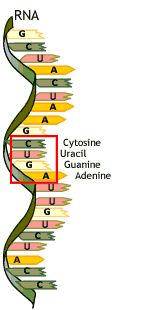

The process represented in the diagram above produces a molecule that is single-stranded and has copied nucleotide sequences from the template strand of DNA. What type of molecule is produced in this process?
New DNA
Polypeptide
mRNA
Carbohydrate


A diagram of a cellular process is shown below. Which of the following identifies the process shown at point Z?
Translation
Mutation
Replication
Transcription

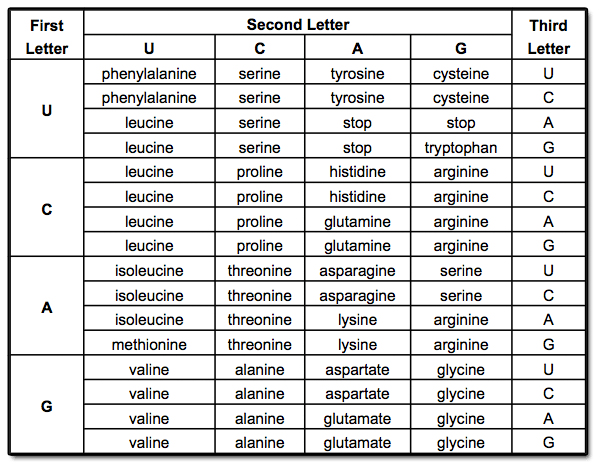
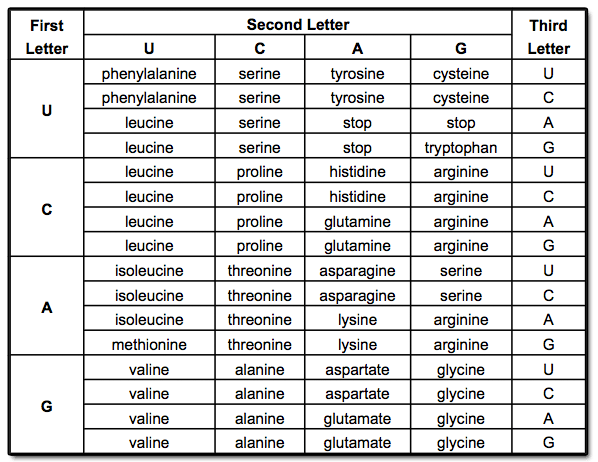
During transcription, the DNA base sequence is transcribed into an mRNA sequence. A codon chart like the one shown below lists the amino acids coded for by particular triads of mRNA bases. A segment of DNA has undergone a mutation in which one nucleotide has been changed. The original sequence was ATA, and the mutated sequence is ATG. Use the codon table to determine whether or not this mutation will cause a change in the protein of the organism.
Yes, the protein of the organism would change because a new amino acid will be coded for.
Yes, the protein of the organism would change because changes in the DNA sequence will always cause a change in proteins.
Even though the DNA sequence changed, the sequence still codes for the same amino acid, so no change in the protein will occur.
It is impossible to determine if a change in proteins will occur using only the DNA sequence.

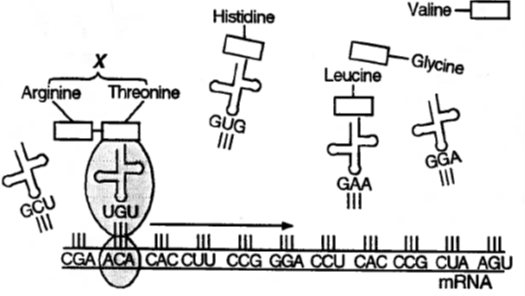
A student constructed a model to illustrate some of the processes involved in the production of proteins in a eukaryotic cell.
Which statement correctly describes the structure and activity identified by the letter X?
A tRNA molecule reacts with an amino acid to produce ribosomal RNA.
A tRNA molecule transports an amino acid for incorporation into a polypeptide.
An rRNA molecule carries an amino acid away from the site of protein synthesis.
An mRNA molecule transports a single amino acid to the site of protein synthesis.

This diagram represents part of the process of translation. One tRNA molecule has transported the amino acid methionine (met) to the mRNA. Another tRNA molecule has transported the amino acid tryptophan (trp) to the mRNA.
Which step is next during translation?
The tRNA will attach to nucleotides in the cytoplasm.
A peptide bond will form between the two amino acids.
The mRNA carrying the amino acids will drop off the ribosome.
The amino acids will be carried to the Golgi apparatus for packaging.


Amino acids are the building blocks of which macromolecule?
DNA
Liquid
Protein
Carbohydrate

Which of the following organic molecules is composed of chains of amino acids?
proteins
carbohydrates
lipids
nucleic acids

Which of the following gives the correct terms?
Definition A: transcription; Definition B: translation
Definition A: translation; Definition B: transcription
Definition A: telophase; Definition B: prophase
Definition A: prophase; Definition B: telophase

The processes defined above are the the two stages of which critical life function?
protein synthesis
osmosis
aerobic respiration
photosynthesis
Which of the following are differences in the structure between RNA and DNA, choose all that apply
DNA uses deoxyribose sugar, RNA uses sugar ribose
DNA pairs Adenine with Uracil, RNA pairs Adenine with Thymine
DNA is a double helix, RNA is a single helix
DNA pairs Adenine with Thymine, RNA pairs Adenine with Uracil
Which organelle is the location where protein is made?
Ribosome
Nucleus
Cytoplasm
Nucleotide
During transcription, this type of ribonucleic acid is responsible for copying the DNA and brining it out of the nucleus.
tRNA
mRNA
rRNA
dRNA
When these bond together, they form a protein
Amino Acids
Peptide Bonds
Ribose
Nucleotides
These building blocks consist of a sugar, phosphate, and nitrogen base.
Ribose
Nucleotide
Gene
Protein
A string of nucleotides that contain the information to make a specific protein
Ribose
Amino Acids
tRNA
Gene
During translation, this type of ribonucleic acid is responsible for delivering amino acids to help make a protein.
mRNA
rRNA
tRNA
dRNA
There are a total of ____ different amino acids
20
1
4
unlimited
mRNA occurs during this process
Translation
Transcription
Replication
Delivery
How many amino acids are found on one tRNA?
20
4
1
3
Which of the following is the complementary mRNA sequence to this DNA strand: AAC TGA
UUG ACU
TTG ACT
AAC TGA
AAC UGA
Which of the following is the tRNA that will be used to decode to this DNA strand: AAC TGA
AAC and TGA
TTG and ACT
UUG and ACU
AAC and UGA


ATG TGA CAG

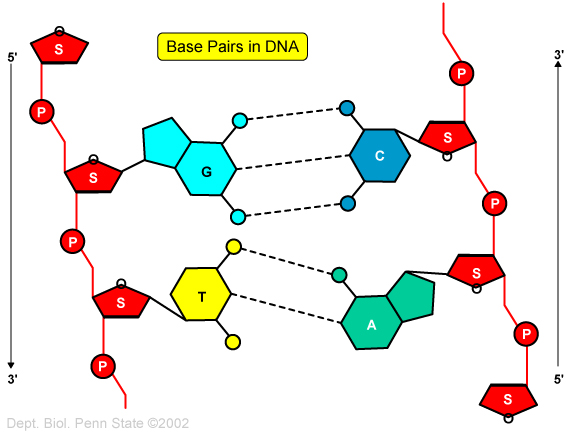


In DNA, adenine pairs with?
Cytosine
Guanine
Adenine
Thymine

Cytosine pairs with?
Thymine
Adenine
Cytosine
Guanin

Guanine pairs with?
Adenine
Thymine
Gaunine
Cytosine

Thymine pairs with?
Thymine
Adenine
Guanine
Cytosine

In RNA, adenine pairs with?
Adenine
Thymine
Uracil
Guanine

What is the complementary strand of DNA for GAT?
TAG
CTA
CAT
AGT

What type of bonds hold two strands of DNA together to make a double helix?
Ionic bonds
Polar bonds
Hydrogen bonds
Nitrogen bonds

What amino acid does AUG code for?
Stop
Met
Leu
Asp
Finish this sentence: DNA replication results in two DNA molecules,
each with 2 new strands
one with 2 new strands and the other with 2 original strands
each with one new strand and one original strand
each with 2 original strand
Based on Chargaff's rule, the percentage of guanine is _____ the percentage of cytosine
greater than
lesser than
equal to
not related
In eukaryotes, DNA is found in
the cytoplasm
the nucleus
the ribosomes
the polymerase
A nucleotide is made of all of the following except
a sugar
a nitrogen
a phosphate group
a codon
RNA has all of the following except
ribose
nitrogen base
phosphate group
deoxyribose
Which base is not found in RNA?
Adenine
Uracil
Thymine
Cytosine
In eukaryotes, where does transcription take place?
cytoplasm
nucleus
ribosome
rRNA
Transcription produces what molecule?
DNA
mRNA
tRNA
rRNA
Proteins are produced from what process?
Replication
Transcription
Translation
Duplication
mRNA is produced from what process?
Replication
Translation
Transcription
Duplication
In eukaryotes, where is mRNA produced?
ribosome
cytoplasm
nucleus
histone
Where are proteins produced?
DNA
ribosome
nucleus
histone
How many nucleotides are needed to specify for two amino acids?
6
9
12
3
Which of the following is not a type of RNA?
cytoplasmic
ribosomal
transfer
messenger
What type of RNA is responsible for carrying messages from DNA to make proteins?
mRNA
rRNA
tRNA
RANi
Which type of RNA is responsible for transporting amino acids to the ribosome?
tRNA
mRNA
rRNA
RNAi
What type of RNA makes up the subunits of the ribosome?
rRNA
mRNA
tRNA
RNAi
From what molecules are mRNA molecules transcribed?
tRNA
proteins
mRNA
DNA
What happens during translation?
mRNA is produced
copies of DNA are made
the RNA is decoded into amino acids
tRNA is produced from mRNA
Which of the following could make up one nucleotide of DNA?
Deoxyribose, phosphate group, thymine
Deoxyribose, phosphate group uracil
Ribose, phosphate group, thymine
Ribose, phosphate group, uracil
Which of the following could make up a nucleotide of RNA?
Deoxyribose, phosphate group, thymine
Deoxyribose, phosphate group, uracil
Ribose, phosphate group, uracil
Ribose, phosphate group, thymine
Which of the following is not a difference between RNA and DNA?
The sugar in RNA is ribose instead of deoxyribose
RNA is generally single stranded and not double straned
RNA contains uracil in place of thymine
DNA has a ribose backbone, RNA has a deoxyribose backbone
All of the following is true in regards to DNA except
All living things contain DNA
DNA is only found in plant cells
DNA is found in the nucleus of cells
DNA contains genetic code
Purines are double ring structures
True
False
Purines always pair with
Purines
Pyrimidines
In 1953, _______________ & ______________________ discovered the structure of DNA.
Lewis & Clark
Johnson & Johnson
Watson & Crick
Gulbrandson & Ud
If you had to describe the shape of DNA, you would say it is
Oblong
Double helix
Pentagon
Replication
DNA replication occurs ___________ cell division
before
after
at the same time as
1 month before
The three types of RNA are
mRNA, tRNA, sRNA
mRNA, tRNA, dRNA
mRNA, tRNA, pRNA
mRNA, tRNA, rRNA
Amino acids make up
carbohydrates
proteins
sugars
gas molecules
What is the name given to a group of 3 nucleotides on a mRNA?
Codons
Anti-codons
RNA
Triplet
What is the process called where mRNA is created/made?
Replication
Transcription
Transloation
Transformation
Transcription occurs in the _____ of the cell
ribosome
cell wall
mitochondria
nucleus
What is the process called where mRNA is converted into amino acids?
Replication
Transcription
Translation
Transformation
Translation occurs in the _____________ part of the cell
mitochondria
nucleus
golgi body
ribosome
ATG TGA CAG


Match the following nucleotide with its complementary base, DNA
Adenine
Thymine
Cytosine
Guanine
Guanine
Cytosine
Thymine
Adenine
Drag the amino acids to their correct location in the protein.
Ala
Agr
Cys
Leu
Ser
mRNA is synthesized during (a)
mRNA is made in the
DNA is located in the _________
mRNA is made of three letters called
Codons
Anti-codons
Triplets
_______ is used to carry the genetic code from the DNA to the ribosome
rRNA
tRNA
mRNA
Which type of RNA makes up ribosomes?
mRNA
tRNA
rRNA
(a) uses uracil instead of thymine
Match the following
3 codons equals
one amino acid
3 DNA bases
triplet
3 mRNA bases
codon
3 tRNA bases
anti-codon
Where does transcription take place? Drag and drop your answer
Ribosome
Endoplasmic reticulum
Golgi body
Nucleus
Cytoplasm
Chloroplast
Vacuole
Match the following
mRNA
DNA to RNA
tRNA
moves amino acids
rRNA
makes ribosomes
Match the following
Triplet
DNA
Codon
mRNA
Anti-codon
tRNA

Where are protein synthesized?
Nucleus
Ribosomes
Mitochondria
Chloroplast
Which type of bond attaches the amino acid to the chain?
Hydrogen bonds
Ionic bonds
Covalent bonds
Peptide bonds
Where is tRNA located in the cell?
Nucleus
Ribosomes
Mitochondria
Cytoplasm
Which organelle convert mRNA to proteins?
Nucleus
Ribosomes
Mitochondria
Cytoplasm
Where does translation occur?
Nucleus
Ribosomes
Mitochondria
Cytoplasm
Converts DNA to mRNA
Converts RNA into proteins
The first step in protein synthesis
The second step in protein synthesis

