wayground logo

Free Printable Worksheets

Font size

S
M
L
XL
Worksheets

2nd Semester Review

Total questions: 176

Worksheet time: 4hrs 55mins

Name
Class
Date
1.
I am single stranded.
a)
DNA
b)
RNA
c)
Both DNA and RNA
2.
I am found ONLY in the nucleus of eukaryotic cells.
a)
DNA
b)
RNA
c)
Both DNA and RNA
3.
I am a nucleic acid.
a)
DNA
b)
RNA
c)
Both DNA and RNA
4.
I am arranged as a double helix or "twisted ladder."
a)
Both DNA and RNA
b)
DNA
c)
RNA
5.
I have the sugar ribose.
a)
RNA
b)
DNA
c)
Both DNA and RNA
6.
I have the sugar deoxyribose.
a)
RNA
b)
DNA
c)
Both DNA and RNA
7.
I include the bases guanine, cytosine, and adenine.
a)
DNA
b)
RNA
c)
Both DNA and RNA
8.
In eukaryotic cells, I travel out of the nucleus to a ribosome.
a)
Both DNA and RNA
b)
DNA
c)
RNA
9.
I have the base thymine.
a)
Both DNA and RNA
b)
RNA
c)
DNA
10.
I have the base uracil.
a)
RNA
b)
DNA
c)
Both DNA and RNA
11.
In a strand of DNA, if it contains 20% of Thymine, then how much Guanine would be present?
a)
30%
b)
20%
c)
80%
d)
10%
12.
Which sequence of DNA bases would pair with this partial strand
ATG TGA CAG
a)
ATG TGA CAG
b)
TAC ACT GTC
c)
GTA AGT GAC
d)
CAT TCA CTG
13.
Which of the following best describes a DNA molecule?
a)
double helix
b)
contains ribose
c)
made of amino acids
d)
contains Uracil
14.
Which of the following units are repeatedly joined together to form a strand of DNA?
a)
amino acids
b)
nucleotides
c)
fatty acids
d)
polysaccharides
15.
Guanine bonds with ______________.
a)
Adenine
b)
Guanine
c)
Cytosine
d)
Thymine
16.
In a molecule of double-stranded DNA, the amount of Adenine present is always equal to the amount of
a)
cytosine
b)
guanine
c)
thymine
d)
uracil
17.
Why is DNA important?
a)
it is very small and very complicated
b)
it's in everything
c)
it serves as the blueprint for traits of all living things
d)
because we eat it every day for energy
18.
What determines the code, or information, of a DNA molecule?
a)
the shape (structure) of the nitrogen bases
b)
the order (sequence) of the nitrogen bases
c)
the color of the nitrogen bases
d)
the frequency (number) of nitrogen bases
19.
Which 2 molecules form the sides (backbone) of the DNA ladder?
a)
deoxyribose sugar and adenine
b)
deoxyribose sugar and a hydrogen bond
c)
deoxyribose sugar and the nucleus
d)
deoxyribose sugar and phosphate
20.
What are the three components of a nucleotide?
a)
sugar, hydrogen, nitrogen base
b)
sugar, oxygen, nitrogen base
c)
sugar, phosphate, nitrogen base
d)
sugar, phosphate, protein
21.
A process in which DNA has the unique ability to make an exact copy of itself.
a)
Replication
b)
Translation
c)
Transcription
22.
Nitrogenous bases are joined by which type of bond?
a)
polar bonds
b)
ionic bonds
c)
covalent bonds
d)
hydrogen bonds
23.
The following picture must be
a)
DNA because it's double stranded
b)
RNA because it's single stranded
c)
DNA because it's single stranded
d)
RNA because it's double stranded
24.
Which two scientists are accredited with correctly deducing the double helix model of DNA?
a)
Watson and Crick
b)
Wilkins and Franklin
c)
Wilkins and Crick
d)
Watson and Franklin
25.
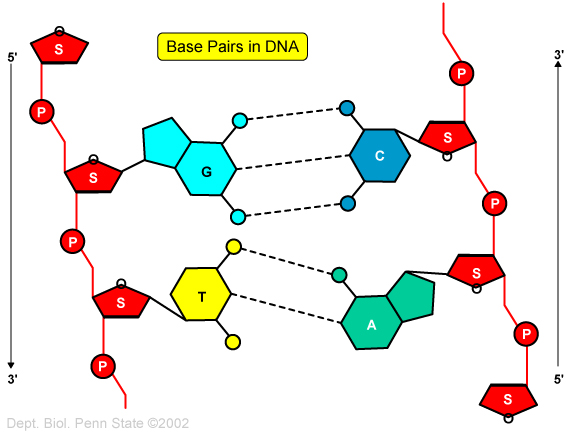
What does this picture represent?
a)
amino acid
b)
base pairing
c)
nucleotide
d)
the DNA molecule
26.
The enzyme that unwinds the DNA to prepare for replication
a)
helicase
b)
replicase
c)
polymerase
d)
synthase
27.
DNA replication results in two DNA molecules,
a)
each one with two original strands
b)
each one with two new strands
c)
each one with one new strand and one original strand
d)
one with two new strands and the other with two original strands
28.
Which enzyme is responsible for adding nucleotides?
a)
Topoisomerase
b)
DNA Polymerase
c)
Ligase
d)
Primase
29.
The process of DNA replication is called semi conservative because it results in
a)
none of these
b)
Two DNA molecules.  One original molecule and one with two new strands
c)
two exact copies with new strands
d)
two identical molecules, each with 1 original strand and one new.
30.
Based on the diagram, how many origins of replication are represented?
a)
1
b)
2
c)
3
d)
4
31.
Place the following in sequential order
1. Recoil
2. Straightens the double helix
3. Breaks Hydrogen bonds
4. Adds Free nucleotides
a)
1, 2, 3, 4
b)
3, 4, 2, 1
c)
3, 2, 4, 1
d)
2, 3, 4, 1
32.
Based on the diagram, the enzyme (represented in gray) is most likely...
a)
DNA polymerase
b)
DNA Ligase
c)
Nuclease
d)
Helicase
33.

How many nucleotides make up a codon?

a)

1

b)

3

c)

5

d)

15

34.

How many codons: AAU GCG AUG

a)

9

b)

1

c)

3

d)

15

35.
ATCAGTGAT A codon is a sequence of three nucleotides that code for an amino acid. If the DNA sequence shown here goes through transcription and translation, how many amino acids will result from this sequence?
a)
5
b)
4
c)
2
d)
3
36.
Translation is a process that produces
a)
mRNA
b)
Protein
c)
Polypeptide Chains
d)
tRNA
37.
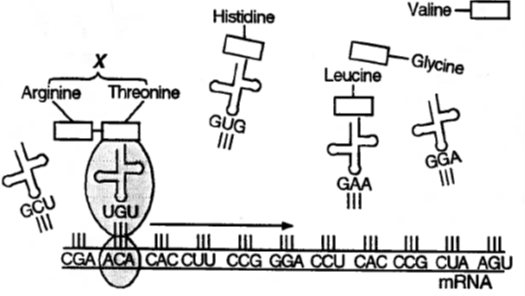
What process is going on in this photo? 
a)
Transcription 
b)
Translation 
c)
Replication 
d)
All the above 
38.

What is the order for Protein Synthesis?

a)

Transcription -> Translation -> Protein

b)

Translation - > Transcription -> Protein

c)

Protein -> Transcription -> Translation

d)

Translation -> Protein -> Transcription
39.
tRNA is involved in
a)
carrying amino acids 
b)
carrying ribosomes
c)
carrying glucose
d)
carrying lipids
40.
What is the location in the cell for translation?
a)
nucleus
b)
mitochondria
c)
ribosome
d)
chloroplast
41.
Which Seq could be found in RNA?
a)
ACCTGT
b)
CGCATT
c)
AUGCUU
42.
Amino acids are joined together in order to form
a)
DNA
b)
ribosomes
c)
proteins 
d)
RNA
43.
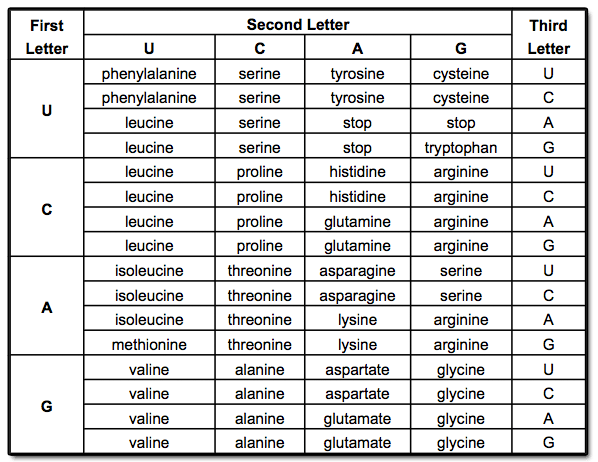
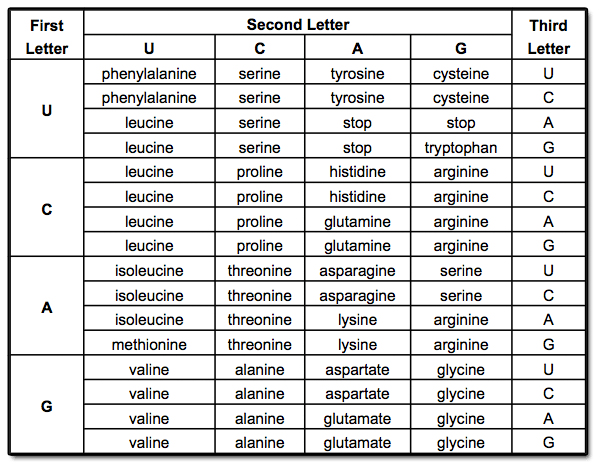
What amino acid is represented by the codon UUA?
a)
Phenylalanine
b)
Tyrosine
c)
Leucine
d)
Stop codon
44.
What is the correct amino acid sequence for the mRNA code AUGCCAGUAUGA
a)
Met-Pro-Ala-Val
b)
Met-Pro-Val
c)
Tyr-Gly-His
d)
Tyr-Gly-Arg-His
45.
What amino acid is represented by the codon UUA?
a)
Phenylalanine
b)
Tyrosine
c)
Leucine
d)
Stop codon
46.
The codon CCU codes for what amino acid?
a)
Isoleucine
b)
Stop
c)
Methionine
d)
Proline
47.
Which amino acid pairs with the codon AGA
a)
Thr
b)
Arg
c)
Ala
d)
Glu
48.

Organic compound made of amino acids that is responsible for cell specialization, gene expression, growth, repair and many critical cellular functions

a)

gene therapy

b)

protein

c)

codon

d)

amino acids

49.
What is does this image represent? 
a)
Mutation
b)
Translation 
c)
tRNA
d)
Transcription 
50.
How are mutations passed on to offspring?
a)
Any mutation that an organism acquires in its life can be passed on to the offspring through its gametes (sex cells)
b)
Only mutations that occur in the gametes can be passed on to the offspring
c)
Mutations are not usually passed on to the offspring. A mutation stays within the original organism.
d)
Mutations are not passed to offspring. They only occur within developing embryos.
51.
What do helpful mutations do? 
a)
Increases chances of survival 
b)
Decreases changes of survival 
c)
Increases chances of developing cancer
d)
Decreases skills
52.

Mutation

a)

a DNA segment in a chromosome that is a copy of another segment

b)

the loss or excision of a section of genetic code, or its product

c)

the set of observable characteristics of an individual

d)

the changing of the structure of a gene, resulting in a variant form

53.
What is heredity?
a)
A kind of genetic disorder
b)
The way DNA divides
c)
A trait you inherit from your parents
d)
The passing down of traits from parents to children
54.
What is the relationship between DNA and chromosomes?
a)
Chromosomes are made of DNA
b)
DNA is made of chromosomes
c)
DNA and chromosomes are the same thing.
d)
All of the above are correct
55.
How many pairs of chromosomes exist in each of your cells?
a)
10
b)
12
c)
23
d)
46
56.
Are recessive traits shown with capital or lowercase letters? 
a)
Capital
b)
Lowercase
57.
The physical appearance or the way a gene looks is known as it's....
a)
genotype
b)
allele
c)
gene
d)
phenotype
58.
The mathematical chance that something will happen is known as...
a)
chance
b)
luck
c)
probability
59.
The different forms of genes are known as
a)
environment
b)
probability
c)
traits
d)
alleles
60.
An allele or gene that always shows is
a)
recessive
b)
dominant
c)
hidden
d)
present
61.
Two of the same genes for a trait (sometimes called purebred). BB or bb
a)
homozygous
b)
hetrozygous
c)
protein
d)
chromosome
62.
Two different genes for a trait (sometimes called hybrid). Bb
a)
protein
b)
homozygous
c)
heterozygous
d)
genotype
63.
What would the ratio for genotypes be for this Punnett Square?
a)
2Bb:2bb
b)
2BB:2Bb
c)
1BB:2Bb:1bb
d)
4Bb
64.
G = dominant green and y = recessive yellow
A fish has a Gy genotype, what will its phenotype be?
a)
yellow
b)
green
c)
greenish-yellow
d)
red
65.
T - tall and t = short
In the punnett square below, what belongs in the missing square
a)
tt
b)
Tt
c)
Bb
d)
TT
66.
Dominant alleles are represented by a:
a)
Male gene
b)
lowercase letter
c)
recessive trait
d)
capital letter
67.
A ________________________ is used to predict the possible genotype from certain parents
a)
Mendel Grid
b)
Genetic Tic Tac Toe
c)
Punnett Square
d)
Pedigree Plot
68.
Heredity is the passing of traits from _____________________ to _____________________
a)
predators to prey
b)
water to rain
c)
parents to offspring
d)
fungi to protists
69.
___________________________ is the field of science that studies of how traits are passed on, or inherited.
a)
dominant traits
b)
ratio
c)
phenotype
d)
genetics
70.
Which is a true statements about this picture?
a)
Brown is recessive
b)
Brown is dominant
c)
Blue is dominant
d)
Blue is codominant
71.
What are the possible phenotypes in this punnett square?
a)
Bb, bb, BB
b)
purple, white
c)
Bb, bb
d)
light purple
72.
What is a gene?
a)
An entire chromosome that  codes for a trait
b)
a piece of clothing
c)
a piece of a DNA on chromosome that codes for a trait
d)
Chemical messengers in your brain that code for a trait
73.
What is a genotype? 
a)
The genetic make up (code)
b)
The physical trait
74.
This type of inheritance pattern is a MIXTURE of both traits.
a)
incomplete dominance
b)
co-dominance
c)
complete dominance
75.
A calico cat shows both the traits for orange fur and black fur. What kind of allele expression is this?
a)
Incomplete Dominance
b)
Co dominance
76.
A red flowered plant (RR) breeds with a White flowered plant (WW). The gene for petal color in these plants expresses incomplete dominance.  What percentage of the offspring will have pink (RW) flowers?
a)
0%
b)
25%
c)
50%
d)
100%
77.
If a woman is a carrier for a sex linked recessive trait of hemophilia and her husband has hemophilia, which of the following is true
a)
All sons will have hemophilia
b)
all daughters will have hemophilia
c)
50% of daughters and 50% of sons have hemophilia
d)
100% of sons have hemophilia and 100% of daughters are carriers
78.
What percentage of the female offspring will be a carrier for this recessive disease?
a)
0%
b)
50%
c)
100%
d)
25%
79.
In fruit flies, eye color is a sex linked trait. Red is dominant to white. What would be the percentages of offspring of a cross of a white eyed female with a red-eyed male?
a)
1 female white eyes, 1 female red-eyes, 1 male white eyes, 1 male red-eyes
b)
2 female red eyes, 2 males white eyes
c)
2 female white eyes, 2 males red eyes
d)
2 female red eyes, 1 male red eyes, 1 male white eyes
80.
A personal with type AB blood has which genotype?
a)
type A
b)
AA
c)
IAIA
d)
IAIB
81.
Hemophilia is a x-linked disorder.  A woman is a carrier for the disorder.  Which is the correct genotype?
a)
Hh
b)
XHXh
c)
hh
d)
XhXh
82.
If a trait is controlled by one gene, but there are 4 possible alleles, the inheritance pattern is called...
a)
dominance
b)
sex-linked
c)
multiple alleles
d)
polygenic
83.
Which of the following statements is true regarding blood types?
a)
A and O are codominant, B is recessive.
b)
B and O are codominant, A is recessive.
c)
A and B are codominant, O is recessive.
d)
A , B and O are all codominant with each other.
84.
An individual with XX chromosomes would be ____________.
a)
Male
b)
Female
85.
True or False: Men can NEVER be "carriers" for recessive sex-linked traits because they only have one X chromosome.
a)
True
b)
False
86.
A red lily crossed with a yellow lily produces heterozygous orange lily flowers. This is an example of which type of inheritance?
a)
Codominance
b)
Incomplete Dominance
c)
Sex Linked
d)
Polygenic Trait
87.
A yellow fish, when crossed with a blue fish, produces heterozygous fish with blue AND yellow scales. This is an example of which type of inheritance?
a)
Sex Linked
b)
Polygenic
c)
Codominance
d)
Incomplete Dominance
88.
Phenotypes which result as a combination of MANY genes, such as skin color and eye color, are known as ______________ traits.
a)
Monogenic
b)
Dihybrid
c)
Multiple Allele
d)
Polygenic
89.
If a woman is a carrier for a sex linked recessive trait of hemophilia and her husband has hemophilia, which of the following is true? Make a punnett square!
a)
All sons will have hemophilia
b)
all daughters will have hemophilia
c)
50% of daughters and 50% of sons have hemophilia
d)
100% of sons have hemophilia and 100% of daughters are carriers
90.
 Colorblindness is a trait that is seen more often in males and is passed to them by their mothers, who may not be colorblind.  Colorblindness is...
a)
a codominant trait
b)
a sex-linked trait
c)
carried on the Y chromosome
d)
associated with a dominant allele
91.
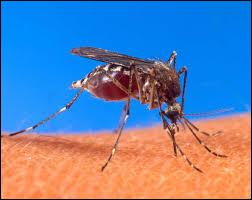
Mosquito  belongs to what kingdom?
a)
Animal Kingdom
b)
Plant Kingdom
c)
Fungi Kingdom
d)
Protista Kingdom
92.

Organisms in this smallest taxonomic group share many characteristics.

a)

domain

b)

kingdom

c)

species

d)

class

93.

The science of describing, classifying, and naming living things is called:

a)

Geology

b)

Biology

c)

Taxonomy

d)

Chemistry

94.

The scientific name for an organism is made from the:

a)

class and family name

b)

genus and species name

c)

domain and kingdom name

d)

kingdom and phylum name

95.

An example of an unicellular organism would be:

a)

monkey

b)

bacteria

c)

spider

d)

human

96.

Which 2 organisms would be able to reproduce and produce fertile offspring?

a)

2 organisms in the same class

b)

2 organisms in the same family

c)

2 organisms in the same genus

d)

2 organisms in the same species

97.

What kingdom do unicellular, prokaryotic organisms that live in extreme environments?

a)

Animal

b)

Archaebacteria

c)

Eubacteria

d)

Plant

98.

I am prokaryotic and am found everywhere. What kingdom do I belong to?

a)

Eubacteria

b)

Archaebacteria

c)

Fungi

d)

Protista

99.

This organism is multicellular, heterotroph, that has a cell wall made of chitin. What kingdom does it belong in?

a)

fungi

b)

plantae

c)

animalia

d)

eubacteria

100.

This organism is found in pond water. It has a nucleus, is microscopic, unicellular and can perform photosynthesis. What kingdom does it belong in?

a)

protista

b)

eubacteria

c)

archaebacteria

d)

plantae

101.

Who first proposed binomial nomenclature as a way of classifying organisms?

a)

Carolus Linnaeus

b)

Aristotle

c)

Charles Darwin

d)

Louis Pasteur

102.
The scientific theory of evolution is supported by different types of evidence. The diagrams below show the skeletons of two different animal species. How does comparing the skeletons of these animals provide support for the scientific theory of evolution?
a)
 It provides information about the organisms' habitats.
b)
 It shows possible common ancestry between organisms.
c)
It provides information to determine the organisms' ages.
d)
It shows possible chromosomal similarities between organisms.
103.
According to fossil records, the horses that lived 50 million years ago were much smaller, weaker and slower than modern horses. Which process is most likely responsible for the changes that have led to the increased size, strength, and speed in horses?
a)
commensalism
b)
inbreeding
c)
migration
d)
evolution by natural selection
104.
The diagram illustrates an embryonic stage of two organisms.Which of the following can be determined by observing the embryos shown in the diagram? 
a)
The organisms share a common ancestry.
b)
The organisms belong to the same genus.
c)
The organisms are native to the same geographic areas.
d)
The organisms will grow into anatomically similar adults.
105.
Scientists have found evidence that about 2.4 million years ago a gene regulating jaw muscles mutated and may have led to the more graceful human jaw we see today. The diagram below shows the skulls of 3 hominid species.Which statement below most closely explains the link between jaw size and hominid evolution? 
a)
The jaws of hominids evolved to be smaller and less protruding over time. 
b)
The jaws of hominids evolved to be smaller and less protruding over time. 
c)
There appears to be no change in the jaws of hominids over time.
d)
The jaws of hominids changed over time due to a change in brain size. 
106.
Scientists are studying the evolutionary history of a group of plants in the United States, and they developed an evolutionary tree, as shown below.Which statement can be inferred from the evolutionary tree?
a)
Species 1 is most closely related to Species 8.
b)
Species 2 is most closely related to Species 3.
c)
Species 3 is most closely related to Species 7.
d)
Species 5 is most closely related to Species 6.
107.
 The diagram represents the relationship between beak structure and food in several species of finches found on the Galapagos Islands. The different beak structures observed in the diagram are evidence of
a)
 different species of finches adapting to different environments over many generations
b)
 finches changing their beak characteristics so that they could feed efficiently
c)
finch species with different beak structures coming to the Galapagos Islands from the mainland
d)
 finches mating with birds of other species and acquiring some of their traits
108.
Natural selection is best described as
a)
a change in an organism in response to a need of that organism
b)
a process of nearly constant improvement that leads to an organism that is nearly perfect
c)
differences in survival rates as a result of different inherited characteristics
d)
inheritance of characteristics acquired during the life of an organism
109.
Which occurrence represents an example of evolution?
a)
 Exposure to radiation reduces the rate of mutation in leaf cells.
b)
A mutation in a liver cell causes a person to produce an enzyme that is less efficient.
c)
 Cells in a zygote eventually change into bone cells or skin cells
d)
Some antibiotics are almost useless, because pathogens have developed a resistance to these antibiotics.
110.
In recent years "SuperBugs" (bacteria that aren't effected by antibiotics) are becoming more and more common. How could natural selection explain this?
a)
Superbugs survive antibiotics and reproduce
b)
Antibiotics cause bacteria to become superbugs
c)
We have always had the same amount of superbugs; modern media just discusses them more.
d)
There is no reliable data on the origin of super bugs.
111.
Which of these is an example of natural selection?
a)
The largest animal in a population will have more opportunities for reproduction.
b)
Several species of organisms work together so that they all succeed.
c)
One species takes all the resources in an environment leaving none for others.
d)
Organism that are best suited to an environment tend to survive and reproduce more often.
112.
Which of the following explains adaptation.
a)
An individual organism changes to meet its needs in the environment. These changes pass down to their offspring.
b)
The species as a whole changes their characteristics.
c)
Beneficial traits allow organism to survive and pass on those traits
d)
New characteristics arise in a species as needed.  If these traits are helpful, they are passed down.
113.
A large herd of goats lives in a field full of poison ivy.  Some goats are able to eat the poison ivy while others have become sick when they eat it. Over time the herd as a whole will tend to
a)
Become more likely to eat poison ivy.
b)
Become less likely to eat poison ivy.
c)
Not change in the proportion of goats that can and can not eat poison ivy.
d)
Eat all the poison ivy and leave only plants all the goats can eat.
114.
Darwin studied which of these species on Galapagos?
a)
Pigeons and tortoises
b)
Tortoises and finches
c)
Finches and Pigeons
d)
Zebras and Mockingbirds
115.
Which of these would best form a fossil?
a)
Muscle
b)
Bone
c)
Skin 
d)
Leaves
116.
What might account for the fact that all of these limbs share similar structures?
a)
They came from the same source
b)
They are all from one animal
c)
They are very similar organisms
d)
Cooincidence
117.
Define homologous structures.
a)
Structures that appear the same, but have different ancestral origins.
b)
Structures that appear the different, but have the same ancestral origins.
c)
Any two body parts from the same organism
d)
Parts that no longer appear to have a function
118.
Define analogous structures.
a)
Structures that appear the same, but have different ancestral origins.
b)
Structures that appear the different, but have the same ancestral origins.
c)
Any two body parts from the same organism
d)
Parts that no longer appear to have a function
119.

Darwin observed many finch species on the Galapagos Islands. To explain these observations, he

proposed that each species evolved from the same common ancestor, which was a finch species

that migrated to the islands from the mainland. What additional evidence did Darwin use to support

his explanation?

a)

The finch populations were very numerous, and different species often bred with one another.

b)

The finch species lived in different habitats on different islands, which isolated them from one another.

c)

The finch species were distributed evenly among all of the islands, but did not interbreed.

d)

The beaks of the finches were identical, allowing them to eat the same foods on any of the islands.

120.

A population of rabbits grows rapidly from one year to the next. Then one year, a disease strikes approximately one fourth of the adult rabbits. The disease remains with the population in the years that follow.

As explained by Darwin’s theory, which of these conditions allows the rabbit population to evolve by natural selection?

a)

The disease affects adult and juvenile rabbits equally.

b)

The disease reduces the ability of the rabbits to reproduce.

c)

Some rabbits are resistant to the disease, and they pass the resistance to their offspring.

d)

No rabbits are resistant to the disease, and all die when the disease strikes them.

121.

Which of the following is a situation that could cause evolutionary change that is NOT due to natural selection?

a)

A volcano erupts and kills many individuals in a population.

b)

A mutation produces sea stars that are less visible to predators.

c)

An insecticide is sprayed in a community to combat mosquitoes.

d)

Cattle are treated with antibiotics to prevent the spread of infections.

122.

What do we call the groups in which we classify organisms?

a)

Categories

b)

Classes

c)

Sets

d)

Taxons

123.

The LARGEST classification group (at the top) is:

a)

Very exclusive

b)

Very inclusive

c)

Very small

d)

Very specific

124.

The smallest classification group consists of:

a)

Organisms that are very different

b)

Organisms that do not look the same

c)

Organisms that are very similar

125.

Why is the most specific taxonomy category?

a)

Kingdom

b)

Domain

c)

Species

d)

Order

126.

What is the most exclusive taxon?

a)

Domain

b)

Family

c)

Species

d)

Order

127.

What is the most inclusive taxon?

a)

Phylum

b)

Order

c)

Class

d)

Domain

128.

What would the scientific name of this organism be?

Kingdom: Animalia

Phylum: Chordata

Class: Reptilia

Order: Crocodila

Family: Alligatoridae

Genus: Alligator

species: mississippiensis

a)

alligator Mississippiensis

b)

Crocodila chordata

c)

Alligator mississippiensis

d)

Reptilia crocodila

129.

What would the scientific name of this organism be?

Kingdom: Animalia

Phylum: Chordata

Class: Mammalia

Order: Carnivora

Family:Canidae

Genus: Canis

species: mesomelas

a)

Mammalia carnivora

b)

Canidae mesomelas

c)

Canis mesomelas

d)

Animalia chordata

130.

What would the scientific name of this organism be?

Kingdom: Animalia

Phylum: Chordata

Class: Aves

Order: Charadriiformes

Family: Laridae

Genus: Thalasseus

species: maximus

a)

thalassues maximus

b)

Anamalia maximus

c)

Aves chordata

d)

Thalassues maximus

131.

Who created the system of Taxonomy?

a)

Albert Einstein

b)

Carolus Linnaeus

c)

Aristotle

d)

Copernicus

132.

Binomial Nomenclature takes which two taxons to name a species?

a)

Genus and Kingdom

b)

Phylum and Class

c)

Family and class

d)

Genus and species

133.
How does a virus cause a person to develop the common cold?
a)
invades the host cell to reproduce
b)
removes energy from the host cell
c)
produces toxins in the host cell
d)
protects the host cell from bacteria
134.
What part of the phage is the DNA?
a)
A
b)
B
c)
C
d)
D
135.
Antibiotics kill viruses
a)
True
b)
False
136.
True or False
The flu is caused by a virus.
a)
true
b)
false
137.
A(n) _____ is a virus that enters a bacterial cell.
a)
endospore
b)
decomposer
c)
plasmid
d)
bacteriophage
138.
When a virus invades a living cell, its _______
takes over the cell's functions.
a)
outer coat
b)
genetic material
c)
core
d)
cytoplasm
139.
What part of a virus is the protein capsule that houses the genetic material (DNA/RNA)?
a)
tail
b)
nucleus
c)
capsid
d)
glycoprotein
140.
Which type of replication allows viral genetic material to lay dormant while the host cell reproduces?
a)
active (lytic)
b)
mitosis
c)
hidden (lysogenic)
d)
cellular respiration
141.
What do viruses need to reproduce?
a)
they need genetic material
b)
They need a host cell
c)
They need  bacteria
d)
They need insulin
142.
Which of these is an animal virus?
a)
Tobacco mosaic virus
b)
bacteriophage
c)
influenza
d)
Lyme disease
143.
Viruses are...
a)
prokaryotic
b)
eukaryotic
c)
non-living
d)
endospores
144.
Viruses 
a)
have many cells
b)
are misfolded proteins
c)
are a protein coat around genetic material
d)
endospores
145.
Viruses can reproduce on their own
a)
False
b)
True
c)
Sometimes
146.
What is the main function of the projections on the surface of a virus?
a)
They aid in respiration
b)
They help the virus grow
c)
They help the virus invade its host by attaching to specific sites on the host
d)
They help the virus digest food molecules
147.
Reasons that viruses are considered to be nonliving is because
a)
They are not cellular
b)
They cannot reproduce on their own
c)
They cannot make proteins
d)
all of the above
148.
Which can be treated with antibiotics?
a)
Virus
b)
Bacteria
c)
Mutagen
d)
Parasite
149.
What are pathogens?
a)
FDA
b)
MRSA
c)
Ebola
d)
Disease causing agents (germs)
150.
The bacteria Kingdom where you can find bacteria from extreme environments is called
a)
Archaebacteria
b)
Eubacteria
c)
Viruses
d)
Cyanobacteria
151.
Round shaped bacteria is called
a)
coccus
b)
bacillus
c)
spirillum
152.
bacteria reproduces using
a)
binary fission
b)
mitosis
c)
sexual reproduction
d)
splitting
153.
Bacteria that needs oxygen to survive is said to be
a)
aerobic
b)
photosynthetic
c)
decomposing
d)
consuming
154.
The outside layer (most outside) of a bacteria is called a
a)
capsule
b)
cell wall
c)
cell membrane
d)
cytoplasm
155.
Name this bacteria shape
a)
bacillus
b)
coccus
c)
spirillum
156.
Name this bacteria shape
a)
coccus
b)
bacillus
c)
spirillum
157.
Bacteria is what type of cell?
a)
prokaryote
b)
eukaryote
158.
All bacteria are harmful to humans
a)
True
b)
False
159.
What is the flagella used for?
a)
eating
b)
reproduction
c)
movement
d)
communicating
160.
A disease causing organism
a)
pathogen
b)
poison
c)
vaccine
161.
Which of the following BEST describes how photoautrophophs obtain their food?
a)
Produce their own food using oxygen
b)
Do not produce their own food
c)
Produce their own food using light
d)
Produce their own food using heat
162.
Which of the following BEST describes how chemoautrophs obtain their food.
a)
Do not produce their own food
b)
Break down chemical compounds
c)
Produce their own food using radiation
d)
Produce their own food using heat
163.
The virus life cycle where infection, replication and destruction of the cell occurs is called?
a)
lysogenic cycle
b)
metabolic cycle
c)
lytic cycle
d)
cycle of death
164.
Which of the following occurs after a virus attaches to a host cell in the viral reproduction process?
a)
The host cell dies
b)
The virus dies
c)
The virus inserts its genetic information into the host cell
d)
copies of the virus are immediately released from the host
165.
HIV is an example of which type of virus?
a)
Enveloped
b)
Helical
c)
Phage
d)
Retrovirus
166.
What do viruses need to reproduce?
a)
they need genetic material
b)
They need a host cell
c)
They need  bacteria
d)
They need insulin
167.
How does a virus cause a person to develop the common cold?
a)
invades the host cell to reproduce
b)
removes energy from the host cell
c)
produces toxins in the host cell
d)
protects the host cell from bacteria
168.
Which type of protist is shown in the picture?
a)
euglena
b)
paramecium
c)
amoeba
d)
eukaryotic
169.
Which type of protist is shown in the picture?
a)
euglena
b)
paramecium
c)
amoeba
d)
autotroph
170.
What is the name for an organism that can produce its own food?
a)
heterotroph
b)
autotroph
c)
amoeba
d)
eukaryotic
171.
What is the name of an organism that cannot produce its own food and must get it from another source?
a)
prokaryotic
b)
eukaryotic
c)
autotroph
d)
heterotroph
172.
Which of the following is true ALL organisms in the protist kingdom?
a)
They are multicellular
b)
They live in moist environments
c)
They move using cilia
d)
They move using flagella
173.
Which of the following is NOT a function of the cilia?
a)
to sweep food into the paramecium's "mouth"
b)
to allow the paramecium to move
c)
to secrete poison to kill predators
d)
to trap food
174.
Many protists, particularly flagellates, use a _________ to regulate how much water they have in their cell.
a)
contractile vacuole
b)
food vacuole
c)
gullet
d)
mitochondria
175.
What organism uses the pseudopod for both movement and capturing its food?
a)
amoeba
b)
paramecium
c)
volvox
d)
pretzel mold
176.
 What amoeba structure is a finger-like projection of the cell membrane used for movement and obtaining food?
a)
Cilia
b)
Pseudopod
c)
Flagella
d)
Hair-like