wayground logo

Free Printable Worksheets

Font size

S
M
L
XL
Worksheets

Fall Semester Review

Total questions: 173

Worksheet time: 2hrs 24mins

Name
Class
Date
1.

A description of something that you can see, smell, touch, taste, or hear.

a)

observation

b)

inference

c)

opinion

d)

question

2.

A guess about an object or outcome based on your observations.

a)

observation

b)

inference

c)

opinion

d)

question

3.

________________ observations describe qualities.

a)

qualitative

b)

quantitaitve

4.

_________________ observations use numbers to measure something.

a)

qualitative

b)

quantitaitve

5.

Which of the following are considered qualitative observations?

a)

15mL

b)

purple liquid

c)

sweet smell

d)

35in

e)

12 grasshoppers

6.

Which of the following are considered quantitative observations?

a)

15mL

b)

purple liquid

c)

sweet smell

d)

35in

e)

12 grasshoppers

7.

how close your measurements are to each other

(a)  

8.

how close your measurement is to the correct/accepted value

(a)  

9.

the goal of scientific investigations is to:

(a)  

10.

A testable prediction based on observations is a:

a)

guess

b)

question

c)

hypothesis

d)

data point

11.

What follows the IF in the hypothesis format?

a)

independent variable

b)

dependent variable

12.

What follows the THEN in the hypothesis format?

a)

independent variable

b)

dependent variable

13.

Which variable is manipulated by the researcher?

a)

independent variable

b)

dependent variable

14.

Which variable is on the y-axis on a graph?

a)

independent variable

b)

dependent variable

15.

Which variable changes in response to the change of the other variable?

a)

independent variable

b)

dependent variable

16.

Which variable is on the x-axis on a graph?

a)

independent variable

b)

dependent variable

17.

Ben makes five paper helicopters with different wing lengths. He drops them the same way from a height of two meters for five trials each. He records the amount of time it takes for each helicopter to fall to the ground.

What is the independent variable?

a)

Dropping the same way

b)

Wing Length

c)

Amount of time it takes the helicopter to hit the floor

d)

Dropping from the same height

18.

Ben makes five paper helicopters with different wing lengths. He drops them the same way from a height of two meters for five trials each. He records the amount of time it takes for each helicopter to fall to the ground.

What is the dependent variable?

a)

Dropping the same way

b)

Wing Length

c)

Amount of time it takes the helicopter to hit the floor

d)

Dropping from the same height

19.

How long you sleep affects your test score. Identify the dependent variable.

a)

length of sleep

b)

test score

20.
Sarah wanted to find out if the size of a car tire made it a smoother ride over bumps. What is the independent variable?
a)
Size of tire
b)
How smooth the ride was over bumps
c)
Type of car
21.

These are what you need to conduct the experiment. They are written as a bulleted list.

(a)  

22.

These are the steps taken to conduct the experiment. They are written as a numbered list.

(a)  

23.

Control Group

a)

What I Change

b)

Result

c)

Compare

d)

Stays the same

24.

The "normal", "typical" or whatever is NOT receiving the tested variable

a)

Independent Variable

b)

Control Group

c)

Controlled Variable

d)

Dependent Variable

25.

The variables in an experiment that stay the same are the -

a)

Independent Variable

b)

Dependent Variable

c)

Constants

d)

Control

26.
Why do we want to test one variable at a time?
a)
Because it is hard to setup a data table with more
b)
To know what is causing the changes
c)
It is what has always been done
d)
No one really knows
27.
Should experiments be repeated over and over to see if the results are the same each time?
a)
yes
b)
no
28.
The name of the information that you get from your experiment (you organize it into charts and graphs).
a)
observations
conclusion
b)
data
c)
variables
d)
hypothesis
29.
The summary at the end of an experiment that explains the results. 
a)
conclusion
b)
procedures
c)
materials
d)
responding variable
30.
What is the first stage in the Technological Design Process
a)
Define a problem
b)
Research
c)
Concept
d)
Construction
31.

You begin to create a prototype of your design only to find that your solution isn't working at all. What should you do?

a)

Add more tape

b)

Go back to an earlier stage and choose another solution

c)

Blame your partner

d)

Keep going and hope it will be ok

32.
What is the purpose of building a prototype?
a)
to test the product and make sure that it is the best solution to the problem
b)
to make sure that the product is in compliance with government regulations
c)
to determine the design constraints for the product
33.

The small, basic units of macromolecules.

a)

polymers

b)

monomers

34.

Complex structure made of monomers.

a)

polymers

b)

monomers

35.

What is the main function of carbohydrates?

a)

genetic information

b)

short-term energy

c)

long-term energy

d)

running the body

36.

What is the main function of proteins?

a)

genetic information

b)

short-term energy

c)

long-term energy

d)

running the body

37.

What is the main function of lipids?

a)

genetic information

b)

short-term energy

c)

long-term energy

d)

running the body

38.

What is the main function of nucleic acids?

a)

genetic information

b)

short-term energy

c)

long-term energy

d)

running the body

39.

Monosaccharides are the (a)   of carbohydrates.

40.

Polysaccharides are the (a)   of carbohydrates.

41.

DNA and RNA are the (a)   of nucleic acids.

42.

Nucleotides are the (a)   of nucleic acids.

43.

Which organelle contains genetic material?

a)

Endoplasmic Reticulum

b)

Golgi Complex

c)

Nucleolus

d)

Nucleus

44.
What organelle is called the "powerhouse" of a cell?

a)
Endoplasmic Reticulum
b)
Nucleus
c)
Mitochondria
d)
Nucleolus
45.
What is the function of the vacuole?
a)
Sac that stores water, nutrients, and waste products
b)
Sac filled with digestive chemicals
c)
Jelly-like substance within the plasma membrane
d)
stack of membranes that packages chemicals
46.
What is the function of nucleus?
a)
Structure that organizes motion of chromosomes. 
b)
Structure that contains DNA and directs the cell 
c)
Membrane that surrounds and protects the cell 
d)
Stack of membranes that packages chemicals
47.
Where does photosynthesis occur?
a)
mitochondria
b)
stomata
c)
xylem
d)
chloroplast
48.
I make proteins for the cell. What am I?
a)
ribosome
b)
mitochondria
c)
chloroplast
d)
lysosome
49.
What can only be found in plant cells?
a)
Cell membrane
b)
Vacuole
c)
Chloroplast
d)
Mitochondrion
50.
What cell part is NOT found in all cells?
a)
Cell Wall
b)
Cell Membrane
c)
Cytoplasm
d)
Genetic Material
51.
What is the fluid inside a cell called? 
a)
Endoplasimic Reticulum
b)
Orange Juice
c)
Water
d)
Cytoplasm
52.

What is the function of the cell membrane?

a)

To control what comes in and out of the cell

b)

To break down food inside the cell

c)

to serve as a barrier

d)

to eat the cells food

53.
Osmosis is the movement of _____ across a membrane.
a)
food
b)
energy
c)
oxygen
d)
water
54.
Which is true about active transport?
a)
It requires energy
b)
it does not require energy
c)
It moves substances down the concentration gradient
d)
it moves material from high to low concentration
55.

What is the definition of Selective Permeability?

a)

The movement of materials across the cell membrane that requires NO ENERGY from the cell.

b)

The movement of materials through (or across) the cell membrane

c)

The ability of the cell membrane to allow some things to pass through while preventing other things from passing through.

56.
During osmosis
a)
water moves from high to low concentration
b)
large or oddly shaped molecules move across a cell membrane
c)
water moves when energy is used
d)
proteins are built
57.
During which phase of the cell cycle does the cell spend the most time?
a)
Mitosis
b)
Cytokinesis
c)
Interphase
58.
During which part of the cell cycle is DNA copied?
a)
Mitosis
b)
Cytokinesis
c)
S phase
59.
During which parts of the cell cycle does the cell grow?
a)
G1 and G2
b)
G1 and S
c)
M phase and cytokinesis
60.
Which phase of mitosis is shown in the picture?
a)
Prophase
b)
Anaphase
c)
Telophase
61.
Which phase of mitosis is shown in the picture?
a)
Interphase
b)
Metaphase
c)
Telophase
62.
Which phase of mitosis is shown in the picture?
a)
Prophase
b)
Metaphase
c)
Anaphase
63.
Which phase of mitosis is shown in the picture?
a)
Prophase
b)
Telophase
c)
Metaphase
64.
What is shown in the picture?
a)
Mitosis
b)
Interphase
c)
Cytokinesis
65.
What kind of transport does not require energy?
a)
Active 
b)
Vacuole 
c)
Passive 
d)
Na/K Pump 
66.

Enzymes are an example of

a)

Lipids

b)

Carbohydrate

c)

Protein

d)

Nucleic Acid

67.
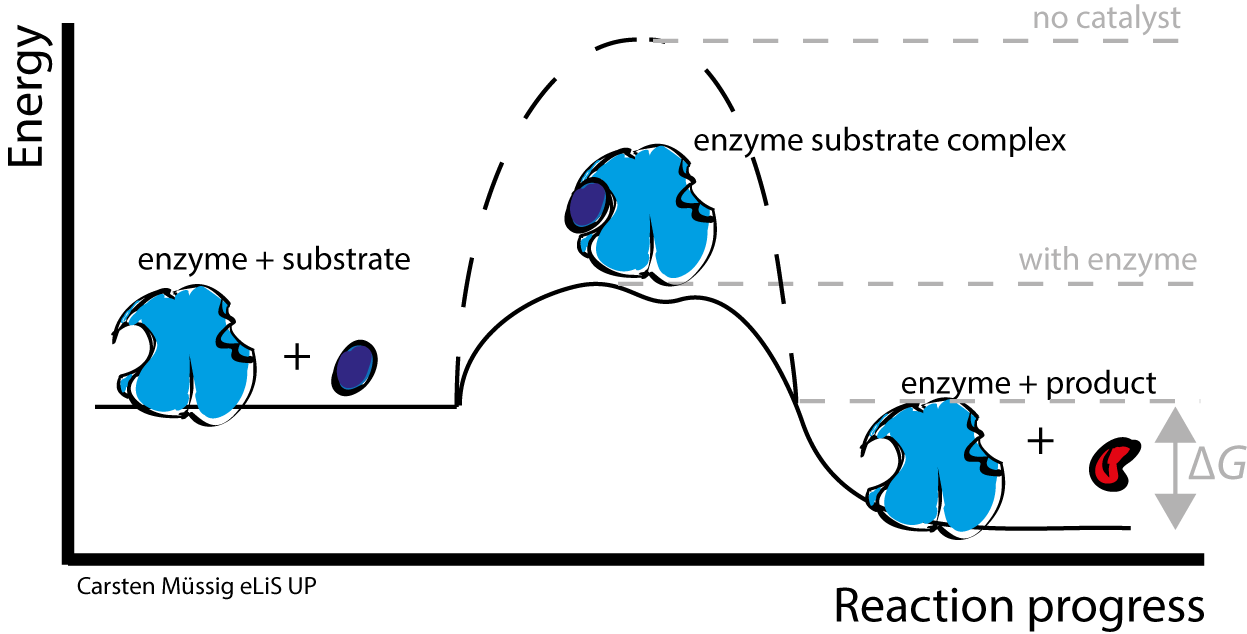
What is the purpose  of an enzyme?
a)
give permission for the reaction
b)
raise activation energy
c)
speed up reactions
d)
control how many reactions occur
68.

In a chemical reaction, ________ are what you have at the end

a)

Products

b)

Molecules

c)

Reactants

d)

Substances

69.
An enzyme speeds up a reaction by
a)
lowering the activation energy.
b)
raising the activation energy.
c)
releasing energy.
d)
absorbing energy.
70.

Which phrase best describes an exothermic chemical reaction?

a)

does not absorb energy

b)

forms products with higher bond energy than reactants

c)

is in a state of equilibrium

d)

releases more energy than it absorbs

71.
What is the function of ATP in living things?
a)
provides energy for cells
b)
stores genetic information
c)
provides structure in the nucleus
72.

What trophic level do the crabs belong to?

a)

Producer

b)

Primary consumer

c)

Secondary consumer

d)

Tertiary consumer

73.

In this food web, a ___ is a primary consumer and a ___ is a secondary consumer.

a)

rabbit, snake

b)

grass, mouse

c)

rabbit, wildflower

d)

snake, mouse

74.

In this aquatic food web, which organism(s) eats the squid?

a)

Seal and seagull

b)

Blue whale

c)

Seagull and krill

d)

It has no predators

75.

_______ are organisms that eat dead organisms.

a)

Omnivores

b)

Detritivores

c)

Carnivores

d)

Herbivores

76.

When energy is passed in an ecosystem from one trophic level to the next, only ___ percent of the energy will be passed on.

a)

1

b)

10

c)

100

d)

50

77.

All energy on Earth comes from

a)

food.

b)

the sun.

c)

chemicals.

d)

non-living things.

78.
The arrows in a food chain or web represents what?
a)
They point to the organism that is being eaten.
b)
It shows how sunlight flows within an ecosystem.
c)
They show what direction the energy is flowing between organisms. 
d)
They represent how water is transferred within a habitat.
79.
A wolf eats a rabbit, that just ate some berries.  What would you call the rabbit?
a)
Producer
b)
Omnivore
c)
Primary Consumer
d)
2nd order Heterotrph
80.
Which of the following would provide the most energy in an ecosystem?
a)
Producers
b)
Herbivore
c)
Omnivore
d)
Carnivore
81.
An organism that obtains energy by eating other organisms.
a)
Consumer
b)
Producer
c)
Decomposer
d)
Detriov
82.
The stacks of disks in the chloroplast are called:
a)
Lamellae
b)
Grana
c)
Stroma
d)
Thylakoid
83.
Where does the light independent reaction take place?
a)
Matrix
b)
Stroma
c)
Thylakoid membrane
d)
Cytoplasm
84.

Which of the following equations represents the overall chemical reaction for photosynthesis?

a)

6O2+ 6H2O → C6H12O6+ 6O2

b)

C6H12O6 + 6H2O→ 6O2+ 6O2

c)

6CO2+ 6H2O→ C6H12O6+ 6O2

d)

6O2 + 6H2O→ C6H12O6 + 6CO2

85.

Where does at the Krebs cycle take place?

a)

Cytoplasm

b)

Mitochondria

c)

Stroma

d)

Thylakoid

86.

Where does at the electron transport chain take place?

a)

Cytoplasm

b)

Mitochondria

c)

Stroma

d)

Thylakoid

87.
______________ produces the most ATP.
a)
photosnthesis
b)
aerobic respiration
c)
anaerobic respiration
d)
glycolysis
88.
Aerobic respiration is different from anaerobic respiration in that aerobic respiration needs...
a)
chlorophyll
b)
carbon dioxide
c)
glucose
d)
oxygen
89.
How many ATP are produced in aerobic respiration?
a)
2
b)
33
c)
4
d)
36
90.
Which organ breaks down lactic acid?
a)
Liver
b)
Lung
c)
Heart
d)
Bladder
91.

How many nitrogenous bases are there in DNA?

a)

1

b)

2

c)

3

d)

4

92.

Which of the following is not a nitrogenous base found in DNA?

a)

Adenine

b)

Guanine

c)

Uracil

d)

Thymine

e)

Cytosine

93.

DNA is made up of Nitrogenous base pairs. The bases bond in which of the following patterns?

a)

Adenine – Thymine; Cytosine – Guanine

b)

Adenine – Cytosine; Guanine – Thymine

c)

Adenine – Guanine; Cytosine – Thymine

d)

Adenine – Guanine; Cytosine – Taurine

94.

DNA looks like a “twisted ladder”. If the “rungs” of the ladder are made up of nitrogenous bases, what are the hand rails or backbone of the ladder made up of?

a)

Sugars and Salts

b)

Phosphates

c)

Sugars

d)

Sugars and Phosphates

95.

Who is credited with discovering the structure of DNA?

a)

Holmes and Watson

b)

Franklin and Crick

c)

Crick and Neck

d)

Watson and Crick

96.

What is a gene?

a)

A cell organelle

b)

A nitrogenous base in DNA

c)

A section of DNA that codes for a specific protein.

d)

A double helix

97.

What is a chromosome?

a)

A condensed form of DNA. It is made of an entire strand of DNA wrapped around histone proteins.

b)

A British rock band.

c)

A part of DNA that has the specific instructions to make a protein.

d)

The part of the cell where DNA is found

98.

Why is DNA important?

a)

it is very small and very complicated

b)

it's in everything

c)

it serves as the blueprint for traits of all living things

d)

because we eat it every day for energy

99.

A _________ is DNA tightly coiled around proteins.

a)

gene

b)

chromosome

c)

trait

d)

mutation

100.

A _______ is a segment of DNA that codes for a specific protein or RNA molecule.

a)

gene

b)

gamete

c)

chromosome

d)

chromatid

101.

How many chromosomes does a human body cell have, total?

a)

48

b)

46

c)

23

d)

47

102.
What is the human genome?
a)
a piece of DNA
b)
a chromosome
c)
all of your cells
d)
all of your DNA
103.
The twisted ladder shape of DNA is referred to as a ....
a)
Twizzler candy
b)
twisted ladder
c)
double helix
d)
yo mama
104.
Which organelle is DNA usually found in?
a)
cell membrane
b)
vacuole
c)
chloroplast
d)
nucleus
105.
What determines the code, or information, of a DNA molecule?
a)
the shape (structure) of the nitrogen bases
b)
the order (sequence) of the nitrogen bases
c)
the color of the nitrogen bases
d)
the frequency (number) of nitrogen bases
106.

This cell organelle is often called the "control center" of the cell because it contains the DNA.

a)

The mitochondira

b)

The vacuole

c)

The nucleus

d)

The cell membrane

107.

Which shows the correct order from SMALLEST to BIGGEST?

a)

Chromosome, Gene, Nitrogenous Base

b)

Gene, Chromosome, Nitrogenous Base

c)

Nitrogenous Base, Gene, Chromosome

d)

They are all the same size

108.

Why is DNA often called "The Blueprint for Life"?

a)

Because it contains the instructions needed for an organism to grow, develop, survive and reproduce

b)

Because when you look at it under the microscope it looks blue.

c)

Because it is like a fingerprint.

109.

The standard arrangement of bases in nucleotides in relation to their opposite pairing

a)

complementary base pairing

b)

phosphoric acid

c)

deoxyribose

d)

cytosine

110.

a sugar derived from ribose by replacing a hydroxyl group with hydrogen

a)

Deoxyribose

b)

Phosphoric Acid

c)

Cytosine

d)

Pyrimidines

111.

The base that pairs with Thymine in DNA

a)

Cytosine

b)

Adenine

c)

Thymine

d)

Guanine

112.

The base that pairs with Cytosine in DNA

a)

Guanine

b)

Adenine

c)

Thymine

d)

Cytosine

113.

Which organelle is the location where protein is made?

a)

Ribosome

b)

Nucleus

c)

Cytoplasm

d)

Nucleotide

114.

During transcription, this type of ribonucleic acid is responsible for copying the DNA and brining it out of the nucleus.

a)

tRNA

b)

mRNA

c)

rRNA

d)

dRNA

115.

When these bond together, they form a protein

a)

Amino Acids

b)

Peptide Bonds

c)

Ribose

d)

Nucleotides

116.

These building blocks consist of a sugar, phosphate, and nitrogen base.

a)

Ribose

b)

Nucleotide

c)

Gene

d)

Protein

117.

Which of the following is the complementary mRNA sequence to this DNA strand: AACTGAA

a)

UUGACUU

b)

TTGACTT

c)

AACTGAA

d)

AACUGAA

118.
The principle shown in the image is called what?
a)
Transcription
b)
The Central Dogma
c)
Translation
d)
The Principle of Proteins
119.
Which of these nitrogenous bases is NOT in RNA?
a)
Uracil
b)
Thymine
c)
Cytosine
d)
Guanine
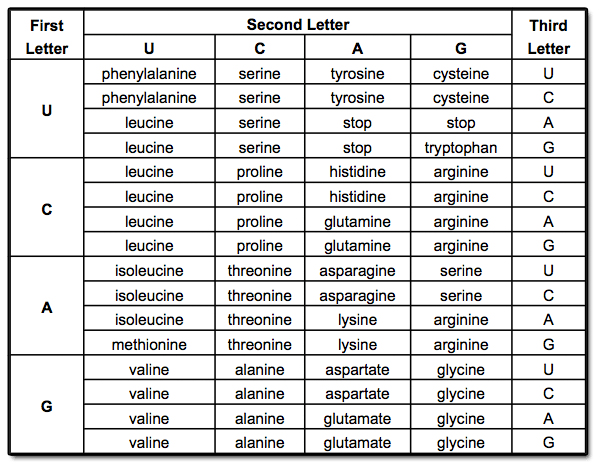
120.
What amino acid is represented by the codon UUA?
a)
Phenylalanine
b)
Tyrosine
c)
Leucine
d)
Stop codon
121.
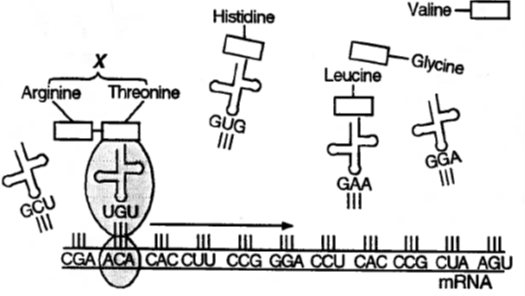
What process is going on in this photo? 
a)
Transcription 
b)
Translation 
c)
Replication 
d)
All the above 
122.

Where does TRANSCRIPTION occur?

a)

Nucleus

b)

Ribosome

c)

Cytoplasm

d)

Mitochondria

123.
Once replication in a DNA molecule is complete, each new DNA molecule contains 
a)
two new strands.
b)
3 exact copies of strands.
c)
one new strand and one old.
d)
two old strands.
124.
What are the functions of genes?
a)
instructions for producing proteins
b)
instructions for producing DNA
c)
instructions for producing lipids
d)
they have no function
125.
Choose the nucleotide sequence of the RNA strand that would be complementary to the following strand: 
GTAGTCA
a)
UATUAGA
b)
ACGACTG
c)
CAUCAGU
d)
CATCAGT
126.
Which of the following is the site of translation?
a)
vacuole
b)
lysosome
c)
nucleus
d)
ribosome
127.
Which of the following best describes a DNA molecule?
a)
double helix
b)
contains ribose
c)
made of amino acids
d)
contains Uracil
128.
Which 2 molecules form the sides (backbone) of the DNA ladder?
a)
deoxyribose sugar and adenine
b)
deoxyribose sugar and a hydrogen bond
c)
deoxyribose sugar and the nucleus
d)
deoxyribose sugar and phosphate
129.
A process in which DNA has the unique ability to make an exact copy of itself.
a)
Replication
b)
Translation
c)
Transcription
130.
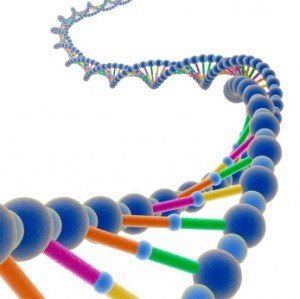
What does this picture represent?
a)
amino acid
b)
base pairing
c)
nucleotide
d)
the DNA molecule
131.
In Eukaryotic cells, where is DNA ALWAYS located?
a)
Cytoplasm
b)
Nucleus
c)
Outside of the cell
d)
DNA is always moving around
132.
A portion of DNA reads GAG. The corresponding mRNA would be
a)
GUG
b)
GTG
c)
CTC
d)
CUC
133.
A portion of mRNA is coded CUG. The corresponding DNA is coded
a)
GAC
b)
GTC
c)
CTG
d)
CAG
134.
What is the term for a three-nucleotide sequence that codes for an amino acid?
a)
base
b)
codon
c)
amine
d)
serine
135.
Which of the following is true of DNA?
a)
It can sometimes leave the nucleus
b)
It never leaves the nucleus
c)
It is portable
d)
It is temporary
136.
I am a single strand.
a)
DNA
b)
RNA
137.
I am arranged as a double helix or "twisted ladder".
a)
DNA
b)
RNA
138.
I include the bases Guanine, Cytosine, Adenine and Thymine.
a)
DNA
b)
RNA
139.
I include the bases Guanine, Cytosine, Adenine and Uracil .
a)
DNA
b)
RNA
140.
I travel outside of the nucleus.
a)
DNA
b)
RNA
141.
I have the sugar ribose.
a)
DNA
b)
RNA
142.
I have the sugar dioxyribose.
a)
DNA
b)
RNA
143.
Why does DNA stay in the nueclus?
a)
To protect it from becoming damaged.
b)
It is lazy. 
c)
It is grounded. 
d)
It cannot move. 
144.

The sperm cell of a kangaroo has 10 chromosomes. What is the total number of chromosomes that should be present in a stomach cell of the same kangaroo?

a)

16

b)

20

c)

30

d)

5

145.

Compared to the number of chromosomes contained in a body cell, how many chromosomes would normally be contained in a gamete?

a)

the same number

b)

one-fourth as many

c)

twice as many

d)

half as many

146.

What type of cells are formed during meiosis?

a)

Somatic Cells

b)

Gametes

147.

In which phase of meiosis would certain gene segments of the homologous pairs "crossover" and exchange genetic information?

a)

Prophase I

b)

Metaphase I

c)

Anaphase I

d)

Telophase I

148.

What event takes place during Anaphase II of meiosis?

a)

nuclear membrane breaks down

b)

spindle fibers break down

c)

cytoplasm divides

d)

sister chromatids separate

149.

Chromosomes line up in the middle of the cell, single file during which phase?

a)

Telophase I

b)

Telophase II

c)

Metaphase I

d)

Metaphase II

150.

Two similar chromosomes that you inherit from your parents (one from mom and one from dad) are called _______

a)

sex chromosomes

b)

homologous chromosomes

c)

homozygous alleles

d)

sister chromatids

151.

The correct order of the phases of mitosis and meiosis could be abbreviated as:

a)

PMTA

b)

MATP

c)

PMAT

d)

PAMT

152.

The end of meiosis results in  ____ to each other.

a)

2 cells that are identical

b)

4 cells that are identical

c)

2 cells that are not identical

d)

4 cells that are not identical

153.

When does genetic material get replicated?

a)

G2

b)

metaphase

c)

anaphase

d)

S phase

154.

How many TOTAL chromosomes do humans have?

(a)  

155.

How many chromosomes do we get from each parent?

(a)  

156.

How many autosomes do humans have?

(a)  

157.

How many sex chromosomes do humans have?

(a)  

158.

Two full sets of chromosomes can be found in ______

a)

haploid cells

b)

diploid cells

159.

One set of chromosomes can be found in _______

a)

haploid cells

b)

diploid cells

160.
What phase is  shown in the picture?
a)
anaphase 1
b)
anaphase 2
c)
metaphase 1
d)
telophase 1
161.
What phase is  shown in the picture?
a)
anaphase 1
b)
anaphase 2
c)
metaphase 1
d)
telophase 1
162.
What phase is shown here?
a)
Prophase II
b)
Metaphase I
c)
Metaphase II
d)
Anaphase I
163.
What phase is shown here?
a)
Metaphase II
b)
Telophase I
c)
Telophase II
d)
Metaphase I
164.
What phases is shown here?
a)
Prophase II
b)
Prophase I
c)
Anaphase II
d)
Interphase I
165.
What phase is shown here?
a)
Anaphase I
b)
Prophase I
c)
Metaphase II
d)
 Metaphase I
166.
What phase is shown here?
a)
Telophase II
b)
Anaphase II
c)
Metaphase I
d)
Interphase I
167.
What phase is shown here?
a)
Telophase I
b)
Metaphase II
c)
Telophase II
d)
Anaphase I
168.
What phase is this?
a)
Interphase II
b)
Prophase I
c)
Metaphase I
d)
Anaphase II
169.
What phase is this?
a)
Interphase II
b)
Prophase I
c)
Metaphase I
d)
Anaphase II
170.
What causes genetic variation in meiosis?
a)
chromosomes lining up
b)
crossing over of chromosomes
c)
separation of chromosomes
d)
chromosomes pulling apart
171.
If the Diploid number of Carrots is 18, the haploid number is
a)
18
b)
9
c)
27
d)
36
172.

Is this karyotype for a male or female?

a)

MALE

b)

FEMALE

173.

A picture of chromosomes in a cell. It is used to show chromosomal disorders.

a)

non-disjunction

b)

karyotype

c)

polar bodies

d)

tetrad