
 Worksheets
MI Lesson 1.3
Total questions: 181
Worksheet time: 2hrs 19mins
Conductive hearing loss typically involves what part of the ear?
outer
inner
outer and middle
middle and inner
Hearing loss which is often irreversible?
conductive
sensorineural
tinnitus
swimmer's ear
The level of loudness of a sound is
period
pitch
amplitude
frequency

Which wave suggests the highest pitch?
1
2
4
5

Which wave suggests the greatest intensity
4
3
2
1

Which statement best compares wave 3 and 4?
Wave 3 is softer but with a higher pitch than wave 4.
Wave 3 is softer but with a lower pitch than wave 4.
Wave 3 is louder but with a higher pitch than wave 4.
Wave 3 is louder but with a lower pitch than wave 4.
This part of the ear receives incoming sound waves and acts as a filter protecting the rest of the ear.
cochlea
ossicles
vestibule
tympanic membrane
The amount of energy a sound wave carries per sound through a unit of area is its ____.
pitch
amplitude/intensity
loudness
frequency
The ____ of a wave increases with increased energy.
wavelength
amplitude
Loudness of waves is measure in ______
Hertz (Hz)
Decibels (Db)
Watts
Meters/second (m/s)
Frequency of waves is measure in _____.
Hertz
Decibels
Watts
Meters/second
High frequency sounds have ______ pitch.
high
low

Which wave shows a higher pitch?
Wave A
Wave B


What does the inner ear consist of?
Cochlea, Auditory Nerve/Tube
Cochlea
Ossicles, Cochlea
Cochlea, Auditory nerve/tube, brain
What are the three tiny bones called?
Ossicles - Hammer, Angus, Stirrup
Ossicles - Hammer, Anvil, Stirrup
Occulars - Hammer, Anvil, Stirrup
Occulars - Hanson, Angus, Stands
What is inside of the Cochlea?
Liquid, and tiny hairs
Water, and tiny hairs
Acid, and hairs
Water, and fuzz
What else does our ears do besides help us to hear?
Smell
Balance
Sight
Fight off sickness
What is the importance of ear wax?
Collects dust and dirt
Help the sound travel
Collect dust, dirt and fight infection
Fight infection
What turns the sound waves into neural signals ?
Cochlea
The movement of the liquid
Movement of the cilia
The Nerve
What comprehend the neural signals
Our Nerves
The cochlea
The ears
Our brain

What is this?
internal auditory canal (eustachian tube)
external auditory canal
pinna
cochlea

What is this?
tympanic membrane
external auditory canal
ossicles
cochlea

What is this?
tympanic membrane
external auditory canal
semicircular canal
vestibulocochlear nerve

What is this?
internal auditory canal (eustachian tube)
external auditory canal
pinna
ossicles

What is this? (hard covering)
bony labyrinth
membranous labyrinth
ossicles
cochlea

What part is #1?
Pinna
Ear Canal
Ear Drum
Oval Window
What part is #2?
Pinna
Ear Canal
Ear Drum
Oval Window
What part is #3?
Pinna
Ear Canal
Ear Drum
Oval Window
What part is #5?
Semicircular Canals
Eustachian Tube
Cochlea
Oval Window
What part is #6?
Semicircular Canals
Eustachian Tube
Cochlea
Oval Window
What part is #7?
Semicircular Canals
Eustachian Tube
Cochlea
Oval Window
What parts are #8?
Semicircular Canals
Auditory Nerves
Ear Bones
Ossicles
What part is #9?
Semicircular Canals
Eustachian Tube
Cochlea
Oval Window
What part is #10?
Incus/Anvil
Malleus/Hammer
Cochlea/Snail Shell
Stapes/Stirrup
What part is #12?
Incus/Anvil
Malleus/Hammer
Cochlea/Snail Shell
Stapes/Stirrup
What part is #13?
Incus/Anvil
Malleus/Hammer
Cochlea/Snail Shell
Stapes/Stirrup
What part is #15?
Outer Ear
Middle Ear
Inner Ear
Sub Ear
What part is #16?
Outer Ear
Middle Ear
Inner Ear
Sub Ear
What part is #17?
Outer Ear
Middle Ear
Inner Ear
Sub Ear
What is the function of the pinna?
detects the direction of motion and acceleration; helps balance
funnels sounds into the middle ear
Earwax and Hairs prevent infection
converts sound waves into impulses
What is the function of the external auditory canal?
brings vibrations to the inner ear
transfers sound energy to the ossicles
Earwax and Hairs prevent infection
funnels sounds into the middle ear
What is the function of the Eardrum?
transfers sound energy to the ossicles
detects the direction of motion and acceleration; helps balance
Hammer, Anvil and stirrup; amplify and transfers eardrum vibrations to the inner ear
maintains equal air pressure in the middle ear
What is the function of ear ossicles?
transfers sound energy to the ossicles
maintains equal air pressure in the middle ear
detects the direction of motion and acceleration; helps balance
Hammer, Anvil and stirrup; amplify and transfers eardrum vibrations to the inner ear
What is the function of Eustachian Tube?
Earwax and Hairs prevent infection
Maintains equal air pressure in middle ear
brings vibrations to the inner ear
converts sound waves into impulses
What is the function of the oval canal?
Earwax and Hairs prevent infection
transfers sound energy to the ossicles
brings vibrations to the inner ear
converts sound waves into impulses
What is the function of the cochlea?
Hammer, Anvil and stirrup; amplify and transfers eardrum vibrations to the inner ear
detects the direction of motion and acceleration; helps balance
maintains equal air pressure in the middle ear
converts sound waves into impulses
What is the function of the semi-circular canals?
detects the direction of motion and acceleration; helps balance
transfers sound energy to the ossicles
Hammer, Anvil and stirrup; amplify and transfers eardrum vibrations to the inner ear
funnels sounds into the middle ear
The part of the ear is a thin muscle that vibrates is called the
ear drum
ear canal
hammer
Which part of the ear is a tube that looks like a snail and it changes sound into nerve impulses that are sent to the brain?
pinna
anvil
cochlea
The part of the ear that carries sound from the pinna to the ear drum is called the
cochlea
ear canal
hammer
The three bones that amplify sound in the ear are called the hammer, anvil, and
cochlea
oval window
stirrup
Conductive hearing loss occurs in the ________.
outer ear only
outer ear and middle ear
middle ear and inner ear
only the inner ear
The part of the ear that catches sound is called the
pinna
ear drum
cochlea
What is the tube that connects the middle ear to the throat?
semicircular canals
auditory nerve
Eustachian tube
Sensorineural hearing loss occurs in the _________.
inner ear only
middle ear and inner ear
outer ear, middle ear and inner ear
outer ear only
Which part of the ear can we see?
cochlea
ear drum
pinna
What separates the middle ear and the inner ear?
round window
oval window
Eustachian tube
What are some causes for sensorinueral hearing loss?
The ________________ carries sound information from the cochlea to the brain.
auditory canal
auditory nerve
ear drum
There are _____ main types of hearing loss.
two
three
four
Mixed hearing loss occurs in the ___________.
inner ear only
outer ear only
outer and middle ear
middle and inner ear
What are some causes of conductive hearing loss?

Provide the most appropriate analysis for the audiogram below.
moderate to severe conductive hearing loss at mid to high frequency in both ears,
mild to severe sensorineural hearing loss at most frequencies in both ears
sensorineural hearing loss only at high frequencies in both ears
conductive hearing loss at all frequencies in both ears

The image shows bone conduction(]) and air conduction (X) for the left ear of a patient. The best analysis would be?
Patient has mild to moderate sensorineural hearing loss.
Patient has no hearing loss evident.
Patient has mild to moderate conductive hearing loss.
Hearing loss can not be determined in only one ear.

Identify the structure identified with #10.
ossicles
semicircular canals
auditory nerve
cochlea
This test is a useful tool for evaluating a person's ability to understand speech when there is significant background noise.
speech-in-noise test
Rinne test
audiogram
Can you hear me now test
Wilbur McCruz went to the ear doc for a hearing test. The doc conducted a Rinne test and found that Wilbur heard air conduction twice as long as he heard bone conduction. The doc should conclude?
That Wilbur has no hearing loss.
That Wilbur has conductive hearing loss.
That Wilbur has sensorineural hearing loss.
That Wilbur is a liar as these results are impossible.
Which region of the ear is affected by sensorineural hearing loss?
outer ear
middle ear
inner ear

Which hearing test uses a tuning fork and can only tell us IF a person has hearing loss, not how much is lost?
pure tone test
rinne test
speech-in-noise test
tinnitus test

How would you describe the hearing loss demonstrated in this audiogram?
Moderate hearing loss in right ear at high frequencies
Moderate hearing loss in right ear at low frequencies
Moderate hearing loss in left ear at high frequencies
Moderate hearing loss in left ear at low frequencies
Which intervention would be most appropriate for someone w/ moderate hearing loss in both ears?
cochlear implant
hearing aid
tubes
labrinthyectomy

Which audiogram matches mild-to-moderate hearing loss in both ears from otitis media?
A
B

How would you describe this patient's hearing loss based on the audiogram?
severe hearing loss in the lower frequencies
mild hearing loss in the higher frequencies
mild hearing loss in low frequencies
severe loss in high frequencies in the right ear
Identify the order in which sound travels through the ear
cochlea, ear drum, ossicles, ear canal
ear canal, ossicles, ear drum, cochlea
ear canal, ear drum, ossicles, cochlea
ear drum, ear canal, ossicles, cochlea
The image shows bone conduction(]) and air conduction (X) for the left ear of a patient. The best analysis would be?
Patient has mild to moderate sensorineural hearing loss.
Patient has no hearing loss evident.
Patient has mild to moderate conductive hearing loss.
Hearing loss can not be determined in only one ear.
This test is a useful tool for evaluating a person's ability to understand speech when there is significant background noise.
speech-in-noise test
Rinne test
audiogram
Can you hear me now test
Wilbur McCruz went to the ear doc for a hearing test. The doc conducted a Rinne test and found that Wilbur heard air conduction twice as long as he heard bone conduction. The doc should conclude?
That Wilbur has no hearing loss.
That Wilbur has conductive hearing loss.
That Wilbur has sensorineural hearing loss.
That Wilbur is a liar as these results are impossible.
18.) During a Rinne test, what does it mean when a patient can hear the tuning fork longer through bone conduction than through air conduction?
a.) conductive hearing loss
b.) sensorineural hearing loss
c.) complete hearing loss
d.) a problem with the brain's ability to process sound
19.) Which of the following is true about cochlear implant technology?
a.) The entire deaf community supports cochlear implants as a treatment for hearing loss.
b.) Cochlear implants are effective for everyone and have predictable results.
c.) A cochlear implant is an option for treating profound hearing loss.
d.) A cochlear implant is necessary for someone with hearing loss to function in mainstream society.

Which structure is a part of the middle ear?
A
B
C
D
Which structure is a part of the outer ear?
A
B
C
D

Which structure is the tympanic membrane?
A
B
C
D
Which structure is the 3 small bones?
A
B
C
D
Which part of the ear has hair cells that convert mechanical energy ( physical motion) to an electrical signal?
ear lobe
ossicles
cochlea
tympanic membrane
What does the Auditory canal do?
Makes ear wax
Pulls sound waves into the ear
End the journey of the sound waves
What happens in the eardrum?
Sound waves vibrate the skin and delivers vibrations
Sound waves make the tiny hairs in your ear move
Carries the message to the brain
What does the fluid inside your ears doing?
Vibrates the skin in your ear
Sends sound waves to the brain
Vibrates the cilia (tiny hairs).
What does the Auditory nerve do?
Carries the message to the brain
Carries the message to the Semi-Circular canal
Send the message to the Eustachian tube
What is in the Semi-Circular canals?
Cilia (Tiny Hairs)
Liquid filled tubes
Thin Skin
Name the 3 bones in your ear
Hammer, Stirrup, Anvil
Hammer, Anvil, Stirrup
Rods, Cones, Anvil
Where is the Eardrum located?
The Outer ear
The Inner Ear
The Middle Ear
Where is the Cochlea located
The Inner Ear
The Middle Ear
The Outer Ear
Where is the Auditory Canal located?
The Inner Ear
The Middle Ear
The Outer Ear
Where is the Eustachian Tube connected to?
The back of the head
The back of the nose
The back of the Ear
What does the middle ear consist of?
Ear canal,Ear drum
Ear canal, ossicles
Ear drum, Ossicles
Ossicles, Cochlea
What does the outer ear consist of?
Auricle/Pinna
Pinna, Ear Canal
Auricle, Ear Canal
Auricle/pinna, Ear Canal
What does the inner ear consist of?
Cochlea, Auditory Nerve/Tube
Cochlea
Ossicles, Cochlea
Cochlea, Auditory nerve/tube, brain
What else does our ears do besides help us to hear?
Smell
Balance
Sight
Fight off sickness
What turns the sound waves into neural signals ?
Cochlea
The movement of the liquid
Movement of the cilia
The Nerve
Hammer, Anvil, and stirrup are all called....
Three bones
Ossicles
Ear bones
Occulars

What is this?
Ear Drum
Ear Canal
Pinna
Cochlea
Hearing Nerve
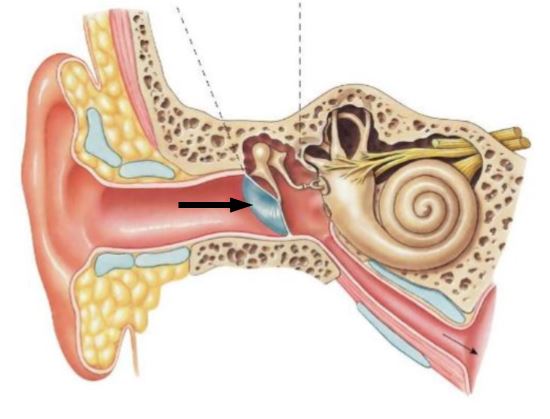
What is this?
Ear Drum
Ear Canal
Pinna
Hammer
Cochlea
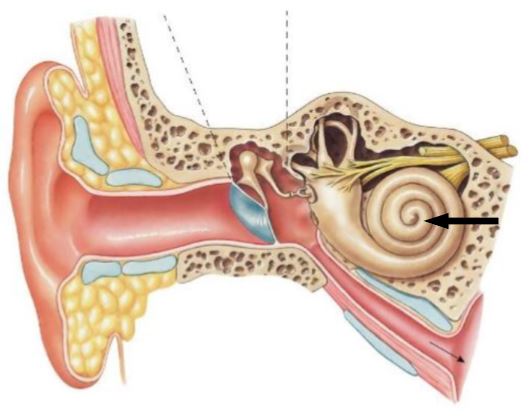
What is this?
Pinna
Hearing Nerve
Cochlea
Ear Drum
Anvil

What is this?
Anvil
Hammer
Stirrup
Cochlea
Ear drum

What is this?
Anvil
Hammer
Stirrup
Cochlea
Ear drum

What is this?
Cochlea
Pinna
Auditory Nerve
Stirrup
Ear drum

What is this?
Hearing Nerve
Cochlea
Pinna
Stirrup
Hammer

What is this?
Anvil
Hammer
Stirrup
Ear Canal
Ear drum
Decibels are the unit that measure what?
Frequency
Volume
Vibration
Pitch
Hertz are the unit that measure what?
Frequency
Volume
Vibration
Mechanical Energy


Stapes
J
I
H
A
Malleus
J
I
H
A
Incus
J
I
H
A

Which of the following is the range for a mild hearing level?
0-10 dB
10-20 dB
30-40 dB
40-50dB

Which of the following is the range for a severe hearing level?
30-40 dB
40-50 dB
60-70 dB
70-90 dB

Does this audiogram represent normal hearing or hearing loss?
normal hearing
mild hearing loss
severe hearing loss
How would you describe the hearing loss demonstrated in this audiogram?
Moderate hearing loss in right ear at high frequencies
Moderate hearing loss in right ear at low frequencies
Moderate hearing loss in left ear at high frequencies
Moderate hearing loss in left ear at low frequencies
Which audiogram matches mild-to-moderate hearing loss in both ears from otitis media?
A
B
How would you describe this patient's hearing loss based on the audiogram?
severe hearing loss in the lower frequencies
mild hearing loss in the higher frequencies
mild hearing loss in low frequencies
severe loss in high frequencies in the right ear
Identify the order in which sound travels through the ear
cochlea, ear drum, ossicles, ear canal
ear canal, ossicles, ear drum, cochlea
ear canal, ear drum, ossicles, cochlea
ear drum, ear canal, ossicles, cochlea
Which structure is a part of the middle ear?
A
B
C
D
Which structure is a part of the outer ear?
A
B
C
D
Which structure is the tympanic membrane?
A
B
C
D
Which structure is the 3 small bones?
A
B
C
D
Which structure ventilates the ear to maintain equal air pressure on both sides of the tympanic membrane?
A
B
C
D
Which part of the ear has hair cells that convert mechanical energy ( physical motion) to an electrical signal?
ear lobe
ossicles
cochlea
tympanic membrane
Which region of the ear is affected by sensorineural hearing loss?
outer ear
middle ear
inner ear
Analyzing the provided information, identify the audiogram that matches the diagnosis of the patient in the space below.
Rick Dragger is a 67-year-old male rock star who just came back from a reunion of his band, The Strolling Tones. Lately, he has noticed that he has trouble distinguishing between certain sounds and has a difficult time hearing the higher voices of women and children. An audiologist has confirmed that he has moderate high frequency sensorineural hearing loss in his left ear.


The image shows bone conduction(]) and air conduction (X) for the left ear of a patient. The best analysis would be?
Patient has mild to moderate sensorineural hearing loss.
Patient has no hearing loss evident.
Patient has mild to moderate conductive hearing loss.
Hearing loss can not be determined in only one ear.

This is a picture of:
Audiograss
Audiogran
Audiogram
Selfie

Which sound wave has high frequency and low amplitude?
A
B
C
D

Which sound wave is soft with a low pitch?
A
B
C
D

Which sound wave is loud with a high pitch?
A
B
C
D

What is the role of structures 11,12, and 13?
They deliver sound vibrations to the middle ear
They help maintain balance
They transfer nerve impulses to the brain to be interpreted
They collect and direct sound to the tympanic membrane
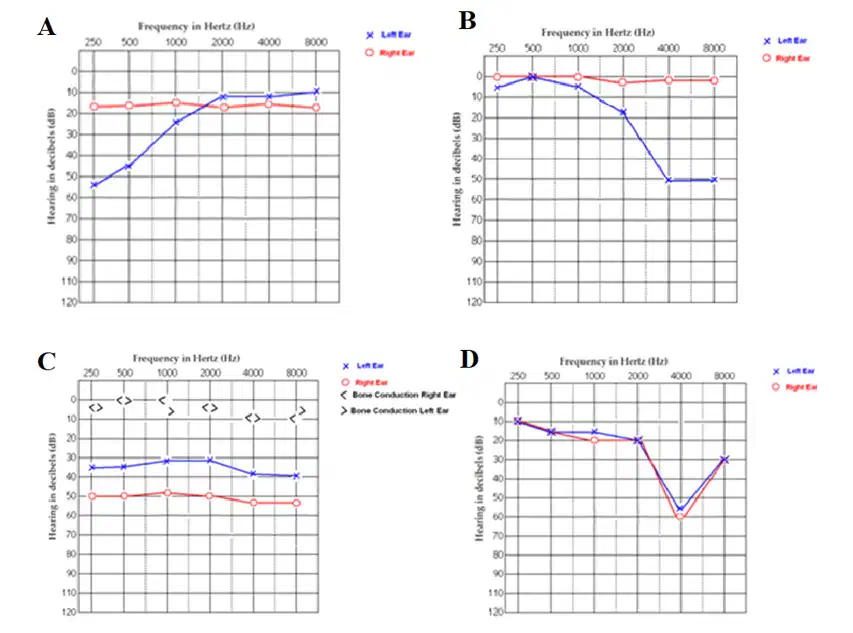
Which audiogram shows conductive hearing loss in both ears?
A
B
C
D
Which audiogram shows conductive hearing loss in both ears?
A
B
C
D
Which audiogram shows high frequency hearing loss in both ears?
A
B
C
D
What is the purpose of the cochlea?
airway for sound to travel to the tympanic membrane
transfer sound vibrations to the inner ear
hair cells move to stimulate nerves
sends electrical signals to the brain
Which hearing test uses a tuning fork and can only tell us IF a person has hearing loss, not how much is lost?
pure tone test
rinne test
speech-in-noise test
tinnitus test
This test is a useful tool for evaluating a person's ability to understand speech when there is significant background noise.
speech-in-noise test
Rinne test
audiogram
Can you hear me now test
A Rinne test is used to determining whether there is conductive hearing loss
True
False
The auditory ossicles transmit vibration directly to the
tympanic membrane
oval window
cochlea
eustachian tube
What is the purpose of the eustachian tube?
equalize air pressure inside and outside ear
create endolymph
help to maintain balance
transfer sound from outer to middle ear
What is the function of middle ear?
Convert mechanical signal to electrical signal
Convert air vibration to electrical signal
Conduct acoustic energy
Identify other function of the ear...
Control balance
Assist in balancing pressure
Assist in speech
State the mechanism of transduction of sound in ear
Oscillation
Vibration
Absorption
Filtration

What is the condition that stimulate a hair cell to generate action potential
Movement of tectorial membrane
Movement of outer hair cell
Movement of basilar membrane
Movement of inner hair cell
Choose the correct frequency region in basilar membrane
Low frequency - Apex, High frequency - Base
Low frequency - Base High frequency - Apex

What is the equivalent of electrode/s in natural ear
Basilar Membrane
Tympanic Membrane
Hair Cells
Tectorial Membrane
Choose the importance of having multi-channel implant
Mimicking the natural ear mechanism
Provide more information as more electrode are used
Stimulate more region on basilar membrane
Add complexity and cross channels interaction
Choose the transmission link method with minimal surgical approach
Percutaneous
Transcutaneous
What is the most importance design consideration for a functional electrode in cochlear
Number of electrodes
Spacing between electrodes
Electrode configuration
Electrode placement
Identify the most important consideration for a cochlear implant
Number of healthy hair cells
Damaged percentage of basilar membrane
Damaged percentage of tympanic membrane
Label the parts of the Outer and Inner Ear
Pinna
Stapes
Incus
Auditory Canal
Auditory Tube
Tympanic Membrane
Malleus
Reorder the following to match how sounds travels through our ear
Ear canal
Ear drum
Ossicles
Cochlea
Auditory nerve
Label the ear
Cochlea
Auditory nerve
Semicircular canal
Ear canal
Ear flap
Ear drum
Eustachian tube
Match the function for each part of the ear
Pinna
Outer ear that collects sound waves
Auditory Canal
Passageway for sound to reach the eardrum
Eustachian tube
Equalizes pressure in the ear
Ossicles
Small bones that transmit sound vibrations
Cochlea
Transforms sound vibrations into nerve impulses
Match the parts of the ear to its function
Tympanic membrane
Transmits sound vibrations to the inner ear
Cochlea
Converts sound waves into nerve impulses
Vestibule
Maintain balance, coordinate eye movemen
Ossicles
Amplifies sound vibrations
Sensory hair cells
convert sound wave to electrical signal

