
 Worksheets
Electric Circuits, Power & Energy
Total questions: 56
Worksheet time: 43mins
A path that allows only one route for an electric current is called a ____.
parallel circuit
parallel current
series circuit
series current
The rate at which an electrical device converts energy from one form to another is called ____.
electrical energy
electrical power
electrical resistance
voltage regulation
A circuit that has two or more branches for electrons to follow is a(n) ____.
circuit diagram
electron circuit
series circuit
parallel circuit
A material through which electrons do NOT easily flow is a(n) ____.
insulator
fuse
conductor
transformer
Which of the following is a device designed to open an overloaded circuit and prevent overheating?
magnet
circuit breaker
resistor
transformer
An ampere is a unit of electrical ______.
pressure
none of these
current
resistance
Which of the following is the correct relationship among power, current, and voltage?
P = I/V
V = P * I
P = I * V
E = P * t
Which of the following is the correct equation to calculate electrical energy?
P = I/V
V = P * I
P = I * V
E = P * t

What type of circuit is shown?
Parallel
Series
Open
How many paths does a series circuit have?
4
3
2
1
What is a parallel circuit?
It is a circuri rhar has one path for energy to flow.
It is a circuit that has no paths for energy to flow.
It is a circutt that has several paths for energy to flow.
None of the above.
Adding more loads to a parallel circuit will increase the currentt.
True
False.
Does a break in one branch affect another branch in a parallel circuit?
Yes
No
Sometimes

The illustration depicts a short circuit.
True
False
In a closed circuit, how does battery voltage affect current?
As voltage increases, current increases.
As voltage increases, current decreases.
Voltage has no affect on current.
If voltage exceeds current, a short circuit circuit will develop.
If an electrical circuit were analogous to a water circuit at a water park, then the battery voltage would be comparable to ___________________.
the rate at which water flows through the circuit
the speed at which water flows through the circuit
the distance that water flows through the circuit
the water pressure between the top and bottom of the circuit
the hindrance caused by obstacles in the path of the moving water


1. Which switch or switches must be closed to make the lamps light?
Only switch a
Only switch b
Switches a and b
Switches a , b and c


A-Series
B-Parallel
A-Parallel
B-Series
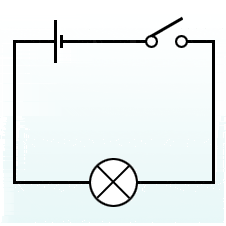


When wires are connected to a battery and a lightbulb in a circuit, the lightbulb is lit. Which types of energy are produced by the battery and lightbulb?
Electrical, light and thermal
thermal and sound
sound and light
all of the above


Tammy makes a complete simple circuit with one bulb and three batteries. The bulb lights for an instant and then goes out. Why?
Too much electricity flows through the bulb's filament
Not enough electricity flows around the circuit
The batteries are flat
The batteries are not good
How much CURRENT does a 1200 W bread maker draw from a 110 V outlet?
P = IV
132000 amps
0.09 amps
1200 amps
10.9 amps


A hot water heater rated at 2600 watts is wired to 120 V ac circuit. What is the amperage?
21.67 Ohms
21.67 amps
11.8 amps
16 amps

Which if the following is a unit of electrical energy?
W
kW h
P
m V

How much does it cost to watch a plasma TV rated at 400 W for 5 hours if each unit (kWh) of electricity costs $1.10?
$2.2
$22
$220
$2200
Electrical power can be calculated using
Resistance x Voltage
Voltage x Current
Voltage ÷ Current
Voltage + Current
The power of an appliance is...
the amount of energy transferred per second
the amount of voltage going through it
the amount of charge that passes through per second
None
Watts is the same as...
Voltage per second
Current per second
Joules per second
all of these
Electric power is measured in
kWh
Amps
Ohms
Watts
Electric energy is measured in
kWh
Amps
Ohms
Watts
The rate at which electric energy is used is called
Electric energy
Electric power
Voltage difference
Electric current
A kilowatt (kW) is how many watts?
10
50
100
1000
Which is NOT a conductor


Which is NOT an insulator


AC stands for __________ current.
alternating
Adjusting
Alarmed
Additional
DC stands for __________ current.
deviating
default
diverging
direct

What type of current is flowing in the circuit ?
Alternating current
Direct current
Both
None

Which type of current is flowing ?
Alternating current
Direct current
Both
None
The rate at which electricity is converted to another form.
electrical current
electrical energy
electrical charge
electrical power

