
 Worksheets
Evolution Standardized Test Practice
Total questions: 9
Worksheet time: 9mins
1. The lyrebird is a pheasant sized bird that lives in open country with dead vegetation and has a lifespan of about 20 years. They escape predators by running through undergrowth, and eat insects and worms by digging through dead leaves and vegetation. They are most known for their outstanding singing, with a capacity to mimic the sounds of other birds and animals, sometimes scaring predators. Both males and females sing, but males are much louder. They mate in autumn and winter, and to attract females, the males will build mounds where they perch, display their tail feathers, and sing. The picture to the right shows a male lyrebird versus a female lyrebird.
Based on the above information, check all survival advantages for the following adaptations on male lyrebirds.
Males with longer claws rather than shorter claws
Males that can sing extremely loud
Males with darker feathers over lighter feathers
Males with long, lacy tails
1. The lyrebird is a pheasant sized bird that lives in open country with dead vegetation and has a lifespan of about 20 years. They escape predators by running through undergrowth, and eat insects and worms by digging through dead leaves and vegetation. They are most known for their outstanding singing, with a capacity to mimic the sounds of other birds and animals, sometimes scaring predators. Both males and females sing, but males are much louder. They mate in autumn and winter, and to attract females, the males will build mounds where they perch, display their tail feathers, and sing. The picture to the right shows a male lyrebird versus a female lyrebird.
Based on the above information, check all reproductive advantages for the following adaptations on male lyrebirds.
Males with longer claws rather than shorter claws
Males that can sing extremely loud
Males with strong, powerful legs
Males with long, lacy tails

2. The graphic shows wolf, elk, and puma populations over time in Yellowstone National Park.
Both wolves and mountain lions hunt elk. Check 3 reasonable explanations for the results in the graph from 2004-2009
Pumas are more likely to reproduce than wolves
Wolves are more efficient at hunting elk than pumas
Pumas are more efficient at hunting elk than wolves
Wolves are having more offspring than pumas
The increase in wolves created more competition for pumas

3. Four different mammal populations contain varying numbers of individuals with a range of fur thickness
Which shows a population that would have the greatest chance of surviving a significant change in climate?
Population 1
Population 2
Population 3
Population 4
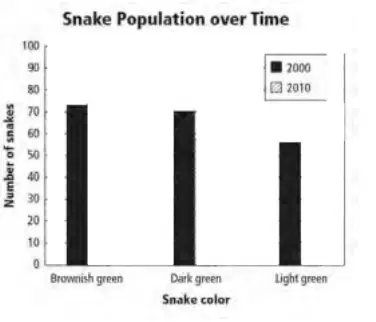
A population of snakes with three scale color variations inhabited a forest in southern Chile.
In 2000, many trees in the forest were cut down for timber, and the landscape lost a lot of its greenery
5. Draw new bars next to each original bar to predict the change in the population's scale colors if this environmental change continues for 100 years.
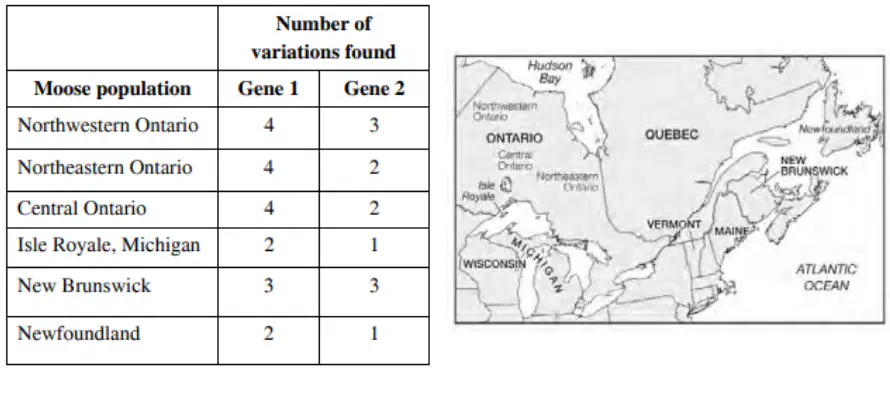
The diversity of a species can be greatly dependent on its environment. The table below shows variation observed in different moose populations in North America. Several genes of the moose were studied and scientists determined how many variations of each gene were present in a given population of moose.
6. Based on the data and the map, what can you conclude about the genetic variation in populations of moose that are geographically isolated? Check two statements
They are less likely to survive a change to their environment
They are more genetically diverse than those not isolated
They are more likely to reproduce by inbreeding
If there is a major environmental change, their survival will not be threatened.
Scientists observe snail populations in an environment. The scientists make the following observations:
-Snails have many predators such as: toads, turtles, snakes, birds, and rats
-Snail shell color is controlled by a known gene
7. Select two predictions the scientists can make about the two populations of snails:
More dark shelled snails will survive in darker environments
More dark shelled snails will survive in lighter environments
More light shelled snails will survive in darker environments
More light shelled snails will survive in lighter environments
Scientists observe snail populations in an environment. The scientists make the following observations:
-Snails have many predators such as: toads, turtles, snakes, birds, and rats
-Snail shell color is controlled by a known gene
Scientists expect to see changes in the number of snails with dark and light shells in each population, based on the habitats in which they live.
8. Select two statements that explain why these predictions can only be proven over a long period of time
Seasonal changes on a population take a long time to have an effect
Genetic changes, such as mutations, in a population take a long time to make a difference
Habitat changes based on the change in snail shell color take a long time to occur
Phenotypic changes in a population take a long time to appear

9. Oldfield mice have lived in Florida's interior wooded areas for over 10,000 years. Some of these mice later moved onto the beaches of Florida's barrier islands, which formed about 6,000 years ago. The table provides characteristics of the two mouse populations.
Which statement is a reasonable explanation for the difference in the appearances of the two Oldfield mouse populations?
A. The dark coats of beach mice became lighter with exposure to sunlight
B. The dark coats of beach mice were more common because the coat color is a dominant trait
C. Beach mice with light coats were more likely to remain in underground burrows
D. Beach mice with dark coats were more easily spotted by predators

