wayground logo

Free Printable Worksheets

Font size

S
M
L
XL
Worksheets

Water Cycle

Total questions: 40

Worksheet time: 1hrs 19mins

Name
Class
Date
1.
What is it called when plants give off water vapor as a waste product?
a)
condensation
b)
evaporation
c)
sublimation
d)
transpiration
2.
During which stage do clouds form?
a)
condensation
b)
evaporation
c)
precipitation
3.
Which stages does liquid water from the ocean turn into water vapor?
a)
condesantion
b)
evaporation
c)
precipitation
d)
run off
4.
Which stage does ground water try to return to the ocean or soak into the ground?
a)
condensation
b)
evaporation
c)
precipitation
d)
run off
5.
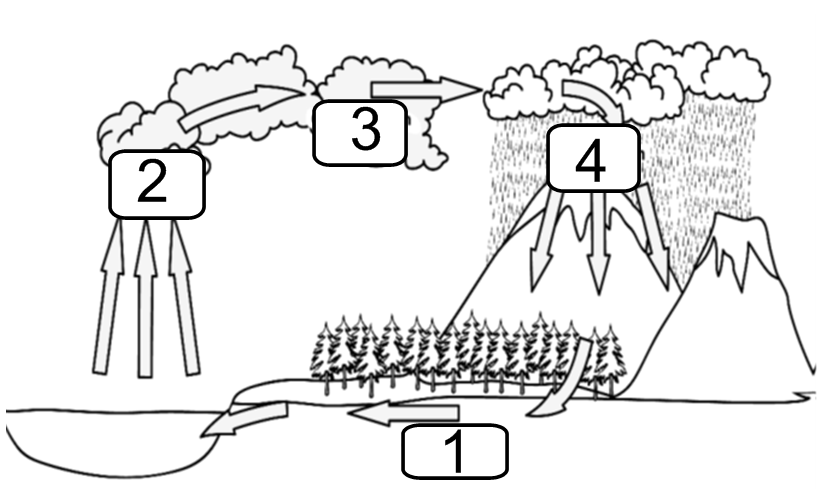
Which stage does the #2 show in the diagram?
a)
condensation
b)
evaporation
c)
precipitation
d)
run off
6.
Which stage does the #3 show in the diagram?
a)
condensation
b)
evaporation
c)
precipitation
d)
run off
7.
what does the #4 show in the diagram?
a)
condensation
b)
evaporation
c)
precipitation
d)
run off
8.
What is the water cycle?
a)
the 3 forms of water
b)
the movement of water on, above, or below the surface of the Earth
c)
when water melts
d)
when clouds form
9.
Which is the opposite of condensation?
a)
runoff
b)
evaporation
c)
precipitation
d)
transpiration
10.
Which best explains why runoff is important?
a)
It returns water to other locations on Earth
b)
It increases the chance of flooding
c)
It makes evaporation occur faster
d)
It increases condensation
11.
The sun will cause water in the puddle to change from
a)
a gas to a liquid
b)
a liquid to a gas
c)
solid to a liquid
d)
a liquid to a solid
12.
A cup of ice sits in the sun.  The ice melts. What change of state will occur NEXT?
a)
from solid to solid
b)
from liquid to solid
c)
from liquid to gas
d)
from gas to liquid
13.
The ______________is the beginning source of energy for the water cycle.
a)
sun
b)
wind
c)
geothermal
d)
volcano
14.
Water begins to evaporate when you add _______ to it.
a)
cold
b)
ice
c)
water cycle
d)
heat
15.

The sun's heat causes water to enter the atmosphere due to _____________________

a)

evaporation

b)

condensation

c)

transpiration

d)

precipitation

16.

When trees release water vapour through their leaves, this is called _________________

a)

evaporation

b)

condensation

c)

transpiration

d)

precipitation

17.

The movement of water downwards, seeping from the surface into soil, is called _________________

a)

surface run off

b)

infiltration

c)

percolation

d)

interception

18.

The rapid flow of water on land is called _______________

a)

storage

b)

surface run off

c)

throughflow

d)

infiltration

19.

Water being stored deep underground in porous rocks is called __________

a)

a reservoir

b)

groundwater

c)

siphoning

20.
What part of the water cycle does this picture show?
a)
condensation
b)
precipitation
c)
evaporation
21.
Which best explains why runoff is important?
a)
It returns water to other locations on Earth
b)
It increases the chance of flooding
c)
It makes evaporation occur faster
d)
It increases condensation
22.
Snow, sleet, hail, and rain are all examples of  ________________. 
a)
evaporation
b)
condensation
c)
accumulation
d)
precipitation
23.
When water _________, dew forms.
a)
Melts
b)
Evaporates
c)
Condenses
d)
Precipitates
24.
Precipitation happens when clouds of water droplets are too ______________.
a)
cold
b)
light
c)
heavy
d)
hot
25.
What is A?
a)
Evaporation
b)
Condensation
c)
Precipitation
d)
Runoff
26.
What is B?
a)
Evaporation
b)
Condensation
c)
Precipitation
d)
Runoff
27.
What is C?
a)
Evaporation
b)
Condensation
c)
Precipitation
d)
Runoff
28.
What is D?
a)
Evaporation
b)
Condensation
c)
Precipitation
d)
Runoff
29.

Water in its gas form is called ____________________,

a)

water vapor

b)

precipitation

c)

ice

d)

air

30.

What is another name or synonym for the water cycle?

a)

Geologic cycle

b)

Hydrologic cycle

c)

Geosphere

d)

Carbon cycle

31.

What is precipitation?

a)

Sweat from our bodies on hot days

b)

Warm rain but not cold snow or sleet

c)

Gas that we use in furnaces or ovens

d)

Any form of water that falls from the sky

32.
Snow, sleet, hail, and rain are all examples of  ________________. 
a)
evaporation
b)
condensation
c)
accumulation
d)
precipitation
33.
After the rain falls down onto Earth's surface, what most likely happens?
What is it called?
a)
1. The remains of the water is soaked into the ground.
2.Groundwater
b)
1. Groundwater
2. The remains of the water is soaked into the ground.
c)
1. Groundwater
2. Transpiration happens to the plants.
d)
1. The liquid turns into a gas or water vapor
2. Evaporation
34.
When the water vapor in the air changes back to liquid, what does it form?
a)
rain,hail,sleet, or snow
b)
water
c)
condensation 
d)
snow and water
35.
Where do we see condensation happening in the water cycle?
a)
ocean water
b)
clouds
c)
run off
d)
ground water/ soil
36.

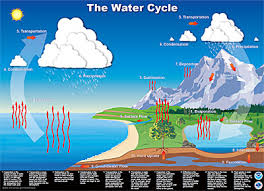
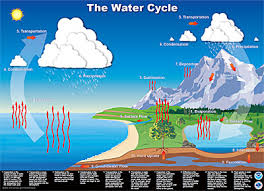
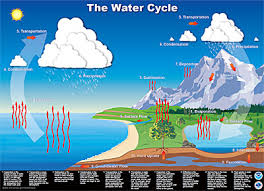
What process is happening in number 6?

a)

transpiration

b)

evaporation

c)

condensation

d)

accumulation

37.

What is number 1 in the diagram?

a)

condensation

b)

evaporation

c)

runoff

d)

precipitation

38.

What is number 3 in the diagram?

a)

evaporation

b)

precipitation

c)

surface runoff

d)

condensation

39.

On earth's surface water can be found in lakes, rivers, glaciers, underground, and in plants and animals. It also can be found, and stored , as snow on mountain tops. Heat energy from the Sun eventually melts the snow. Then gravity pulls water down mountains in rivers and through groundwater. Snow usually melts in the spring and summer.

a)

Infiltration

b)

Condensation

c)

Precipitation

d)

Evaporation

40.
What is water that flows in rivers and streams into the oceans and lakes?
a)
evaporating
b)
condensing
c)
precipitating
d)
runoff