wayground logo

Free Printable Worksheets

Font size

S
M
L
XL
Worksheets

Unit 2 Review!

Total questions: 37

Worksheet time: 28mins

Name
Class
Date
1.

Describe the water flow through the sponge.

a)

In osculum out porocytes

b)

Out osculum in porocytes

c)

In porocytes out osculum

d)

Out porocytes in osculum

2.

Which statement describes characteristics of planarians?

a)

They live in oceans, are parasites, and reproduce only sexually.

b)

They live in fresh water, are parasites, and reproduce only asexually.

c)

They live in oceans, are free living, and reproduce sexually and asexually.

d)

They live in fresh water, are free living, and reproduce sexually and asexually.

3.

Planaria are...

a)

free-living

b)

parasitic

c)

roundworms

d)

nematodes

4.
Which of the 3 types of flatworms we talked about are not parasites?
a)
planarians
b)
flukes
c)
tapeworms 
d)
roundworms 
5.

This type of flatworm is free-living in freshwater and marine environments.

a)

Trichinosis

b)

Planarian

c)

Schistosomiasis

d)

Tapeworm

6.

A person who eats raw or undercooked meat is most likely to get an infection from which kind of worm?

a)

an earthworm

b)

a tapeworm

c)

a hookworm

d)

a pinworm

7.
What are the two types of flatworms?
a)
Trematoda and Cestoda 
b)
cubozoa 
c)
theres only one type and its free-living. 
d)
Free-living and parasitic 
8.
Parasitic flatworms include
a)
leeches
b)
ascaris worms
c)
tapeworms
d)
heartworms
9.
What type of worm is a tapeworm?
a)
A Flatworm
b)
A Roundworm
c)
A Segmented Worm
10.
What are the stages of metamorphosis?
a)
eggs >nymph > pupa > adult
b)
eggs > pupa >  nymph  > adult
c)
egg > larva > pupa > adult
11.

Fin A & B is the

a)

Caudal fin

b)

Pectoral fin

c)

Anal fin

d)

Dorsal fin

12.
Identify the correct pair.
a)
5 - pectoral fin
b)
10 - anal fin
c)
6 - caudal fin
d)
10 - pelvic fin
13.

Which group has a swim bladder?

a)

Jawless Fish

b)

Jawed Cartilage Fish

c)

Bony Fish

14.

Which groups of animals can keep the same body temperature, all the time (Warm Blooded)?

a)

Amphibians

b)

Birds

c)

Fish

d)

Mammals

e)

Reptiles

15.

Which group of animals will have hair hair or feathers on their skin?

a)

Amphibians

b)

Birds

c)

Fish

d)

Mammals

e)

Reptiles

16.

Mr. Ackert discovers a new animal. The animal is cold blooded, lays eggs, has scales, and breaths with lungs. Which group?

a)

Fish

b)

Amphibian

c)

Reptiles

17.

Choose a group of animals have skin that has nothing on the outside and is very smooth and wet.

a)

Amphibians

b)

Birds

c)

Fish

d)

Mammals

e)

Reptiles

18.

Mr. Ackert discovers a new animal. The animal is warm blooded, lays eggs and breathes with lungs. Which group does it belong?

a)

Reptiles

b)

Birds

c)

Mammals

19.

Mr. Ackert discovers a new animal. The animal lays eggs, has scales, and breathes with gills. It belongs to which group?

a)

Reptiles

b)

Birds

c)

Mammals

d)

Fish

20.

9) Where does a placental mammal develop before its body systems can function independently?

a)

inside its mother’s body

b)

in a pouch on its mother’s body

c)

in a nest near its mother

d)

inside an egg that is protected by the mother

21.

How does the Platypus give birth?

a)

They lay eggs.

b)

They give birth to live young.

c)

They are born in a lab.

d)

The platypus is not real.

22.
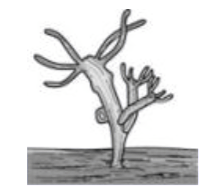
Many invertebrate animals, such as the hydra, reproduce asexually. What form of reproduction in this stage of the life cycle of the hydra is shown in the diagram? 
a)
binary fission
b)
budding
c)
fragmentation 
d)
vegetation propagation
23.

Which of these is a type of asexual reproduction?

a)

Budding

b)

Sexual

c)

Gametes

d)

Sperm + Egg

24.

The dots on the back of this fern plant are tiny reproductive cells called

a)

chloroplasts

b)

anthers

c)

spores

d)

ovaries

25.

Mosses and ferns are different from flowers and trees because they are reproduced from ________.

a)

Seeds

b)

Pollen

c)

Spores

d)

Water

26.

At this stage you learn to walk and talk

a)

Baby

b)

Childhood

c)

Foetus

d)

Adulthood

27.

At this stage, your body is fully developed.

a)

Baby

b)

Adulthood

c)

Elderly

d)

Foetus

28.

Children become teenagers

a)

Adulthood

b)

Baby

c)

Foetus

d)

Adolescence

29.
What is another name for a caterpillar?
a)
chrysalis
b)
larva
c)
cocoon
d)
pupa
30.
3 Stages
a)
Complete Metamorphosis 
b)
Incomplete Metamorphosis 
c)
Both Complete and Incomplete Metamorphosis
31.
Just gets bigger, maybe adds wings. 
a)
Complete Metamorphosis 
b)
Incomplete Metamorphosis 
32.
List the four stages of the complete metamorphosis life cycles in the correct order. 
a)
egg, pupa, larva, adult
b)
egg, larva, pupa, adult
c)
adult, egg, larva, pupa
d)
adult, egg, pupa, larva
33.
List the correct order of the three stages in an incomplete life cycle. 
a)
egg, nymph, adult
b)
adult, nymph, egg
c)
egg, adult, nymph
d)
nymph, egg, adult
34.
Complete or Incomplete Metamorphosis 
a)
Complete because the stages look the same throughout its life 
b)
Complete because the stages look different throughout its life
c)
Incomplete because it looks the same throughout its life 
d)
Incomplete because it looks different throughout its life 
35.
How do you know this insect is undergoing incomplete metamorphosis? 
a)
The insect changes color when it becomes an adult.
b)
The first stage of the insects development is as an egg.
c)
The insect undergoes more than four stages in its development.
d)
The insect has similar body parts throughout its development.
36.
Which life cycle has nymphs that resemble the adults? 
a)
complete metamorphosis
b)
direct development
c)
indirect development
d)
incomplete metamorphosis
37.
List the correct order of the three stages in an incomplete life cycle. 
a)
egg, nymph, adult
b)
adult, nymph, egg
c)
egg, adult, nymph
d)
nymph, egg, adult