
 Worksheets
grade 7 - photosynthesis recap quiz
Total questions: 35
Worksheet time: 6mins

Which organelle performs photosynthesis?
Mitochondria
Chloroplasts
Ribosomes
What is the correct equation for photosynthesis?
6CO2 + 6H2O ------> C6H12O6 + 6O2
6O2+C6H12O6------> 6H2O+ 6CO2
6H2O+ C6H12O6------> 6O2+ 6CO2
C6H12O6+6CO2------>6O2+ 6H2O+
What are the products of photosynthesis?
Sugar
Oxygen
Water
Glucose
What source of energy, helps plants to photosynthesize?
Water
Air
The Sun
Flowers
What is photosynthesis??
The process of green plants and some other organisms use sunlight to make foods from carbon dioxide and water.
When a plant turns green
Plants eating other plants
How does photosynthesis benefit heterotrophs
It takes out of a lot of sugars
It makes them turn a color
It creates food that they can eat
What does ATP stand for?
A tree plant
Adenosine tri-phosphate
Another tight plan
Which is NOT a reactant needed for producing food in a green plant?
Carbon Dioxide (CO2)
Oxygen (O2)
Water (H2O)
Which of the following is NOT a product of photosynthesis?
Carbon Dioxide (CO2)
Glucose (C6H12O6)
Oxygen (O2)
Glucose is a type of ____________.
Protein
Salt
Sugar
The arrow in a chemical reaction means ___________.
Sum
Yields/Produces
Difference
Where does photosynthesis happen in the plant?
Roots
Stem
Flower
Leaf
Photosynthesis is a _______________ change. We know this because new substances are created during this reaction.
physical
chemical
Which of the following correctly lists all of the reactants in photosynthesis?
Glucose, Oxygen, Chemical Energy
Water, Carbon Dioxide, Light Energy
Carbon Dioxide, Oxygen, Light Energy
Glucose, Water, Chemical Energy
What is the name of the molecule that stores and transports chemical energy in plant cells?
Carbon Dioxide
H2O
DNA
ATP
Chlorophyll
As an aquatic plant does photosynthesis, bubbles of "air" rise from leaves and float to the top of the water. What are these bubbles made of?
Carbon Dioxide
H2O
Oxygen
ATP
Chlorophyll
As a light source moves closer to a plant, does the rate of photosynthesis increase, decrease, or stay the same?
Increase
Decrease
Stay the same
Where plants take water and minerals?
from the soil
from the air
from the sun
from the animals
During photosynthesis the carbon from carbon dioxide is broken apart and used to make what molecule?
Sodium Carbonate
Glucose
Oxygen
Water
How does a plant obtain carbon dioxide?
Through the roots of the plant.
Through a chemical reaction in the chlorophyll.
Through the stomata of the plant.
Through the glucose in the stem.
How does a plant obtain water?
Through the roots of the plant.
Through a chemical reaction in the chlorophyll.
Through the stomata of the plant.
Through the glucose in the stem.
What process is the following equation representing?
glucose + oxygen -> carbon dioxide + water + energy
respiration
photosynthesis
chlorophyll
a heterotroph
An organism that makes its own food is called...
chlorophyll
photosynthesis
a heterotroph
an autotroph
What are the two stages of photosynthesis?
capturing the sun's energy + breaking down glucose molecules into smaller molecules
capturing the sun's energy + using that energy to make food
breaking down glucose molecules into smaller molecules + using that energy to make food
breaking down glucose molecules into smaller molecules + then breaking them down into even smaller molecules
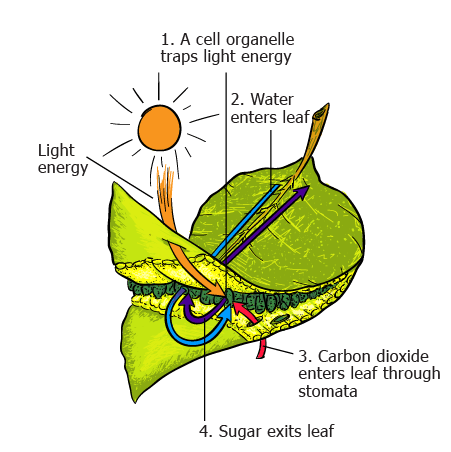
What substances and organelle work together to absorb sunlight to perform photosynthesis in this example?
Why do plants need sunlight for photosynthesis?
The light creates heat needed for photosynthesis to occur
The light provides the energy needed to power photosynthesis
Plants can't absorb carbon dioxide in darkness
Plants can't absorb water in darkness
Occurs in animals
photosynthesis only
cellular respiration only
cellular respiration and photosynthesis
all of the above

