
NEW
Font size
 Worksheets
Unit 09 Review - Counterfeiting, Forgery, and Handwriting
Total questions: 25
Worksheet time: 27mins
Which of the following procedures would result in the resizing, warping and loss of detail in original evidence?
Copying
Shredding
Erasing
Chemical tampering
Document analysts can examine writing instruments.
True
False
Analyzing a copy of evidence can be more effective than analyzing the original.
True
False
Shredded documents are unable to be analyzed.
True
False
Which of the following is used to visualize indented impressions?
ESDA
Digital imaging instruments
Ultraviolet light sources
VSC
Questioned document examiners can best determine the authorship of an unknown handwriting sample with the use of samples from ―
chromatograms
alterations
known authors
spectrograms
A questioned document examiner obtains a check with an allegedly forged signature that they determine to be falsified. What should the examiner testify to in a court of law?
The intent of the person forging the signature
The manufacturer of the paper
The authorship of the document
A professional opinion on forgery
What characteristic would be helpful in analyzing written handwriting in a questioned document?
The crossing of t’s and the dotting of i’s in the sample
The exact composition of colors in the ink
Erasures and obliterations in the text
The addition of brighteners to the paper
FISH (Forensic Information System of Handwriting) contains a database of handwriting samples dating back to the 1990’s. What government agency was created to identify counterfeit documents and maintain the FISH database?
The Central Intelligence Agency (CIA)
The Federal Bureau of Investigation (FBI)
The Department of the Treasury
The U.S. Secret Service

One method to determine the authenticity of a U.S. $5 bill are the tiny words “USA FIVE”, located along one edge of the purple 5 on the back of the note. What is this feature known as?
Color-shifting ink
microprinting
A security thread
watermark
The watermarks on some U.S. paper currency mirror the image of the ―
security thread
portrait on the front of the bill
seal of the treasury
federal seal of the United States
A convenience store accountant came across a possible counterfeit $100 bill that featured Benjamin Franklin. When local law enforcement arrived, they took possession of the currency as evidence and then submitted the bill to the crime laboratory. The analyst advised red and blue fibers were present in the bill in addition to watermarks present on the bill. What characteristic(s), if any, are present to indicate that the bill is counterfeit?
The currency does not feature the correct president, so the bill is counterfeit.
The currency does not feature the correct president, but features red and blue fibers and watermarks, so the bill is counterfeit.
The currency features the correct president, so the bill is not counterfeit.
The currency features the correct president, red and blue fibers, and watermarks so the bill is not counterfeit.

The image is an example of which of the following?
Cursive handwriting
Down strokes
Decorative elements on letters
Unintentional strokes
Which of the following uses a decorative element?


If the picture represents how an individual writes the letter g, which of the following best represents how an individual would write the letter y?


Analyzing size and appearance of connecting lines is an exemplar used when examining the form of ―
formatting
letters
lines
margins

An unknown sample of handwriting is shown below. Based on the sample, what characteristic of the letter form should be considered during analysis?
Angle of the letter slant
Choice of writing instrument
Placement of dots on i’s and crosses on t’s
Spacing between the letters
Which handwriting characteristics should a questioned document analyst consider when comparing an unknown handwriting sample to a known handwriting sample?
Grammar, punctuation and sentence structure should be similar in both samples.
Letter form, line form and spatial formatting should be similar in both samples.
Nouns, verbs and sentence structure should be similar in both samples.
Punctuation, spelling and spacing between letters/words should be similar in both samples.
A handwritten ransom note was left in the mailbox of the family whose son was abducted. There were no known suspects for the abduction, so the note was sent to the crime laboratory to be analyzed. To get a lead on the case, the ink was analyzed and ran through the database to potentially find a similar ink composition that could help determine where the pen was manufactured. Which database was used to analyze the ink?
Forensic Information System of Handwriting
Forensic Information System of Ink
US International Ink Library
US International Pen Library
Type of ink analysis used to determine the chemical makeup of ink by separating the different compounds
Chromatography
Spectroscopy
Type of ink analysis used to determine the exact colors in ink and ultraviolet and infrared light is used to see how the ink colors change
Chromatography
Spectroscopy
Based on the appearance of a sample of handwriting, a questioned document examiner has analyzed the speed of writing and pressure exerted while writing. What characteristic of handwriting did the examiner analyze?
Formatting
Letter Form
Line Form
Typeface
A student drew a thick line on a piece of paper with a pen. The piece of paper was placed in a solvent for a period of time. As time went on, the solvent slowly traveled up the piece of paper separating the ink components. What process did the student carry out?
Gas chromatography
Ion exchange chromatography
Liquid chromatography
Thin-layer chromatography
What scientific procedure is commonly used to determine the chemical composition of an unknown ink sample for comparison to an exemplar?
Raman spectroscopy
Thin-layer chromatography (TLC)
Ultraviolet light analysis
Visual comparison using the FISH database
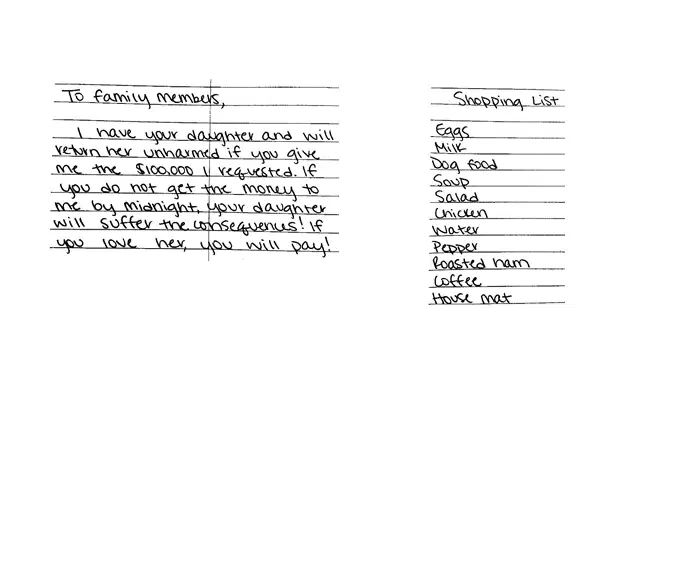
What similarities, if any, can be made when comparing the ransom note with the shopping list?
The d in food on the shopping list is the same as the d in daughter in the ransom note; the u in soup on the shopping list is the same as the u in suffer in the ransom note; and the last e in coffee on the shopping list is the same as the e in love in the ransom note.
The lower case c in chicken on the shopping list is the same as the second c in consequences in the ransom note; the s in house on the shopping list is the same as the last s in consequences in the ransom note; and the o in soup on the shopping list is the same as the o in consequences in the ransom note.
The m in ham on the shopping list is the same as the m in midnight in the ransom note; the t in mat on the shopping list is the same as the t in return in the ransom note; and the n in chicken on the shopping list is the same as the n in return in the ransom note.
There are no words present on both the list and the note that can be compared, so it is inconclusive if the coworker wrote the ransom note.

