Wayground logo

Free Printable Worksheets

Font size

S
M
L
XL
Worksheets

DNA, Chromosomes and Cell Reproduction

Total questions: 32

Worksheet time: 23mins
Name
Class
Date
1.
What are the nucleotides made of?
a)
Sugar, Phosphate, nitrogen base
b)
Phosphate, Adenine, nitrogen base
c)
Thymine, Adenine, Cytomine
d)
Phosphate, Nitrogen, Adenine
2.
Adenine bonds with ______________.
a)
Guanine
b)
Thymine
c)
Cytosine
d)
Adenine
3.
Guanine bonds with ______________.
a)
Adenine
b)
Guanine
c)
Cytosine
d)
Thymine
4.
Why is DNA important?
a)
it is very small and very complicated
b)
it's in everything
c)
it serves as the blueprint for traits of all living things
d)
because we eat it every day for energy
5.
What are the 4 nitrogen bases?
a)
adenine, thymine, cytoplasm, and guanine
b)
adenine, thymine cytosine, and guanine
c)
adenine, thymine, cytosine, and gylcerol
d)
adenine, thymine, cytosine, and glucose
6.
Which sequence of DNA bases would pair with this partial strand
ATG TGA CAG
a)
ATG TGA CAG
b)
TAC ACT GTC
c)
GTA AGT GAC
d)
CAT TCA CTG
7.

In eukaryotes, which organelle is DNA usually found in?

a)

cell membrane

b)

vacuole

c)

chloroplast

d)

nucleus

8.
What does DNA stand for?
a)
Deoxyribonucleic acid
b)
Denitrogenous acid
c)
Deribonucleic acid
d)
Diribonucleic acid
9.
The sugar in DNA is ?
a)
sucrose
b)
glucose
c)
deoxyribose
d)
fructose
10.
Which of the following monomers are repeatedly joined together to form a strand of DNA?
a)
amino acids
b)
nucleotides
c)
fatty acids
d)
polysaccharides
11.
What determines the code, or information, of a DNA molecule?
a)
the shape (structure) of the nitrogen bases
b)
the order (sequence) of the nitrogen bases
c)
the color of the nitrogen bases
d)
the frequency (number) of nitrogen bases
12.
Which 2 molecules form the sides (backbone) of the DNA ladder?
a)
deoxyribose sugar and adenine
b)
deoxyribose sugar and a hydrogen bond
c)
deoxyribose sugar and the nucleus
d)
deoxyribose sugar and phosphate
13.
The two strands of nitrogenous bases in DNA are joined by which type of bond?
a)
polar bonds
b)
ionic bonds
c)
covalent bonds
d)
hydrogen bonds
14.
If a DNA molecule consists of 29% Guanine, how much cytosine will it contain?
a)
29%
b)
58%
c)
21%
d)
I have no idea.
15.

What do genes do?

a)

make proteins

b)

store energy

c)

create covalent bonds

d)

create hydrogen bonds

16.

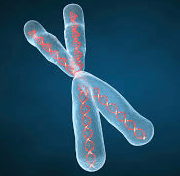
What is this a picture of?

a)

nucleotide

b)

DNA strand

c)

chromosome

d)

gene

17.

DNA is shaped in a:

a)

double helix

b)

tightly packed swirl

c)

twisted ladder

d)

nucleotide

18.

antiparallel stands of nucleotides run in:

a)

opposite directions

b)

the same direction

c)

base pairs

d)

chromosomes

19.
Each identical side of a chromosome is the 
a)
centromere
b)
chromatin
c)
centriole
d)
chromatid
20.
The structure that holds two chromosomes together until they separate for cell division is the
a)
chromatid
b)
chromatin
c)
centromere
d)
cytoplasm
21.

A _______ is a segment of DNA that controls our traits.

a)

gene

b)

gamete

c)

chromosome

d)

chromatid

22.

A _________ is DNA tightly coiled around proteins.

a)

gene

b)

chromosome

c)

trait

d)

mutation

23.

How many chromosomes does a human body cell have, total?

a)

48

b)

46

c)

23

d)

47

24.

Chromosomes are only visible when a cell divides.

a)

True

b)

False

25.

What is cell reproduction used for in the body?

a)

Creation of sex cells

b)

Movement

c)

Growth and repair

d)

Sexual reproduction

26.

When the cell is working, the DNA is...

a)

Tightly coiled into Chromosomes

b)

Lined up in the middle of the cell

c)

Loose and unwound

d)

Two chromatids separating to the opposite ends of the cell

27.

After DNA forms chromosomes, where do the chromosomes move?

a)

Tightly coiled into Chromosomes

b)

Line up in the middle of the cell

c)

Loose and unwound

d)

Two chromatids separating to the opposite ends of the cell

28.

What happens after chromosomes are lined up down the center of the cell?

a)

Tightly coiled into Chromosomes

b)

Line up in the middle of the cell

c)

Loose and unwound

d)

Two chromatids separating to the opposite ends of the cell

29.

Before the cell can reproduce, what must happen to the DNA?

a)

Tightly coils into Chromosomes

b)

Line up in the middle of the cell

c)

Loose and unwound

d)

Two chromatids separating to the opposite ends of the cell

30.

The number of chromosomes before and after cell reproduction....

a)

Increases

b)

Decreases

c)

Stays the Same

31.

What happens during DNA Replication?

a)

The DNA is loose, unwound and used to make proteins

b)

The DNA is tightly Coiled into Chromosomes

c)

An identical copy of the DNA is produced

d)

Two Copies of DNA line up and then separate into two separate cells

32.

What happens with the DNA when the cell is working?

a)

The DNA is loose, unwound and used to make proteins

b)

The DNA is tightly Coiled into Chromosomes

c)

An identical copy of the DNA is produced

d)

Two Copies of DNA line up and then separate into two separate cells