
 Worksheets
Marginal Analysis v3.0
Total questions: 18
Worksheet time: 9mins
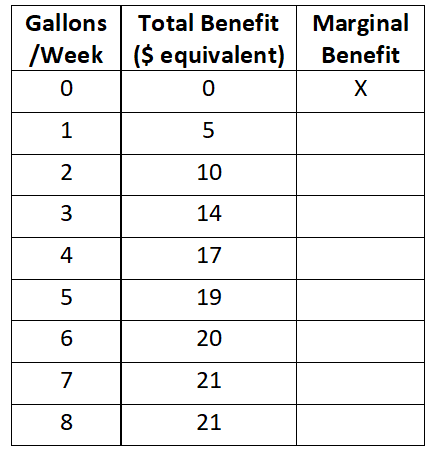
The table shows your total benefits from consuming different quantities of gas each week.
What is the marginal benefit of one more gallon of gas, when you currently have 3 gallons?
(a)
The table shows your total benefits from consuming different quantities of gas each week.
What is the marginal benefit of one more gallon of gas, when you currently have 4 gallons?
(a)
The table shows your total benefits from consuming different quantities of gas each week.
The price of gasoline is $2.50/gallon.
Given this information, using the principle of Optimization at the Margin, the optimal number of gallons of gas to consume each week will be:
(a)
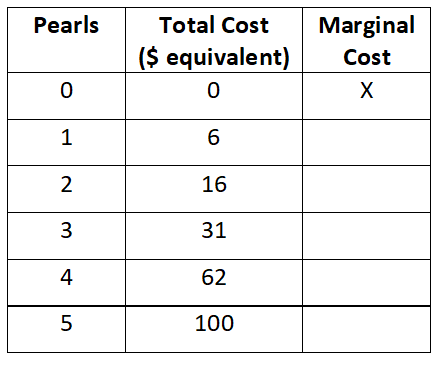
A deep-sea diver can sell each pearl he retrieves for $20 in the seaside market.
However, each time he dives in search of a pearl, it is harder to find than the one he found before. The table below describes the cost (in time and effort) of retrieving each successive pearl.
At what number of pearls harvested should the diver stop diving for more pearls?
(a)
Using cost-benefit analysis, a local government would decide to build a new bridge if
The additional tax paid by an individual resident is greater than the additional benefit of building the bridge for all residents.
The toll paid by an individual resident crossing the bridge is less than the resident’s benefit from crossing the bridge.
The total costs of building the bridge are less than the total benefits from building the bridge.
The total costs of building the bridge are greater than the total benefits from building the bridge.
Total costs are at a minimum and total benefits are at a maximum.
According to the theory of consumer behavior, which of the following decreases first as additional units of a product are consumed?
Total utility
Average utility
Marginal utility
Marginal physical product
Total physical product
An opportunity cost is entailed in which of the following situations?
I. A student decides to attend college full-time.
II. A family uses its $20,000 savings to purchase an automobile.
III. A farmer decides to grow more wheat and less corn.
I only
II only
III only
I and III only
I, II, and III
Assume a worker can either cut grass or wash windows in a given day. It takes 5 hours to mow a one-acre lawn and 2.5 hours to wash all the windows in a house. When a worker chooses to wash the windows of four houses in a neighborhood, what is the opportunity cost of this decision?
The pay the worker receives for washing the windows in the four houses
The pay the worker would receive for cutting one lawn
Cutting the grass at the same four houses
The pay the worker would have received from cutting the grass at two houses
The pay the worker would receive for cutting .25 lawns

Widening existing highways
Building new highways
Building a new bridge
Building a new tunnel
Expanding an existing airport
When total utility is at its maximum, marginal utility is
increasing
negative
equal to zero
at a maximum
at minimum
The graph used to visually represent the economic concepts of scarcity, choice and opportunity cost is the
supply and demand graph
upsloping supply curve only graph
downsloping demand curve only graph
production possibilities graph
All of the following are true about a nation that does not trade, except:
it can consume only what it produces.
it has a production possibilities curve and a consumption possibilities curve that are the same.
it is inefficient.
it could enhance its consumption through trade.
Which of the following statements about a production possibilities curve is true? There may be more than one correct answer. Choose all correct answers.
to produce more of one product, you must give up production of another.
all points on the curve are efficient.
all points outside the curve are unattainable with current resources.
all points inside the curve are inefficient.
None of these statements are true.
If a new technology lowered costs and increased output in both the production of capital goods and the production of consumer goods, we would expect
the entire production possibilities curve to shift out and right.
the entire production possibilities curve to shift in and left.
The number of capital goods produced to increase and the number of consumer goods produced to decrease.
The number of consumer goods produced to increase and the number of capital goods produced to decrease.

Based on the table above, what is the opportunity cost to Picnicland of increasing the production of hotdogs from 450 to 900?
150 burgers
225 burgers
300 burgers
450 burgers
Generally, each successive unit of a good consumed will cause marginal utility to...
Increase at an increasing rate
Increase at a decreasing rate
Decrease (or "diminish")
Who knows? Life's a gamble!
Tom has currently studied for AP Microeconomics for 4 hours and AP U.S. History for 4 hours. He's a hard worker. He has 1 more hour available for studying... how should he decide how to spend that hour?
He should compare the total benefit of 5 hours of studying for AP Microeconomics to the total benefit of 5 hours of studying for AP US History.
He should compare the marginal benefit of 1 more hour studying for AP Microeconomics to the marginal benefit of 1 more hour of studying for AP US History.
He should compare the total benefit of 9 hours of studying for AP Microeconomics to the total benefit of 9 hours of studying for AP US History.
Which of the following is the best definition of the word "marginal?"
Additional
Abstract
Econometric
Complicated

