wayground logo

Free Printable Worksheets

Font size

S
M
L
XL
Worksheets

4.9 U1-4

Total questions: 71

Worksheet time: 15hrs 57mins

Name
Class
Date
1.
This variable in an experiment is the one being changed by the scientist. 
a)
dependent variable
b)
independent variable
c)
data
d)
control group
2.
An experiment is performed on plants to see how different liquids affect plant growth. Each plant in the experiment is given a different liquid; water, apple juice, or milk. Each plant has the same amount of soil, sunlight, and listens to the same music. In this investigation, the independent variable is ...
a)
The type of plant
b)
The amount of sunlight
c)
The type of music
d)
The type of liquid
3.
Dependent variable means
a)
the scientist controls what to test
b)
educated guess
c)
ask a question
d)
what is being measured
4.

Convert 210 mm to cm

a)

2.1 cm

b)

21 cm

c)

210 cm

d)

2100 cm

5.

Convert 35,000 mg to kg

a)

0.035 kg

b)

0.35 kg

c)

3.5 kg

d)

35 kg

6.
Which is greater? 
9,000 milliliters or 10 liters
a)
9,000 mL
b)
10 L
7.
The metric prefix " deka" means __?__
a)
one tenth  (0.1)
b)
ten  (10)
c)
one hundred  (100)
d)
one thousandth  (0.001)
8.
What is the SI unit for length?
a)
meter
b)
liter
c)
mass
d)
second
9.
What is the SI unit for mass?
a)
kilograms 
b)
meters
c)
pounds
d)
liters
10.

Roni measured the weight of her agenda. The unit she used was ____________.

a)

liter

b)

meter

c)

gram

d)

Newton

11.
Distance and direction of an object's change in position from a starting point
a)
displacement
b)
distance
c)
motion
d)
reference point
12.
 Amy runs 2 miles south, then turns around and runs 3 miles north. What is displacement?
a)
5 miles
b)
1 mile 
c)
2 miles south
d)
1 mile north 
13.
The _______ of two or more vectors is the sum of the vectors.
a)
components
b)
scalar
c)
resultant
d)
magnitude
14.
Which symbol is used to show vector quantities?
a)
Circle
b)
Line
c)
Arrow
d)
Triangle
15.
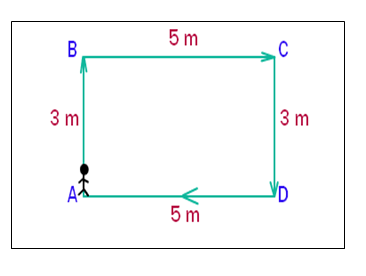
Sara walks from Point A to Point B. Which is true?
a)
Distance and displacement are EQUAL
b)
Distance is less than displacement
16.
Find the distance Sara walks from A to B,  B to C then C to D?
a)
11m
b)
3m
c)
5m
17.

Michael walks in the following order: from Point A, to Point B, and finally to Point C. Which is true?

a)

Distance and displacement are EQUAL

b)

Distance is less than displacement

c)

Displacement is less than distance.

18.
A quantity that has both magnitude and direction is called a scalar quantity.
a)
True
b)
False
19.

Another word for "size" is...

a)

magnification

b)

magnetism

c)

magnitude

d)

magnanimity

20.

Two cars are travelling at 10 m/s, in different directions. Select the sentences that are true.

a)

Their speeds are the same.

b)

Their speeds are different.

c)

Their velocities are the same.

d)

Their velocities are different.

21.

An example of scalar magnitude:

a)

velocity

b)

mass

c)

acceleration

d)

force

22.
This is speed in a specific direction.
a)
Velocity
b)
Motion
c)
Position
23.

A position-time graph of an athlete winning the 100-m run is shown. Estimate the time taken by the athlete to reach 65 m.

a)

6.0 s

b)

6.5 s

c)

5.5 s

d)

7.0 s

24.

A position-time graph of an athlete winning the 100-m run is shown. What was the instantaneous position of the athlete at 2.5 s?

a)

15 m

b)

20 m

c)

25 m

d)

30 m

25.

A position-time graph of an athlete winning the 100-m run is shown. What was the instantaneous position of the athlete at 2.5 s?

a)

15 m

b)

20 m

c)

25 m

d)

30 m

26.

From the following position-time graph of two brothers running a 100-m run, analyze at what time do both brothers have the same position. The smaller brother started the race from the 20-m mark.

a)

2 s

b)

4 s

c)

6 s

d)

8 s

27.

How far apart were runners A and B at t=20.0 s?

a)

10 m

b)

30 m

c)

50 m

d)

70 m

28.
Reference point can also be described as what?
a)
An ending point
b)
A starting point 
c)
A description
d)
A location
29.
An object’s position always depends on its what?
a)
Reference point
b)
Location
c)
Direction
d)
Distance
30.
a)

4 m/s

b)

3 m/s

c)

0 m/s

d)

-5 m/s

31.
a)

4 m/s

b)

-3 m/s

c)

0 m/s

d)

-5 m/s

32.
a)

not moving

b)

positive constant velocity

c)

negative constant velocity

d)

changing velocity

33.
a)

not moving

b)

positive constant velocity

c)

negative constant velocity

d)

changing velocity

34.
a)

not moving

b)

positive constant velocity

c)

negative constant velocity

d)

changing velocity

35.

Observers using different ___________________ may measure different velocities for an object in motion

a)

frame of reference

b)

relatives of motion

c)

projectile motions

d)

constant velocity

36.

What is the train's speed with respect to the stationary observer?

a)

40 mph

b)

50 mph

c)

10 mph

d)

30 mph

37.

What is the walker's speed from the observer's perspective?

a)

10 mph

b)

40 mph

c)

50 mph

d)

30 mph

38.

What is the walker's speed with respect to the train?

a)

30 mph

b)

10 mph

c)

40 mph

d)

50 mph

39.
The speedometer on your car tells you
a)
average velocity
b)
instantaneous velocity
c)
average speed
d)
instantaneous speed
40.
In which of the following graphs (click the image) are both runners moving at the same speed (note that graph c is the bottom right graph, and graph d is the bottom left graph)? 
a)
Graph A
b)
Graph B
c)
Graph C
d)
Graph D
41.
What two measurements are necessary for calculating speed?
a)
Mass and time
b)
Temperature and mass
c)
Mass and distance
d)
Distance and time
42.
What is the speed of an object that travels 60 meters in 4 seconds?
a)
240 m/s
b)
15 m/s
c)
0.067 m/s
d)
15 mph
43.

Jose wandered 4 km at 2 km/hr. How long did Jose wander?

a)

2 hours

b)

8 hours

c)

0.5 hours

d)

2 km

44.

A vehicle travels 2345 m in 315 s toward the evening sun. What is its speed?

a)

7.44 m/s

b)

0.13 m/s

c)

738,675 m/s

d)

7.44m

45.

What distance will a car traveling 65 km/hr travel in 180 min?

a)

11,700 m

b)

195 m

c)

21.7 m

d)

2.77 m

46.

How long will it take to go 150,000 m traveling at 50 km/hr?

a)

3000 hours

b)

3000 sec

c)

3 hours

d)

3 sec

47.

What distance will be traveled if you are going 120 km/hr in 30 min?

a)

3600 km

b)

60 km

c)

4 km

d)

40 km

48.

A car travels 240 km in 2 hours and a sprinter travels 100 m in 9.5 sec. Who is traveling faster?

a)

the car

b)

the sprinter

c)

they are traveling the same speed

d)

not enough information to answer this question

49.

A train travels 120 km in 2 hours and 30 minutes. What is its average speed?

a)

60 km/hr

b)

240 km/hr

c)

48 km/hr

d)

300 km/hr

50.

An old lady rolls down a hill at 3 meters/second. The hill is 36 meters long. How many seconds does it take the old lady to reach the bottom of the hill?

a)

39 seconds

b)

12 seconds

c)

15 seconds

d)

33 seconds

51.
A golf ball accelerates off a tee at 15m/s2, changing its velocity from 0m/s to 50 m/s down the fairway. How long did it take the golf ball to accelerate?
a)
750 seconds
b)
35 seconds
c)
0.3 seconds
d)
3.3 seconds
52.
A ball of clay is thrown at a wall at a velocity of 28.0 m/s.  After it hits the wall, it takes 0.020 s to stop.  What is the acceleration of the clay when it hits the wall?
a)
1400 m/s2
b)
-1400 m/s2
c)
0.56 m/s2
d)
-0.56 m/s2
53.
A box sliding down an inclined plane attains a velocity of 27 m/s in 3 seconds from rest.  Find the acceleration.
a)
30 m/s
b)
24 m/s2
c)
9 m/s2
d)
81 km/hr
54.
A roller coasters accelerates from an initial velocity of of 6.0 m/s to a final velocity of 70 m/s over 4 seconds.  What's the acceleration?
a)
24 m/s2
b)
18 m/s2
c)
16 m/s2
d)
16 m/s
55.
A dog runs with an initial speed of 7.5 m/s on a waxed floor.  It slides to a stop in 15 seconds.  What is the acceleration?
a)
-7.5 m/s
b)
-7.5 m/s2
c)
-0.5 m/s2
d)
7.5 mi//hr
56.
Acceleration is defined as the CHANGE in 
a)
time it takes for one place to move to another place. 
b)
velocity of an object.
c)
distance divided by the time interval 
d)
velocity divided by the time interval 
57.

Acceleration is...

a)

How much position changes in a certain amount of time.

b)

How much velocity changes in a certain amount of time.

58.

Velocity is...

a)

How much position changes in a certain amount of time.

b)

How much velocity changes in a certain amount of time.

59.

Displacement is...

a)

How much position changes.

b)

How much velocity changes.

60.
The tendency of an object to resist a change in its state of motion is called the object's ______.
a)
incline
b)
straight line
c)
friction 
d)
inertia 
61.
Without a force to stop or slow a coasting object, the object will coast forever in a ______ line. 
a)
blue
b)
red
c)
straight
d)
vertical 
62.
_________ opposes the motion of one object moving past another. 
a)
friction 
b)
velocity
c)
unbalanced forces
d)
simple machines 
63.

Objects at rest remain at rest and objects traveling at a steady rate in a straight line continue that way until a(an) _________acts on them.  

a)

non-zero net force

b)

balanced force

c)

zero net force

d)

unbalanced force

64.
An object in motion will stay in what kind of motion as long as the net forces acting on it are zero?
a)
slowing motion in a straight line
b)
accelerating motion in a straight line
c)
constant motion in a straight line
d)
constant motion in an unpredictable direction
65.
An object following a straight-line path at a constant speed 
a)
has zero acceleration
b)
has no forces acting on it
c)
has a net force acting in the direction of motion
d)
none of these
66.

Describe what will happen to the truck in this picture

a)

Positive acceleration

b)

Negative acceleration

c)

Constant speed

d)

Stationary

67.

Describe what will happen to the truck in this picture

a)

Positive acceleration

b)

Negative acceleration

c)

Constant speed

d)

Stationary

68.

Describe what will happen to the truck in this picture

a)

Accelerate

b)

Decelerate

c)

Constant speed

d)

Stationary

69.

Describe what will happen to the truck in this picture

a)

Positive acceleration

b)

Negative acceleration

c)

Constant speed

d)

Stationary

70.

Describe what will happen to the truck in this picture

a)

Positive acceleration

b)

Negative acceleration

c)

Constant speed

d)

Stationary

71.

Describe what will happen to the truck in this picture

a)

Positive acceleration

b)

Negative acceleration

c)

Constant speed

d)

Stationary