wayground logo

Free Printable Worksheets

Font size

S
M
L
XL
Worksheets

Simple Harmonic Motion

Total questions: 20

Worksheet time: 2hrs 40mins
Name
Class
Date
1.
A force of  30 N stretches a very light ideal spring 0.73 m from equilibrium. What is the force constant (spring constant) of the spring?
a)
41 N/m
b)
22 N/m
c)
34 N/m
d)
46 N/m
2.

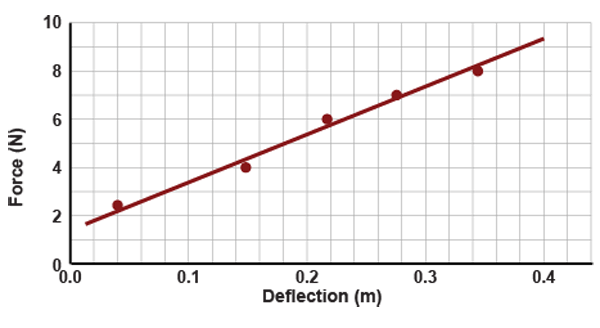
From the graph ,the spring constant is.

a)

4.5 m

b)

15 N

c)

20 N/m

d)

200 N/m

3.
A mass-spring system can oscillate with simple harmonic motion because a compressed or stretched spring has which kind of energy?
a)
kinetic
b)
mechanical
c)
gravitational potential
d)
elastic potential
4.

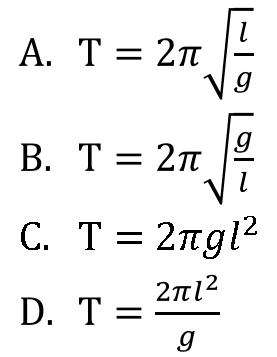
Based on your findings, which equation could best describe the pendulum’s period?

a)

A

b)

B

c)

C

d)

D

5.
What is the frequency of a pendulum that has a period of 10 s?
a)
10 Hz
b)
1/1000 Hz
c)
.1 Hz
6.
The period of a pendulum may be decreased by
a)
Increasing the mass of the bob
b)
moving the equilibrium point
c)
decreasing the mass of the bob
d)
shortening the length of pendulum
7.

Position at which the body would come to rest if it were to lose all of its energy refers to

a)

equilibrium position

b)

maximum displacement / amplitude

c)

periodic position

d)

good position

8.

Given an expression of x = 10 sin (0.25πt) where x in cm, t in second. Which of these answers are true?

a)

the frequency is 0.125 Hz

b)

the amplitude is 10 m

c)

the angular frequency is 0.125 rad s-1

d)

at t = 0, x = 10 cm

9.

Given an expression of a SHM

x = 10 sin (11.4t). Calculate the time taken when x=10 cm for the 1st time

a)

0.138 s

b)

1.24 s

c)

11.11 s

d)

0.79 s

10.
For a system in simple harmonic motion, which of the following is the time required to complete a cycle of motion?
a)
amplitude
b)
period
c)
frequency
d)
revolution
11.
In any system in SHM, the restoring force acting on the mass in the system is proportional to
a)
the displacement
b)
the length of the pendulum
c)
the mass
d)
the frequency
12.

The number of cycles or oscillation made in one second is defined as

a)

time taken

b)

period

c)

frequency

d)

amplitude

13.
The diagram shows a velocity-time graph for a mass moving up and down on the end of a spring. Which point represents the velocity of the mass when at the lowest point of its motion? 
a)
A
b)
B
c)
C
d)
D
14.

A spring has a spring constant of 450 N/m. How far is the spring compressed if 150 N of force are used?

a)

2.2 m

b)

3m

c)

5.0 m

d)

0.3 m

15.

Which of the following springs is the stiffest?

a)

A spring that requires a force of 2000 N to compress it by 5 m.

b)

A spring that requires a force of 4000 N to stretch it by 10.0 m.

c)

A spring that requires a force of 2400 N to compress it by 4m.

d)

A spring that requires a force of 4800 N to stretch it by 12 m.

16.
What Quantity can you calculate from the graph and give the magnitude of that quantity.  
a)
distance 4.5 m
b)
Force 15 N
c)
spring constant 20 N/m
d)
spring constant 200 N/m
17.
A stiff material has a:
a)
high spring constant
b)
low spring constant
c)
spring constant of any value
d)
spring constant which is difficult to predict
18.
What is the amplitude of a wave?
a)
the amount of time that occurs in one full cycle
b)
the distance traveled by the wave during one full cycle
c)
the amount of cycles that occur in a given time
d)
the size of the disturbance
19.
What is the wavelength of a wave?
a)
the size of the disturbance
b)
the amount of time that occurs in one full cycle
c)
the distance between two crests of a wave
d)
the amount of cycles that occur in a given time
20.
What is the speed of a wave if the wavelength is 100 m and the period is 20 s?
a)
2,000 m/s
b)
120 m/s
c)
80 m/s
d)
5 m/s