
 Worksheets
SSEMI1 & SSEMI3 Test Review
Total questions: 49
Worksheet time: 29mins
What are the four main parts of the circular flow diagram?
Product Market, Stock Market, Factor Market, Fish Market
Product Market, House Market, Factor Market, Good Market
Factor Market, Product Market, Households, Firms
Factor Market, households, Stock Market, super market
Where are factors of production (land, labor, etc) exchanged in the circular flow model?
Factor Market
Product Market
Firms
Individuals
Where do factors of production (land, labor, etc) come from in the circular flow model?
Factor Market
Product Market
Firms
Individuals
In the circular flow diagram firms pay wages for which factor of production?
Land
Labor
Entrepreneurship
Raw materials
A person stocks shelves at a grocery store and receives a wage. They have completed an exchange in which part of the circular flow model?
Individuals
Businesss
Factor Market
Product Market
Someone buys a car in exchange for a large amount of money. They have completed an exchange in which part of the circuclar flow model?
Product Market
Factor Market
Firms
Individuals

Goods and services are sold in the ___ market
Factor
Product
Illegal
Black
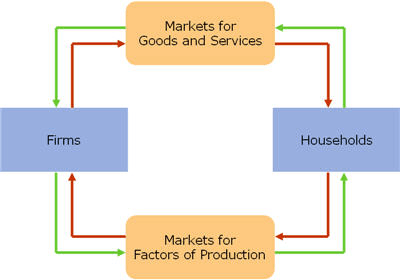

What does A represent on the Circular flow diagram?
Factor market
Firm/businesses
Product market
Households

What does D represent on the Circular flow diagram?
Factor market
Product market
Resource market
Households

What does B represent on the Circular flow diagram?
Resource market
Product market
Stock market
Factor market

What does C represent on the Circular flow diagram?
Apartments
Households
Firms
Businesses
What are firms in the circular flow diagram?
a group of lawyers who work together as a business.
solidly in place and stable
the suppliers of the four factors of production
the producers of goods and services
Melissa has a large rural property where she grows pine trees and sells them to Big Paper Company.
1. Seller?
2. Which market did the exchange occur in?
3. Melissa was part of which sector?
4. The money was paid to?
1. Pine trees
2. Resource market
3. Household
4. The household sector
1. Melissa
2. Resource market
3. Household
4. The household sector
1. Melissa
2. Resource market
3. Firms
4. The household sector
1. Melissa
2. Product market
3. Firms
4. The household sector
What is a major advantage of a business that is a partnership rather than a sole proprietorship? (SSEMI3)
The responsibility for the business is shared
The business is easy to set up
The partners are not responsible for business debts
The business is easy to sell
Advantages of this business type are that the owner is their own boss and gets to keep all the profits. (SSEMI3)
Partnership
Sole Proprietorship
Corporation
Franchise
Dan has $5,000. He wants to invest his money in the type of business that has the least amount of liability. In which type of business should he invest? (SSEMI3)
corporation
partnership
proprietorship
A business partnership has ___________ who share the risks and the profits. (SSEMI3)
One owner
No more than three owners
Two or more owners
Five or more owners
In this market, one firm controls the market, there are very high barriers to entry, price makers, & there are no available substitutes
Perfect Competition
Oligopoly
Cartel
Monopoly
An industry that is dominated by a few large firms is
monopolistic competition.
a monopoly.
perfect competition.
an oligopoly.
SSEMI3 b This market structure has a large number of buyers and sellers with identical products
Perfect Competition
Monopolistic Competition
Oligopoly
Monopoly
SSEMI3 b This is a market structure with a large number of buyers and sellers of products that are similar but can be differentiated by brand, quality, etc.
Perfect Competition
Monopolistic Competition
Oligopoly
Monopoly
SSEMI3 b Which market structure, other than a monopoly, would have the highest barrier to entry?
Oligopoly
Pure Competition
Monopolistic Compeitition
SSEMI3 b Coca-Cola Company and Pepsi Company control roughly 73% of the carbonated (soft drink) soda market. What market structure would this be considered?
Monopoly
Oligopoly
Monopolistic Competition
Perfect Competition
SSEMI3 b If you live in Augusta/Richmond County and do not have a well system, then you are on city water and sewer. This is an example of a
Monopoly
Oligopoly
Monopolistic Competition
Perfect Competition
List the four market structures in order from least competitive to most competitive.
Oligopoly, Monopoly, Perfect Competition, Monopolistic Competition
Perfect Competition, Oligopoly, Monopoly, Monopolistic Competition
Monopoly, Oligopoly, Monopolistic Competition, Perfect Competition
Monopoly, Monopolistic Competition, Perfect Competition, Oligopoly
There are many sellers of blue jeans. Each blue jean seller makes their product slightly different to set it apart from others. There is free entry and exit into the blue jean market. Which market structure does this describe?
Perfect Competition
Oligopoly
Monopoly
Monopolistic Competition
In a sole proprietorship, liability is
General
Limited
Unlimited
There is no liability.
In a partnership, the owners
have limited liability.
have unlimited liability.
always split the profits 50/50, no matter what.
cannot be separated or bought out.
Which of the following have limited life?
Sole proprietorship
Partnership
Corporation
Sole proprietorship and partnership
Corporation and sole proprietorship
This type of business is owned by two or more people and has unlimited liability.
Sole Proprietorship
Partnership
Corporation
Franchise
This type of business is owned by many people called stockholders.
Sole Proprietorship
Partnership
Corporation
Franchise
Nike, Google and Apple are examples of.....
Sole Proprietorships
Partnerships
Corporations
Franchises
In which market structure does a firm have the greatest control over its product’s price?
Monopoly
Oligopoly
perfect competition
monopolistic competition

