wayground logo

Free Printable Worksheets

NEW

Font size

S
M
L
XL
Worksheets

Heredity and Genetics Review

Total questions: 40

Worksheet time: 38mins

Name
Class
Date
1.

What do we call an organism's physical appearance based on their genes?

a)

phenotype

b)

genotype

c)

homozygous

d)

purebred

2.
What is genetics?
a)
The study of DNA nucleotides
b)
The study of heredity
c)
The study of a cell dividing into 2
d)
The study of eye color
3.
The passing of DNA from parents to offspring
a)
Generation
b)
Heredity
c)
Inheritance
d)
Traits
4.

In chickens, a genetic trait called feathered shank (F) is dominant over clean shank (f). If a hen's genotype is ff and the rooster's genotype is Ff, what percentage of their offspring would have feathered shanks?

a)

0%

b)

50%

c)

75%

d)

100%

5.

True or False:

Traits can not be changed by the environment, only by genes.

a)

True

b)

Fase

6.
What do half colored symbols represent?
a)
The individual is a carrier (heterozygous).
b)
The individual expresses the trait.
c)
The individual has both recessive alleles.
d)
The individual has both dominant alleles.
7.
How many kids did the mother and father from the first generation have?
a)
2
b)
4
c)
5
d)
6
8.

In peas, yellow pod color is dominant to green pod color. A heterozygous parent is crossed with a homozygous recessive plant. What are the chances that the offspring will have green pods?

a)

25%

b)

50%

c)

75%

d)

100%

9.

In peas, yellow pod color is dominant to green pod color. Two heterozygous parents are crossed. What are the chances that the offspring will have green pods?

a)

25%

b)

50%

c)

75%

d)

100%

10.
An organism that has two different alleles for a trait (hybrid)
a)
fertilization
b)
genotype
c)
homozygous
d)
heterozygous
11.
An organism's genetic makeup, or allele combination
a)
fertilization
b)
genotype
c)
phenotype
d)
heterozygous
12.
A chart that shows all the possible combinations of alleles that can result from a genetic cross
a)
dominant allele
b)
codominance
c)
probability
d)
Punnett Square
13.
The different forms of a gene
a)
heredity
b)
genetics
c)
gene
d)
alleles
14.
This trait always shows up in an organism when the allele is present
a)
dominant allele
b)
codominance
c)
probability
d)
recessive allele
15.
What are the two genotypes that show the DOMINANT Phenotype
a)
GG, gg
b)
GG, Gg
c)
Gg, gg
16.
A unit of genetic material that determines a trait
a)
Carrier
b)
DNA
c)
chromosome
d)
Gene
17.
What is a dominant allele?
a)
A trait that is always shown (capital letter)
b)
A trait that can be hidden (lower case letter)
c)
Alleles that are the same
d)
Alleles that are different
18.

This is a picture of ?

a)

Gene

b)

Chromosome

c)

Medicine

d)

Genotype

19.
What are the nucleotides made of?
a)
Sugar, Phosphate, nitrogen base
b)
Phosphate, Adenine, nitrogen base
c)
Thymine, Adenine, Cytomine
d)
Phosphate, Nitrogen, Adenine
20.
Adenine bonds with ______________.
a)
Guanine
b)
Thymine
c)
Cytosine
d)
Adenine
21.
Guanine bonds with ______________.
a)
Adenine
b)
Guanine
c)
Cytosine
d)
Thymine
22.
Why is DNA important?
a)
it is very small and very complicated
b)
it's in everything
c)
it serves as the blueprint for traits of all living things
d)
because we eat it every day for energy
23.
Which sequence of DNA bases would pair with this partial strand
ATG TGA CAG
a)
ATG TGA CAG
b)
TAC ACT GTC
c)
GTA AGT GAC
d)
CAT TCA CTG
24.
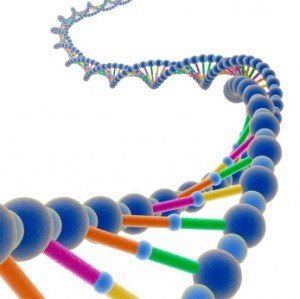
The drawing shows the structure of what molecule?
a)
A DNA molecule
b)
A lipid molecule
c)
A carbohydrate molecule
d)
A protein molecule
25.

How many chromosomes are found in a human body cell?

a)

46

b)

23

c)

12

d)

104

26.

Which scientists were NOT involved in the discovery of DNA's structure?

a)

Rosaling Franklin

b)

Gregor Mendel

c)

James Watson

d)

Francis Crick

27.

Differences in traits such as hair texture are determined by differences in-

a)

the location of sugar groups in DNA

b)

the sequence of nucleotides in DNA

c)

the number of nitrogenous bases in DNA

d)

the molecules attached to the phosphate in DNA
28.
What are the three types of mutation? 
a)
Insertion, Deletion, Subsitution
b)
Deletion, Newstion, Subsitution 
c)
Newstion, Deletion, Insertion 
d)
Insertion, Newstion, Substitution 
29.
Which of the following best describes a DNA molecule?
a)
double helix
b)
contains ribose
c)
made of amino acids
d)
contains Uracil
30.
What do hurtful mutations do? 
a)
Decrease chances of survival 
b)
Increases changes of survival 
c)
Decreases likelihood of developing cancer
d)
Increases likelihood of developing cancer
31.
What do helpful mutations do? 
a)
Increases chances of survival 
b)
Decreases changes of survival 
c)
Increases chances of developing cancer
d)
Decreases skills
32.
What is the definition of DNA mutation? 
a)
The original DNA strand
b)
The strand with four pairs 
c)
A change in the DNA strand
d)
The strand in a double helix 
33.
DNA codes for __________ which determine ___________
a)
mRNA, tRNA
b)
mRNA, ribosomes
c)
proteins. traits
d)
proteins, peptide bonds
34.
Males are more likely to suffer from a sex-linked disease or disorder because
a)
males are the weaker sex
b)
males have less DNA
c)
males have 1 X chromosome, so the disorder is more likely to be expressed
35.
If a gene is found only on the X chromosome and not the Y chromosome, it is said to be 
a)
sex-linked trait
b)
polygenic trait
c)
codominant trait
d)
incomplete dominance trait
36.

The new DNA strand formed after DNA replication is an exact copy of its parent strand

a)

True

b)

False

37.

Selective breeding is...

a)

a process to create an organism with desired traits from parents with those desired traits

b)

natural method of producing offspring with desired traits

c)

creating a new species

d)

making organisms reproduce during times of stress

38.
Who was the first adult mammal successfully cloned?
a)
Dolly the Sheep
b)
Copy Cat the Cat
c)
Donald Trump the Donald
d)
Agouti Gout the Mouse
39.
Why aren't more scientists using gene modification?
a)
Because they are poor
b)
Because they are lazy
c)
Because of ethics and morality
d)
Because of how long it takes
40.
When DNA is manipulated and moved from one source to another it is known as
a)
genetic engineering
b)
electrophoresis
c)
gene therapy
d)
GMO