
 Worksheets
Reaction Rates
Total questions: 17
Worksheet time: 17mins
Smaller clumps allow for a _________ surface area to be exposed for the reaction.
the surface area of the reactants are smaller.
Na2S + 2 HCl → 2NaCl + H2S
What would happen if we increased the volume of the container where the reaction occurred?
More NaCl would be produced
Less H2S would would be produced
More reactions would occur
More HCl would be needed
(NH4)2SO4 + Ba(NO3)2 → 2NH4NO3 + BaSO4
What would happen if we increased the concentration of (NH4)2SO4?
More product would be produced
Less (NH4)2SO4 would participate in the reactions
There would be less collisions between
(NH4)2SO4 and Ba(NO3)2
There would be more Ba(NO3)2 particles to react

Which of the following would increase the number of collisions that occur? Choose all that appy.
Increase Surface Area
Decrease Concentration
Increase Temperature
Increase Volume
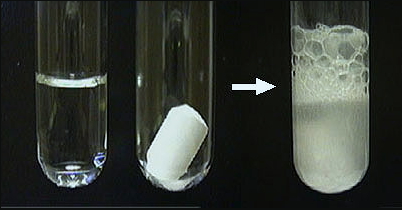
How could we make this reaction happen more quickly?
Decrease the concentration of the acid
crush the chalk to increase the surface area
Put the test tube in an ice bath
AgNO3 + NaCl → AgCl + NaNO3
What would you expect to happen if we decrease the temperature of this reaction container?
The energy of the reactants would decrease.
The would be more product produced.
The number of particles of
AgNO3 and NaCl would decrease.
The number of collisions in the reactants would increase.
More collisions (in the correct orientation) results in... (choose all that apply)
a slower reaction rate
an increased reaction rate
more product being produced
less volume of the reaction container

Which of the following is true?
The reaction rate of the diagram on the left would be greater because there are more collisions that will happen because of greater surface area.
The reaction rate of the diagram on the right would be greater because there are more collisions that will happen because of lesser surface area.
The reaction rate of the diagram on the right would be greater because there are more collisions that will happen because of greater surface area.
The reaction rate of the diagram on the left would be greater because there are more collisions that will happen because of lesser surface area.

In which container would you expect a higher reaction rate, and why? (Note: The number of particles is the same in both containers.)
The left would have a higher reaction rate because it has a greater volume and more collisions will happen.
The right would have a higher reaction rate because it has a greater volume and more collisions will happen.
The left would have a higher reaction rate because it has a lesser volume and more collisions will happen.
The right would have a higher reaction rate because it has a lesser volume and more collisions wil happen.

