
 Worksheets
Sound Waves and Wave Vocabulary
Total questions: 24
Worksheet time: 12mins
Name
Class
Date
1.
Material (matter) through which a wave travels
a)
medium
b)
Doppler Effect
c)
sound
d)
pitch
2.
How high or low a sound is; depends on the frequency (greater frequency= higher pitch)
a)
pitch
b)
frequency
c)
sound
d)
medium
3.
A wave in which the vibration is in the same direction as that in which the wave is traveling; sound waves
a)
longitudinal wave
b)
ocean wave
c)
transverse wave
d)
mechanical wave
4.
The part of a longitudinal wave where the particles of the medium are close together.
a)
rarefaction
b)
compression
c)
crest
d)
trough
5.
A part in a longitudinal wave where the particles are spread apart
a)
compression
b)
rarefaction
c)
crest
d)
trough
6.
A disturbance that transfers energy from one place to another without transferring energy
a)
wave
b)
trough
c)
pitch
d)
sound
7.
The term for how loud or soft a sound is:
a)
pitch
b)
volume
c)
sound
d)
medium
8.
Which feature of sound is determined by amplitude?
a)
Pitch
b)
Smoothness
c)
Loudness
9.
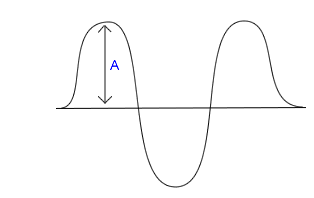
If the distance represented by the letter A (the amplitude) were increased, how would it change the sound?
a)
The sound would be higher.
b)
The sound would be lower.
c)
The sound would be softer.
d)
The sound would be louder.
10.
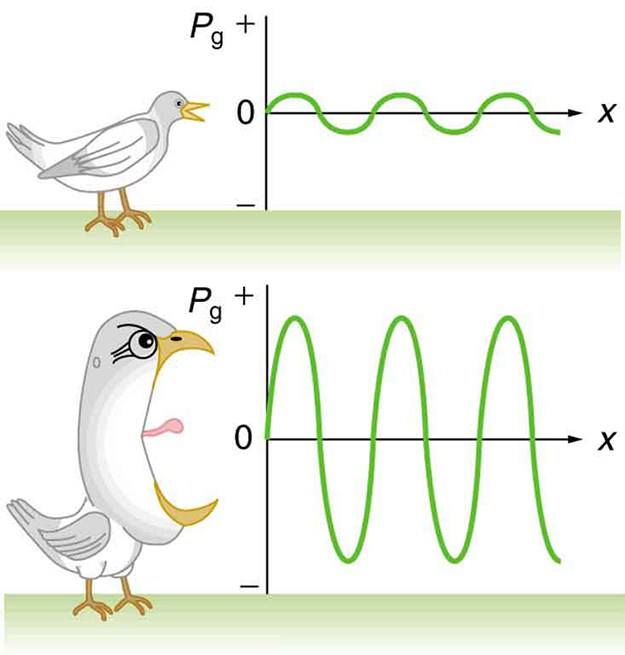
When a sound is louder what measurement gets bigger?
a)
Frequency
b)
Amplitude
c)
Wavelength
d)
Crest
11.
Highest point of a wave
a)
crest
b)
trough
c)
wavelength
d)
frequency
12.

What is changed in the second picture?
a)
Someone is talking louder in picture 2
b)
Someone is talking softer in picture 2
c)
Someone is talking lower pitch in picture 2
d)
Someone is talking higher pitch in picture 2
13.

What is changed in the second picture?
a)
Someone is talking louder in picture 2
b)
Someone is talking softer in picture 2
c)
Someone is talking lower pitch in picture 2
d)
Someone is talking higher pitch in picture 2
14.

What is changed in the second picture?
a)
Someone is talking louder in picture 2
b)
Someone is talking softer in picture 2
c)
Someone is talking lower pitch in picture 2
d)
Someone is talking higher pitch in picture 2
15.

What is changed in the second picture?
a)
Someone is talking louder in picture 2
b)
Someone is talking softer in picture 2
c)
Someone is talking lower pitch in picture 2
d)
Someone is talking higher pitch in picture 2
16.
What is transported by a wave?
a)
air
b)
energy
c)
matter
d)
particles
17.

Examine the wave.
Which region on this wave would correspond to rarefaction?
a)
W
b)
X
c)
Y
d)
Z
18.

Sound waves move more quickly through _________________ matter
a)
dense
b)
light
19.
Why is sound able to travel faster through a solid than a gas?
a)
Gas molecules are packed tightly.
b)
Sound does not travel faster through a solid than a gas.
c)
Solid molecules are packed tightly.
d)
Gas molecules move slowly.
20.
How does a sound wave interact with a human ear?
a)
vibrates the ear drum
b)
bounces off the ear canal
c)
rotates the ear drum
d)
vibrates the ear canal
21.

If the distance represented by the letter A were increased, how would it change the way the sound was heard?
a)
The sound would be higher.
b)
The sound would be lower.
c)
The sound would be softer.
d)
The sound would be louder.
22.

How is sound produced by these instruments?
a)
Striking the surface
b)
vibrating columns of air
c)
plucking the strings
23.
Natural frequency is best described as
a)
the frequency at which an object naturally vibrates at when it is disturbed
b)
a vibration that can be heard in the wild
c)
the radio frequency that astronauts naturally use when travelling into space
d)
the material used to make a swing
24.
True or false? Every object has a natural frequency.
a)
True
b)
False
100 %

